If you have small eyes, you've probably noticed that some sunglasses seem to hide them completely, while others make your eyes appear brighter, more open and naturally balanced.
This is not simply a question of frame size.
It is the relationship between lens height, frame geometry, bridge placement and visual contrast that determines how your eyes are perceived.
Many guides recommend larger sunglasses for small eyes, but this advice is incomplete. A larger frame with poor proportions can overwhelm the face, while a balanced frame with carefully designed lenses can make the eye area appear more open.
Understanding these relationships allows you to choose sunglasses that complement your facial proportions rather than simply covering them.
If you're still deciding which frame shapes suit your overall facial proportions, begin with our guide to Best Sunglasses for Your Face Shape.
You may also enjoy reading How Sunglasses Change Facial Balance, where we explain why eyewear influences facial perception far more than most people realise.
WHAT MAKES EYES APPEAR SMALLER?

Eye size is only one part of the equation.
People often believe they have small eyes when the real cause is the relationship between the eyes, eyebrows, brow bone, cheeks and surrounding facial proportions.
Prominent eyebrows, a stronger brow ridge or fuller cheeks can all make the eyes appear visually smaller even when they are average in size.
Likewise, sunglasses with very low lenses or thick upper frame lines can reduce the visible eye area, making the eyes appear less expressive.
What we perceive as small eyes is often a question of visual balance rather than anatomy.
Small eyes do not need bigger sunglasses. They need sunglasses that create more openness around the eye area. This is why lens height, frame proportions and contrast usually matter more than overall frame width.
WHY SOME SUNGLASSES MAKE SMALL EYES LOOK EVEN SMALLER
The human eye is naturally attracted to areas of contrast.
If a frame creates excessive visual weight around the eyes without enough space inside the lenses, the eyes can appear compressed.
Very dark lenses, shallow lens heights and extremely thick upper rims can all reinforce this effect.
This does not mean you should avoid bold acetate frames.
It means every element of the frame needs to work together.
A balanced acetate frame creates structure while still allowing the eye area to remain visually open.
This distinction explains why two sunglasses with almost identical dimensions can produce completely different results when worn.
QUICK ANSWER
The best sunglasses for small eyes usually feature medium lens height, balanced acetate thickness and enough structure to define the eyes without overwhelming them. Rectangular frames, structured panto silhouettes and softer acetate colours often create a brighter, more open appearance than oversized frames with very dark lenses.
WHY LENS HEIGHT IS MORE IMPORTANT THAN FRAME SIZE
One of the biggest misconceptions in eyewear is that larger sunglasses automatically make small eyes appear larger.
In reality, lens height has a much greater influence than overall frame size.
A lens that is too shallow visually compresses the eye area because there is very little vertical space surrounding the eyes.
By contrast, a balanced lens height introduces more negative space around the eyes, making them appear brighter and more expressive.
This is one of the reasons why well-designed acetate frames often feel more flattering than oversized fashion frames.
Low lens height
Can visually compress the eyes and make the frame feel too narrow around the upper face.
Medium lens height
Creates balanced openness and is usually the strongest choice for small eyes.
Very high lens height
Can overwhelm delicate features if the overall frame is too large or too visually heavy.
RECTANGULAR FRAMES CREATE A MORE OPEN EYE AREA

Rectangular sunglasses are often one of the most effective choices for people with small eyes because they introduce strong horizontal balance without reducing the visible eye area.
Instead of drawing attention towards the centre of the face, the eye naturally follows the clean upper line of the frame from temple to temple.
This creates the impression of greater openness rather than simply making the eyes appear larger.
Well-proportioned rectangular frames also help separate the eyebrows from the eyes, allowing the upper part of the face to feel lighter and more balanced.
Jane Shiny Black is an excellent example. Its architectural silhouette creates strong facial definition while keeping the eyes as one of the main focal points.
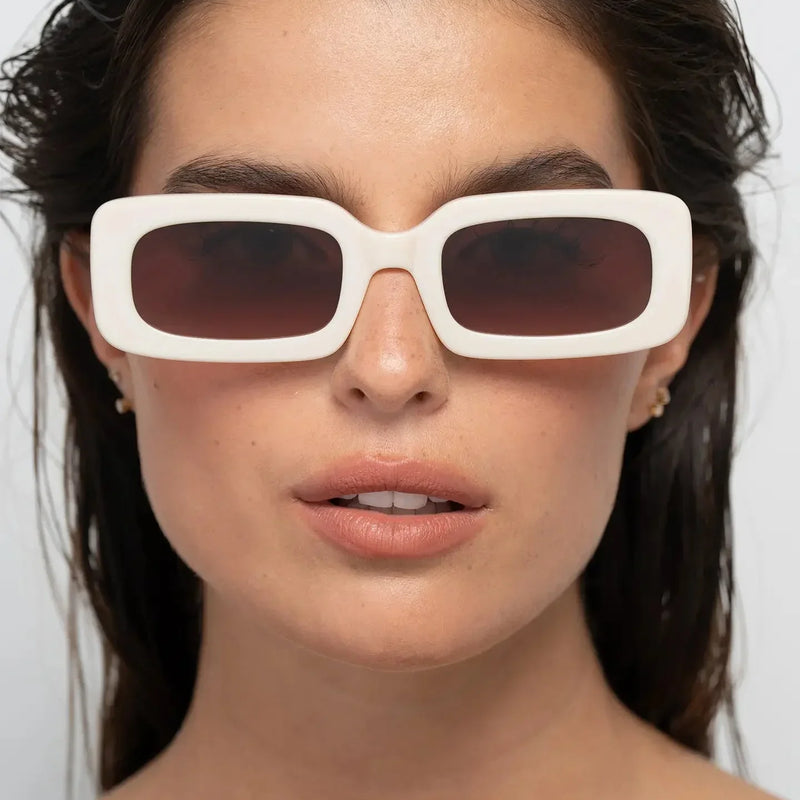
If you prefer a softer everyday aesthetic, Jane Cream White delivers the same balanced geometry with gentler facial contrast.
Rectangular frames don't make your eyes bigger.
They reduce visual competition around them, allowing your eyes to become more noticeable within the overall proportions of your face.
STRUCTURED PANTO FRAMES CREATE SOFTER BALANCE

Panto sunglasses solve the same problem differently.
Rather than using strong horizontal lines, they rely on gentle curves and balanced proportions to create openness around the eyes.
This makes them particularly suitable for people whose facial features are naturally soft or delicate.
The rounded lower section allows the eyes to feel more open without the frame appearing oversized.
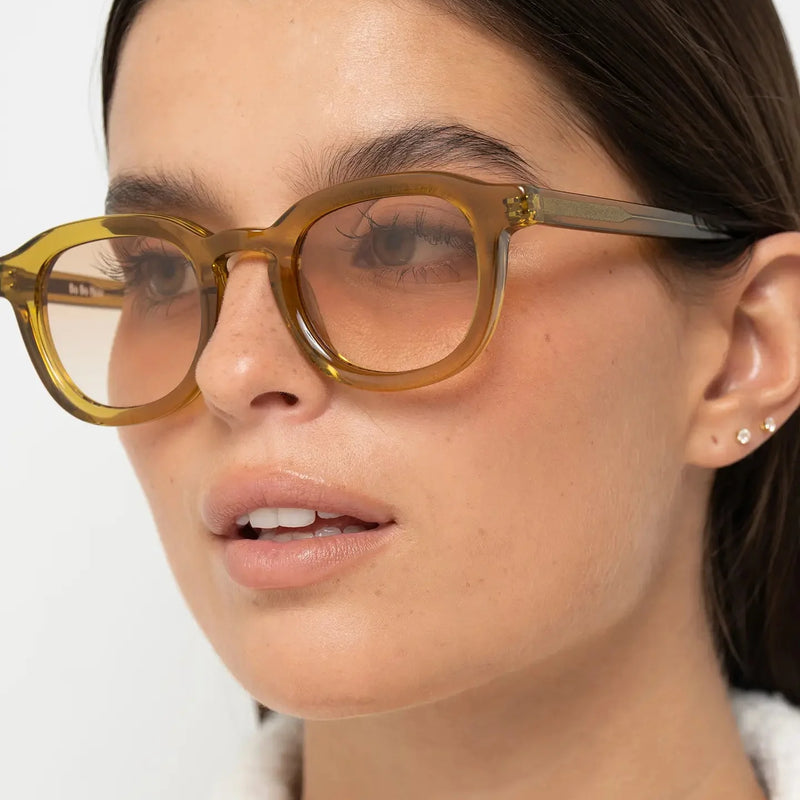
Narr Olive Yellow demonstrates this particularly well. The warm acetate softens contrast while the structured silhouette still provides enough definition around the eye area.
For stronger contrast, Narr Shiny Black offers the same balanced proportions with a more defined architectural appearance.
Rectangular frames are ideal if you want:
- More eye definition
- Cleaner facial structure
- Maximum horizontal balance
Structured panto frames are ideal if you want:
- Softer transitions
- Balanced everyday styling
- Gentler facial proportions
WHY ACETATE THICKNESS CHANGES HOW YOUR EYES ARE PERCEIVED

Many people believe that thin frames always suit small eyes better.
In reality, this is one of the biggest misconceptions in eyewear.
Very thin frames often provide so little visual structure that the eyes lose definition instead of gaining it.
Balanced acetate thickness creates a clear outline around the eyes without overpowering the face.
This explains why many premium acetate frames feel considerably more flattering than lightweight metal frames for people with smaller eyes.
The objective is not maximum thickness.
It is controlled visual weight.
If you would like to understand this principle in greater depth, read Thin vs Thick Frame Sunglasses.
FRAME COLOUR CHANGES MORE THAN STYLE

Colour is often treated as a purely aesthetic choice.
In reality, it also changes how facial features are perceived.
Black acetate increases definition by creating stronger contrast around the eyes, while cream, olive and tortoise acetate soften the transition between the frame and the face.
If your eyes naturally appear small because your facial features are already highly defined, softer acetate colours often create better balance.
If your face lacks definition, black acetate can introduce the contrast needed to make the eye area stand out more confidently.
For a deeper comparison, explore Black vs Tortoise Sunglasses and Warm vs Cool Tone Sunglasses.
When trying sunglasses, don't ask yourself whether your eyes look bigger.
Ask yourself whether your eyes remain one of the first features people notice.
Balanced sunglasses don't enlarge your eyes—they create proportions that naturally draw attention towards them.
DO LENS COLOURS CHANGE HOW SMALL EYES ARE PERCEIVED?

Absolutely.
Lens colour influences much more than the way you see the world. It also affects how your eyes are perceived by everyone looking at you.
People with naturally small eyes often benefit from lenses that preserve some visual connection between the eyes and the rest of the face.
Very dark lenses can reduce eye visibility, while medium-density and gradient lenses allow the eye area to feel brighter and more expressive.
This is particularly important because sunglasses already introduce an additional visual layer between your eyes and the outside world.
Gradient lenses create a softer transition, preventing the sunglasses from becoming one solid block of contrast across the upper face.
To understand this in greater detail, read Gradient vs Solid Lenses.
Solid dark lenses
Create stronger contrast and more definition, but may reduce eye visibility.
Gradient lenses
Create softer contrast while maintaining more openness around the eye area.
Medium-density lenses
Offer one of the most balanced solutions for everyday wear.
WHY BRIDGE PLACEMENT MATTERS MORE THAN MOST PEOPLE THINK

Most people never consider where the bridge actually positions the sunglasses on the face.
Yet bridge placement has a significant influence on how the eyes are perceived.
If the frame sits too high, the visible distance between the eyebrows and the upper rim becomes smaller. This can make the eyes feel visually compressed.
If it sits too low, the frame loses its relationship with the brow line and the face can appear less structured.
The strongest sunglasses follow the natural architecture of your face rather than forcing a different position.
This is why comfort and aesthetics are closely connected. A frame that sits naturally almost always creates better visual balance.
People often think they are choosing between comfort and appearance.
In reality, the two are closely related.
A frame that sits correctly usually creates better facial proportions because it follows the natural relationship between your eyes, eyebrows and nose.
FRAME WIDTH SHOULD COMPLEMENT YOUR EYES — NOT DOMINATE THEM

Choosing wider sunglasses will not automatically make your eyes appear larger.
In fact, the opposite often happens.
If the frame extends too far beyond your facial proportions, your eyes can become visually disconnected from the rest of the face.
The objective is balance, not scale.
A well-proportioned frame creates a smooth relationship between the temples, eyebrows and eye area, allowing the face to feel naturally harmonious.
Oversized sunglasses only work when every other proportion remains balanced.
If you're unsure about sizing, our guide to What Size Sunglasses Should I Choose? explains the key measurements.
OUR FAVOURITE BO BO NOIR FRAMES FOR SMALL EYES

Each Bo Bo Noir silhouette creates a different visual effect.
Rather than asking which collection is the best, consider which one creates the most balanced relationship with your own facial features.
Jane
Creates clean horizontal definition and helps the eyes become a stronger focal point.
Narr
Offers softer transitions while maintaining excellent structure for everyday wear.
Triboulet
Combines warm acetate with gradient lenses to create a brighter, lighter appearance.
William
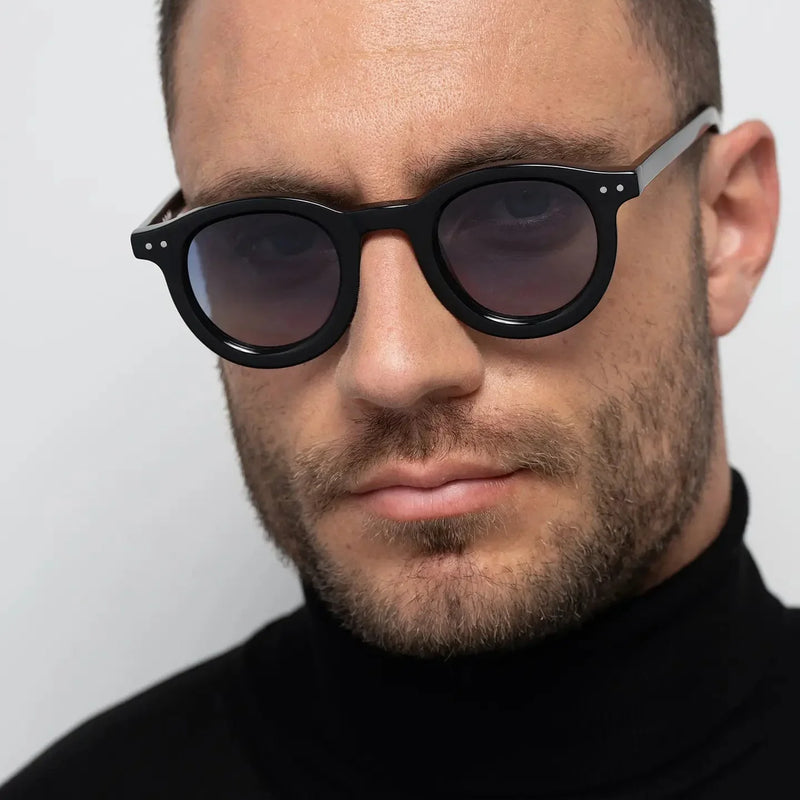
Shows how a balanced round silhouette can still create openness when acetate thickness and lens proportions are carefully controlled.
DECISION GUIDE
Choosing sunglasses becomes much easier when you think about the visual result you want to achieve rather than following general styling rules.
If you want more eye definition…
Choose rectangular acetate frames.
If you want softer everyday balance…
Choose structured panto frames.
If your eyes disappear behind dark lenses…
Choose gradient lenses.
If your face already has strong definition…
Choose softer acetate colours such as olive, cream or tortoise.
If your facial features feel delicate…
Choose balanced acetate thickness instead of extremely thin frames.
Don't ask whether sunglasses make your eyes look bigger.
Ask whether they make your eyes easier to notice.
The difference is subtle, but it completely changes the way you evaluate eyewear.
The most flattering sunglasses don't exaggerate your features. They create harmony between them.
COMMON MISTAKES WHEN CHOOSING SUNGLASSES FOR SMALL EYES
Choosing sunglasses for small eyes is rarely about finding a frame that makes your eyes appear larger.
It is about avoiding proportions that reduce the presence of your eyes within the overall balance of your face.
The most flattering sunglasses don't compete with your eyes. They help them become one of the natural focal points of your face.
The most common mistakes include:
- Choosing oversized frames simply because they are fashionable.
- Selecting very shallow lenses that visually compress the eye area.
- Combining heavy acetate with extremely dark lenses.
- Ignoring bridge fit and overall frame position.
- Choosing sunglasses based only on trends instead of facial proportions.
- Trying sunglasses too close to the mirror instead of viewing your face from a natural distance.
Well-balanced sunglasses should feel comfortable, look proportional and allow your eyes to remain expressive.
HOW TO CHOOSE WITH CONFIDENCE
Instead of searching for sunglasses that make your eyes look bigger, focus on finding a frame that creates better visual harmony.
If your eyes disappear behind dark lenses...
Choose gradient lenses or a lighter lens tint to preserve more expression around the eye area.
If your face already has strong definition...
Choose tortoise, olive or cream acetate to soften facial contrast.
If your features are delicate...
Choose structured panto frames that create definition without looking heavy.
If you prefer cleaner architectural lines...
Choose balanced rectangular acetate frames with medium lens height.
If you're between two frame sizes...
Choose the frame that feels proportionate to your face rather than automatically choosing the larger option.

Stand two or three metres away from the mirror before making your decision.
Most people judge sunglasses from just a few centimetres away, yet almost nobody will ever see you from that distance.
Great sunglasses create harmony across your whole face, not just around your eyes.
FINAL THOUGHTS
Small eyes are not a limitation when choosing sunglasses.
They simply require a better understanding of proportion.
The most flattering frames are not the biggest, the darkest or the boldest. They are the ones that create balance between your eyes, your brow line and the rest of your facial features.
Lens height, frame geometry, acetate thickness, bridge fit and colour all influence how your eyes are perceived.
When these elements work together, sunglasses stop drawing attention away from your face and start reinforcing its natural character.
That is why choosing sunglasses should never be about following trends.
It should be about understanding how thoughtful design creates confidence through balance, proportion and visual harmony.
Frequently Asked Questions
Do sunglasses make small eyes look even smaller?
Some do. Frames with shallow lenses, excessive upper weight or very dark lenses can reduce the visibility of the eyes. Balanced frame proportions usually create a much more open appearance.
Are rectangular sunglasses a good choice for small eyes?
Yes. Rectangular frames create stronger horizontal definition, helping the eyes remain one of the focal points of the face without overwhelming delicate features.
Do panto sunglasses suit small eyes?
Yes. Structured panto frames create softer transitions while maintaining enough definition to balance the eye area.
Should I avoid oversized sunglasses?
Not necessarily. Oversized frames can work well if they remain proportionate to your face. Size alone does not determine whether sunglasses are flattering.
Does lens height matter?
Very much. Medium lens height often creates a brighter, more open appearance than shallow lenses, which can visually compress the eyes.
Are gradient lenses better than solid lenses?
For many people, yes. Gradient lenses create softer transitions around the eyes and preserve more facial expression than very dark solid lenses.
Which frame colour works best?
Black acetate creates stronger definition, while tortoise, olive and cream acetate soften contrast and create a more relaxed appearance.
Do thick acetate frames suit small eyes?
Balanced acetate thickness usually works better than extremely thin frames because it creates definition without overwhelming the face.
Can sunglasses make my eyes look larger?
They cannot change your eye size, but they can change how your eyes are perceived by improving facial balance and reducing visual competition around them.
Which Bo Bo Noir collection works best for small eyes?
Jane is ideal for stronger structure, Narr creates softer everyday balance, Triboulet brightens the eye area with warm acetate and gradient lenses, while William offers balanced round styling for those who prefer curved silhouettes.
👁 YOU MAY ALSO LIKE
Choosing sunglasses for small eyes is just one part of understanding how eyewear changes facial balance. These guides explore related facial features, frame geometry and design principles to help you make more confident decisions.
Best Sunglasses for a Thin Face
Learn how frame width and visual structure create better balance for narrower facial proportions.
Read the article →
Best Sunglasses for Deep Set Eyes
Discover how frame geometry, lens colour and bridge fit influence depth and eye definition.
Read the article →
How Sunglasses Change Facial Balance
Understand why different frame shapes change the way your facial features are perceived.
Read the article →
Thin vs Thick Frame Sunglasses
See how acetate thickness changes visual weight, definition and everyday styling.
Read the article →
Explore the Bo Bo Noir Sunglasses Collection
Discover bold acetate silhouettes designed around proportion, balance and long-term wearability.
Explore the collection →