Have you ever tried on two pairs of sunglasses that looked almost identical, yet one immediately felt right while the other seemed completely wrong?
This happens far more often than people realise.
The sunglasses that suit you best are rarely the most fashionable or the most expensive. They are the ones that create the strongest visual relationship between your facial features.
Frame geometry, lens proportions, acetate thickness, colour, bridge position and facial balance all influence how your sunglasses are perceived. Even small differences can completely change the overall impression.
This is why two people wearing the same sunglasses can look entirely different.
If you're still learning how facial proportions influence eyewear, begin with our guide to How Sunglasses Change Facial Balance. You may also find our article on How to Choose Sunglasses for Your Face Shape useful before exploring the finer details of visual perception.
This guide explains why some sunglasses immediately feel natural, while others never quite look right—even if they fit perfectly.
QUICK ANSWER
Sunglasses suit you when they create harmony between your eyes, eyebrows, nose, cheekbones and jawline. The best frames don't change your face—they change how the relationship between your facial features is perceived.
People often think they are choosing sunglasses.
In reality, they are choosing proportions.
The frame itself is only one part of the equation. What matters is how it changes the balance of your entire face.
WHY DO SOME SUNGLASSES LOOK RIGHT IMMEDIATELY?

Your brain evaluates faces incredibly quickly.
Before you consciously notice the shape of a frame, your visual system has already assessed whether the overall proportions feel balanced.
This judgement happens in fractions of a second.
Rather than analysing individual features, your brain compares the relationship between the forehead, eyes, nose, cheekbones, jawline and the sunglasses themselves.
When those proportions feel harmonious, the sunglasses immediately appear as though they belong on your face.
When they don't, something feels slightly "off", even if you cannot explain why.
Visual Principle
Your brain notices balance before it notices beauty.
This is why proportion often influences attractiveness more than the individual shape of the sunglasses themselves.
WHY TWO PEOPLE LOOK COMPLETELY DIFFERENT WEARING THE SAME SUNGLASSES

One of the biggest misconceptions in eyewear is that a frame either suits everyone or suits no one.
In reality, the same sunglasses can create completely different visual results depending on the person wearing them.
This is because every face has a unique combination of proportions, spacing and visual weight.
The distance between the eyes, the height of the forehead, the width of the cheekbones, the shape of the jaw and even eyebrow position all influence how a frame is perceived.
The sunglasses remain exactly the same.
The composition around them changes.
Did You Know?
Two faces with almost identical measurements can still suit completely different sunglasses because visual balance depends on relationships—not isolated dimensions.
YOUR BRAIN SEES BALANCE BEFORE IT SEES STYLE

When you look at someone wearing sunglasses, your brain doesn't begin by analysing the colour, the brand or even the shape of the frame.
Instead, it immediately evaluates balance.
Within a fraction of a second, your visual system compares the proportions of the forehead, eyes, nose, cheekbones, jawline and the sunglasses themselves.
If those proportions feel harmonious, the sunglasses immediately look natural.
If they don't, something feels slightly uncomfortable—even if you can't explain exactly why.
This is one of the reasons why some sunglasses seem to suit you instantly while others never feel completely right.
People rarely remember the exact shape of your sunglasses.
What they remember is the impression your face creates.
Balance is processed before style.
FRAME GEOMETRY CHANGES HOW EVERY FACIAL FEATURE IS PERCEIVED

Every frame shape influences the face differently.
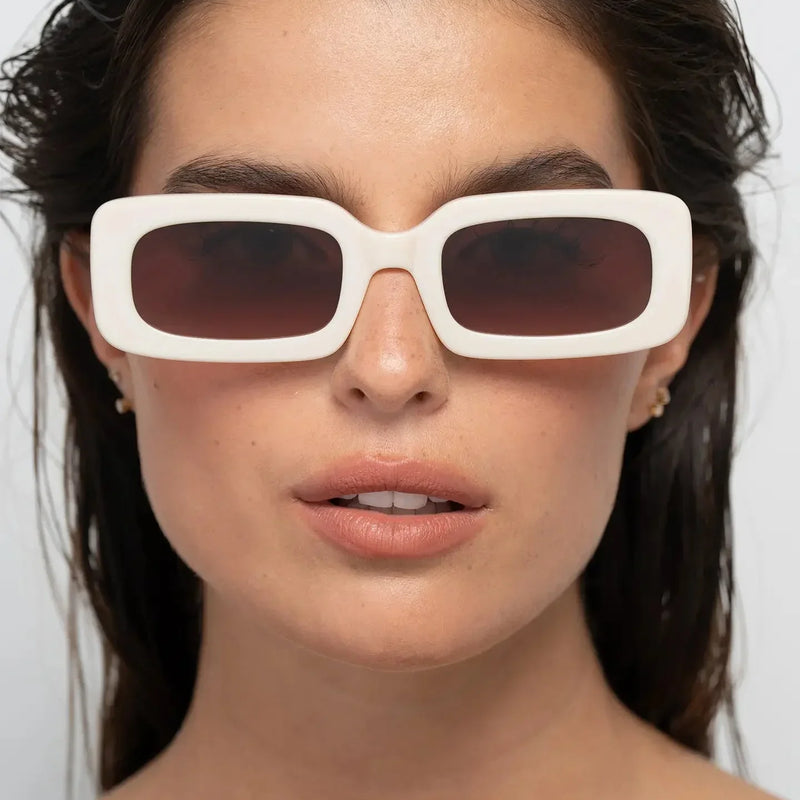
Rectangular sunglasses strengthen horizontal structure.
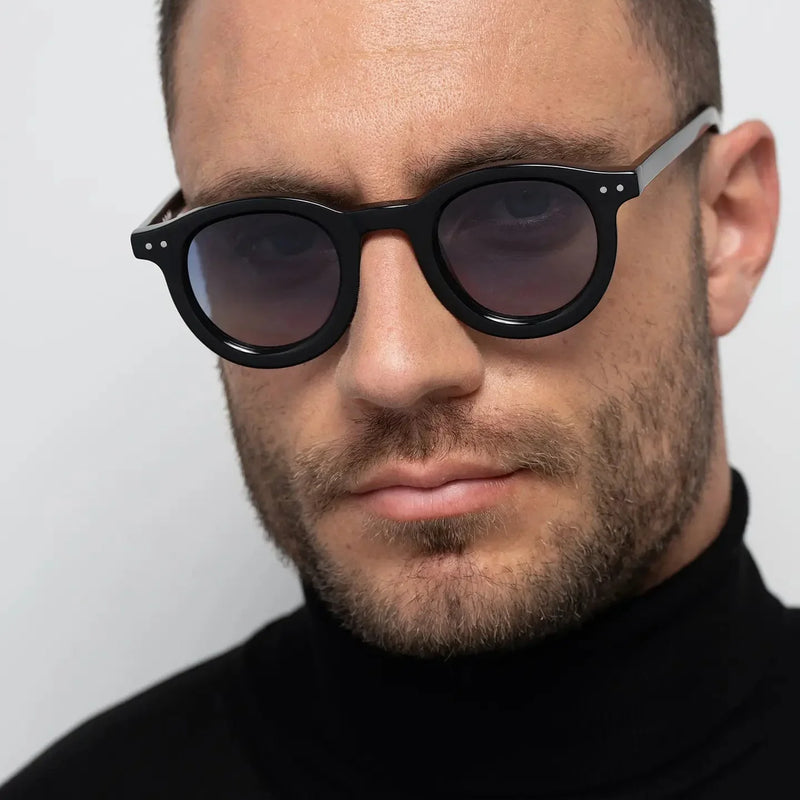
Round frames soften stronger facial angles.
Panto silhouettes combine gentle curves with architectural definition.
The frame doesn't change your face. It changes the relationship between your facial features.
This is why choosing sunglasses should never begin with trends.
It should begin with understanding how geometry interacts with your own proportions.
If you'd like to understand this in greater depth, explore Round vs Square Sunglasses.
Rectangular frames
Create stronger definition and visual structure.
Round frames
Introduce softer visual rhythm and reduce angularity.
Panto frames
Balance structure with softer proportions for versatile everyday wear.
WHY VISUAL WEIGHT MATTERS MORE THAN FRAME SIZE

One of the biggest misconceptions in eyewear is that larger sunglasses automatically create a stronger look.
They don't.
What actually changes facial perception is visual weight.
Visual weight comes from the combination of acetate thickness, frame colour, lens proportions and overall geometry.
A medium-sized frame with balanced acetate often creates a much stronger impression than an oversized frame with very little structure.
This explains why premium acetate sunglasses usually feel more intentional than lightweight fashion frames.
The sunglasses that attract the most compliments are rarely the biggest.
They're usually the ones where visual weight is perfectly matched to the wearer's facial proportions.
WHY PROPORTION IS MORE IMPORTANT THAN FACE SHAPE

Face shape is helpful, but it is only one part of choosing sunglasses.
Two people with the same face shape can look completely different wearing the same frame.
That's because proportion extends far beyond face shape alone.
Eye spacing, eyebrow position, forehead height, nose width, cheekbone definition and jawline all influence how sunglasses are perceived.
This is why relying exclusively on face-shape guides often leads to disappointing results.
Understanding overall facial balance almost always produces better choices.
If you're unsure where to begin, our guide to How Sunglasses Change Facial Balance explains these principles in much greater detail.
"I have a round face, so only square sunglasses will suit me."
Reality is much more nuanced.
Facial balance depends on the relationship between all your features—not simply the outline of your face.
WHY ACETATE THICKNESS CHANGES THE WAY YOU LOOK

Most people think acetate thickness is simply a design choice.
In reality, it changes how your entire face is perceived.
Thicker acetate creates stronger visual weight, giving the eyes greater definition and helping facial features feel more connected.
Very thin frames often have the opposite effect. Instead of framing the face, they almost disappear, leaving individual features to compete for attention.
This doesn't mean thicker frames are always better.
The most flattering sunglasses are those where the visual weight of the frame matches the visual weight of the face.
People rarely describe a pair of sunglasses as having the "right acetate thickness."
Instead they say things like:
- "They look expensive."
- "They suit your face."
- "They look natural."
What they're actually noticing is balanced visual weight.
COLOUR CHANGES PERCEPTION JUST AS MUCH AS SHAPE
Colour influences far more than personal style.
It changes contrast.
Contrast changes attention.
Attention changes perception.
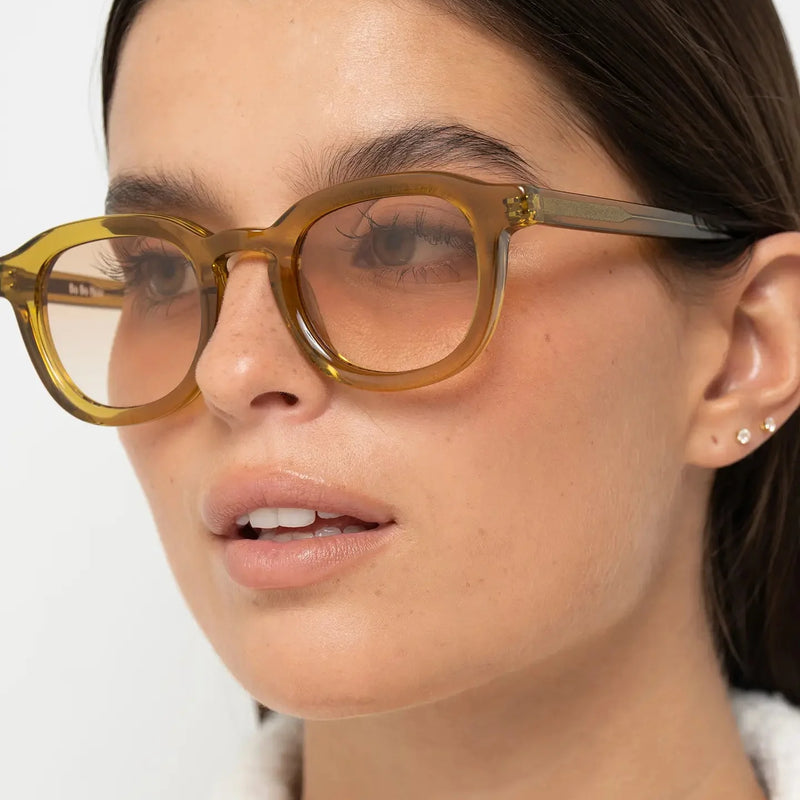
Dark acetate strengthens facial definition, while warmer colours such as tortoise, olive and honey soften transitions and create a more relaxed visual balance.
Neither approach is universally better.
The best choice depends on how much definition your face naturally has and the impression you want to create.
If you'd like to understand this further, explore our comparisons of Black vs Tortoise Sunglasses and Warm vs Cool Tone Sunglasses.
Black acetate
Creates stronger definition and sharper facial contrast.
Tortoise acetate
Balances warmth with structure, making it one of the most versatile finishes.
Olive, cream and warm neutrals
Create softer transitions while maintaining visual presence.
WHY SOME SUNGLASSES FEEL MORE INTENTIONAL

Have you ever looked at someone wearing sunglasses and thought they simply looked "put together"?
That impression rarely comes from fashion trends.
It comes from consistency.
When frame geometry, colour, acetate thickness and facial proportions all work together, the sunglasses feel intentional rather than decorative.
This is why some people appear effortlessly stylish while wearing relatively simple frames.
The sunglasses complement the face instead of competing with it.
Intentional eyewear doesn't attract attention because it is louder.
It attracts attention because nothing feels out of place.
Harmony creates confidence.
OUR FAVOURITE BO BO NOIR SILHOUETTES

Each Bo Bo Noir collection creates balance in a different way because each silhouette explores a different relationship between geometry, visual weight and facial proportion.
Jane creates confident architectural definition through clean rectangular lines.
Narr combines structured panto geometry with softer transitions, making it one of the most versatile everyday silhouettes.
Triboulet introduces generous proportions and gradient lenses that soften facial contrast while maintaining presence.
William demonstrates how bold round acetate can feel balanced when geometry and visual weight are carefully controlled.
The strongest frame isn't necessarily the boldest one.
It's the one that feels naturally connected to your facial architecture.
Choose Jane if...
You enjoy clean architectural styling with strong definition.
Choose Narr if...
You want balanced everyday versatility with softer proportions.
Choose Triboulet if...
You prefer warmer contrast and generous lens proportions.
Choose William if...
You enjoy confident round silhouettes with balanced visual weight.
When choosing sunglasses, don't ask yourself whether the frame is fashionable.
Ask yourself whether every element feels connected.
If the frame, your facial proportions and your personal style all work together, the sunglasses will almost always feel timeless rather than trendy.
COMMON MISTAKES WHEN CHOOSING SUNGLASSES
Many people believe choosing sunglasses is simply a matter of finding a frame they like.
In reality, the biggest mistakes happen when style is considered before proportion.
The sunglasses that suit you best are not necessarily the trendiest or the most expensive—they are the ones that create the strongest relationship between your facial features.
The most common mistakes include:
- Choosing trends instead of choosing proportions.
- Focusing only on face shape while ignoring eye spacing, forehead height and facial structure.
- Selecting frames that are either too visually heavy or too visually light.
- Ignoring bridge fit and how the frame sits on the face.
- Choosing colours that create too much or too little contrast.
- Judging sunglasses from a few centimetres away instead of viewing your whole face naturally.
The best sunglasses don't compete with your face.
They complete it.
HOW TO CHOOSE WITH CONFIDENCE
Instead of asking whether a pair of sunglasses looks good on its own, ask a different question.
Does this frame improve the balance of my face?
If your face needs more definition...
Choose frames with stronger geometry and balanced acetate thickness.
If your features already feel very defined...
Choose softer silhouettes or warmer acetate colours to create smoother transitions.
If your face feels longer than you would like...
Choose generous lens height and stronger horizontal proportions.
If your facial features compete for attention...
Choose a frame that naturally directs the eye back towards your eyes.
If you're deciding between two pairs...
Choose the frame that makes your face feel calmer, more balanced and more cohesive—not simply the one that attracts the most attention.

"If sunglasses are fashionable, they'll probably suit me."
Fashion trends can introduce new shapes and colours, but they cannot replace proportion.
The sunglasses that remain in your wardrobe for years are almost always the ones that feel naturally balanced every time you wear them.
FINAL THOUGHTS
People often think great sunglasses change the way they look.
In reality, they change the way their face is perceived.
Frame geometry, visual weight, lens proportions, bridge position and colour all work together to influence how every facial feature relates to the next.
When those relationships feel balanced, sunglasses stop looking like an accessory.
They become part of your facial architecture.
That is why the best sunglasses never rely on trends alone.
They create confidence through proportion, harmony and intentional design.
Once you understand these principles, choosing sunglasses becomes far less about following rules and far more about recognising balance.
Frequently Asked Questions
Why do some sunglasses instantly suit my face?
Because their proportions complement the relationship between your eyes, forehead, cheekbones and jawline. Your brain recognises this balance almost immediately.
Why do the same sunglasses look different on different people?
Every face has different proportions, feature spacing and visual weight. The frame stays the same, but the facial composition around it changes completely.
Is face shape the most important factor?
No. Face shape is helpful, but overall facial proportion, eye position, forehead height, bridge fit and frame geometry usually have a greater influence.
Does frame thickness matter?
Yes. Balanced acetate thickness creates visual structure and helps distribute attention evenly across the face.
Can sunglasses make my face look more balanced?
Absolutely. While they cannot change your facial structure, they can significantly change how your proportions are perceived.
Why do expensive-looking sunglasses often feel more flattering?
It's often because they have carefully considered proportions, controlled visual weight and refined frame geometry rather than simply premium materials.
Do colours influence how sunglasses look on me?
Yes. Darker colours increase definition, while warmer tones soften contrast and create smoother transitions between the frame and the face.
Can sunglasses make me look more confident?
They can influence how balanced and intentional your appearance feels, which often affects confidence as much as style itself.
Should I always follow current trends?
No. Trends change quickly, but balanced proportions remain flattering regardless of fashion cycles.
How do I know when I've found the right pair?
When your eyes naturally become the focal point of your face and the sunglasses feel like a seamless extension of your features rather than an object sitting on top of them.
👁 YOU MAY ALSO LIKE
Understanding why certain sunglasses suit you is the foundation of choosing eyewear with confidence. These guides explore the principles behind facial balance, frame geometry and intentional design in greater depth.
How Sunglasses Change Facial Balance
Discover how frame geometry changes the way your facial features are perceived.
Read the article →
What Makes Sunglasses Look Flattering?
Learn why some frames immediately enhance facial proportions while others feel slightly out of balance.
Read the article →
Why Do Expensive Sunglasses Look Better?
Explore how proportion, refinement and visual weight influence the perception of premium eyewear.
Read the article →
Thin vs Thick Frame Sunglasses
Understand how acetate thickness changes facial definition, contrast and overall balance.
Read the article →
Explore the Bo Bo Noir Sunglasses Collection
Discover acetate sunglasses designed around proportion, structure, visual harmony and long-term wearability.
Explore the collection →