Free Worldwide Shipping • 14-Day Returns • Designed in PortugalFree Worldwide Shipping • 14-Day Returns • Designed in PortugalFree Worldwide Shipping • 14-Day Returns • Designed in PortugalFree Worldwide Shipping • 14-Day Returns • Designed in PortugalFree Worldwide Shipping • 14-Day Returns • Designed in PortugalFree Worldwide Shipping • 14-Day Returns • Designed in PortugalFree Worldwide Shipping • 14-Day Returns • Designed in PortugalFree Worldwide Shipping • 14-Day Returns • Designed in PortugalFree Worldwide Shipping • 14-Day Returns • Designed in PortugalFree Worldwide Shipping • 14-Day Returns • Designed in PortugalFree Worldwide Shipping • 14-Day Returns • Designed in PortugalFree Worldwide Shipping • 14-Day Returns • Designed in PortugalFree Worldwide Shipping • 14-Day Returns • Designed in PortugalFree Worldwide Shipping • 14-Day Returns • Designed in PortugalFree Worldwide Shipping • 14-Day Returns • Designed in Portugal
Choosing between black vs tortoise sunglasses sounds like a colour decision, but the difference becomes more useful when you understand what each colour does to the visual boundary around your face.
Black acetate usually creates a more continuous outline, which can increase contrast, definition and perceived visual weight. Tortoise breaks that outline into multiple tones, introducing warmth and depth while often making the boundary feel less uniform.
But colour is only one variable. A thick tortoise frame can have more presence than a narrow black one. Frame geometry, opacity, acetate volume, lens colour and facial contrast can all change the result. If you are still deciding on geometry first, read our guide to choosing sunglasses for your face shape.
The most accurate comparison therefore controls the shape first: same geometry → different acetate colour → different contrast → different perceived visual weight. That is the principle we will use throughout this guide.
Black and tortoise can use similar frame geometry while creating different relationships with the face. The useful comparison is not simply dark versus brown, but continuous contrast versus tonal variation.
Quick Answer
Choose black sunglasses when you want clearer definition, stronger contrast and a more continuous frame outline. Choose tortoise when you want tonal depth, warmth and a less uniform transition between frame and face. Neither is universally more flattering or refined. Geometry and acetate volume still matter, so compare black and tortoise in the same or similar frame shape whenever possible. If both work, the final decision should come down to how much contrast you want and which one you are more likely to wear repeatedly.
BBN Insight
Physical frame weight and perceived visual weight are not the same thing. Two acetate frames can have similar physical dimensions while appearing very different on the face. Black tends to preserve a continuous dark perimeter. Tortoise interrupts that perimeter with tonal variation. The amount of material has not necessarily changed, but the way your eye reads it has.
The simplest distinction is that black tends to create continuity while tortoise introduces variation.
A black acetate rim can read as one uninterrupted shape. Tortoise contains shifts between lighter and darker areas, so your eye has more information to process inside the same silhouette.
Decision variable
Black sunglasses
Tortoise sunglasses
Frame boundary
More continuous
More tonally varied
Typical visual effect
Definition and graphic clarity
Depth and tonal complexity
Perceived contrast
Often stronger
Often less uniform
Wardrobe relationship
Clear, graphic and easy to repeat
Layered, tonal and colour-responsive
Main trade-off
Can feel visually dense in substantial geometry
Pattern and tone vary significantly between frames
These are tendencies, not rules. Geometry, thickness, opacity and lenses can strengthen, weaken or even reverse the expected effect.
2. Why do black sunglasses usually look stronger?
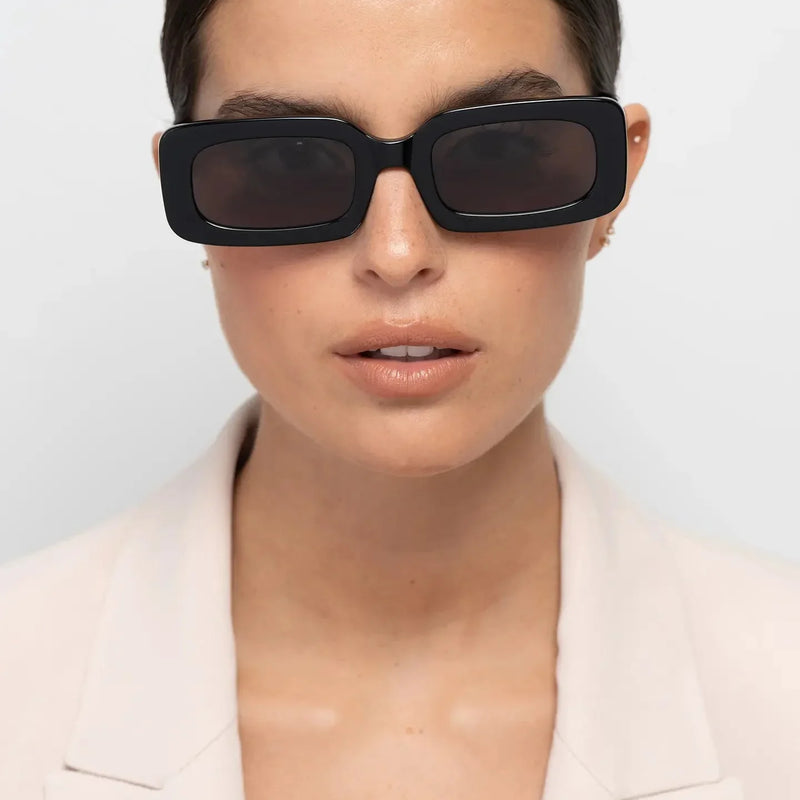
Black sunglasses often feel stronger because dark opaque acetate creates a clearly defined perimeter around the lenses. Instead of visually breaking into multiple tones, the frame can be perceived as one continuous shape.
That continuity makes geometry easier to read. A rectangular frame can look more architectural; a round frame more clearly circular; a panto frame more visibly defined around the brow and lower lens line.
Black therefore does not create structure by itself. It makes existing structure more visible.
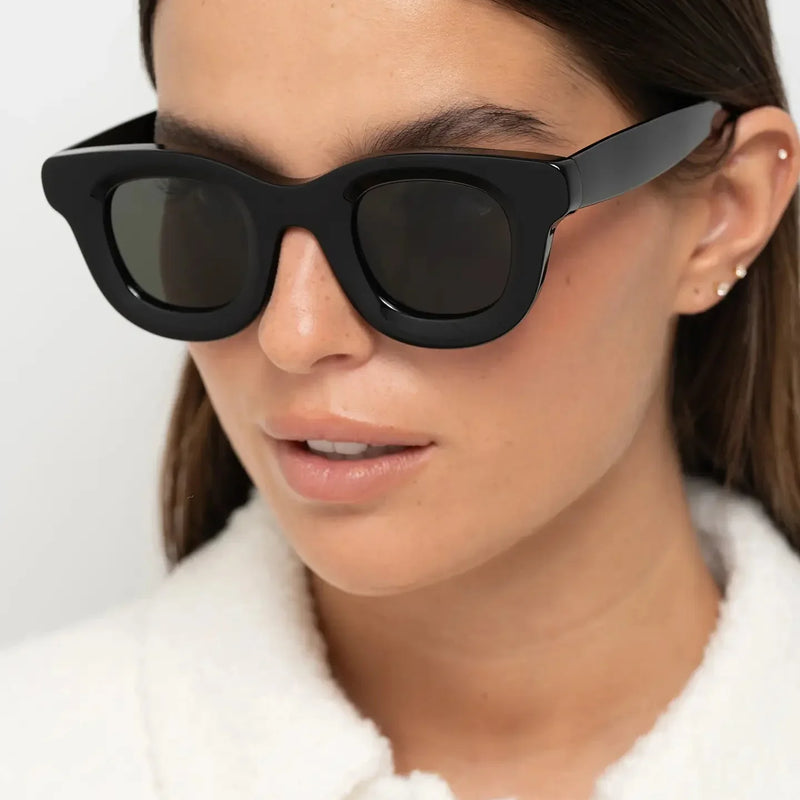
Opaque black makes the perimeter of the Narr panto geometry easy to read. The colour reinforces the silhouette rather than changing its underlying shape.
This is why substantial black frames can have significant visual presence. The effect comes from geometry + material volume + opacity + contrast, not from the word “black” alone.
If you want to understand the wider distinction between quiet and stronger frame presence, continue with Minimal vs Bold Sunglasses.
3. Why can tortoise sunglasses look softer?
Tortoise acetate contains multiple tones rather than one uninterrupted colour. Darker areas still define the frame, while amber, brown or lighter sections interrupt that boundary.
That variation can reduce the impression of one continuous dark line around the eyes. The result is often described as softer, but dimensional is the more useful word: the frame has visible depth and variation rather than a single flat colour field.
Tortoise does not remove the physical volume of an acetate frame. Tonal variation changes how continuously that volume is perceived.
This distinction matters. A substantial tortoise frame is still substantial. Calling every tortoise frame “light” or “subtle” confuses physical volume with perceived visual weight.
Dark tortoise with limited tonal variation may still look strong. A more varied tortoise can visually break up the same amount of acetate more noticeably.
BBN Insight: tortoise is not simply brown
Treating tortoise as a single colour misses its most important visual characteristic. Tortoise is a pattern of contrast within the frame itself. Two tortoise acetates can therefore behave differently depending on how dark, transparent, warm or varied their pattern is.
4. What happens when the frame shape stays the same?
This is the cleanest way to understand black vs tortoise sunglasses.
If you compare a rectangular black frame with a round tortoise frame, you are changing at least two major variables simultaneously: colour and geometry. Any difference you perceive may be caused by either one.
Keep the model constant and the comparison becomes much more useful:
Geometry: establishes the actual silhouette around the face.
Colour and opacity: determine how continuous or varied that silhouette appears.
Contrast: describes how strongly the frame separates visually from the face.
Perceived visual weight: is the combined impression produced by those variables.
A useful real-world example is the Narr frame family. Narr is available in both Shiny Black and Tortoise. Because the frame family stays constant, the comparison is more informative than comparing black and tortoise across unrelated silhouettes.
The panto geometry remains the reference point. Shiny black gives that geometry a more continuous dark boundary; tortoise introduces variation inside that boundary. The design has not suddenly become a different shape — the colour changes how strongly the same design language is perceived.
This is the principle to use whenever both colourways are available: compare like with like before drawing conclusions about black or tortoise.
5. How do black and tortoise sunglasses interact with complexion?
Complexion matters primarily through contrast, not through a rigid rule that assigns black or tortoise to a particular skin tone.
A dark black frame may create a pronounced boundary on one face and a more integrated effect on another. Tortoise adds another variable because different parts of the acetate can relate differently to skin, hair and eyebrows.
This is why simple warm-skin-versus-cool-skin rules are often inadequate for eyewear. Sunglasses occupy a large area around the eyes. Geometry, hair colour, eyebrow definition, lenses and frame thickness all participate in the result.
Ask how much separation you want between the frame and your face rather than which colour you have supposedly been assigned.
6. Does face shape determine whether black or tortoise is better?
No. Face shape can help you think about frame geometry, but it does not automatically determine frame colour.
For example, a rectangular frame may introduce horizontal and angular structure to softer facial proportions. Choosing that rectangle in black can make its outline more explicit; choosing the same geometry in tortoise can retain the structure while introducing tonal variation.
The useful sequence is therefore:
Choose the geometry → check the scale and fit → then use colour to adjust contrast and presence.
Wardrobe is often more useful than abstract colour rules because sunglasses are worn repeatedly with clothing you already own.
Black creates a clear, repeatable anchor. It can echo black shoes, bags, belts and outerwear, but it does not require an all-black wardrobe. Its neutrality comes from the absence of strong hue rather than from being visually invisible.
Tortoise behaves differently. Brown, amber and darker areas can connect with several colours simultaneously, making the frame feel integrated with cream, olive, denim, navy, brown and other tonal combinations.
If your wardrobe...
Consider first
Why
Uses strong monochrome contrast
Black
Extends the graphic clarity already present in the clothing.
Uses layered earth and neutral tones
Tortoise
Its internal colour variation can connect with several tones at once.
Changes style frequently
Either
Choose according to the amount of frame contrast you want to repeat.
Already contains both warm and dark neutrals
Either
Repeat wear becomes a more useful deciding factor than palette alone.
Frame colour is only part of what you see. The lenses occupy most of the visual area inside a pair of sunglasses, so their darkness, tint and gradient can reinforce or interrupt the frame.
A black frame with dark lenses can create a highly continuous composition because frame and lens remain visually close. Change to a lighter or coloured lens and the geometry may become easier to separate into frame and interior.
Tortoise can behave differently. A brown or gradient lens may extend the warm tonal family of the acetate, while a contrasting lens colour can make the frame feel more expressive.
Triboulet Tortoise Light Blue shows why the lens cannot be ignored: the tortoise acetate remains warm and varied, while the lighter blue lens introduces a separate colour relationship inside the frame.
When comparing two sunglasses online, do not attribute every visual difference to black or tortoise if the lenses are also different.
9. Which is easier for everyday wear?
Neither colour is inherently more versatile. Everyday wear depends on what feels repeatable within your own visual language.
Black may be easier if you consistently want eyewear to provide a defined anchor. Tortoise may be easier if you prefer tonal variation and want the frame boundary to feel less uniform.
The important question is not which colour works with the greatest theoretical number of outfits. It is which visual effect you are comfortable repeating.
The repeat-wear test
Imagine wearing the frame with your three most common outfits rather than your most carefully styled one.
If one colour still feels natural in all three contexts, that tells you more about everyday versatility than a generic rule about black or tortoise.
10. How should you compare black and tortoise sunglasses online?
Black is relatively easy to understand in a product photograph because its silhouette usually remains clear. Tortoise requires closer inspection because pattern, transparency and colour distribution may change with lighting and angle.
When comparing online, use images to separate the variables rather than relying on one front photograph.
Check these six things
Front view: understand the overall geometry.
Worn view: judge frame-to-face contrast and scale.
Angle view: inspect acetate volume and depth.
Tortoise variation: look at how light and dark areas are distributed.
Lens colour: separate its effect from the acetate colour.
Frame dimensions: do not assume a softer colour compensates for incorrect size.
The most useful product comparison keeps geometry constant. Bo Bo Noir offers black and tortoise versions within the same frame families, allowing colour to be evaluated without simultaneously changing the underlying silhouette.
Narr Shiny Black: panto geometry with stronger continuity
Design variable: opaque shiny black acetate within Narr's panto geometry.
Visual effect: stronger continuity around the lenses and clearer definition of the silhouette.
Consider it if: you want the frame itself to remain a clearly visible part of your facial composition.
Consider another direction if: you like Narr's geometry but want more tonal variation inside the frame boundary.
You want the same design language with more tonal variation
The decision principle
Do not ask whether black or tortoise is better in isolation. First choose a geometry that works. Then ask whether you want that geometry to appear more continuous and defined or more tonally varied and dimensional.
12. Frequently asked questions about black vs tortoise sunglasses
Are black or tortoise sunglasses better?
Neither is universally better. Black usually creates a more continuous and defined frame boundary, while tortoise introduces tonal variation and depth. Choose after considering geometry, fit, contrast and how often you expect to wear the frame.
Do black sunglasses look more refined?
Black can look highly refined when geometry, scale and material are well resolved, but refinement does not come from black alone. A poorly proportioned black frame does not become refined simply because of its colour.
Do tortoise sunglasses look more expensive?
Tortoise can reveal colour depth and material variation particularly clearly, but that does not make tortoise an automatic indicator of price or quality. Construction, material, finishing, design and fit should be evaluated separately.
Are tortoise sunglasses more versatile than black?
Not inherently. Tortoise can integrate easily with layered neutral and earth tones, while black provides a consistent graphic anchor across many wardrobes. Personal repeat wear is a better measure of versatility than colour alone.
Do tortoise sunglasses suit everyone?
There is no single tortoise pattern and no frame colour suits everyone in the same way. Dark tortoise, lighter amber tortoise and highly varied patterns can create different levels of contrast, and geometry and fit remain essential.
Can black sunglasses look too harsh?
They can feel visually dense when strong colour contrast is combined with substantial acetate or very assertive geometry. If you like the shape but not the intensity, tortoise or a more translucent acetate can alter perceived visual weight without necessarily changing the frame architecture.
Is black or tortoise better for a round face?
Choose geometry before colour. If a more angular or horizontally structured frame creates the balance you want, black can make that outline more explicit while tortoise can introduce tonal variation. Face shape alone does not determine the colour.
Is black or tortoise better for a square face?
Again, geometry comes first. Curvature, width and proportion determine how the frame interacts with angular facial structure. Black or tortoise can then be used to increase or soften the perceived contrast of that geometry.
Should I buy black or tortoise sunglasses for everyday wear?
Choose the effect you are more comfortable repeating. Black is useful when you consistently enjoy clear frame definition. Tortoise is useful when you prefer visible material depth and tonal variation. Your regular wardrobe and expected frequency of wear should decide between two otherwise suitable frames.
Can I own both black and tortoise sunglasses?
Yes. They can serve different visual roles even in similar geometry. Black can provide stronger continuity and definition, while tortoise can give the same general frame category a more varied relationship with colour and contrast.
Final thoughts
The useful difference between black and tortoise sunglasses is not that one is universally stronger, softer, more refined or more versatile.
Black tends to create a more continuous frame boundary. Tortoise introduces tonal variation within that boundary. That difference can change contrast, definition, depth and perceived visual weight even when the underlying geometry remains similar.
Start with the shape and fit. Then compare opacity, acetate pattern, lens colour and the amount of contrast each version creates against your face. Finally, test the decision against your real wardrobe and expected frequency of wear.
The strongest choice is the colour that gives the right geometry the level of presence you actually want to repeat.
Compare black and tortoise sunglasses
Explore how colour, geometry, acetate and visual weight change the character of a frame.
Enjoy a 10% discount on your purchase! Sign up for our newsletter now.Enjoy a 10% discount on your purchase! Sign up for our newsletter now.Enjoy a 10% discount on your purchase! Sign up for our newsletter now.Enjoy a 10% discount on your purchase! Sign up for our newsletter now.Enjoy a 10% discount on your purchase! Sign up for our newsletter now.Enjoy a 10% discount on your purchase! Sign up for our newsletter now.Enjoy a 10% discount on your purchase! Sign up for our newsletter now.Enjoy a 10% discount on your purchase! Sign up for our newsletter now.Enjoy a 10% discount on your purchase! Sign up for our newsletter now.Enjoy a 10% discount on your purchase! Sign up for our newsletter now.Enjoy a 10% discount on your purchase! Sign up for our newsletter now.Enjoy a 10% discount on your purchase! Sign up for our newsletter now.Enjoy a 10% discount on your purchase! Sign up for our newsletter now.Enjoy a 10% discount on your purchase! Sign up for our newsletter now.Enjoy a 10% discount on your purchase! Sign up for our newsletter now.