Free Worldwide Shipping • 14-Day Returns • Designed in PortugalFree Worldwide Shipping • 14-Day Returns • Designed in PortugalFree Worldwide Shipping • 14-Day Returns • Designed in PortugalFree Worldwide Shipping • 14-Day Returns • Designed in PortugalFree Worldwide Shipping • 14-Day Returns • Designed in PortugalFree Worldwide Shipping • 14-Day Returns • Designed in PortugalFree Worldwide Shipping • 14-Day Returns • Designed in PortugalFree Worldwide Shipping • 14-Day Returns • Designed in PortugalFree Worldwide Shipping • 14-Day Returns • Designed in PortugalFree Worldwide Shipping • 14-Day Returns • Designed in PortugalFree Worldwide Shipping • 14-Day Returns • Designed in PortugalFree Worldwide Shipping • 14-Day Returns • Designed in PortugalFree Worldwide Shipping • 14-Day Returns • Designed in PortugalFree Worldwide Shipping • 14-Day Returns • Designed in PortugalFree Worldwide Shipping • 14-Day Returns • Designed in Portugal
The challenge with sunglasses in 2027 is not finding a fashionable frame. It is choosing a style that feels current while remaining useful enough to wear once the novelty has passed.
The best sunglasses styles for 2027 are not defined by one silhouette. Rectangular frames create stronger horizontal structure, panto frames combine curves with upper-frame definition, and substantial round frames introduce softer geometry without necessarily looking delicate. Colour, acetate thickness and transparency then determine how strongly each shape is perceived.
That distinction matters because sunglasses change more than an outfit. Their width, geometry and contrast alter facial balance and can make the frame either an everyday part of your appearance or a much stronger focal point.
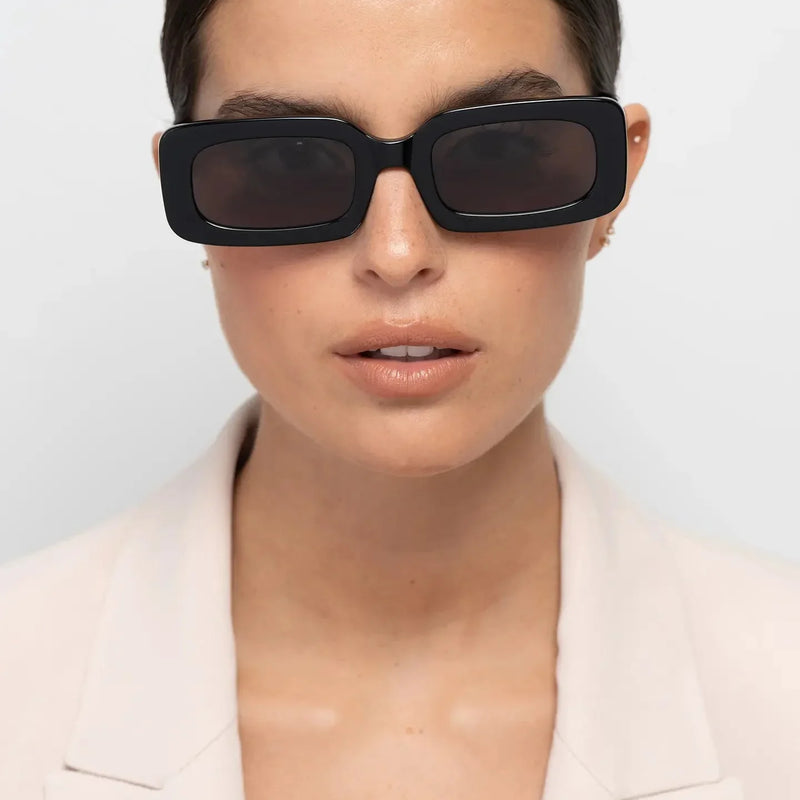
Rectangular sunglasses remain one of the clearest 2027 directions because they create immediate horizontal definition. Black acetate makes that geometry particularly easy to read on the face.
What are the best sunglasses styles for 2027?
The strongest sunglasses styles for 2027 are rectangular frames, balanced panto shapes, substantial round sunglasses and bold acetate frames with controlled proportions. Black and tortoise provide stronger definition, while olive, burgundy and translucent acetate offer ways to introduce colour or reduce visual density.
Choose by effect rather than novelty: rectangles for stronger structure, panto for a balance of curves and definition, round frames for softer geometry, and transparent or lighter acetate when you want visible scale without maximum contrast.
A frame usually becomes easier to wear when one design element creates the personality and the others provide balance. Strong geometry does not require strong colour, and substantial acetate does not require extreme width.
How are sunglasses styles changing in 2027?
The strongest 2027 direction is not simply towards larger or stranger frames. Familiar silhouettes are being made more expressive through proportion, acetate volume, colour and clearer geometry, allowing them to feel current without depending entirely on novelty.
Rectangular frames can become slightly broader and deeper without turning into extremely narrow fashion shapes. Panto frames can use substantial acetate to feel more architectural, while round frames can gain enough material presence to appear deliberate rather than delicate. The underlying shape remains recognisable; what changes is the way it is proportioned and presented.
That gives these styles greater potential beyond one season. A frame built around a useful visual effect — adding definition, introducing curvature, controlling contrast or adjusting perceived width — has a stronger reason to remain relevant after the trend cycle moves on. Future sunglasses trends you will actually wear explores that longer-term direction in more detail.
Panto frames illustrate the shift particularly well: familiar curved geometry remains, while substantial acetate and a stronger upper frame give the silhouette more contemporary presence.
What makes a sunglasses style worth choosing?
A useful sunglasses style needs to do more than look current. It should create a visual effect that works for the wearer and remain repeatable across different clothes, settings and seasons.
This is the practical difference between style and trend. A trend tells you what is receiving attention; the frame itself tells you what happens on the face. Rectangular frames add horizontal definition, round frames introduce curvature, panto shapes balance both, while thicker acetate makes any of those geometries more visible.
The better buying question is therefore not “Which sunglasses are fashionable?” but “Which effect do I want around my eyes and across my face?” If you are deciding between quieter and more expressive eyewear, minimal vs bold sunglasses provides the clearer comparison.
Why are rectangular sunglasses one of the strongest 2027 styles?
Rectangular sunglasses remain important because their effect is clear: they introduce horizontal direction around the eyes. This can create stronger facial definition, add perceived width to narrower proportions and provide useful contrast to softer facial contours.
The more wearable 2027 versions do not need extremely narrow lenses. Slightly deeper proportions and substantial acetate can preserve the directional quality while giving the frame more balance. Corner treatment and colour then control the intensity: sharper edges and black acetate feel more graphic, while tortoise, cream or olive can soften the same basic geometry.
If rectangular eyewear is already your preferred direction, best rectangular sunglasses for women provides a more focused look at width and scale. For the wider geometry decision, round vs square sunglasses explains how curves and straighter lines change facial balance differently.
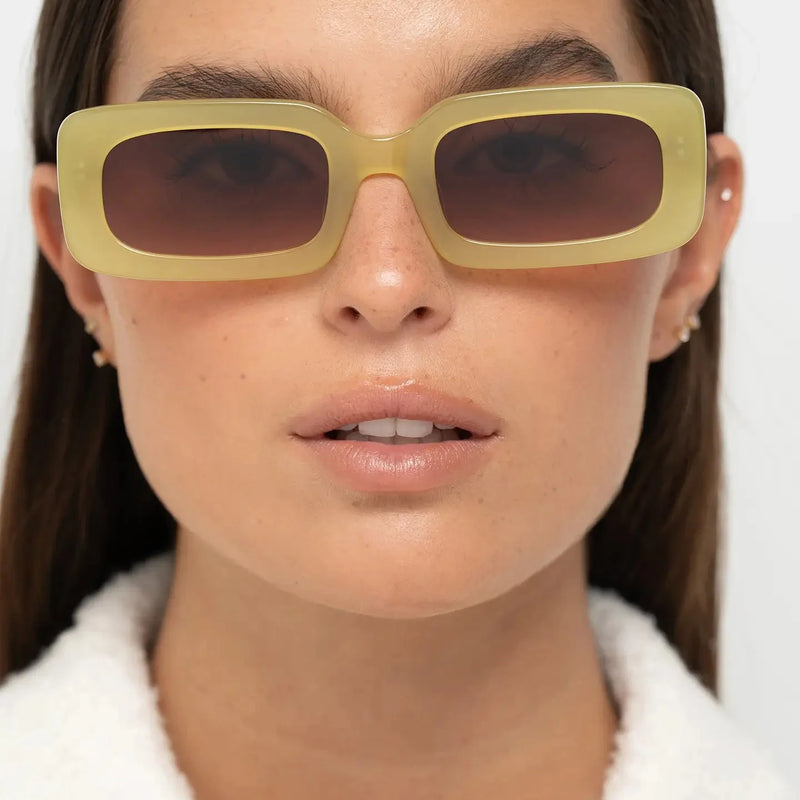
Colour can substantially change the same rectangular direction. Cream acetate preserves the frame's structure while creating a softer boundary than opaque black.
Why do panto sunglasses remain so versatile?
Panto sunglasses occupy useful territory between round and more angular eyewear. Their curved lower lenses create softness, while the upper frame usually provides enough direction to keep the silhouette defined.
That makes panto useful when rectangular frames feel too severe but fully round frames feel too soft. Substantial acetate can give the shape more authority, while black, tortoise, olive or burgundy can change its personality without altering the underlying geometry.
This adaptability gives panto frames strong potential beyond a single trend cycle. If you want to see how additional panto scale affects facial structure, how oversized panto frames create stronger facial definition explores the effect directly.
Dark acetate makes the panto structure more explicit. The curved lower lenses soften the shape, while the upper frame maintains definition around the eyes.
When do round sunglasses work best?
Round sunglasses are useful when you want to introduce curvature rather than reinforce existing facial angles. They can create contrast with a stronger jaw, angular cheekbones or a more structured brow, but their final effect depends heavily on scale, material and colour.
A small, thin round frame behaves very differently from a substantial acetate version. Additional material gives the curved geometry more visual authority, while transparent acetate can reduce the density of the silhouette and allow more of the face to remain visible.
Round sunglasses therefore do not need to feel retro or delicate in 2027. Their proportions can be contemporary while retaining the softness that defines the shape. If compatibility with facial geometry is your main concern, best sunglasses for face shape provides the wider framework.
Crystal acetate shows why a substantial round frame does not need maximum visual density. The geometry remains clearly visible while transparency softens the boundary around the eyes.
Why is bold acetate still important in 2027?
Substantial acetate can make familiar shapes feel more intentional without requiring unusual geometry. It gives rectangular frames stronger architecture, makes panto silhouettes more visible and allows round frames to feel assertive rather than delicate.
The important distinction is between material presence and excessive scale. A frame can use thicker acetate without becoming extremely wide or tall, while colour can regulate how strongly that material is perceived. Black creates a denser outline, tortoise introduces tonal variation and translucent acetate keeps the thickness visible while reducing contrast.
Thickness is therefore useful when it reinforces the shape rather than becoming the entire reason for choosing it. Thin vs thick frame sunglasses explains the trade-offs in more detail.
BBN insight
The most wearable 2027 styles rarely maximise shape, width, thickness and contrast simultaneously. The stronger approach is to decide where the character should come from and let the remaining variables create balance.
What Part 1 tells us about the best sunglasses styles for 2027
Rectangular sunglasses remain relevant because they create useful horizontal definition.
Panto frames balance curved lower geometry with greater structure around the brow.
Round frames can feel contemporary when scale and material are deliberate.
Substantial acetate strengthens familiar geometry without requiring unusual shapes.
Colour and transparency control how strongly the frame is perceived.
The most useful 2027 styles combine a clear visual effect with enough versatility to remain wearable beyond the trend cycle.
Next: visual weight, frame width, oversized proportions, colour, lenses and how those variables change the same basic sunglasses style.
How does visual weight change the same sunglasses style?
Two frames can belong to the same style family and still look very different on the face because shape is only one part of what we perceive. Acetate thickness, colour, transparency, lens darkness and overall scale combine to determine visual weight — how strongly the sunglasses register when someone looks at you.
A substantial black rectangle generally creates more visual weight than a similarly sized crystal frame because its outline is darker and more continuous. Tortoise sits somewhere between those effects: the frame remains visible, but tonal variation breaks up the boundary. This is why choosing shape without considering material and colour can produce a result very different from the one you expected.
Visual weight is not the same as physical weight. A frame can look substantial while remaining comfortable, or contain significant acetate while appearing softer because the material is translucent. For a deeper explanation, read how frame contrast changes your appearance.
Black acetate strengthens the complete outline of a rectangular frame. Geometry, material thickness and dark colour work together to create visual presence.
Why does frame width matter as much as shape?
Shape tells you whether a frame is rectangular, round or panto; width determines how that geometry spreads across the face. A wider frame can create greater horizontal presence and make the central face appear relatively narrower, while a more contained version of the same shape produces a different balance.
This matters particularly with substantial acetate because thickness makes width easier to notice. A frame does not need to extend dramatically beyond the face to feel bold; a modest increase in width combined with stronger acetate may be enough. Go too wide, however, and the eyewear can begin to look disconnected from the temples or simply fit poorly.
A frontal worn view makes width easier to judge because the outer edges of the frame can be read directly against the proportions of the face.
Are oversized sunglasses still one of the best styles for 2027?
Oversized sunglasses remain relevant, but the strongest versions are more controlled than simply choosing the largest possible frame. Scale can come from width, lens height or acetate thickness, and each affects the face differently. Deeper lenses increase vertical presence, while a broader rectangle emphasises horizontal proportions even when its lenses are not especially tall.
The most wearable oversized styles avoid making every variable extreme at once. Large dimensions combined with very thick black acetate and dark lenses can create considerable visual density; keeping one of those elements quieter often makes the overall direction easier to repeat.
The decision is therefore less about whether oversized is “in” and more about where you want the additional scale to appear. See oversized vs standard sunglasses for the full comparison.
Think about scale in three separate ways
More width changes horizontal balance. More lens height increases vertical presence. More acetate thickness makes the silhouette more visible. A frame can increase one without maximising the other two.
Why does the brow line change how a sunglasses style looks?
The upper frame sits close to one of the strongest natural lines on the face: the eyebrows. Two sunglasses with similar lens shapes can therefore create noticeably different effects depending on how their upper edges relate to the brow. A straighter top adds horizontal structure, a curved top feels softer, and a lifted outer edge can introduce more directional energy.
Position matters too. A frame sitting unusually low can leave a large gap beneath the eyebrows and feel disconnected, while one sitting too high may cover more of the brow than intended. The frame does not need to copy the eyebrows exactly; the relationship simply needs to look deliberate.
A close-up is particularly useful here because it shows the upper frame, eye position and eyebrows together rather than isolating the sunglasses from the face.
How does colour change a sunglasses style?
Colour can alter the personality of a frame without changing its geometry. A black rectangle can look graphic and strongly defined, while the same basic shape in tortoise feels warmer and more varied. Olive introduces muted colour, burgundy creates deeper expression, and translucent acetate can make substantial geometry feel less dense.
This is one of the easiest ways to use a trend without abandoning a shape you already know works. Instead of moving to unfamiliar geometry simply because it feels new, you can keep familiar proportions and change the colour direction.
For the broader palette, sunglasses colour trends 2027 looks specifically at the colours shaping contemporary eyewear.
Burgundy changes the personality of a familiar panto silhouette without requiring unusual geometry, making colour itself the more expressive element.
Should you choose black, tortoise or a coloured frame?
Choose black when you want the sunglasses to create stronger definition. Opaque dark acetate forms a continuous outline, making the frame shape immediately visible. Tortoise retains depth but introduces tonal variation, which can make the same amount of acetate feel less severe.
Muted colours such as olive and burgundy move further away from conventional neutrals without necessarily becoming difficult to wear. Their usefulness depends less on whether they are “trend colours” and more on whether they repeat naturally with your wardrobe and colouring.
There is no universal winner: black prioritises definition, tortoise warmth and variation, while muted colour gives the frame more personality. For the stronger-contrast end of this decision, see why dark frames create stronger facial definition.
Muted olive introduces visible colour without behaving like a highly saturated statement. The panto geometry remains clear while the colour changes its character.
Why are crystal and transparent frames useful in 2027?
Transparent acetate is useful for people who like substantial sunglasses but find dark frames too visually dominant. The material can remain thick and the silhouette can remain large, yet light and skin tone are still partly visible through the acetate, reducing the sense of one continuous boundary around the eyes.
This works particularly well with round and panto shapes, where additional acetate can give the geometry more presence without automatically making it look heavy. Translucent colours add another layer because peach, yellow and other crystal tones change with light and material thickness rather than behaving like flat opaque colour.
A worn front view makes the effect of transparency easier to judge: the frame remains substantial and clearly round, but the outline is less visually dense than opaque black acetate.
How does lens colour affect the overall sunglasses style?
The frame establishes most of the geometry, but the lenses occupy a large proportion of what people actually see. Their colour and density therefore contribute to the complete style rather than functioning as a separate technical detail. Grey tends to remain visually neutral, brown can reinforce warmer acetate, and green introduces subtle colour while remaining relatively versatile.
The relationship between frame and lens matters too. Warm tortoise with brown lenses creates a more continuous palette, while contrasting lens colour makes the separation between frame and lens more obvious. Neither is inherently better; the question is whether you want the lenses to reinforce the frame or create another point of interest.
Tortoise acetate and brown lenses create a continuous warm palette, while the gradient prevents the lens area from reading as one uniformly dark surface.
Do gradient or solid lenses create a better 2027 look?
Neither is inherently better. Solid lenses create more consistent density across the lens area and can reinforce a clean, graphic frame, while gradient lenses transition from darker to lighter and can visually soften the lower part of the sunglasses.
That difference becomes more noticeable with substantial acetate. When the frame already creates considerable presence, a gradient can prevent the complete front from appearing equally dense. A solid dark lens does the opposite, reinforcing a stronger and more uniform visual statement.
Choose according to whether you want the lenses to reinforce or moderate the frame's visual weight. For the dedicated comparison, read gradient vs solid lenses.
Do matte and glossy finishes change the style of acetate frames?
Yes. Finish changes how light behaves across the material, so frames with similar colour and geometry can still feel different. A glossy surface reflects more light and makes acetate colour, pattern and polished edges more immediately visible, while matte treatment generally produces a quieter surface impression.
Neither finish is automatically more premium. The effect depends on the complete frame and quality of execution. For 2027, finish is best treated as another way of controlling how strongly the material itself attracts attention. See matte vs glossy acetate frames for the direct comparison.
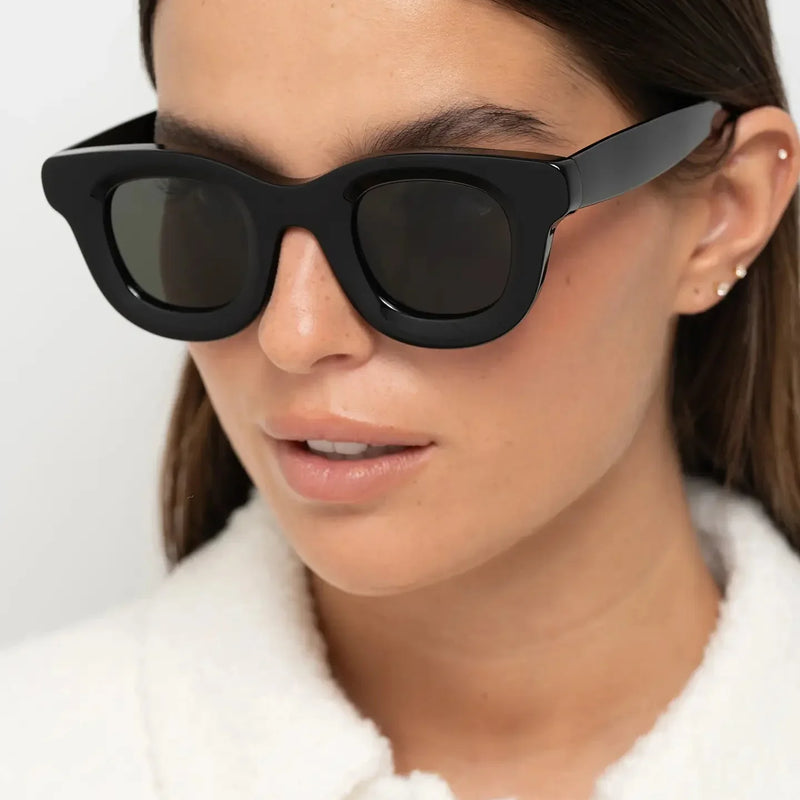
A side view reveals aspects of acetate that a frontal worn image can hide: surface reflection, pattern depth, material thickness and the transition into the temples.
Should you choose a classic or a more current sunglasses style?
The strongest choice often sits between the two. A completely trend-led frame may be harder to repeat, while an extremely conservative one may not provide the expression you actually want. Familiar geometry with one contemporary adjustment — more substantial acetate, slightly broader proportions, muted colour or a translucent finish — creates a useful middle ground.
This is also a practical way to think about longevity. Rectangles, panto shapes and round frames are established categories; what changes is their proportion, material treatment and cultural context. Choosing a version whose underlying geometry already works for you gives it a reason to remain useful when the styling direction evolves.
A recognisable shape does not become outdated simply because the trend cycle changes. What tends to date faster is an extreme combination of proportion, colour and styling.
How do the main 2027 sunglasses directions compare?
Style direction
Main visual effect
Works particularly well when
Main trade-off
Rectangular
Adds horizontal structure and clearer facial definition.
You want stronger direction around the eyes.
Can feel severe when width, colour and thickness are all very strong.
Panto
Balances curved lower geometry with upper-frame structure.
A rectangle feels too angular but a fully round frame feels too soft.
Provides less overt horizontal definition than a rectangle.
Round
Introduces curvature and can soften stronger facial angles.
You want contrast with more angular facial structure.
Small delicate versions create a very different effect from substantial acetate.
Bold acetate
Makes whichever geometry you choose more visible.
You want material presence without relying on unusual shape.
Dark colour, thickness and extreme scale together can become visually dominant.
Crystal acetate
Retains visible geometry while reducing visual density.
You like substantial frames but want softer contrast.
Provides less graphic definition than opaque dark acetate.
Muted colour
Adds personality without requiring high saturation.
You want an alternative to black or tortoise that can still work frequently.
Wardrobe compatibility becomes more important.
What Part 2 tells us about sunglasses styles for 2027
Visual weight depends on thickness, colour, transparency, lenses and scale — not shape alone.
Frame width and lens height affect facial balance in different ways.
Oversized eyewear remains relevant when proportions are controlled rather than simply maximised.
The upper frame and eyebrow relationship can change how integrated a style looks.
Black creates stronger definition, tortoise adds tonal variation, muted colour adds personality and crystal acetate reduces visual density.
Lens colour and density contribute to the complete identity of the sunglasses.
Gradient lenses can moderate visual density, while solid lenses create a more consistent effect.
Familiar geometry with one or two contemporary adjustments generally offers more long-term potential than maximising every trend at once.
Next: face shape, facial proportions, hair, personal style, wardrobe and real-life use — and how those factors determine which 2027 sunglasses style is actually right for you.
How should sunglasses style work with face shape?
Face shape is useful as a starting point, but it should not become a rigid rule. Two people described as having the same face shape can still have different facial widths, brow positions, cheekbone structure, nose proportions and feature scale, so the same sunglasses can create very different results.
A better approach is to ask what the frame adds to the face. Rectangular sunglasses introduce straighter lines and horizontal direction, round frames add curvature, and panto shapes balance both. Width, lens height, acetate thickness and colour then determine how strongly that geometry is perceived.
A frontal worn view is the clearest way to judge how rectangular geometry changes facial balance. Width, lens height and the relationship with the eyebrows can be assessed together.
Why are facial proportions more useful than a face-shape label?
Proportions explain why a frame works rather than simply categorising the face. A narrower face may react strongly to additional width, while a broader face may need enough horizontal scale to avoid making the sunglasses appear visually compressed. Lens height affects vertical presence, and acetate thickness determines how clearly those dimensions are read.
This is why two rectangular frames can have completely different effects. One may be narrow and shallow, creating a sharper line, while another can be broader and deeper, producing more coverage and balance. The style category remains the same, but the visual result changes.
For proportion, a frontal worn image is more useful than a technical side view because it shows how the outer frame width relates directly to the face.
Should feature size influence the sunglasses style you choose?
Feature scale influences how dominant a frame feels. Substantial acetate beside smaller or more delicate features can create a stronger contrast, while the same frame may feel more integrated beside larger-scale features. Neither effect is automatically better; the decision is whether you want harmony or deliberate contrast.
If a frame feels too visually heavy, changing colour or transparency can sometimes solve the problem without abandoning the shape. A substantial crystal frame, for example, can preserve visible geometry while reducing the density of the outline around the eyes.
Crystal acetate separates scale from visual density. The frame remains substantial, but transparency softens the boundary between the silhouette and facial features.
Why do nose and bridge proportions affect the final style?
A frame can have the right shape and still look wrong if it sits at an unhelpful height. Bridge fit influences where the lenses sit around the eyes, how the upper frame relates to the eyebrows and how much of the face remains visible above and below the sunglasses.
That makes bridge position both a fit issue and a styling issue. With substantial frames, even a small change in vertical position can make the sunglasses feel much more or less dominant.
A close-up worn image is the right view for bridge analysis because it shows frame height, nose position, eyes and eyebrows together.
How do eye proportions influence sunglasses style?
The lenses create a new visual boundary around the eyes, so their size and position affect how open or enclosed that area appears. Deeper lenses provide more vertical space, while narrow lenses compress the eye area visually. Dark substantial acetate strengthens the boundary further, while lighter or transparent finishes make it feel less enclosed.
This is why the same frame trend does not work identically for everyone. The useful question is how much space, contrast and definition you want around the eyes rather than whether one shape is universally flattering.
A close-up makes it easier to judge how much space exists around the eyes and how lens shape, upper frame and brow line interact.
Should hair colour influence which sunglasses style you choose?
Hair changes the visual environment around the frame, particularly near the temples and upper face. Dark hair can make black acetate feel more integrated, while lighter or grey hair may increase the contrast created by the same frame. Tortoise, olive, burgundy and crystal give you different ways to control that relationship without changing the geometry.
The goal is not strict colour matching. Decide whether you want the sunglasses to connect with the surrounding colouring or stand apart as a stronger focal point.
Hair, skin and frame are perceived together. A close-up shows whether dark acetate harmonises with the surrounding colouring or becomes the stronger visual element.
BBN insight
Do not ask only whether a frame matches your colouring. Decide whether you want harmony or contrast. Both can work; they simply make the sunglasses play different roles in your appearance.
How should personal style influence your sunglasses choice?
The best sunglasses style should make sense beside the clothes you already wear repeatedly. Someone whose wardrobe relies on clean lines and structured pieces may find a strong rectangle easy to integrate, while someone who prefers softer silhouettes and earth tones may naturally repeat tortoise or olive panto frames more often.
The sunglasses do not need to copy the wardrobe literally. Contrast can make an outfit more interesting, but it should still feel intentional and easy enough to repeat.
Lifestyle imagery is more useful here than a technical product view because personal style is about how the frame works within a complete look.
Which sunglasses styles are easiest to build into a wardrobe?
Versatility depends on more than choosing a neutral colour. Distinctive proportions can dominate an outfit even when the frame is black, while familiar panto or rectangular geometry in olive or tortoise may be surprisingly easy to repeat. The most versatile pair is therefore the one whose shape, colour and visual weight work with the way you actually dress.
Black works naturally with strong contrast and monochrome wardrobes, while tortoise connects easily with brown, cream, camel, denim and navy. Olive fits muted neutrals and earth tones, burgundy adds deeper colour, and crystal acetate allows visible geometry without introducing a heavy colour block.
Muted olive is a useful example of wardrobe-friendly colour because it remains distinctive without behaving like a highly saturated statement.
Should your best pair be an everyday frame or a statement frame?
If you are buying one primary pair, repeatability should carry more weight. The frame needs to work across ordinary clothes, travel, city use and different levels of formality. If you already own a dependable everyday pair, a second frame can reasonably be more expressive in colour, scale or geometry.
A statement frame does not need every design variable to be strong. Often the most wearable versions concentrate the expression in one place — a stronger shape with quieter colour, or a distinctive colour with familiar geometry.
Burgundy provides the statement while the underlying panto geometry remains familiar, showing how colour can carry the personality without making the entire frame extreme.
Should the way you use sunglasses change the style you buy?
Yes. A frame that looks convincing in isolation still needs to make sense for the situations in which you will actually wear it. Everyday city use rewards versatility, travel benefits from a frame that works with many outfits, and driving makes lens choice and stable fit particularly important.
Function should not erase style, but the design needs to survive real use. A pair that works only with one specific look may create less value than a frame whose proportions and colour move naturally between different situations.
For real-life use, lifestyle imagery is more useful than a technical product view because everyday value depends on how naturally the frame works outside a controlled studio setting.
Why do some sunglasses styles look more considered than others?
A frame often looks more considered when its design variables support one another. Width works with lens height, acetate thickness reinforces the geometry, colour creates an intentional amount of contrast and finishing allows the material to read clearly.
None of those elements needs to be extreme. Coherence is more important than excess, which is why simply making a frame thicker or adding a visible logo does not automatically improve the result.
For material and construction, a detail image is more useful than lifestyle photography because acetate depth, temple transitions and finishing can be inspected directly.
Why should quality matter when choosing a 2027 style?
Trend relevance has little value if the frame does not remain convincing with use. When sunglasses are intended for frequent wear, material, finishing and construction become part of the style decision rather than separate technical concerns.
With acetate eyewear, surface quality is particularly visible because the material occupies so much of the design. Bo Bo Noir eyewear can involve human handling in selected production and finishing stages, but the frames should not be described as entirely handmade.
An angled product view is appropriate for quality because it exposes more of the frame's surfaces, edges and material depth than a frontal lifestyle image.
Which 2027 sunglasses styles have the strongest long-term potential?
The strongest candidates are usually built around repeatable visual functions rather than novelty alone. A well-proportioned rectangle will continue to create horizontal definition, a panto will continue to balance curves with structure, and a substantial round frame will continue to introduce softer geometry even when fashion language changes.
The same principle applies to colour. Black remains useful because it creates definition, tortoise because it combines depth with tonal variation, and crystal because it can reduce visual density while preserving shape. Olive and burgundy can also last when they genuinely work with the wearer's wardrobe rather than being chosen only because they appear in a trend forecast.
A useful test is to mentally remove “2027” from the description. If you would still choose the proportions, colour and relationship with your face, the frame has a stronger foundation. How to build a timeless sunglasses collection develops that idea further.
For longevity, a clean product view is useful because it strips away styling context. Geometry and material need to remain convincing on their own.
A useful test before choosing a 2027 sunglasses style
Shape: does the geometry create the structure or softness you want?
Scale: do width, lens height and acetate thickness work with your facial proportions?
Contrast: does the frame colour create the amount of visual presence you enjoy?
Repeatability: can you realistically wear the frame across several outfits and situations?
What are the biggest mistakes when choosing a trending sunglasses style?
The first is choosing by trend name alone. “Oversized”, “rectangular” or “bold acetate” describes only part of the frame and says nothing about whether the width, colour and visual weight will work for you. Another mistake is assuming that more distinctive automatically means more flattering.
The better objective is intentionality. When you understand what shape, scale and contrast are doing, you can choose a stronger frame with much more confidence. This is closely related to why do some sunglasses suit me better than others?.
BBN insight
The goal is not to find the frame that attracts the most attention in isolation. It is to find the frame whose shape, scale and contrast create the kind of attention you want when it is actually on your face.
What Part 3 tells us about choosing the right sunglasses style
Face shape is a starting point; facial proportions give more precise guidance.
Width, lens height, bridge position and eyebrow relationship can change the effect of the same basic shape.
Feature scale influences how dominant substantial eyewear appears.
Hair and facial colouring can change frame contrast without requiring strict matching rules.
Personal style and wardrobe compatibility are stronger predictors of repeat wear than trend relevance alone.
An everyday pair should prioritise versatility, while a second pair can reasonably be more expressive.
Real-life use should influence the final choice.
Quality, finishing and material matter more when a frame is intended for frequent, long-term wear.
The strongest long-term styles remain useful because of what they do visually, not because of the year attached to them.
Next: the final decision guide, Bo Bo Noir frame comparison, buying checklist, streamlined FAQ and final recommendations.
Which sunglasses style should you choose in 2027?
The easiest way to choose is to begin with the effect you want rather than the frame that appears most fashionable. Rectangular sunglasses create stronger horizontal structure, panto frames balance curves with definition, and round frames introduce softer geometry. Once the shape is clear, width, acetate thickness, colour and lens treatment can refine how strongly that style appears on the face.
If you want more definition, darker opaque acetate usually strengthens the frame boundary. If you want substantial eyewear with less visual density, crystal or lighter acetate can preserve scale while allowing more of the face to remain visible. Tortoise sits between those directions, while olive and burgundy add personality without requiring unfamiliar geometry.
The right 2027 frame is therefore the one where shape creates the effect you want, scale suits your proportions and colour gives you a level of contrast you will actually enjoy repeating.
A clean front view is useful at the decision stage because it isolates width, lens height and silhouette without the additional variables of styling or facial proportions.
Choose the style by the effect you want
If you want
Start with
What it changes
Consider another direction if
Stronger facial definition
Rectangular geometry in black or another darker opaque frame.
Creates a clearer horizontal boundary around the eyes.
Dark angular frames already feel too severe.
Balanced structure
A panto frame in black, tortoise or olive.
Combines curved lower geometry with enough upper-frame definition.
You specifically want a stronger rectangle or fully round shape.
Softer geometry
A substantial round frame.
Introduces curvature and can contrast with stronger facial angles.
Horizontal definition is your priority.
Bold scale with less contrast
Crystal or translucent acetate.
Preserves material presence while softening the frame boundary.
You want maximum dark-frame definition.
More colour without extreme styling
Olive or burgundy in familiar geometry.
Makes colour the expressive element rather than shape.
You need the most neutral possible everyday pair.
Burgundy demonstrates a useful 2027 principle: the colour can provide most of the personality while the underlying panto geometry remains familiar and wearable.
Rectangular, panto or round: which should you choose?
Choose rectangular frames when you want the sunglasses to introduce clearer horizontal direction. Their straighter lines create more obvious structure, particularly when combined with substantial or darker acetate.
Choose panto when you want a middle ground. The curved lower lens softens the silhouette, while the upper frame retains enough direction to define the eyes. This makes panto particularly useful when a rectangle feels too angular but a fully round frame feels too soft.
Choose round frames when curvature is the effect you want most. In substantial acetate they can still feel strong and deliberate, while crystal finishes allow that size to remain visible with less visual density.
Round does not automatically mean delicate. Substantial black acetate gives curved geometry much more visual authority.
How should shape and colour work together?
Shape determines where the frame creates structure; colour determines how strongly that structure is perceived. A black rectangle appears more graphic than a tortoise version, while a cream or crystal interpretation can retain the same basic geometry with a softer boundary.
The strongest combinations usually avoid making every element equally dominant. If the shape is already strong, a quieter colour can improve wearability. If the geometry is familiar, a deeper colour can become the main expressive signal.
The rectangular silhouette remains clearly structured, but the lighter acetate changes how strongly that geometry is perceived against the face.
Which Bo Bo Noir frames illustrate the main 2027 styles?
The following frames are not ranked from best to worst. Each demonstrates a different relationship between geometry, material and contrast, so the useful question is which effect most closely matches what you want.
Jane Shiny Black — stronger rectangular definition
Jane Shiny Black combines substantial rectangular geometry with opaque black acetate, making the width and upper line particularly visible.
Creates: strong horizontal structure and a graphic boundary around the eyes.
Best considered for: people who want the frame to create clear facial definition.
Consider another direction if: dark angular eyewear already feels too dominant.
Tortoise preserves the rectangular architecture while tonal variation breaks up the continuous density of a solid dark frame.
Jane Tortoise — rectangular structure with warmer variation
Jane Tortoise keeps the directional character of the Jane silhouette while patterned acetate makes the outline feel less continuous.
Creates: strong rectangular definition with warmer visual variation.
Best considered for: people who like a structured frame but find solid black too severe.
Consider another direction if: you want lower overall visual weight rather than simply a softer dark-frame effect.
Narr Burgundy — panto geometry with deeper colour
Narr Burgundy uses familiar panto geometry while allowing colour to create much of the personality.
Creates: balanced curvature with a stronger colour identity.
Best considered for: people who want more colour than black or tortoise without choosing a highly saturated frame.
Consider another direction if: maximum neutrality is your priority.
William Crystal Yellow — substantial round geometry with softer contrast
William Crystal Yellow demonstrates how transparency can separate frame thickness from visual heaviness. The round silhouette remains clear, but the crystal acetate allows light and skin tone to remain partly visible.
Creates: substantial round geometry with lower visual density.
Best considered for: people who like expressive acetate but find opaque dark frames too strong.
Consider another direction if: your priority is maximum horizontal definition.
A close-up shows the real effect of transparency on the face: the frame remains clearly visible, but its boundary is softer than an equally substantial black frame.
Less horizontal structure than rectangular eyewear.
BBN insight
Product should confirm a decision you already understand. Decide whether you need structure, softer geometry, colour or lower contrast first; then choose the frame that expresses that effect most convincingly.
What should you check before buying a 2027 sunglasses style?
Shape: does the frame create the structure or softness you want?
Width: do the outer edges work with your facial proportions?
Lens height: does the frame occupy the right amount of vertical space?
Bridge: does it position the frame at a useful height?
Brow relationship: does the upper frame sit naturally with your eyebrows?
Thickness: does the acetate create useful presence rather than unnecessary visual weight?
Colour: does it create a level of contrast you enjoy?
Lenses: do colour and density support the frame rather than conflict with it?
Wardrobe: can you imagine wearing the frame with several outfits you already own?
Use: does the style make sense for the situations in which you will actually wear it?
Quality: do material, finishing and construction remain convincing at close range?
Longevity: would you still want the frame if nobody described it as a 2027 trend?
The final buying decision should include close inspection. Temple transitions, hinge integration, acetate edges and surface finishing reveal information that a worn image cannot.
Frequently asked questions
What sunglasses styles are trending in 2027?
Rectangular frames, balanced panto shapes, substantial round sunglasses, bold acetate and crystal finishes are among the strongest directions. The broader shift is towards controlled proportions rather than novelty for its own sake.
Are rectangular sunglasses still fashionable in 2027?
Yes. Rectangular sunglasses remain relevant because they create clear horizontal structure. Slightly deeper lenses and controlled width can make them more wearable than extremely narrow versions.
Are round sunglasses still in style?
Yes. Round frames remain relevant, particularly when substantial acetate gives the geometry more presence or crystal finishes reduce visual density.
Are panto sunglasses fashionable?
Yes. Panto frames remain versatile because they combine curved lower lenses with greater structure around the upper frame.
Are oversized sunglasses still in style?
Yes, but controlled scale matters more than choosing the largest possible frame. Width, lens height and acetate thickness should be considered separately.
Are thick acetate sunglasses still fashionable?
Yes. Substantial acetate remains important because it makes frame geometry and material depth more visible, but thickness works best when balanced with width, lens height and colour.
Are black or tortoise sunglasses more versatile?
Black creates a stronger, more graphic outline, while tortoise introduces tonal variation and warmth. The more versatile choice depends on the amount of contrast you prefer and the colours you wear most often.
Are transparent sunglasses still fashionable?
Yes. Crystal acetate remains useful because it allows substantial frames to keep their geometry while appearing less visually dense than opaque dark acetate.
What is the most flattering sunglasses shape?
There is no universal shape. Rectangular frames create structure, round frames introduce curvature and panto frames balance both. Width, lens height, bridge position and colour can matter just as much.
Should sunglasses contrast with your face shape?
Contrast can work, but it is not a universal rule. A frame can either contrast with or echo facial geometry successfully when its proportions are deliberate.
Which sunglasses style works best as an everyday pair?
The strongest everyday pair is one whose shape, scale and colour work with several outfits and situations you already have. Repeatability is more useful than choosing the most neutral frame by default.
Should I choose trendy or classic sunglasses?
A familiar geometry with one or two contemporary adjustments often creates the strongest balance. Current colour, slightly broader proportions or substantial acetate can update an established shape without making it dependent on one short trend cycle.
Which sunglasses styles are most likely to last?
Well-proportioned rectangular, panto and round frames have strong long-term potential because their underlying visual effects remain useful even when trend language changes.
Are Bo Bo Noir sunglasses entirely handmade?
No. Bo Bo Noir sunglasses should not be described as entirely handmade. Production can combine precision processes with human involvement in selected stages such as finishing, adjustment, inspection or quality control.
The best sunglasses styles 2027 checklist
You understand what the frame shape does to your face.
The width and lens height work with your proportions.
The bridge positions the sunglasses appropriately.
The upper frame works naturally with your brow line.
The acetate thickness creates intentional visual presence.
The colour gives you the amount of contrast you actually want.
The lens treatment supports the complete design.
The frame works with several outfits you already own.
The style makes sense for the situations in which you will wear it.
The material and construction remain convincing at close range.
You would still choose the frame without the 2027 trend label.
What are the best sunglasses styles for 2027 really about?
The strongest sunglasses styles for 2027 are not asking everyone to wear the same silhouette. They offer different ways to control facial balance: rectangular frames create structure, panto frames balance curves and definition, round sunglasses introduce softer geometry, while acetate thickness and colour determine how strongly each shape is perceived.
The broader direction is towards deliberate rather than excessive expression. A frame can be substantial without being extremely wide, colourful without becoming difficult to repeat, or transparent without disappearing from the face.
The best sunglasses style for 2027 is the one whose shape, scale and contrast you would still choose after nobody is calling it a trend.
Final BBN perspective
Use trends to discover more possibilities, but choose by consequence. When you understand whether you need structure, softness, colour or lower contrast, the right frame becomes much easier to identify.
Explore sunglasses by shape, colour and visual presence
Compare Bo Bo Noir frames after deciding which geometry, scale and level of contrast work best for you.
Enjoy a 10% discount on your purchase! Sign up for our newsletter now.Enjoy a 10% discount on your purchase! Sign up for our newsletter now.Enjoy a 10% discount on your purchase! Sign up for our newsletter now.Enjoy a 10% discount on your purchase! Sign up for our newsletter now.Enjoy a 10% discount on your purchase! Sign up for our newsletter now.Enjoy a 10% discount on your purchase! Sign up for our newsletter now.Enjoy a 10% discount on your purchase! Sign up for our newsletter now.Enjoy a 10% discount on your purchase! Sign up for our newsletter now.Enjoy a 10% discount on your purchase! Sign up for our newsletter now.Enjoy a 10% discount on your purchase! Sign up for our newsletter now.Enjoy a 10% discount on your purchase! Sign up for our newsletter now.Enjoy a 10% discount on your purchase! Sign up for our newsletter now.Enjoy a 10% discount on your purchase! Sign up for our newsletter now.Enjoy a 10% discount on your purchase! Sign up for our newsletter now.Enjoy a 10% discount on your purchase! Sign up for our newsletter now.



 A frontal worn view makes width easier to judge because the outer edges of the frame can be read directly against the proportions of the face.