Free Worldwide Shipping • 14-Day Returns • Designed in PortugalFree Worldwide Shipping • 14-Day Returns • Designed in PortugalFree Worldwide Shipping • 14-Day Returns • Designed in PortugalFree Worldwide Shipping • 14-Day Returns • Designed in PortugalFree Worldwide Shipping • 14-Day Returns • Designed in PortugalFree Worldwide Shipping • 14-Day Returns • Designed in PortugalFree Worldwide Shipping • 14-Day Returns • Designed in PortugalFree Worldwide Shipping • 14-Day Returns • Designed in PortugalFree Worldwide Shipping • 14-Day Returns • Designed in PortugalFree Worldwide Shipping • 14-Day Returns • Designed in PortugalFree Worldwide Shipping • 14-Day Returns • Designed in PortugalFree Worldwide Shipping • 14-Day Returns • Designed in PortugalFree Worldwide Shipping • 14-Day Returns • Designed in PortugalFree Worldwide Shipping • 14-Day Returns • Designed in PortugalFree Worldwide Shipping • 14-Day Returns • Designed in Portugal
Panto sunglasses are easy to recognise and surprisingly easy to misunderstand. They are often described simply as round sunglasses, but that description misses the proportions that give the shape its particular character.
If you are considering panto sunglasses, the useful question is not whether your face belongs to a rigid “round”, “square” or “oval” category. It is whether the frame's curves, width, brow relationship and visual weight create the kind of balance you want around your eyes.
That distinction matters because two panto frames can share the same underlying shape family while looking noticeably different on the face. Frame thickness, lens depth, colour, opacity and overall proportion all change the result. This is part of the wider reason frame width changes facial proportions even when the basic shape remains familiar.
This guide explains what panto geometry actually is, how it differs from a simple round frame, who tends to respond well to it and how to choose between different interpretations of the shape.
Panto geometry introduces curve around the eyes, but the final effect depends on more than the lens outline. Width, brow position and acetate volume all influence how strongly the sunglasses shape the face.
Quick Answer
Panto sunglasses belong to a family of rounded eyewear shapes, typically combining a curved lower lens with a more structured upper frame relationship. They are not simply another name for all round sunglasses. Panto frames can work particularly well when you want to introduce curve, soften strong facial angles or create character without the rigid horizontal effect of a rectangular frame. Whether they suit you ultimately depends on geometry, proportion, brow relationship, visual weight, fit and the identity you want the sunglasses to create.
BBN Insight
Panto is a shape family, not a finished visual effect. Two panto sunglasses can share rounded geometry while producing different impressions because their width, lens depth, acetate thickness, opacity, colour and brow relationship are different. Shape tells you where to start; proportion and visual weight tell you what the frame will actually do.
Panto sunglasses are rounded frames whose character comes from the relationship between a curved lens shape and the structure of the upper frame. The lower part of the lens usually carries much of the curve, while the top of the frame can feel more controlled than a perfect circle.
This creates a useful tension. Panto has the softness associated with rounded eyewear, but it does not necessarily create the completely circular impression of a pure round frame.
That makes panto particularly versatile as a design starting point. The geometry can be made quiet or assertive, traditional or contemporary, depending on how the designer controls width, depth, bridge, brow line, material and colour.
“Panto” describes the underlying geometry, not how bold the finished sunglasses must look.
Viewed from the front, panto is easier to understand as a relationship between curves and upper structure rather than as a perfect circle.
2. Are panto sunglasses the same as round sunglasses?
Not exactly. Panto and round overlap, but they are not perfect synonyms. A panto frame belongs broadly within rounded eyewear, yet its outline does not need to form a simple, uniform circle.
A straightforward round frame makes circularity the dominant visual message. Panto geometry usually has more tension between the rounded lower lens and the upper portion of the frame. That difference may be subtle, but on the face it can change how the glasses interact with the eyebrows, cheek area and horizontal width of the face.
Variable
Panto
Simple round
Overall family
Rounded
Rounded
Dominant geometry
Curve with a more structured upper relationship
More consistently circular
Visual effect
Can balance softness with definition
Circularity tends to remain more visually dominant
Variation
Can change considerably through brow line, depth and proportion
Variation still exists, but the circular outline remains the main reference
The practical lesson is simple: do not reject or choose panto sunglasses because you think all rounded frames will behave the same way. The finished proportions matter more than the category label alone.
BBN Insight: shape family ≠ finished visual effect
“Panto” helps classify the geometry. It does not tell you how wide the frame is, how substantial the acetate feels, how strongly the upper line defines the brow or how much contrast the colour creates against your face. Those variables determine the final wearing experience.
3. What gives a panto frame its distinctive shape?
Panto becomes easier to understand when you stop looking at the frame as one outline and instead examine the relationships inside it.
The lower curve introduces softness. Because the lower part of the lens avoids strong rectangular corners, the frame can reduce the feeling of rigid geometry around the cheek area.
The upper frame relationship provides structure. Depending on the design, the top can interact with the brow more deliberately than a pure circle would.
The lens depth controls how much vertical space the frame occupies. A deeper panto can feel more expansive; a shallower interpretation can feel more compact.
The overall width changes the apparent proportion of the face. The same basic panto idea can feel balanced, narrow or oversized depending on how far the frame extends laterally.
The material volume determines how visibly the geometry is drawn. A substantial acetate rim makes the panto outline much more obvious than a visually lighter construction would.
4. How do panto sunglasses affect facial proportions?
Panto sunglasses introduce visible curvature around the eyes. That can change the balance of a face because curves interact differently with existing facial lines than strong rectangles or sharply angular frames.
On a face with pronounced angularity through the jaw, cheekbones or brow, rounded lens geometry can introduce a contrasting visual language. Instead of repeating those angles, the sunglasses add curve.
But that does not mean panto is reserved for angular faces. On a face that already contains softer curves, the frame can create harmony rather than contrast. Whether that looks convincing depends on width, scale and how much definition the frame material provides.
This is why simple “face shape rules” are often inadequate. Two people described as having the same face shape may have different facial widths, eyebrow positions, feature scale and preferred levels of frame presence.
A better question is: do you want your sunglasses to introduce curve, repeat curve or create stronger angular contrast?
5. Who do panto sunglasses tend to suit?
Panto sunglasses are worth considering if you want rounded geometry without reducing the frame to a perfect circle.
They can be particularly useful when you want to soften strong facial angles. The lower curve introduces a different geometry from a square jaw or pronounced cheek structure, which can create visual balance through contrast.
They can also work when you already have softer facial proportions but want more definition. In that case, a substantial acetate panto in a darker or more opaque colour can create a clear boundary around the eyes while retaining curved geometry.
Panto can also appeal to people who find rectangular sunglasses too rigid but consider perfectly circular frames too literal. The upper structure of a panto can provide a useful middle ground.
Panto may be worth trying if you want to:
introduce curve against angular facial structure;
create harmony with naturally softer facial lines;
avoid the rigid effect of a strongly rectangular frame;
wear rounded sunglasses without choosing a perfect circle;
make acetate and colour part of the frame's identity.
The deciding factor is not whether you belong to a prescribed face-shape category. It is whether the specific panto frame creates the proportion and visual presence you want.
Rounded geometry does not automatically mean a visually soft frame. Opaque black acetate can give panto sunglasses strong definition and presence.
6. When might panto sunglasses be the wrong direction?
Panto is not a universal solution. If the effect you want depends on strong horizontal structure, pronounced corners or a deliberately architectural rectangular silhouette, rounded panto geometry may move in the opposite direction.
You may also dislike panto if you want the sunglasses to feel extremely discreet. A substantial acetate interpretation can create considerable visual weight even though the lens geometry itself is curved.
Scale matters too. A panto that is too narrow can visually compress the face; one that extends too far can dominate facial proportions. Neither outcome is caused by panto geometry alone. It is a relationship between shape and size.
So instead of asking whether panto is “good” or “bad” for a particular face, ask whether curve, scale and frame presence support the visual direction you actually want.
7. How does frame thickness change the panto effect?
Frame thickness changes how clearly the eye perceives panto geometry. The more substantial the frame front, the more strongly the outline is drawn around the eyes.
This creates an important distinction between physical volume and perceived softness. Rounded geometry may soften angularity, but thick opaque acetate can simultaneously increase definition and visual presence.
That means a bold panto frame can contain two apparently opposing effects: softness from the curve and strength from the material.
This tension is one reason substantial panto sunglasses can feel distinctive without relying on extreme geometry. The lens shape remains familiar while the material gives it more authority.
BBN Insight: curve and visual weight are separate variables
A rounded frame does not have to disappear into the face. Panto can combine curved geometry with substantial acetate, allowing the shape to soften certain facial lines while the material creates stronger definition. This is why evaluating shape alone can be misleading.
8. How do colour and lenses change panto sunglasses?
Once the geometry is established, colour and lenses determine how strongly that geometry is perceived.
Dark opaque acetate creates a clearer perimeter around the eyes. The panto outline becomes more explicit, increasing facial definition even though the underlying shape remains curved.
Tortoise can break that boundary into several tones. Instead of one continuous dark line, variation in the material introduces depth and makes the frame interact differently with skin, hair and clothing.
Olive yellow and other expressive colours can give the same shape a more individual identity without changing its fundamental geometry.
Lens colour adds another layer. A lighter or more expressive lens can reduce the sense of a solid dark field across the eyes, while a darker lens can make the whole frame-and-lens combination feel more visually concentrated.
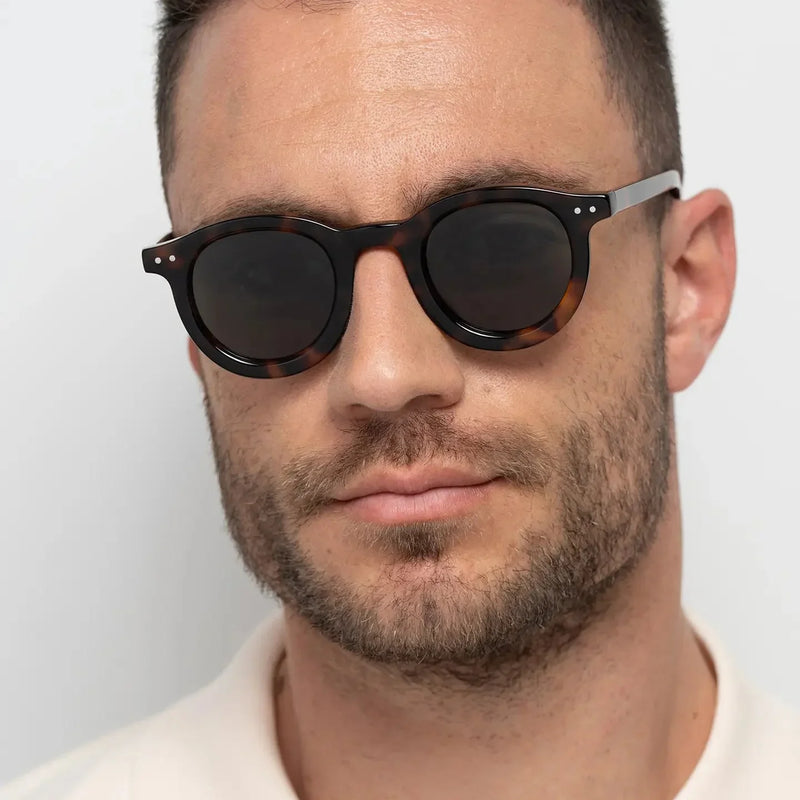
The geometry remains panto, but tortoise acetate and a lighter blue lens change the frame's contrast, depth and overall visual character.
This leads to a useful buying principle: choose the geometry first, then decide how loudly you want that geometry to speak.
9. How should panto sunglasses sit around the brow?
The relationship between a panto frame and your eyebrows can change whether the sunglasses feel integrated with your face or visually disconnected from it.
Because the lower lens carries substantial curve, the upper portion of the frame becomes particularly important. It provides structure close to the brow and helps prevent the sunglasses from reading as an isolated circle floating lower on the face.
There is no universal rule requiring the frame to reproduce the exact eyebrow line. Facial anatomy, bridge fit, lens depth and personal preference all matter. What you are looking for is a relationship that feels intentional rather than accidental.
If the frame sits very low, the distance between brow and upper rim can become visually dominant. If it sits too high, the sunglasses may interfere with the brow rather than working with it.
10. Narr vs Triboulet: two interpretations of panto geometry
Within Bo Bo Noir, Narr and Triboulet are two interpretations of panto sunglasses. Looking at them together demonstrates the central point of this guide: belonging to the same shape family does not make two frames visually interchangeable.
Narr uses a directional panto silhouette, while Triboulet develops the idea through an extra-bold panto-round silhouette with more sculptural volume. The difference is therefore not simply about colour. It is about how proportion and material presence change the same broad geometry.
Decision variable
Narr
Triboulet
Shape family
Directional panto silhouette
Extra-bold panto-round silhouette
Proportion
49–24–145
Read through its more pronounced sculptural volume and overall frame presence
Material expression
Panto geometry remains directional while acetate colour can add another layer of identity
Material volume plays a more explicit role in the frame's visual character
Visual effect
A defined panto interpretation with visible character
A more sculptural interpretation in which acetate volume becomes a stronger part of the silhouette
Consider it if
You want directional panto geometry with a clear identity
You want panto geometry to play a more pronounced structural role on the face
Trade-off
If you want a more exaggerated sense of acetate volume, another panto interpretation may suit that direction better
If you want less material presence around the eyes, a less sculptural interpretation may be preferable
Narr: a directional panto silhouette
Narr shows how a directional panto silhouette can carry visible identity through both geometry and acetate treatment.
Narr uses a directional panto silhouette in a 49–24–145 proportion. Its identity begins with the geometry rather than with colour alone: the panto curve provides the shape language, while different acetate treatments can alter how strongly that geometry is perceived.
Consider Narr if: you want a directional panto frame with visible character and a choice of acetate expressions.
Consider another direction if: you want the panto idea expressed through more pronounced sculptural volume.
Triboulet: extra-bold panto with sculptural volume
Triboulet makes material volume a more pronounced part of the panto silhouette, giving the curved geometry a stronger sculptural presence.
Triboulet takes panto geometry in a more sculptural direction. Its extra-bold panto-round silhouette gives material volume a stronger role in the overall impression, so the acetate does not simply surround the lens — it becomes part of how the shape is read on the face.
Consider Triboulet if: you want panto geometry with more pronounced acetate volume and a stronger structural presence around the eyes.
Consider another direction if: your priority is less material presence or a distinctly angular silhouette.
BBN Insight: do not choose between panto frames by shape name alone
If two sunglasses are both described as panto, the useful comparison begins after the label. Compare their actual proportions, material volume, colour, lens treatment and relationship with your face. Shared geometry does not mean shared visual weight.
11. How should you choose panto sunglasses?
Once you understand the shape, choosing panto sunglasses becomes a sequence of smaller decisions rather than a question of whether panto is universally flattering.
Geometry: decide whether rounded panto lines create the type of contrast or harmony you want.
Proportion: examine frame width and lens depth rather than focusing on shape alone.
Brow Relationship: look at how the upper frame sits in relation to your eyebrows.
Visual Weight: decide how much definition you want from acetate thickness, opacity and colour.
Fit: make sure the bridge, width and overall position work physically as well as visually.
Identity: ask whether the finished effect feels like something you will genuinely want to wear repeatedly.
This framework is more useful than matching one frame shape to one face-shape label because it separates the variables that actually change the result.
For example, if you like panto geometry but the first pair you try feels too dominant, the problem may not be panto. The frame may simply be too wide, too opaque or too visually heavy for the effect you want.
Likewise, if a panto feels too soft, moving toward darker acetate or greater material presence can add definition without abandoning the rounded geometry.
Physical fit remains separate from visual preference. Bridge position, frame width and how the sunglasses sit on the face all affect whether the proportions work in practice. For more detail, see how sunglasses should fit your face.
The best choice is therefore not “the panto that suits your face shape”. It is the combination of panto geometry, proportion and visual weight that produces the balance you want to repeat.
12. Frequently asked questions about panto sunglasses
What does panto mean in glasses?
Panto describes a rounded eyewear shape family in which the curved lens geometry works with a more structured upper frame relationship. It should not be understood simply as another word for every circular frame.
Are panto glasses round?
Panto frames belong broadly to rounded eyewear, but they are not necessarily perfect circles. Their character often comes from the relationship between a rounded lower lens and a more controlled upper portion of the frame.
Who suits panto sunglasses?
Panto sunglasses can work across many facial structures. They are particularly worth exploring if you want to introduce curve against angular features, repeat softer facial lines or find a middle ground between strongly rectangular and perfectly circular sunglasses.
Are panto sunglasses good for angular faces?
They can be. Rounded panto geometry can introduce visual contrast against a more angular jaw, brow or cheek structure. The final result still depends on frame width, scale, brow position and visual weight.
Can panto sunglasses work on round faces?
Yes. A rounded face does not automatically rule out rounded sunglasses. A panto frame can create definition through its upper structure, material thickness, colour and width even when its lens geometry contains curves.
Do thick panto frames look different from lighter panto frames?
Yes. Greater material volume makes the frame boundary more visible and generally increases perceived visual weight. This can make rounded panto geometry feel more defined and sculptural.
Where should panto sunglasses sit relative to the eyebrows?
There is no single correct eyebrow position for every wearer. The upper frame should create an intentional relationship with the brow while also fitting correctly at the bridge and sitting at an appropriate height for your facial anatomy.
Are panto sunglasses timeless?
Panto is an established eyewear geometry rather than a shape that depends on one current trend. Individual proportions, colours and styling can still feel more or less trend-driven, so longevity depends on the complete frame rather than the panto label alone.
What is the difference between panto and round sunglasses?
Both belong to rounded eyewear, but a simple round frame makes circularity the dominant geometry. Panto usually combines a rounded lower lens with a more structured relationship through the upper frame, creating a different interaction with the brow and facial proportions.
How do I choose between different panto frames?
Compare the actual frame rather than the shape name. Look at width, lens depth, brow relationship, acetate thickness, opacity, colour, lenses and fit, then choose the combination that creates the level of presence you want.
Final thoughts
Panto sunglasses are more useful to understand as a system of proportions than as another name for round glasses.
Their rounded lower geometry can introduce softness, but the upper frame, width, acetate volume, colour and lenses determine how much structure and visual weight remain. This is why one panto can feel relatively balanced while another feels much more sculptural and assertive.
Rather than relying on a rigid face-shape rule, use the sequence Geometry → Proportion → Brow Relationship → Visual Weight → Fit → Identity. It identifies the variables that actually change how the sunglasses interact with your face.
Panto tells you the family. The right frame is the interpretation of that geometry that creates the balance, presence and identity you actually want to wear.
Explore Bo Bo Noir panto sunglasses
Discover Narr and Triboulet — two interpretations of panto geometry shaped through proportion, acetate and different levels of material presence.
Enjoy a 10% discount on your purchase! Sign up for our newsletter now.Enjoy a 10% discount on your purchase! Sign up for our newsletter now.Enjoy a 10% discount on your purchase! Sign up for our newsletter now.Enjoy a 10% discount on your purchase! Sign up for our newsletter now.Enjoy a 10% discount on your purchase! Sign up for our newsletter now.Enjoy a 10% discount on your purchase! Sign up for our newsletter now.Enjoy a 10% discount on your purchase! Sign up for our newsletter now.Enjoy a 10% discount on your purchase! Sign up for our newsletter now.Enjoy a 10% discount on your purchase! Sign up for our newsletter now.Enjoy a 10% discount on your purchase! Sign up for our newsletter now.Enjoy a 10% discount on your purchase! Sign up for our newsletter now.Enjoy a 10% discount on your purchase! Sign up for our newsletter now.Enjoy a 10% discount on your purchase! Sign up for our newsletter now.Enjoy a 10% discount on your purchase! Sign up for our newsletter now.Enjoy a 10% discount on your purchase! Sign up for our newsletter now.