Choosing sunglasses can become confusing when a frame feels comfortable but still looks visually wrong.
The bridge may sit securely, the temples may create no pressure and the lenses may cover the eyes correctly. Yet the sunglasses can still make the face appear broader, narrower, longer or less balanced than expected.
Frame width changes facial proportions because it introduces a new horizontal boundary across the upper face.
The outer edges of the sunglasses become reference points that the eye compares with the forehead, temples, cheekbones and jaw. When those relationships feel coherent, the frame appears naturally connected to the wearer. When they do not, even an attractive silhouette can feel too small, excessively wide or visually disconnected.
This is why choosing sunglasses requires more than identifying whether your face is round, oval, square, long or heart-shaped.
Overall frame width must be considered alongside lens height, bridge placement, acetate thickness, frame colour and outer-corner geometry.
This guide explains how frame width changes facial proportions, why physical width and perceived width are not always the same and how to recognise sunglasses that create balance without overwhelming your features.
For a broader introduction to eyewear sizing, begin with What Size Sunglasses Should I Choose?

QUICK ANSWER: HOW DOES FRAME WIDTH CHANGE FACIAL PROPORTIONS?
Frame width changes facial proportions by controlling how far the visual line of the sunglasses extends across the upper face. A frame that aligns closely with the temples generally creates balanced proportions. A frame that is too narrow can make the uncovered sides of the face appear broader, while an excessively wide frame can make the eyes appear closer together and cause the sunglasses to feel separate from the face.
The correct width depends on more than face shape. Lens height, bridge position, frame thickness, colour and outer-corner geometry all influence how wide the sunglasses appear once worn.
Most people evaluate frame width by asking whether the sunglasses cover enough of the face.
A more useful question is whether the outer edges create a coherent relationship with the temples, cheekbones and eyes.
Balanced width does not simply make the face look wider or narrower. It makes the complete facial composition feel intentional.
WHY DOES FRAME WIDTH CHANGE HOW YOUR FACE LOOKS?
The face is not perceived as a collection of separate features.
The eye continuously compares the distances between the forehead, eyebrows, eyes, nose, cheekbones, mouth and jaw.
When sunglasses are added, the frame introduces a strong new structure across the centre of this system.
The outer edges establish where the eyewear begins and ends. The bridge controls the visible space between the lenses. The upper rim creates a relationship with the eyebrows, while the lower rim interacts with the cheeks.
Frame width therefore changes the visual organisation of the upper face.
A balanced frame creates enough horizontal presence to support the natural width of the face without becoming visually separate from it.
A narrow frame concentrates attention around the eyes and nose. This leaves more of the temples and cheek area exposed, which can make those areas appear proportionally broader.
A very wide frame pulls attention towards the outer corners. This can create stronger horizontal balance, but it may also reduce the apparent spacing of the eyes when the lenses extend too far beyond the face.
The frame is not physically changing the facial structure.
It is changing the visual references used to interpret that structure.
This is one reason sunglasses can have such a noticeable effect on appearance. They create new lines around the most expressive and visually important area of the face.
To understand the wider relationship between eyewear and facial structure, read How Sunglasses Change Facial Balance.
WHAT IS THE DIFFERENCE BETWEEN PHYSICAL WIDTH AND PERCEIVED WIDTH?
Frame width can be understood in two different ways.
Physical width is the measurable distance across the front of the sunglasses.
Perceived width is how broad the frame appears after colour, thickness, lens shape, outer corners and visual contrast are considered.
Two sunglasses can have almost identical measurements and still look noticeably different on the same face.
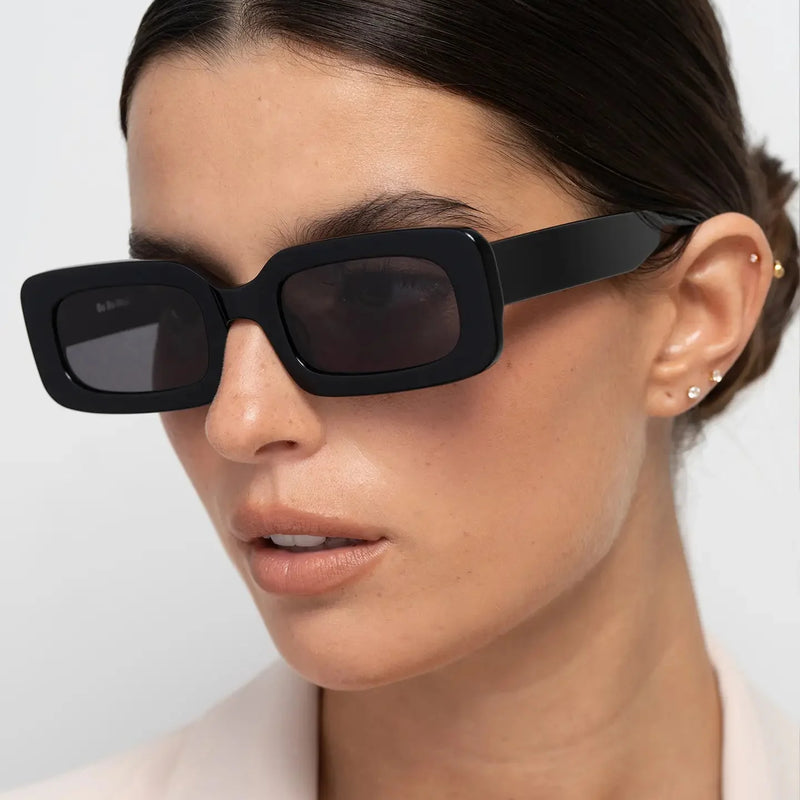
A thick shiny black rectangular frame creates a clear, high-contrast boundary around the eyes. Its outer corners remain visible from a distance, making the silhouette feel broad, structured and defined.
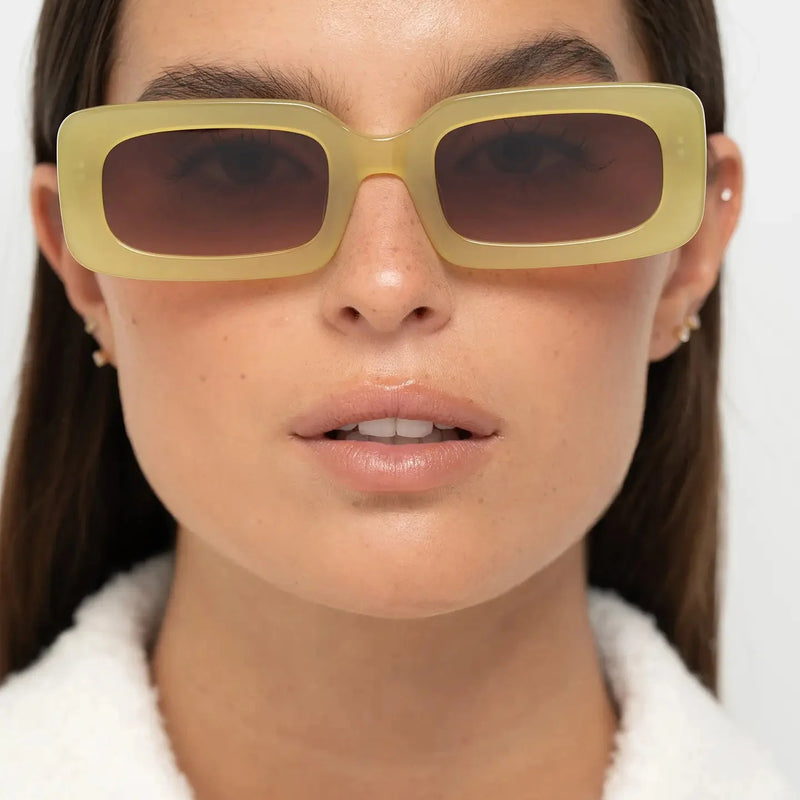
A cream, crystal or translucent frame allows more of the skin tone to remain visible around or through the acetate. The outline becomes less dominant, so the same physical width can appear lighter and less expansive.
Thin metal frames create another effect. Because the rims occupy less visual space, the eye continues beyond them more easily. The sunglasses may therefore appear smaller even when their total width is similar to a substantial acetate frame.
Physical width
The measurable distance from one outer edge of the frame front to the other.
Perceived width
The visual impression created by colour, rim thickness, lens shape, outer-corner geometry and contrast with the face.
A successful fit requires physical scale and visual weight to work together.
This distinction explains why selecting sunglasses from measurements alone can be misleading.
Measurements establish scale, but they do not explain how strongly the frame will appear once it is placed against the face.

HOW DO WIDE FRAMES CHANGE FACIAL PROPORTIONS?
Wide frames increase horizontal emphasis across the upper face.
This can be useful when the face has stronger vertical proportions or when the wearer wants the sunglasses to create a clearer and more defined silhouette.
On a longer face, a wider frame encourages the eye to move sideways. This can reduce the visual dominance of facial length and create greater balance between the upper, middle and lower sections of the face.
On a narrow face, moderate additional width can create useful presence around the eyes. However, the outer edges should still maintain a visible relationship with the temple line.
Width becomes flattering when it expands the silhouette without separating it from the face.
A wider frame may become less effective when its outer edges extend considerably beyond the temples.
In this situation, the eyes may appear crowded towards the inner parts of the lenses, while the outer sections contain too much empty visual space.
The frame then becomes the dominant object rather than supporting the facial proportions beneath it.
This does not mean oversized sunglasses should be avoided.
Oversized frames intentionally increase scale. The important distinction is that a well-considered oversized design preserves the relationship between overall width, lens height, bridge position and facial structure.
A frame can therefore be generous in size without appearing incorrectly fitted.
Oversized and too wide are not the same.
An oversized frame increases scale while maintaining a coherent relationship with the eyes, bridge, eyebrows and temples.
A frame becomes too wide when its outer proportions no longer support the facial structure beneath it.
HOW DO NARROW FRAMES CHANGE FACIAL PROPORTIONS?
Narrow frames shorten the horizontal line surrounding the eyes.
This concentrates visual attention towards the centre of the face.
On smaller or narrower facial proportions, a controlled narrow frame can create an understated and refined result, particularly when its outer edges remain close to the temples.
On broader faces, however, narrow sunglasses can produce the opposite effect from what the wearer expects.
Many people select smaller frames because they believe these will make the face appear narrower.
In practice, a frame that ends well inside the temples can make the exposed sides of the face appear more prominent.
The contrast between the compact frame and the broader temple or cheek area increases the perceived width of the face.
Narrow frames can also change the apparent spacing of the eyes.
When the lenses and bridge concentrate too much visual weight around the centre, the upper face may feel compressed, particularly when the acetate is dark or substantial.
The physical fit often reveals the same proportional problem.
If the temples angle sharply outwards immediately after the hinges, the frame front is probably too narrow. Pressure at the sides of the head, instability and repeated adjustment are additional warning signs.
A compact silhouette should remain comfortable and visually balanced.
Narrowness is a design direction, not a reason to accept poor fit.
WHERE SHOULD THE OUTER EDGES OF SUNGLASSES SIT?
The outer edges of the sunglasses provide one of the clearest reference points when evaluating frame width.
For a naturally balanced fit, they should usually align closely with the widest area of the upper face or extend only slightly beyond the temples.
This does not require exact mathematical alignment.
Different shapes create different visual directions.
A rectangular frame may extend slightly further because its outer corners emphasise horizontal structure. A rounded or panto frame can appear more contained because its curves return attention towards the centre of the lenses.
The objective is visual continuity rather than exact measurement.
Evaluate the frame from the front rather than relying only on side angles or close-up photographs.
Observe whether the outer corners appear connected to the face or whether they float noticeably beyond it.
Then examine the temples.
They should move backwards in a relatively natural line. A small outward angle may be normal, but a pronounced flare suggests that the frame front is too narrow for the wearer.
Finally, check the position of the eyes inside the lenses.
The pupils do not need to sit exactly in the geometric centre. However, they should not appear crowded against the inner lens edges or isolated inside lenses that extend excessively towards the temples.
Balanced width
The outer edges relate naturally to the temples, the eyes sit comfortably within the lenses and the arms extend without obvious pressure.
Too narrow
The frame finishes well inside the temple line, the arms flare outwards or the uncovered sides of the face appear disproportionately broad.
Too wide
The frame extends significantly beyond the temples, the eyes appear too close to the inner lens areas or the sunglasses repeatedly slip because they lack lateral support.

WHY DO RECTANGULAR FRAMES OFTEN APPEAR WIDER?
Rectangular frames naturally direct the eye from side to side.
Their straighter upper and lower lines reinforce horizontal movement, while defined outer corners make the full width of the silhouette easier to recognise.
This means a rectangular frame can appear wider than a round or panto frame with similar physical measurements.
Rounded frames behave differently.
The curved outer edges turn attention back towards the centre of the lenses. The silhouette feels more contained, which can reduce the perception of width even when the overall dimensions remain similar.
Frame geometry determines the direction in which the eye travels.
Rectangular sunglasses can therefore create useful horizontal definition on longer or narrower facial proportions.
They may also add structure to softer facial contours by introducing clearer corners around the eye area.
However, rectangular geometry can feel too dominant when excessive width, thick dark acetate and shallow lenses are combined within the same frame.
In that situation, the wearer may benefit from softer colour, controlled width or a rounder silhouette rather than simply choosing a smaller size.
For a wider comparison of these geometries, read Round vs Rectangular Sunglasses.
HOW DOES LENS HEIGHT CHANGE THE EFFECT OF FRAME WIDTH?
Frame width does not work independently from lens height.
Together, these dimensions create the overall silhouette of the sunglasses and determine whether the frame appears compact, elongated, oversized or balanced.
A wide frame with shallow lenses directs attention strongly from side to side.
This creates a more architectural and controlled appearance because the horizontal dimension is visibly stronger than the vertical one.
A wide frame with deeper lenses creates a larger visual field across the face.
Rather than simply extending towards the temples, it also occupies more space between the eyebrows and cheeks.
The width-to-height relationship determines whether a frame feels horizontally refined or broadly oversized.
This distinction is particularly important for longer facial proportions.
A moderately wide frame with sufficient lens height can organise the middle of the face and reduce the dominance of facial length.
However, a very shallow frame may introduce horizontal definition without occupying enough vertical space to create complete balance.
On shorter or smaller faces, excessive lens height can become more important than width.
The frame may align correctly with the temples but still cover too much of the cheeks or sit too close to the eyebrows.
Wide frame with shallow lenses
Creates strong horizontal direction and a cleaner, more architectural silhouette.
Wide frame with medium-depth lenses
Creates balanced scale and often works well for longer facial proportions.
Wide frame with deep lenses
Creates greater coverage and stronger oversized presence.
Narrow frame with deep lenses
Can feel vertically dominant and visually compact at the same time.
The correct combination depends on the effect you want the frame to create.
A person seeking understated horizontal definition may prefer a medium-width rectangular frame with restrained lens depth.
A person seeking stronger coverage may prefer generous width combined with deeper lenses, provided the bridge and outer edges still relate naturally to the face.
For a broader explanation of overall sizing, read What Size Sunglasses Should I Choose?
WHY DOES BRIDGE WIDTH AFFECT HOW WIDE SUNGLASSES LOOK?
The bridge influences both physical fit and perceived facial proportion.
It controls the distance between the lenses and determines where the frame sits across the nose.
A narrower bridge brings the lenses visually closer together.
This concentrates attention towards the centre of the face and can make the outer sections of the frame appear broader by comparison.
A wider bridge creates more visible space between the lenses.
This can make the frame feel more open, although an excessively wide bridge may cause the sunglasses to sit too low or make the eyes appear too close to the inner lens edges.
Two frames with the same total width can create different facial proportions because their bridge spacing distributes that width differently.
Bridge position also changes the relationship between the upper rim and the eyebrows.
If the bridge causes the frame to sit too high, the upper rim may compress the visible space around the eyes.
If it sits too low, the frame can lose its relationship with the brow line and make the face appear less organised.
The strongest fit usually places the eyes comfortably within the lenses while allowing the upper rim to support, rather than compete with, the eyebrows.

Frame width is often discussed as though all of the width sits outside the lenses.
In reality, the bridge determines how that width is distributed across the centre of the face.
A well-positioned bridge can make a substantial frame feel coherent, while poor bridge spacing can make a moderate frame appear visually incorrect.
HOW DOES FRAME THICKNESS CHANGE PERCEIVED WIDTH?
Frame thickness increases the visibility of the silhouette.
A thick acetate rim creates a stronger boundary around the lenses and makes the outer dimensions easier to recognise from a distance.
A thinner frame exposes more of the face and allows the eye to move beyond the rim with less interruption.
This means a thick frame can appear wider than a thin frame even when both have similar physical measurements.
The effect is strongest when thick acetate is combined with dark colour and defined outer corners.
Black rectangular sunglasses create a particularly clear horizontal line because the colour, thickness and geometry all reinforce the same visual direction.
Transparent or lighter acetate reduces this effect.
The material may remain substantial, but lower contrast allows the silhouette to integrate more softly with the face.
This is why a wearer who likes bold acetate but feels overwhelmed by black may not need a narrower frame.
A softer colour can preserve the same physical width while reducing its perceived scale.
For a deeper explanation of acetate thickness and visual weight, read Why Do Thick Acetate Frames Look More Expensive?

DO DARK FRAMES LOOK WIDER THAN LIGHT OR TRANSPARENT FRAMES?
Dark frames usually appear wider because they create stronger contrast against the skin.
The outer edges remain clearly visible, allowing the eye to recognise the complete silhouette immediately.
Black acetate produces the strongest version of this effect.
It creates a continuous outline across the upper face and gives rectangular corners more definition.
Tortoise frames reduce the severity of the outline through colour variation.
They maintain visible structure but allow light and warm tones to interrupt the silhouette.
Olive, cream and crystal acetate soften the effect further.
These colours preserve physical scale while reducing the impression of one dense horizontal block across the eyes.
Colour therefore changes perceived width without changing the actual frame measurement.
Shiny black acetate
Creates maximum edge definition and makes the complete frame width highly visible.
Tortoise acetate
Maintains structure while introducing warmer variation and softer transitions.
Olive acetate
Creates visible definition with less severity than solid black.
Cream or crystal acetate
Reduces contrast and makes the same width appear lighter and less dominant.
This creates a useful decision principle.
When a frame feels too wide visually but fits correctly physically, try changing the colour before changing the size.
A lower-contrast version may create the balance you need without sacrificing comfort or temple alignment.
To explore contrast in greater depth, read How Frame Contrast Changes Your Appearance.
WHICH FRAME WIDTH WORKS FOR DIFFERENT FACE SHAPES?
Face shape can provide a useful starting point, but it should not be treated as a rigid sizing rule.
Two people with oval faces may need completely different frame widths because their temple width, feature scale, eye spacing and brow position are different.
Width should respond to actual facial proportions rather than to a category alone.
Longer facial proportions
Often benefit from moderate or generous width combined with enough lens height to organise the middle of the face. Very narrow, shallow frames may emphasise length.
Rounder facial proportions
Usually benefit from frames that align clearly with the temples and introduce controlled horizontal structure. Excessively narrow frames can make the cheeks appear broader.
Square facial proportions
Can carry strong width, although softer outer corners may prevent the frame from repeating too much angularity.
Oval facial proportions
Can often explore several widths. The primary consideration becomes whether the wearer wants subtle integration or stronger visual presence.
Heart-shaped facial proportions
Often work well with controlled width and outer edges that do not add unnecessary emphasis around the upper face.
Narrow facial proportions
Usually need careful width control. A frame can create useful horizontal balance, but excessive extension beyond the temples may make the eyes appear visually compressed.
Broader facial proportions
Generally require enough physical width to prevent temple pressure and avoid making the uncovered sides of the face appear disproportionately broad.
The strongest approach is to use face shape as context rather than as the final answer.
Check the outer edges, eye position, bridge fit and temple direction.
These relationships usually reveal more than a general face-shape label.
WHAT ARE THE MOST COMMON FRAME-WIDTH MISTAKES?
Most frame-width mistakes come from evaluating one variable in isolation.
A person may focus only on the printed measurements, the current trend or the general face-shape advice without considering how the complete frame behaves on the face.
- Choosing the widest frame simply because oversized sunglasses are fashionable.
- Selecting a narrow frame in the hope that it will make a broad face appear slimmer.
- Ignoring the way the temples flare outwards from the hinges.
- Assuming that two frames with the same measurement will look equally wide.
- Forgetting that thick black acetate increases perceived width.
- Ignoring lens height while evaluating overall scale.
- Choosing a bridge that places the eyes too close to the inner lens edges.
- Judging width only from angled photographs rather than from the front.
- Confusing an intentionally oversized silhouette with a poorly fitted frame.
- Reducing physical width when the real problem is excessive colour contrast.
- Choosing a physically comfortable frame that still looks visually disconnected.
- Following face-shape rules without considering temple width and feature scale.
The most reliable decisions come from changing one variable at a time.
If a frame feels too dominant, compare the same or similar width in tortoise, olive or cream.
If it feels too compact, increase width while preserving moderate lens height.
If it slips, examine bridge fit and temple support before assuming the complete frame is too wide.
WHICH BO BO NOIR FRAMES ILLUSTRATE DIFFERENT WIDTH EFFECTS?
Each Bo Bo Noir silhouette uses width, colour and geometry differently.
The objective is not to identify one universally superior frame.
It is to understand which visual effect supports your own facial proportions and the role you want the eyewear to play.

Jane Shiny Black
Creates the clearest horizontal definition through rectangular geometry, substantial acetate and high contrast.
Creates: strong outer-edge visibility and a precise upper-face structure.
Best for: wearers who want the frame to become an intentional part of their appearance.
Avoid if: you prefer low contrast or your facial proportions are easily overwhelmed by broad dark silhouettes.
Explore Bo Bo Noir sunglasses →
Jane Tortoise
Maintains the same rectangular direction while using warm colour variation to soften perceived width.
Creates: horizontal balance with less severity than solid black.
Best for: wearers who want visible structure with warmer integration.
Avoid if: you want the strongest possible graphic contrast.
Jane Cream White
Preserves the rectangular silhouette while reducing the density of the outer boundary.
Creates: lighter perceived width and a softer relationship with the skin.
Best for: wearers who like generous acetate but want less visual heaviness.
Avoid if: your priority is maximum facial definition.
Jane Olive Green
Creates a middle position between black and transparent acetate.
Creates: controlled definition with a more organic colour transition.
Best for: everyday wearers seeking structure without severe contrast.
Avoid if: you prefer either a completely neutral or highly graphic frame.
William Shiny Black
Uses round geometry to contain perceived width and return attention towards the centre of the lenses.
Creates: visible acetate presence with softer horizontal direction.
Best for: faces that benefit from curved geometry or need less rectangular emphasis.
Avoid if: you specifically want sharp outer corners and maximum side-to-side definition.
Triboulet Tortoise Gradient Brown
Combines a structured panto silhouette with warm acetate and gradient lenses.
Creates: balanced width with softer eye-area density.
Best for: wearers who want visible material character without one continuous dark block.
Avoid if: you prefer highly angular rectangular geometry.
Explore Triboulet Tortoise Gradient Brown →
William Crystal Peach
Uses transparent warm acetate to preserve physical scale while reducing perceived width.
Creates: a lighter, softer and more open relationship with the face.
Best for: wearers who want visible acetate form without strong contrast.
Avoid if: you need the frame to create maximum eye-area definition.
Explore William Crystal Peach →
These examples show why width cannot be separated from colour and geometry.
A rectangular black frame and a transparent round frame may have similar physical dimensions, yet they create very different facial proportions because the visual direction is not the same.
DECISION GUIDE: WHICH FRAME WIDTH SHOULD YOU CHOOSE?
Begin with the visual result and physical fit you need.
Do not begin with a general rule that wider is better, smaller is safer or oversized is more flattering.
If the frame presses at the temples…
Increase physical width. Do not rely on a softer colour to solve a structural fit problem.
If the frame fits but looks too dominant…
Keep a similar width and reduce contrast through tortoise, olive, cream or crystal acetate.
If your face appears broader beside the frame…
Choose a frame whose outer edges reach closer to the natural temple width.
If your eyes appear too close together…
Reduce excessive outer width or reconsider the bridge-to-lens distribution.
If your face appears long…
Choose enough width to create horizontal balance, then ensure the lenses have sufficient height.
If your face is narrow…
Use controlled width with clear geometry. Avoid outer edges that extend far beyond the temples.
If your features are delicate…
Choose moderate width or soften a larger silhouette with lighter acetate and medium-density lenses.
If you want stronger definition…
Choose rectangular geometry, visible outer corners and a darker frame colour.
If you want softer balance…
Choose rounder geometry, lower contrast and transparent or warm acetate.
If you want an oversized effect…
Increase width and lens height together while preserving bridge stability and coherent eye position.
If you want one versatile everyday frame…
Choose medium width, moderate lens height and a colour that provides definition without excessive contrast.
There is no universal ideal frame width.
The correct width is the one that creates the intended visual effect while remaining physically stable and connected to the face.
Compare sunglasses from three distances.
Check temple pressure and bridge fit closely, assess eye position at arm’s length and then step further away to judge the complete silhouette.
A balanced frame should remain coherent at every distance.
FREQUENTLY ASKED QUESTIONS
How should sunglasses width fit your face?
The outer edges should generally align closely with the widest area of the upper face or extend only slightly beyond the temples. The temples should move backwards without pronounced outward flaring, and the eyes should sit comfortably inside the lenses.
Do wider sunglasses make your face look thinner?
Not automatically. A correctly proportioned wider frame can create horizontal balance, but an excessively wide frame may overwhelm the face or make the eyes appear closer together.
Can narrow sunglasses make your face look wider?
Yes. When the frame finishes well inside the temples, the uncovered sides of the face can appear proportionally broader.
How do I know if sunglasses are too narrow?
Common signs include pressure at the temples, arms that flare sharply outwards, outer edges that finish well inside the face and a visually compressed eye area.
How do I know if sunglasses are too wide?
The frame may be too wide if it extends significantly beyond the temples, repeatedly slips, leaves excessive space outside the eyes or appears visually disconnected from the face.
Should the pupils sit in the centre of sunglasses lenses?
They do not need to sit in the exact geometric centre, but they should appear comfortably positioned and not crowded against the inner edges or isolated inside excessively wide lenses.
Does lens height matter as much as frame width?
Yes. Width controls horizontal direction, while lens height controls vertical coverage. The two dimensions must work together to create balanced scale.
Do rectangular sunglasses look wider than round sunglasses?
Usually, yes. Straight lines and defined outer corners make the full horizontal silhouette more visible, while round edges return attention towards the centre.
Do black sunglasses look wider?
Black frames usually appear wider because their high-contrast outer edges are easier to recognise against the face.
Do transparent sunglasses look smaller?
Transparent frames do not become physically smaller, but they often appear lighter and less dominant because more of the skin remains visually present through the material.
Can the bridge make sunglasses appear too wide?
Yes. Bridge width determines how the total frame width is distributed between the lenses and outer edges. Poor bridge spacing can make the eyes appear crowded or disconnected.
Are oversized sunglasses supposed to extend beyond the face?
They may extend slightly beyond the natural temple line, but the overall silhouette should still maintain coherent eye position, bridge support and temple stability.
What width is best for a long face?
Longer faces often benefit from moderate or generous width combined with sufficient lens height. Very narrow, shallow frames can emphasise vertical length.
What width is best for a round face?
A round face usually benefits from frames that align clearly with the temples and introduce controlled horizontal definition without becoming excessively wide.
What width is best for a narrow face?
Narrow faces generally need controlled width. The frame should add enough horizontal presence to create balance without extending far beyond the temples.
What width is best for a broad face?
Broad faces usually require enough physical width to prevent temple pressure and avoid leaving excessive uncovered space at the sides of the face.
Can thick frames make sunglasses look too wide?
Yes. Thick rims increase perceived width because they create stronger visual boundaries. A lighter or transparent colour can reduce that effect without changing the measurement.
Should I choose sunglasses by the numbers printed inside the temple?
The printed measurements are useful, but they do not describe total perceived width, frame thickness, colour contrast or outer-corner geometry. They should be used as a starting point rather than the complete decision.
Can a frame fit physically but still look wrong?
Yes. Physical comfort and visual proportion are related but not identical. A frame may feel secure while appearing too dominant, too compact or poorly distributed around the eyes.
Which Bo Bo Noir frame creates the strongest horizontal definition?
Jane Shiny Black creates particularly strong horizontal definition through rectangular geometry, substantial acetate and high contrast.
Which Bo Bo Noir frame creates a softer width effect?
Jane Cream White, William Crystal Peach and warm tortoise styles create softer perceived width because their colours reduce contrast and allow the frame to integrate more gently with the face.
FINAL THOUGHTS
Frame width changes facial proportions because it creates a new horizontal structure around the eyes.
The effect depends not only on how many millimetres the frame measures, but on how that width is distributed through the bridge, lenses, outer corners and temples.
Colour, acetate thickness and geometry then determine how strongly the silhouette is perceived.
A wide black rectangular frame can create clear definition and horizontal balance.
A similarly sized transparent or round frame can appear softer, lighter and more contained.
The strongest choice is the frame whose physical width, perceived width and facial relationship support the same visual intention.
Look beyond face-shape categories.
Examine temple alignment, eye position, bridge fit, lens height and the strength of the outer boundary.
When these elements work together, the sunglasses feel integrated rather than imposed.
The result is not simply a frame that fits.
It is a frame that gives the face clearer proportion, stronger balance and greater visual coherence.
YOU MAY ALSO LIKE
Frame width is one part of a larger system involving thickness, contrast, geometry and facial structure. These guides continue the decision journey.
Why Do Thick Acetate Frames Look More Expensive?
Understand how material depth, edge control and visual weight influence the appearance of acetate eyewear.
Read the article →
What Size Sunglasses Should I Choose?
Learn how frame measurements, bridge fit and temple alignment work together.
Read the article →
How Sunglasses Change Facial Balance
Explore how frame shape, colour and visual direction change the way facial features are perceived.
Read the article →
Thin vs Thick Frame Sunglasses
Compare visual weight, facial definition and everyday wearability across different frame profiles.
Read the article →
Why Dark Frames Create Stronger Facial Definition
Discover how colour contrast and edge visibility organise the eye area.
Read the article →
Why Transparent Frames Create Softer Facial Balance
Learn why lower-contrast acetate reduces visual weight without removing structure.
Read the article →
Explore the Bo Bo Noir Sunglasses Collection
Compare acetate silhouettes through width, geometry, colour and visual balance.
Explore the collection →