Livraison gratuite dans le monde • Retours sous 14 jours • Conçu au PortugalLivraison gratuite dans le monde • Retours sous 14 jours • Conçu au PortugalLivraison gratuite dans le monde • Retours sous 14 jours • Conçu au PortugalLivraison gratuite dans le monde • Retours sous 14 jours • Conçu au PortugalLivraison gratuite dans le monde • Retours sous 14 jours • Conçu au PortugalLivraison gratuite dans le monde • Retours sous 14 jours • Conçu au PortugalLivraison gratuite dans le monde • Retours sous 14 jours • Conçu au PortugalLivraison gratuite dans le monde • Retours sous 14 jours • Conçu au PortugalLivraison gratuite dans le monde • Retours sous 14 jours • Conçu au PortugalLivraison gratuite dans le monde • Retours sous 14 jours • Conçu au PortugalLivraison gratuite dans le monde • Retours sous 14 jours • Conçu au PortugalLivraison gratuite dans le monde • Retours sous 14 jours • Conçu au PortugalLivraison gratuite dans le monde • Retours sous 14 jours • Conçu au PortugalLivraison gratuite dans le monde • Retours sous 14 jours • Conçu au PortugalLivraison gratuite dans le monde • Retours sous 14 jours • Conçu au Portugal
Most people who own several pairs of sunglasses still reach for one more often than the others.
It is the pair that leaves the house without much thought. The pair that gets packed first for a weekend away, stays within reach in the car and works with clothes that were never chosen around the eyewear.
That preference is easy to describe as personal taste, but taste alone does not explain why some sunglasses become your favourite pair.
A favourite pair usually succeeds across several dimensions at the same time. The width works with the face. The bridge stays stable. Pressure remains comfortable. The colour creates the right amount of definition. The frame has character without requiring every outfit to accommodate it.
Over time, those small successes remove friction from the decision to wear it.
This is why favourite sunglasses are not necessarily the newest pair, the most expensive pair or even the frame that created the strongest first impression. They are more often the sunglasses that continue to make sense after novelty disappears.
Favourite sunglasses usually prove themselves away from the mirror. The real test is whether the frame continues to feel natural during ordinary days, repeated outfits and longer periods of wear.
Why do some sunglasses become your favourite pair?
Sunglasses become favourites when fit, comfort, visual balance, versatility and personal style reinforce one another. A frame that sits securely, distributes pressure comfortably and creates proportions you like removes physical and visual friction every time it is worn.
The best everyday pair also works naturally with a meaningful part of your wardrobe. It does not need to be neutral, but its colour, geometry and visual weight should feel easy to repeat.
Avoid judging only by the first impression. Favourite sunglasses usually reveal themselves through repeated wear: the pair becomes easier to choose because it continues to feel right.
BBN insight
A favourite pair is not simply the sunglasses you like most. It is the pair that asks the least from you. When fit, visual balance and wardrobe compatibility are already resolved, choosing the frame stops feeling like a decision.
What makes a favourite pair different from a good pair?
A good pair of sunglasses can satisfy the obvious requirements.
The lenses provide the protection you need. The frame feels well made. The shape is flattering. The colour is attractive.
But none of those qualities guarantees frequent wear.
A favourite pair goes further because those qualities work together in everyday conditions.
The distinction is important. Sunglasses are not experienced as a list of specifications. They are experienced as one object sitting across the bridge, surrounding the eyes and changing how the face is perceived.
If the width is right but the bridge constantly slips, the frame creates friction. If the fit is comfortable but the colour only works with a small part of the wardrobe, it creates another kind of friction. If the frame is visually striking but feels unlike the person wearing it, the novelty may disappear quickly.
A favourite pair removes enough of these small compromises that wearing it becomes almost automatic.
This also helps explain why some sunglasses suit you better than others. Suitability rarely comes from one facial rule. It emerges from the relationship between frame geometry, proportions, contrast and the wearer.
Why repeat wear matters more than first impressions
The first few minutes with a new frame are dominated by appearance.
You notice the colour, silhouette and how different the sunglasses make you look. This is useful, but it tells you relatively little about whether the frame will become an everyday favourite.
Repeat wear introduces a more demanding test.
After an hour, you notice pressure. After several outfits, you discover whether the colour is genuinely versatile. After seeing the frame in photographs and from different angles, you learn whether its visual presence still feels natural.
This is where a frame moves from attraction to usefulness.
A pair that survives this transition has a much stronger chance of becoming a favourite because the initial appeal is being supported by real-world performance.
This is also why a frame that feels immediately impressive can receive less wear than a quieter alternative. Strong first impressions and long-term compatibility are related, but they are not the same thing.
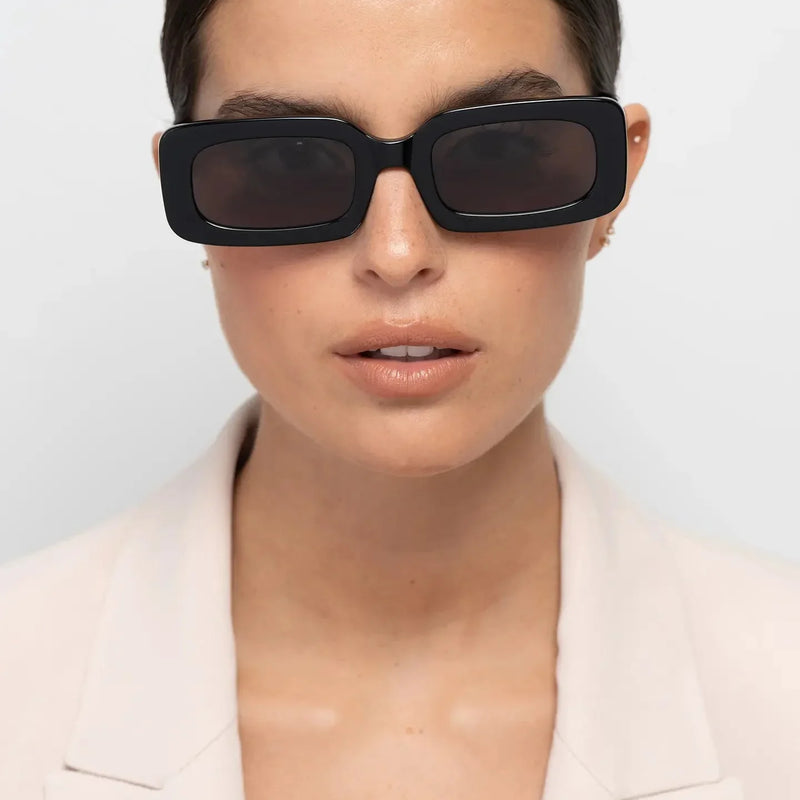
A frame can be visually distinctive without becoming difficult to repeat. Tortoise softens the continuous outline of a structured rectangle, creating definition with less contrast than solid black.
The five-part favourite-pair framework
Instead of asking whether sunglasses simply “look good”, it is more useful to judge five connected qualities.
Factor
What to look for
Why it matters
Fit
Stable bridge, appropriate width and temples that hold without excessive pressure.
Poor fit creates physical friction every time the frame is worn.
Comfort
Pressure remains evenly distributed during longer wear.
A visually successful frame will still be avoided if it becomes distracting.
Visual balance
Width, brow line, lens height and frame weight work with facial proportions.
The frame feels intentional rather than simply placed on the face.
Compatibility
Colour and silhouette work with clothes you already wear regularly.
Greater wardrobe compatibility creates more opportunities for repeat wear.
Personal style
The frame has enough character to feel recognisable without feeling like a costume.
The strongest favourites reinforce identity rather than asking the wearer to perform one.
No single factor needs to be extreme.
In fact, favourite sunglasses often succeed because none of these areas creates a significant weakness. The frame does not need to be the lightest, boldest or most neutral. It needs the different qualities to cooperate.
Why fit removes friction from everyday wear
Fit is one of the strongest predictors of whether sunglasses will actually be worn frequently.
A frame that slides down the nose requires constant correction. One that is too narrow can create pressure at the temples. Excessive width can make the frame feel unstable even when the front looks attractive.
These are small problems, but favourite sunglasses are defined partly by the absence of small problems.
Frame width is particularly important because it affects both comfort and visual proportion. A suitable width allows the frame to sit naturally across the face without appearing compressed or unnecessarily extended.
Bridge position matters for the same reason. It determines where the frame rests, how high the lenses sit around the eyes and whether the sunglasses remain stable during movement.
The objective is not to make the frame disappear physically. It is to make its presence predictable.
Why visual balance builds confidence
Comfort determines whether sunglasses are physically easy to wear. Visual balance determines whether they remain psychologically easy to wear.
A balanced frame does not need to make the face look symmetrical or follow a rigid face-shape rule.
It needs to create a convincing relationship between the eyewear and the features around it.
Width affects how broad the upper face appears. Lens height changes how much space the frame occupies vertically. Brow-line direction can echo or counter the eyebrows. Acetate thickness determines how much visual weight is concentrated around the eyes.
Colour then changes the strength of all these effects.
This is why two frames with similar measurements can feel completely different. A polished black rectangle creates a stronger outline than a translucent frame of comparable size. A tortoise panto breaks up the outline through pattern, while crystal acetate allows more skin tone and light to remain visible through the frame.
If you want to understand that relationship in more detail, how frame contrast changes your appearance explains why the same face can read differently as frame contrast changes.
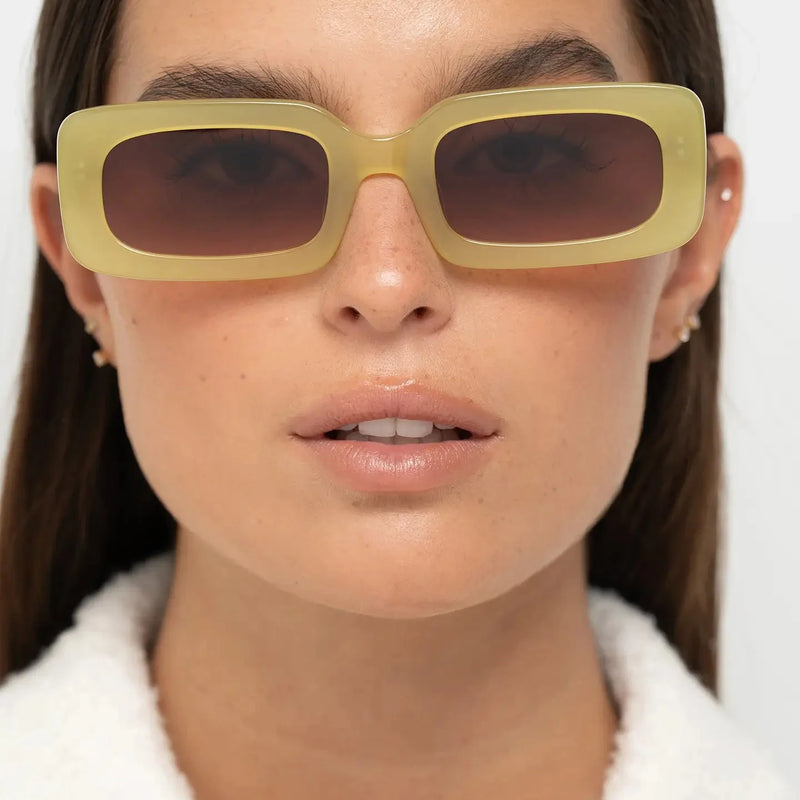
Visual weight is not determined by frame thickness alone. Translucent acetate can preserve substantial geometry while reducing the contrast between the frame and the face.
Why versatility means compatibility, not neutrality
Favourite sunglasses are often described as versatile, but versatility does not mean choosing the quietest possible frame.
It means choosing eyewear that works repeatedly with the wardrobe you actually own.
A polished black frame may be extremely versatile for someone whose clothing depends on monochrome contrast. Tortoise may integrate more naturally with cream, navy, camel, denim and brown. Olive can behave almost like a neutral in an earth-toned wardrobe, while burgundy can add colour without becoming difficult to repeat.
The right question is therefore not “Which sunglasses go with everything?”
It is “Which sunglasses go with most of what I actually wear?”
This distinction matters because a theoretically neutral frame can still receive little wear if its visual character feels disconnected from the person wearing it.
For a practical application of this idea, Best Everyday Sunglasses explains how shape, colour and repeatability work together when choosing one pair for frequent use.
What creates favourite-pair potential?
Fit removes the need for constant physical adjustment.
Comfort allows the frame to remain wearable beyond the first few minutes.
Visual balance makes the sunglasses feel coherent with the face.
Wardrobe compatibility creates more opportunities for repeat wear.
Personal style makes the frame feel recognisable without becoming performative.
Repeated positive experiences gradually turn confidence into familiarity.
Next: why comfort depends on pressure distribution, how material and finishing affect the ownership experience and why construction quality matters more the longer a frame is worn.
Why comfort depends on pressure distribution, not weight alone
People often describe uncomfortable sunglasses as “too heavy”.
Sometimes weight contributes to the problem, but total weight is only part of the experience.
Sunglasses are supported by a small number of contact areas, particularly the bridge, the sides of the head and the area around or behind the ears. How the frame distributes pressure across those areas can strongly influence how comfortable it feels during longer wear.
A relatively lightweight frame can become distracting if the bridge concentrates pressure in a small area or the temples grip too firmly. A more substantial acetate frame can feel comfortable when its proportions, bridge contact and temple pressure work well for the wearer.
This is why perceived weight and actual weight are not always the same thing.
Do not judge comfort only when you first put sunglasses on. A better test is whether the frame becomes less noticeable as you continue wearing it, rather than progressively demanding your attention.
Where should sunglasses feel comfortable?
Comfort is easier to evaluate when you stop asking whether the entire frame “feels good” and pay attention to the individual contact areas.
The bridge should support the frame without developing into an increasingly distracting pressure point.
The temples should provide enough stability to help keep the sunglasses in position without creating excessive inward pressure at the sides of the head.
The area around the ears should feel secure without becoming a persistent source of irritation.
The relationship between these areas varies from one person to another because facial proportions and fit requirements are individual.
The useful signal is what happens over time.
A strong everyday candidate should remain stable without making you repeatedly push it back into position, adjust the temples or remove it simply to relieve pressure.
The extended-wear test
A mirror tells you how a frame looks. Time tells you more about how it behaves.
Wear the sunglasses continuously instead of repeatedly taking them on and off.
Move your head normally and look down to see whether the frame remains stable.
Notice whether pressure becomes more apparent at the bridge or temples.
Pay attention to how often you instinctively reposition the frame.
Consider whether removing the sunglasses creates noticeable relief.
The objective is not to make the sunglasses physically disappear. It is to prevent a small source of discomfort from becoming increasingly difficult to ignore.
Why frame balance changes how substantial sunglasses feel
Physical weight tells only part of the story because sunglasses are not carried in the hand. They are supported across the face.
Where the frame’s mass sits therefore matters.
A substantial frame front needs to work coherently with the bridge and temples. If the front feels disproportionately dominant, the sunglasses may feel less stable during movement even when their overall weight is not unusually high.
The temples contribute to that stability and influence how the frame interacts with the sides of the head.
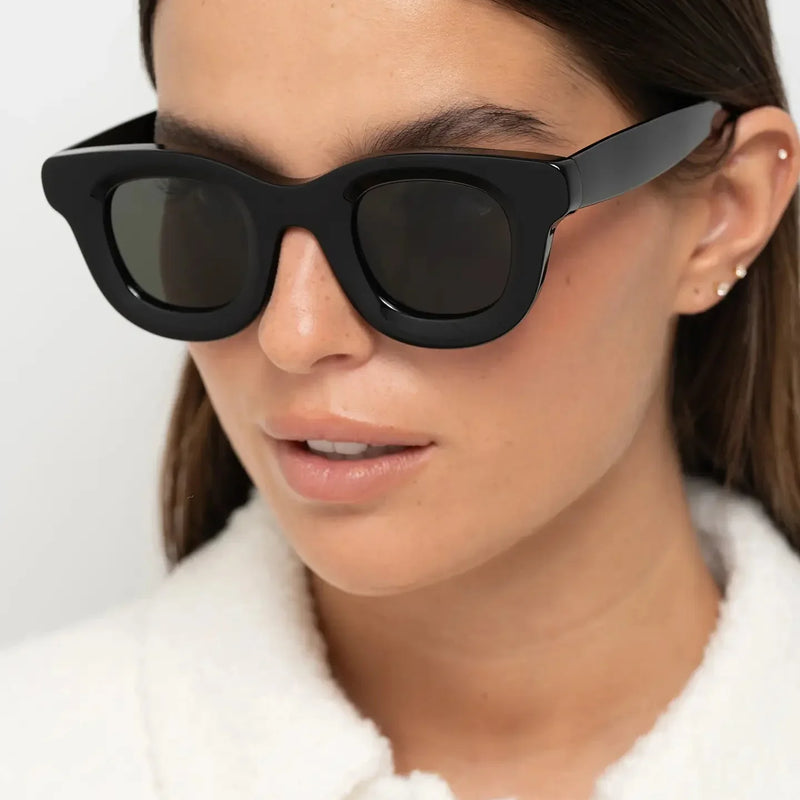
This makes the side profile more important than it may appear when judging sunglasses only from the front.
Temple proportions, hinge position and the transition between the frame front and arms all contribute to the physical and visual balance of the design.
It is another reason favourite sunglasses need to work from more than one angle. The side of the frame is not simply decorative; it forms part of the structure that influences repeated wear.
Why material and finishing build trust over time
Material can create an immediate impression of quality, but the longer-term experience depends on how the different elements of the frame work together.
This distinction matters for favourite sunglasses because the pair you wear most is also the pair you handle most.
You open and close the temples repeatedly. You touch the frame when putting it on or adjusting it. You clean the lenses, handle the edges and regularly move the sunglasses between your face and their case.
Details that may seem minor during the first encounter therefore have many opportunities to become noticeable.
Surface finishing, edge consistency, hinge behaviour and overall alignment can all contribute to whether the frame continues to feel resolved through repeated use.
Instead of relying on one visible feature, a convincing frame brings material, construction and finishing together.
This is one reason premium perception is rarely created by a single specification. What makes some sunglasses feel premium looks more closely at how material, finishing, balance and construction contribute to the overall experience.
Material, colour and geometry are experienced together. Translucent acetate can make a substantial silhouette appear visually softer by allowing more light and surrounding colour to interact with the frame.
Why acetate changes the experience of a frame
Acetate is often discussed primarily as a visual material because it can support rich colour, transparency, pattern and substantial frame geometry.
But its contribution to a favourite pair goes beyond colour alone.
Acetate can create visible depth through the rims and temples, particularly in thicker frame designs. Its appearance can also change according to lighting, angle and the particular colour treatment of the frame.
Transparent and patterned acetates make these differences especially noticeable.
Crystal finishes allow light and surrounding colour to influence how the frame appears. Tortoise introduces variation across the surface rather than creating one uninterrupted block of colour.
These characteristics can make acetate visually interesting beyond the initial purchase because the material is experienced from changing viewpoints rather than one fixed product image.
Coloured acetate can create character without relying on a highly saturated shade. Olive, for example, can remain visually distinctive while working naturally with many neutral wardrobe colours.
Why finishing becomes more noticeable with repeat wear
Some qualities of sunglasses are immediately visible. Others become more relevant because the wearer encounters them again and again.
Finishing belongs to the second category.
The surfaces, edges and transitions of a frame influence how coherent the object feels when viewed and handled at close range.
This becomes particularly relevant with substantial acetate, where the thickness of the material makes edges and surface transitions more visible.
Polishing can also influence the way light interacts with acetate, helping reveal colour, transparency and material depth.
Importantly, this does not mean that a frame needs to be made entirely by hand to achieve a refined result.
Modern eyewear production can combine precision manufacturing with human involvement at selected stages of finishing, adjustment, inspection or quality control. The relevant question for the wearer is the quality and consistency of the finished frame, not whether every production stage was performed manually.
Our Journal article on why hand polishing can make acetate frames look better examines one particular finishing technique and its visual effect on acetate; it should not be interpreted as meaning that every Bo Bo Noir frame, or every stage of Bo Bo Noir production, is completed by hand.
BBN insight
Quality should be judged by the finished object rather than by romanticising the production method. Precision processes and skilled human intervention can play different roles; what ultimately matters to the wearer is how consistently the frame is constructed, finished and experienced.
Why construction quality matters more in the pair you wear most
Favourite sunglasses naturally experience more use than occasional frames.
They are opened, folded, cleaned, carried and stored more frequently. They move between cases, pockets, bags and everyday environments.
That repetition makes construction quality particularly relevant.
Hinges need to perform consistently. The relationship between the frame front and temples should remain coherent. Alignment matters because even a visually attractive frame can become distracting if it no longer sits as expected.
This does not mean sunglasses will never need care or adjustment.
Eyewear is a wearable object. Regular use, handling and accidental pressure can affect fit over time.
The more useful buying question is whether the frame appears thoughtfully constructed in the areas that will experience repeated interaction.
Price can reflect material choices, manufacturing complexity, finishing, design development and other factors, but price alone cannot determine whether sunglasses will become your favourite pair.
An expensive frame can still be too narrow, too wide or visually disconnected from your style.
A beautiful colour can still spend most of its life in a case if it rarely works with what you wear.
For that reason, “premium” is more useful when understood as a combination of qualities rather than a price category.
A convincing frame brings material, construction, finishing, fit and visual design into the same experience.
The material looks considered. The surfaces and edges feel resolved. The frame sits predictably. Its proportions make sense on the face. Nothing obvious interrupts the experience every time it is worn.
That combination is more relevant to favourite-pair potential than price alone.
Why consistency creates trust in an everyday frame
Trust in a favourite pair develops through repetition.
You know where the sunglasses sit. You know how they feel after an hour. You know how they behave when you move. You know which clothes work with them.
Construction can contribute to that same sense of predictability.
When the temples behave consistently, the frame remains comfortable and the sunglasses continue to sit as expected, the wearer has fewer reasons to reconsider the choice.
This is a quiet form of product quality.
It does not necessarily produce the strongest first impression, but it becomes increasingly valuable the more often the frame is used.
That is particularly important for a favourite pair because familiarity should reduce decision friction, not reveal new sources of it.
Why the way sunglasses age affects long-term attachment
A favourite pair will eventually show evidence of use because it is being used.
That does not automatically reduce its value.
The more useful question is whether the frame retains its visual coherence as it moves from new object to familiar possession.
Material quality, finishing, construction and care all influence that experience.
Acetate can retain visual depth and polished character when it is looked after appropriately, while stable construction helps preserve the predictable fit that made the sunglasses comfortable in the first place.
Care remains important. Sunglasses should be stored in an appropriate case, cleaned with suitable materials and protected from unnecessary heat, impact and pressure.
But a frame intended for regular use should not depend on remaining untouched to continue looking considered.
The qualities that attract you to sunglasses are not always the same qualities that make you keep wearing them.
At first glance
After repeated wear
What you learn
Shape
Whether the silhouette remains easy to wear across different outfits and settings.
A strong shape only becomes useful when you continue wanting to wear it.
Colour
How naturally the colour repeats across your real wardrobe.
Compatibility matters more than theoretical neutrality.
Weight
Where pressure becomes noticeable during longer periods of wear.
Perceived comfort matters more than weight alone.
Material
How surfaces, edges and other details feel through repeated handling.
Material is experienced through use as well as appearance.
Premium impression
Whether the frame continues to feel coherent, stable and considered.
Long-term trust comes from consistency rather than price alone.
What comfort, material and construction add to a favourite pair
Comfort depends on pressure distribution as well as total frame weight.
Bridge contact, temple pressure and frame balance become clearer during longer wear.
Material matters because favourite sunglasses are seen and handled repeatedly.
Finishing influences how coherent the frame feels at close range.
Precision manufacturing can coexist with human involvement in selected finishing, adjustment, inspection or quality-control stages.
Bo Bo Noir sunglasses should not be described as entirely handmade unless a specific product or process explicitly supports that claim.
Construction quality becomes increasingly relevant as frequency of use increases.
Premium perception comes from multiple resolved details working together rather than price or a romanticised production claim.
Next: how colour becomes part of personal style, why familiarity reduces decision friction and how a frequently worn frame can eventually become part of your visual identity.
How colour becomes part of personal style
Colour is one of the first things people notice about a frame, but its real importance becomes clearer over time.
A colour that looks interesting once only becomes useful when it continues to work across different outfits, seasons and settings.
This is why favourite sunglasses are not always neutral in the strict sense. They are usually compatible with the wearer’s real wardrobe and preferred level of contrast.
Black can feel dependable because it creates strong definition and works easily with monochrome clothing. Tortoise can feel warmer and softer while remaining versatile. Olive can behave almost like a neutral, while burgundy introduces more individuality without becoming difficult to repeat.
Transparent acetate works differently again. It reduces the visual boundary between frame and face, allowing more skin tone and surrounding light to remain visible.
Over time, the successful colour becomes part of how the wearer expects to see themselves.
Burgundy adds visible character without forcing the wearer to build the whole outfit around the frame.
Why frame contrast affects how familiar you look to yourself
Favourite sunglasses often have a level of contrast that feels natural to the wearer.
High-contrast frames, especially polished black, create a strong outline around the eyes and make the eyewear more visually dominant.
Lower-contrast frames, including crystal, tortoise and some olive finishes, allow the face to remain more visually continuous.
Neither approach is inherently better.
The important question is which level of definition feels right when you see it repeatedly in mirrors, photographs and everyday situations.
Over time, that visual repetition can become part of self-recognition.
A wearer who becomes accustomed to strong black frames may feel under-defined in a transparent pair. Someone who prefers softer contrast may find the same black frame too severe even when the basic geometry suits them.
This is why favourite sunglasses are often linked not just to one shape, but to one preferred level of visual presence.
How familiarity turns a good frame into a personal object
Familiarity is one of the least visible reasons a pair becomes a favourite.
Once a frame has worked repeatedly, the wearer no longer needs to reconsider the decision from the beginning.
They already know how it looks with a coat, a T-shirt, a suit or a linen shirt. They know how it feels after several hours. They know how much facial definition it creates and whether the temples remain comfortable.
This knowledge reduces uncertainty.
That matters because getting dressed already involves many small decisions. A reliable pair of sunglasses removes one of them.
Familiarity can also make a distinctive frame easier to wear.
A silhouette that initially felt expressive may become psychologically quiet through repetition. The wearer stops seeing it as “the bold frame” and starts seeing it as simply their frame.
That is one reason favourite sunglasses can become recognisable to other people at the same time as they become less noticeable to the wearer.
BBN insight
A favourite frame often becomes less noticeable to the wearer at the same time as it becomes more recognisable to everyone else.
A strong silhouette can become an everyday signature when its effect feels familiar enough that the wearer no longer needs to reconsider it each time.
Why favourite sunglasses feel like identity rather than performance
Eyewear is unusually visible because it sits at the centre of the face.
That gives sunglasses a strong expressive role, but it also means a frame can feel uncomfortable when its visual message does not match the wearer.
A favourite pair usually avoids that problem.
It may be distinctive, colourful or bold, but it still feels connected to the wearer’s existing style.
The frame does not create the sensation of becoming somebody else. It reinforces something already present.
For one person, that may be the clarity of a black rectangle. For another, it may be the softer warmth of tortoise panto sunglasses or the transparency of a crystal round frame.
The important quality is coherence.
This is why personal style often matters more than rigid face-shape rules. A technically flattering frame will not become a favourite if the wearer feels disguised by it.
If you are deciding how much visual presence feels natural, minimal versus bold sunglasses provides a useful comparison.
Why memories strengthen attachment to a frame
Once sunglasses are worn often enough, they begin to collect associations.
They appear in holiday photographs. They accompany familiar routes through the city. They are worn during drives, lunches, weekends away and ordinary afternoons that later become part of memory.
This gives the object a value that cannot be explained by material, shape or colour alone.
The frame becomes connected to experience.
That does not mean every frequently used object becomes emotionally important. The practical qualities still need to work first.
But once fit, comfort and visual confidence are established, repeated use gives emotional meaning more room to develop.
This is why favourite sunglasses can become surprisingly difficult to replace even when another pair is technically newer or more fashionable.
The old pair is no longer being compared on specifications alone.
It is being compared against a history of successful wear.
Why trends matter less once a frame becomes yours
Trends can influence discovery.
They can introduce a new shape, colour or proportion that the wearer might not otherwise have considered.
But once a frame becomes integrated into personal style, the original trend context becomes less important.
A panto frame may have been purchased during a period when curved acetate was especially visible. A rectangle may have been chosen because directional silhouettes were returning. A crystal finish may first have attracted attention because transparent acetate was gaining momentum.
None of those reasons needs to remain relevant for the frame to keep working.
What matters is whether the design has moved from fashion reference to personal utility.
This is one of the clearest differences between a trend purchase and a favourite pair.
The trend purchase remains dependent on context. The favourite pair creates its own context.
A distinctive frame does not need to remain a statement forever. Repeated wear can turn expressive geometry into part of the wearer’s normal visual identity.
Why versatility is personal, not universal
There is no single frame that works with every wardrobe in the same way.
A black rectangular frame may be extremely versatile for someone who wears monochrome clothing. A tortoise panto may integrate more naturally with denim, cream, navy and brown. Burgundy may become an easy repeat colour for someone whose wardrobe already contains deeper warm neutrals.
This means versatility should be judged against the wearer’s real life rather than an abstract idea of neutrality.
The question is not “Which sunglasses go with everything?”
It is “Which sunglasses go with most of what I actually wear?”
This shift makes buying decisions more realistic and reduces the chance of choosing a supposedly safe frame that never feels personally right.
Why the same frame can feel different in another colour
Shape is only one part of a frame’s identity.
Change the colour and the relationship between the eyewear and the face can change significantly.
A black round frame has a stronger outline and clearer definition. The same shape in crystal peach feels lighter and more integrated. Tortoise introduces pattern, while crystal yellow adds visible warmth without creating the density of opaque acetate.
This is useful when a wearer likes the geometry of a frame but is unsure about its level of visual presence.
Instead of abandoning the shape, changing the colour can solve the problem.
The basic silhouette remains recognisable, but the visual and emotional effect changes with the finish.
The geometry remains closely related, but the visual result changes. Shiny black strengthens the outline; crystal peach preserves the shape while reducing contrast.
When a favourite pair becomes a signature
There is a point at which repeated wear becomes recognisable to other people.
The sunglasses begin to appear consistently in photographs, social situations and everyday routines.
At that stage, the frame may become part of how others identify the wearer.
A signature frame does not need to be visually extreme.
Its recognisability can come from consistency rather than novelty.
This makes a strong case for choosing eyewear with enough personality to remain identifiable but enough balance to avoid visual fatigue.
The best signature sunglasses are not necessarily the loudest.
They are the ones the wearer keeps choosing.
Why replacing a favourite pair can be difficult
Once a frame becomes deeply familiar, replacing it becomes more complicated than finding another pair with similar measurements.
The old sunglasses have already passed months or years of real-world testing.
The wearer knows their comfort, wardrobe compatibility, contrast and visual effect.
The new pair has not yet earned that trust.
This can make an objectively good replacement feel unfamiliar at first.
A more useful replacement strategy is to identify what made the original successful before searching for something new.
Was it the width? The bridge? The panto shape? The tortoise colour? The lower level of contrast? The fact that it worked with almost every coat and shirt?
Once those qualities are separated, the search becomes more rational.
This is also where how many pairs of sunglasses should you own becomes useful: additional frames are most valuable when they complement rather than simply duplicate the pair already doing most of the work.
What colour, familiarity and identity add to a favourite pair
Colour becomes valuable when it remains easy to repeat, not simply when it looks interesting once.
The right level of contrast can become part of how the wearer recognises themselves.
Familiarity reduces decision friction and makes distinctive eyewear easier to wear.
Emotional attachment usually develops after practical qualities such as fit and comfort have already succeeded.
A trend can introduce a frame, but repeated wear can turn it into personal style.
Versatility is individual and depends on the wardrobe the wearer actually owns.
A favourite pair can eventually become a signature through consistency rather than visual excess.
Next: how to choose sunglasses with favourite-pair potential, compare different Bo Bo Noir frame directions and make the final buying decision with less hesitation.
How to choose sunglasses with favourite-pair potential
You cannot know with certainty which sunglasses will become your favourite before living with them.
But you can improve the odds considerably.
The most useful approach is to stop asking which frame creates the strongest first impression and start asking which pair removes the greatest number of compromises.
A strong candidate should fit securely, remain comfortable during longer wear, create the level of facial definition you prefer and work naturally with a meaningful part of your existing wardrobe.
It should also have enough character to feel worth choosing repeatedly.
That creates a more useful buying process: fit first, comfort second, visual effect third, compatibility fourth and novelty last.
The seven-step favourite-pair test
1. Start with frame width
Before judging colour or style, check whether the width feels appropriate for your face.
A frame that is too narrow can create pressure at the temples and make the face appear broader than the eyewear. One that is excessively wide may slide, feel unstable or make the eyes appear unusually close to the inner lens area.
The front view is important, but it is not the whole frame.
Look at the side and three-quarter view as well. Pay attention to how the temples leave the frame front, how the brow line sits relative to the eyebrows and whether the proportions still feel coherent in profile.
4. Choose the amount of contrast you want to repeat
Black creates stronger definition. Tortoise breaks up the outline through pattern. Olive introduces quieter colour, while crystal acetate lowers the visual contrast between frame and face.
The best option is not the one that looks most dramatic for thirty seconds.
It is the level of contrast you are comfortable seeing repeatedly.
Would you still want the shape if it stopped appearing in trend coverage? Would the colour still work with the same wardrobe? Would its proportions still make sense on your face?
If the answer remains yes, the frame has a better chance of moving from a trend purchase to personal style.
The shortest version
Choose the pair that solves the most everyday problems while still giving you a visual reason to want to wear it.
Which frame direction is more likely to work for you?
If you want
Start with
Why
Consider another option if
Stronger facial definition
A darker rectangular frame
Horizontal geometry and opaque colour create a clearer outline.
You already find dark eyewear visually dominant.
Softer everyday structure
A tortoise or olive panto
Curved lower geometry and warmer colour reduce severity.
You specifically want a very graphic or angular effect.
Bold shape with lower contrast
A crystal acetate round frame
The silhouette remains visible while transparency reduces the hard boundary around the face.
Maximum definition is your main objective.
Colour without excessive brightness
Burgundy or olive acetate
Both introduce individuality while remaining relatively easy to repeat.
Your wardrobe depends almost entirely on stark monochrome contrast.
Which Bo Bo Noir frame fits each favourite-pair priority?
The following frames are not presented as universal winners.
Each illustrates a different combination of geometry, colour and visual weight, allowing you to begin with the effect you want rather than the product name.
Triboulet Olive — for soft structure and repeatable colour
Triboulet Olive combines panto geometry with an earth-toned acetate finish.
The rounded lower lens introduces softness, while the upper frame retains enough direction to keep the silhouette structured.
Olive creates visible colour without the same level of contrast as polished black, making it easier to integrate with wardrobes built around navy, black, cream, denim, brown and stone.
Creates: soft structure with controlled colour.
Consider it if: you want a frame with personality that can still behave like an everyday neutral.
Consider another direction if: you want maximum graphic definition or a distinctly rectangular silhouette.
Triboulet Olive combines a balanced panto silhouette with a colour that remains visible without becoming highly contrasting.
Jane Tortoise — for clearer structure with warmer contrast
Wearers who want expressive acetate without a dense dark outline.
You want stronger angular definition.
The point of the comparison is not to identify one “best” model. It is to match the frame’s visual effect with the effect you are most likely to want repeatedly.
BBN insight
The strongest product choice begins with the effect you want to repeat. Product comes after principle: geometry, contrast, fit and wardrobe compatibility should explain the recommendation before the frame name does.
What should you check before making the final decision?
Before buying, bring the entire decision back to a few practical signals.
Width: does the frame appear proportionate to your face?
Bridge: is the frame likely to sit at the height and position you prefer?
Temple relationship: do the arms appear to leave the frame naturally rather than flaring dramatically outward?
Visual weight: does the thickness and colour create the amount of presence you want?
Wardrobe compatibility: can you immediately think of several outfits you already own that work with the frame?
Material and finishing: do the surfaces, edges and construction appear coherent at close range?
Role: does the frame add something useful to what you already own?
If the objective is specifically one highly repeatable pair, Best Everyday Sunglasses continues the decision from a practical-use perspective.
Frequently asked questions
Why do I keep wearing the same pair of sunglasses?
You probably keep choosing the same pair because it removes several forms of friction at once. It fits predictably, remains comfortable, works with familiar clothing and creates a visual effect you already trust.
What makes sunglasses comfortable enough for everyday wear?
Everyday comfort depends on appropriate frame width, stable bridge contact and temple pressure that remains comfortable during longer wear. Total weight matters, but pressure distribution and fit can be equally important.
Can substantial acetate sunglasses still be comfortable?
Yes. A substantial acetate frame can remain comfortable when its proportions suit the wearer and pressure is not concentrated excessively at the bridge or temples. A lighter frame can still feel uncomfortable when the fit is wrong.
Why do some sunglasses feel better after wearing them several times?
Familiarity reduces uncertainty. You learn how the frame behaves, which clothes work with it and how its shape changes your appearance, making the decision to wear it easier.
Do favourite sunglasses need to be neutral?
No. They need to be compatible. Olive, burgundy, tortoise and crystal acetate can all become highly repeatable when their colour and visual weight fit naturally with the wearer’s wardrobe.
Are black sunglasses the easiest colour to wear?
Black is versatile but creates strong contrast. Some wearers find tortoise, olive or translucent acetate easier because these alternatives create softer definition while still working with many neutral colours.
Why are tortoise sunglasses easy to repeat?
Tortoise combines familiar warm tones with pattern. The pattern interrupts the continuous frame outline, often producing a softer effect than solid black without becoming as visually light as transparent acetate.
Can transparent sunglasses become an everyday pair?
Yes. Transparent and translucent frames can work particularly well when you like substantial geometry but prefer lower contrast around the eyes.
Does frame width affect whether sunglasses become a favourite?
Yes. Width influences both comfort and visual proportion. A frame that is too narrow can create pressure, while one that is too wide may feel unstable or visually disconnected from the face.
Should favourite sunglasses match your face shape?
Face shape can be useful as a starting point, but it should not be the only rule. Frame width, lens height, brow line, bridge position, visual weight and contrast can be more useful when choosing sunglasses for frequent wear.
Why do some sunglasses look good but rarely get worn?
They may succeed visually while creating practical friction. Common reasons include pressure, poor stability, difficult wardrobe compatibility, excessive contrast or a silhouette that only feels right in specific outfits.
Are expensive sunglasses more likely to become favourites?
Not necessarily. Price can reflect material, design development, manufacturing complexity or finishing, but a frame still needs to fit correctly and suit the wearer’s visual preferences. Price cannot compensate for the wrong proportions.
Does acetate quality matter?
Material quality can influence colour depth, transparency, surface appearance and how the frame presents itself over time. It should still be considered together with construction, finishing, fit and care rather than treated as a guarantee on its own.
Are Bo Bo Noir sunglasses handmade?
Bo Bo Noir sunglasses should not be described as entirely handmade. Their production can combine precision manufacturing with human involvement in selected processes such as finishing, adjustment, inspection or quality control. The relevant buying consideration is the quality and consistency of the finished frame rather than whether every stage was performed manually.
How many pairs of sunglasses do you really need?
There is no universal number. A useful collection contains frames with distinct roles. Additional pairs become more valuable when they offer a different shape, colour, lens treatment or level of contrast rather than simply duplicating what you already own.
How do I know whether sunglasses are too trend-driven?
Ask whether you would still choose them if nobody described the frame as fashionable. If the fit, colour, proportions and wardrobe compatibility remain convincing, the design has stronger long-term potential.
Can favourite sunglasses become part of your personal style?
Yes. Repeated wear can turn a frame into a visual signature. The sunglasses become familiar to the wearer and recognisable to other people because they are worn consistently rather than because they are necessarily extreme.
Which Bo Bo Noir frame creates softer everyday structure?
Triboulet Olive combines panto geometry with quieter earth-toned contrast. It is worth considering when you want visible structure without the harder outline of solid black.
Which Bo Bo Noir frame creates stronger horizontal definition?
Jane Tortoise creates clearer horizontal structure through its rectangular geometry while tortoise softens the continuous outline of the frame.
The favourite-pair checklist
The frame width feels appropriate rather than merely fashionable.
The bridge and temples remain comfortable during longer wear.
The frame feels coherent from the front, side and three-quarter view.
The colour creates a level of contrast you enjoy repeating.
The sunglasses work with clothing you already own.
The material and finishing remain convincing at close range.
The frame adds a useful role rather than duplicating another pair.
You would still want the design without knowing whether it was currently trending.
You can imagine reaching for it on an ordinary day without reconsidering the choice.
The more of these questions a frame answers successfully, the stronger its favourite-pair potential.
Why the best pair becomes easier to choose with time
Favourite sunglasses rarely earn that position because of one spectacular feature.
They earn it because several smaller qualities continue to work together.
The width feels right. The bridge does not become distracting. The colour belongs naturally beside familiar clothing. The frame changes the face in a way the wearer recognises and enjoys.
Material, finishing and construction contribute to the ownership experience. Familiarity reduces uncertainty. Repeated wear creates association.
Eventually, the sunglasses stop feeling like one option among several.
They become the pair you reach for without needing to reconsider why.
The most useful question is therefore not simply “Which sunglasses look best?” It is “Which pair solves the most everyday needs while still feeling recognisably mine?”
If a frame continues to answer that question after the novelty has disappeared, it has the strongest chance of becoming a favourite.
Explore sunglasses by shape, colour and visual effect
Compare Bo Bo Noir frames after deciding which proportions, contrast and level of presence make the most sense for you.
Bénéficiez de 10 % de réduction sur votre achat ! Inscrivez-vous à notre newsletter.Bénéficiez de 10 % de réduction sur votre achat ! Inscrivez-vous à notre newsletter.Bénéficiez de 10 % de réduction sur votre achat ! Inscrivez-vous à notre newsletter.Bénéficiez de 10 % de réduction sur votre achat ! Inscrivez-vous à notre newsletter.Bénéficiez de 10 % de réduction sur votre achat ! Inscrivez-vous à notre newsletter.Bénéficiez de 10 % de réduction sur votre achat ! Inscrivez-vous à notre newsletter.Bénéficiez de 10 % de réduction sur votre achat ! Inscrivez-vous à notre newsletter.Bénéficiez de 10 % de réduction sur votre achat ! Inscrivez-vous à notre newsletter.Bénéficiez de 10 % de réduction sur votre achat ! Inscrivez-vous à notre newsletter.Bénéficiez de 10 % de réduction sur votre achat ! Inscrivez-vous à notre newsletter.Bénéficiez de 10 % de réduction sur votre achat ! Inscrivez-vous à notre newsletter.Bénéficiez de 10 % de réduction sur votre achat ! Inscrivez-vous à notre newsletter.Bénéficiez de 10 % de réduction sur votre achat ! Inscrivez-vous à notre newsletter.Bénéficiez de 10 % de réduction sur votre achat ! Inscrivez-vous à notre newsletter.Bénéficiez de 10 % de réduction sur votre achat ! Inscrivez-vous à notre newsletter.