Livraison gratuite dans le monde • Retours sous 14 jours • Conçu au PortugalLivraison gratuite dans le monde • Retours sous 14 jours • Conçu au PortugalLivraison gratuite dans le monde • Retours sous 14 jours • Conçu au PortugalLivraison gratuite dans le monde • Retours sous 14 jours • Conçu au PortugalLivraison gratuite dans le monde • Retours sous 14 jours • Conçu au PortugalLivraison gratuite dans le monde • Retours sous 14 jours • Conçu au PortugalLivraison gratuite dans le monde • Retours sous 14 jours • Conçu au PortugalLivraison gratuite dans le monde • Retours sous 14 jours • Conçu au PortugalLivraison gratuite dans le monde • Retours sous 14 jours • Conçu au PortugalLivraison gratuite dans le monde • Retours sous 14 jours • Conçu au PortugalLivraison gratuite dans le monde • Retours sous 14 jours • Conçu au PortugalLivraison gratuite dans le monde • Retours sous 14 jours • Conçu au PortugalLivraison gratuite dans le monde • Retours sous 14 jours • Conçu au PortugalLivraison gratuite dans le monde • Retours sous 14 jours • Conçu au PortugalLivraison gratuite dans le monde • Retours sous 14 jours • Conçu au Portugal
Searching for the most relevant sunglasses shapes for 2027 quickly creates a problem: knowing that rectangles, ovals, cat-eyes or aviators are current does not tell you what any particular frame will actually do on your face.
That is because shape is only the starting point. A narrow rectangle and a deep rectangular frame share a geometric family but create different horizontal emphasis, coverage and visual weight. The same is true of a compact oval versus a substantial oval, or a traditional aviator versus a flatter navigator.
The wider Eyewear Trends 2027 picture includes changes in material, colour and visual presence. This guide isolates one question: which frame shapes matter in 2027, how are their proportions changing, and how should you choose between them?
The useful framework is Shape → Proportion → Visual Effect → Wearability → Identity.
Shape establishes the geometry. Width, lens depth, material thickness and colour determine how strongly that geometry registers on the face.
Quick Answer
The key sunglasses shapes for 2027 include rectangular frames, ovals, cat-eyes, aviators and navigators, oversized silhouettes, shields and wraps, plus enduring round and panto forms. The important shift is not that one shape is replacing every other. Familiar geometries are being redrawn through lens height, width, scale, corner treatment, brow line, material thickness and curvature. Choose the shape that creates the facial effect you want, then judge the specific frame by proportion and fit rather than by its trend label alone.
BBN Insight: the proportion shift
A frame shape is not a finished visual effect. Shape gives you the geometric family; proportion determines how that family behaves. Lower lens height can make a familiar rectangle feel more directional. More acetate can turn a curved frame into a sculptural object. Greater curvature can transform eyewear from face-framing to face-enclosing.
Current 2027 evidence points to a broad mix rather than one dominant silhouette. Rectangles, oval frames, cat-eyes, aviators and navigators, oversized forms, shields and wraps, round frames and other curved geometries are all relevant parts of the emerging picture.
The more useful observation is that these shapes often appear in contrasting versions. Oval sunglasses can be compact and narrow or substantial and chunky. Rectangles can be low-profile and elongated or larger and more architectural. Aviator-derived frames can retain the familiar pilot idea while becoming flatter, squarer or closer to a navigator.
The international Spring/Summer 2027 season is still developing, so individual runway signals should be treated as emerging evidence rather than a final verdict on the entire year.
2. Why is proportion the real 2027 shift?
A shape name tells you surprisingly little about the finished frame. “Rectangle” does not specify lens depth. “Oval” does not specify scale. “Cat-eye” does not tell you how far the outer corner rises. “Aviator” does not tell you whether the lens is teardrop-shaped, flattened or squared.
Six variables can materially change the same basic geometry:
Lens height: lower lenses increase horizontal emphasis; deeper lenses occupy more vertical territory.
Overall width: determines how far the shape extends across the face.
Frame thickness: changes visual weight even when the lens geometry remains similar.
Corner treatment: rounded, sharp or lifted corners alter the character of the silhouette.
Brow line: a flat, curved or lifted upper line changes the relationship with the eyebrows.
Curvature: determines whether the frame primarily sits across the face or begins to wrap around it.
Familiar geometry can therefore feel new without becoming a completely new shape.
3. Rectangular sunglasses: lower, wider and more architectural
Rectangular sunglasses remain relevant because the geometry can be adjusted across a wide range. A low rectangle emphasises horizontal movement. A deeper rectangle occupies more of the upper face. Thicker acetate makes either version more substantial.
The defining visual effect is structure. Straight lines and visible corners create a clearer geometric boundary than round or oval frames. This can introduce angular contrast against softer facial lines or reinforce an already structured face.
For 2027, the useful distinction is whether the frame becomes low and elongated, balanced and everyday, or deeper and more architectural.
A rectangular silhouette creates definition through straighter boundaries and visible corners. Material thickness and lens depth determine how forcefully that structure reads.
Consider rectangular sunglasses if: you want visible structure, horizontal definition or a clearer geometric boundary. Consider another direction if: you want curvature to be the dominant visual language.
4. Oval sunglasses: narrow and chunky create opposite effects
Oval sunglasses illustrate why a shape label is not enough. Current 2027 direction includes both small, narrow ovals and more substantial oval frames.
A narrow oval reduces vertical lens depth and increases horizontal emphasis, creating a compact, deliberately low-profile effect. A chunky oval keeps the curved geometry but surrounds it with more material, increasing visual weight and facial presence.
Consider an oval if: you want curved geometry with more horizontal movement than a pure circle. Watch the trade-off: very narrow versions are more directional and provide less vertical coverage, while chunky versions can become visually dominant.
5. Cat-eye sunglasses: the amount of lift changes the shape
The cat-eye is better understood as a relationship between the brow line, outer corner and lower lens than as one fixed silhouette.
Current 2027 interpretations do not point in only one direction. Some emerging versions soften the classic upward sweep with rounder lines, while others make the frame lower, straighter or more architectural.
A controlled lift can subtly pull visual attention outward and upward. A sharper corner makes that directional effect more explicit, while a softer lower lens reduces the severity of the geometry.
Consider a cat-eye if: you want the upper outer corner to play an active role in the silhouette. Consider another direction if: you prefer a neutral brow line without visible upward movement.
6. Aviator and navigator sunglasses: familiar geometry, new proportions
Aviator sunglasses remain recognisable through their pilot-derived geometry, but current versions demonstrate how much that idea can change through proportion and construction.
A traditional teardrop lens can become flatter or squarer. A navigator introduces more obvious structure. Material can move from fine metal toward acetate or mixed construction, while bridge design and lens depth further change the result.
Consider an aviator or navigator if: you like a familiar pilot-derived identity but want to choose how soft or structured it feels. Deeper teardrop lenses create more vertical movement; flatter navigator forms introduce more horizontal structure.
7. Oversized sunglasses: when scale becomes part of the shape
Oversized is not a geometric family in the same sense as rectangle, oval or cat-eye. It is a scale relationship. A rectangle, square, round frame or shield can all become oversized.
Increasing scale changes how much of the upper face is occupied and how dominant the eyewear becomes. Material matters too: a large frame with thin rims can remain relatively open, while similar dimensions in thick opaque acetate create far greater visual mass.
Consider oversized sunglasses if: you deliberately want greater coverage or stronger frame presence. Check carefully: overall width, cheek contact, brow relationship and bridge stability rather than assuming larger automatically means better fit.
8. Shield and wrap sunglasses: curvature changes the relationship with the face
Shield and wraparound sunglasses are among the more visibly directional signals in the current 2027 landscape. Their defining variable is not simply lens size. It is curvature.
A conventional frame can often be read primarily as a front plane. A wrap continues around the sides of the face, while a shield can create a broad, more continuous lens field. The result is more enclosing and often more technical than a similarly wide flat-front frame.
Consider shields or wraps if: you want curvature and facial enclosure to become part of the design. Consider another direction if: you want a clearly defined front-facing frame rather than a form that follows the head.
9. Round and panto sunglasses: familiar curves with stronger structure
Curved frames offer an alternative to the straight boundaries of rectangles, shields and navigators. A true round frame distributes curvature more evenly around the lens. A panto frame retains a rounded lower area while creating a more differentiated upper relationship.
Material thickness changes the result again. Fine rims allow the curved outline to remain visually light; substantial acetate makes it more sculptural and defined.
Round geometry does not have to feel visually delicate. Opaque acetate and greater rim thickness can give a curved frame substantial definition.
The Journal's dedicated guide to Panto Sunglasses explores the distinction between panto geometry, brow relationship and visual weight in greater depth.
Consider round or panto geometry if: you want curve to play a visible role in the frame. Then decide whether that curve should feel light, balanced or deliberately substantial.
10. The 2027 sunglasses shape spectrum
Instead of ranking shapes from best to worst, it is more useful to position them across visual variables. A single frame can move along several of these scales at once.
Variable
One direction
Other direction
What changes visually
Lens depth
Low-profile
Deep
Horizontal emphasis vs vertical coverage
Geometry
Angular
Curved
Definition vs softness of outline
Curvature
Face-framing
Face-enclosing
Front-plane presence vs wraparound continuity
Visual weight
Quiet
Sculptural
How strongly the frame defines the upper face
Scale
Compact
Oversized
Amount of facial territory occupied
For the individual shape families, the same principle becomes even more practical:
Shape
2027 proportion shift
Visual effect
More versatile version
More directional version
Rectangle
Lower, wider or deeper
Horizontal structure
Balanced rectangle
Very low elongated rectangle
Oval
Narrow ↔ chunky
Curved horizontal movement
Moderate oval
Micro/narrow or heavy oval
Cat-eye
Variable outer lift
Upward/outward direction
Soft controlled lift
Sharp architectural lift
Aviator / navigator
Teardrop → flatter/squarer
Vertical softness ↔ structure
Classic pilot proportion
Flattened or squared navigator
Shield / wrap
Greater curvature
Facial enclosure
Moderate wrap
Broad continuous shield
Round / panto
More material and structure
Curved definition
Moderate round
Sculptural acetate panto
The shape name tells you where to start. Proportion tells you how far the design moves from familiar territory.
11. Everyday wear vs more directional 2027 sunglasses shapes
Wearability depends more on the specific proportions than on the category name. A balanced rectangle can integrate easily into everyday clothing, while an extremely low rectangle makes the same geometry much more conspicuous. A moderate aviator may feel familiar; a dramatically flattened navigator becomes more directional.
The same principle applies elsewhere. A moderate oval retains curved horizontal movement without pushing scale to an extreme. A broad shield becomes more directional through continuous lens area and curvature. A strong cat-eye can achieve similar visual impact through outer lift rather than size.
More directional does not mean better.
It means the design variable is more visible. For everyday wear, choose the degree of the trend before choosing the trend itself.
Moderate scale, controlled lens depth, stable fit and a frame width that relates well to the face generally increase versatility. Extreme versions of any shape reduce that range but can create a stronger identity.
12. How do different sunglasses shapes change facial proportions?
Sunglasses do not physically change your face, but their geometry changes the lines, boundaries and areas that the eye notices first.
Shape
Main visual effect
Watch for
Rectangle
Adds straight horizontal structure
Very low lens height can become highly directional
Oval
Combines curve with horizontal movement
Narrow and chunky versions behave very differently
Cat-eye
Creates outward/upward direction at the outer edge
Degree of lift can dominate the effect
Aviator / navigator
Moves between vertical softness and horizontal structure
Lens depth and bridge design vary widely
Shield / wrap
Creates broader visual continuity across and around the face
Curvature, fit and scale become especially important
Round / panto
Introduces visible curve against facial structure
Material thickness can make curved geometry feel much stronger than expected
This is why rigid face-shape rules are incomplete. Two people described as having the same face shape can still have different widths, feature scales, eyebrow positions and preferences for visual weight.
13. Shape vs scale: why the same geometry can look completely different
Shape describes the outline. Scale describes how much territory that outline occupies. Confusing the two is one of the most common reasons sunglasses look different in person than expected.
Imagine two round frames. One is compact with fine rims. The other is wider, deeper and made from substantial opaque acetate. Both are round, but they do not create remotely the same presence.
The same applies to rectangles. Lowering lens height while preserving width creates a more horizontally emphasised frame. Increasing both width and lens depth moves the same geometry toward an oversized architectural effect.
Scale does not change the shape family, but it can change its identity.
14. How to choose a 2027 sunglasses shape
Instead of beginning with “Which shape suits my face?”, work through five decisions in order.
1. Shape: decide whether you want angularity, curve, lift or continuous enclosure.
2. Proportion: evaluate width, lens height, rim thickness, brow line and curvature within that shape.
3. Visual Effect: ask whether the frame adds horizontal structure, softens angles, lifts the outer face, increases coverage or becomes a stronger visual object.
4. Wearability: decide how directional you want the proportions to be and where you need to wear the sunglasses.
5. Identity: choose whether the frame should integrate quietly or become a defining part of how you look.
Only after those decisions should colour, lens treatment and finish refine the result. A strong shape in the wrong proportion will not become right simply because you prefer its colour.
15. Where Bo Bo Noir fits into the 2027 shape landscape
Bo Bo Noir does not need to reproduce every emerging shape to participate meaningfully in the 2027 eyewear conversation. The collection is strongest where its own design language — proportion, structure, clarity and substantial acetate — intersects naturally with the geometry being discussed.
Three frames illustrate three different geometric directions without forcing a Bo Bo Noir product into every trend.
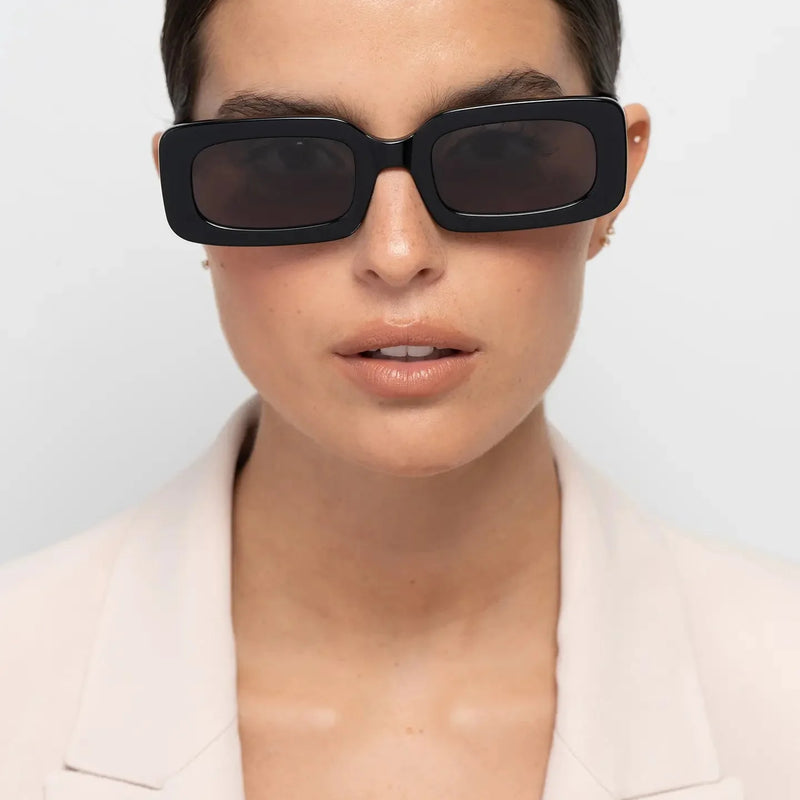
Jane: rectangular structure with visible definition
Jane demonstrates how rectangular geometry and substantial acetate can work together to create a clear, structured boundary.
Design variable: defined rectangular geometry expressed through substantial acetate.
Visual effect: stronger horizontal structure and a clear boundary around the eyes.
Consider it if: you want a feminine rectangular frame with visible definition rather than a very thin or micro-scale interpretation.
Consider another direction if: you want curved geometry or a deliberately low-profile frame.
16. Common mistakes when choosing a trend-led sunglasses shape
Choosing by shape name alone. Two frames labelled oval or rectangular can have very different lens heights, widths and visual weights.
Confusing trend visibility with wearability. A highly visible runway or street-style shape may be useful inspiration without being the right everyday proportion for you.
Ignoring scale. A shape that works at a moderate size can feel completely different when it becomes extremely narrow or oversized.
Using face shape as the only rule. Facial width, brow position, feature scale, bridge fit and preferred visual weight can matter as much as a broad oval, round or square classification.
Buying the most extreme version of a trend. You can choose a contemporary rectangle, oval or cat-eye without pushing every proportion to its limit.
Forgetting identity. The technically flattering frame is not necessarily the frame you will want to wear. Sunglasses also communicate how much structure, character and visual presence you want in your appearance.
17. Frequently asked questions about sunglasses shapes in 2027
What sunglasses shapes are trending in 2027?
Current 2027 directions include rectangles, ovals, cat-eyes, aviators and navigators, oversized forms, shields and wraps, plus enduring round and curved shapes. The larger change is how these familiar geometries are being altered through scale, lens depth, curvature and material.
Are rectangular sunglasses still in style in 2027?
Yes. Rectangular sunglasses remain relevant in both lower, elongated versions and more substantial interpretations. Lens height, width and material thickness determine whether the frame feels minimal, balanced or architectural.
Are oval sunglasses trending in 2027?
Oval sunglasses are part of the current 2027 direction in contrasting forms. Narrow ovals reduce lens depth and feel more compact, while chunky ovals retain curved geometry with greater material presence.
Are cat-eye sunglasses still fashionable in 2027?
Yes, but there is not one fixed 2027 cat-eye. Current interpretations range from softer, rounder versions to lower and more architectural forms. The degree of outer lift is more useful to evaluate than the label alone.
Are aviator sunglasses still in style in 2027?
Aviator and pilot-derived frames remain relevant, particularly as their proportions evolve. Flatter upper lines, squarer lenses, navigator geometry, different materials and altered lens depth can make the familiar aviator idea feel noticeably different.
Are oversized sunglasses still in style in 2027?
Oversized sunglasses remain relevant, but oversized describes scale rather than one shape. Rectangular, square, rounded and shield-like frames can all use larger proportions. Fit and material thickness determine whether that scale feels balanced or overwhelming.
What is the difference between round and panto sunglasses?
A pure round frame distributes curvature more evenly around the lens. Panto geometry usually combines a rounded lower lens area with a more differentiated upper relationship. Width, brow line and material thickness can make the two families behave very differently on the face.
Which sunglasses shape is easiest to wear every day?
There is no single shape that is easiest for everyone. Moderate proportions generally increase versatility: balanced width, controlled lens depth and a stable fit matter more than whether the frame is labelled rectangular, round, oval or aviator.
Should I choose sunglasses based only on my face shape?
No. Face shape can provide a starting point, but frame width, lens height, brow relationship, bridge fit, visual weight and personal preference often explain more about whether a particular frame feels balanced.
18. Final thoughts: choose the proportion, not just the shape
The 2027 sunglasses landscape is not defined by one silhouette replacing everything that came before it. Rectangles, ovals, cat-eyes, aviators, shields, round frames and other familiar geometries can all feel current because their proportions are moving in different directions.
Instead of asking only whether a shape is fashionable, look at what its lens height, width, corner treatment, brow line, material thickness and curvature are doing. Those variables explain why two frames from the same family can produce very different results.
For 2027, use Shape → Proportion → Visual Effect → Wearability → Identity. The shape gives you the category. The remaining decisions determine whether that particular frame belongs in your wardrobe.
Sources and methodology
This guide separates current 2027 evidence from broader editorial interpretation. The emerging shape picture was reviewed against Spring/Summer 2027 fashion reporting and fashion-week street-style evidence available at the time of publication.
Because the international Spring/Summer 2027 season is still developing, individual shapes are presented as current directions rather than guaranteed outcomes for the entire year. Bo Bo Noir's editorial analysis then focuses on the visual mechanics behind those directions: geometry, scale, lens depth, brow relationship, curvature and visual weight.
Bénéficiez de 10 % de réduction sur votre achat ! Inscrivez-vous à notre newsletter.Bénéficiez de 10 % de réduction sur votre achat ! Inscrivez-vous à notre newsletter.Bénéficiez de 10 % de réduction sur votre achat ! Inscrivez-vous à notre newsletter.Bénéficiez de 10 % de réduction sur votre achat ! Inscrivez-vous à notre newsletter.Bénéficiez de 10 % de réduction sur votre achat ! Inscrivez-vous à notre newsletter.Bénéficiez de 10 % de réduction sur votre achat ! Inscrivez-vous à notre newsletter.Bénéficiez de 10 % de réduction sur votre achat ! Inscrivez-vous à notre newsletter.Bénéficiez de 10 % de réduction sur votre achat ! Inscrivez-vous à notre newsletter.Bénéficiez de 10 % de réduction sur votre achat ! Inscrivez-vous à notre newsletter.Bénéficiez de 10 % de réduction sur votre achat ! Inscrivez-vous à notre newsletter.Bénéficiez de 10 % de réduction sur votre achat ! Inscrivez-vous à notre newsletter.Bénéficiez de 10 % de réduction sur votre achat ! Inscrivez-vous à notre newsletter.Bénéficiez de 10 % de réduction sur votre achat ! Inscrivez-vous à notre newsletter.Bénéficiez de 10 % de réduction sur votre achat ! Inscrivez-vous à notre newsletter.Bénéficiez de 10 % de réduction sur votre achat ! Inscrivez-vous à notre newsletter.