Livraison gratuite dans le monde • Retours sous 14 jours • Conçu au PortugalLivraison gratuite dans le monde • Retours sous 14 jours • Conçu au PortugalLivraison gratuite dans le monde • Retours sous 14 jours • Conçu au PortugalLivraison gratuite dans le monde • Retours sous 14 jours • Conçu au PortugalLivraison gratuite dans le monde • Retours sous 14 jours • Conçu au PortugalLivraison gratuite dans le monde • Retours sous 14 jours • Conçu au PortugalLivraison gratuite dans le monde • Retours sous 14 jours • Conçu au PortugalLivraison gratuite dans le monde • Retours sous 14 jours • Conçu au PortugalLivraison gratuite dans le monde • Retours sous 14 jours • Conçu au PortugalLivraison gratuite dans le monde • Retours sous 14 jours • Conçu au PortugalLivraison gratuite dans le monde • Retours sous 14 jours • Conçu au PortugalLivraison gratuite dans le monde • Retours sous 14 jours • Conçu au PortugalLivraison gratuite dans le monde • Retours sous 14 jours • Conçu au PortugalLivraison gratuite dans le monde • Retours sous 14 jours • Conçu au PortugalLivraison gratuite dans le monde • Retours sous 14 jours • Conçu au Portugal
Some sunglasses feel convincing almost immediately.
You put them on and the frame seems more stable. The bridge feels settled rather than distracting. The temples hold without demanding attention. The acetate looks more dimensional, and the frame appears to sit on the face with greater intention.
This is usually what people mean when they ask why premium sunglasses feel better.
The answer is rarely one feature.
A higher price does not automatically create comfort, quality or better design. But when fit, pressure distribution, frame balance, material, construction and finishing work together coherently, the wearing experience can feel noticeably more resolved.
That difference often becomes clearer over time.
A well-balanced frame may require less adjustment. A bridge that works with your facial proportions can reduce concentrated pressure. Suitable frame width can help the temples sit more naturally. Material and finishing become more noticeable because you see and handle the frame repeatedly.
This guide explains those differences without reducing quality to branding, price or romantic production claims.
If your first question is whether paying more actually makes sense, start with are expensive sunglasses worth it?. If you want a broader quality framework first, what makes good sunglasses explains the qualities that matter regardless of price.
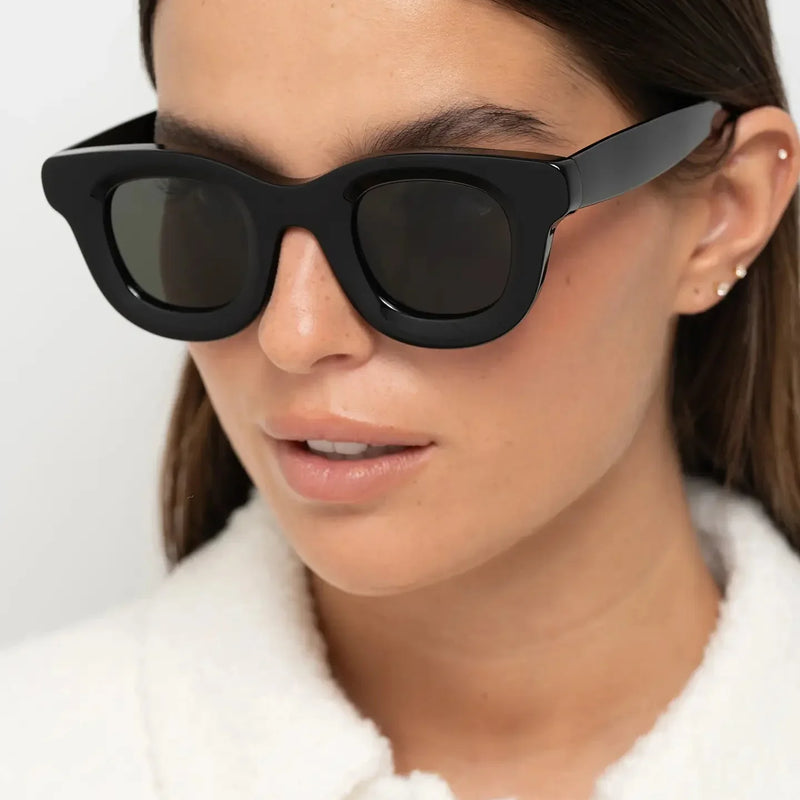
Premium feel begins with the relationship between frame and wearer. Width, bridge position, temple contact and frame balance all influence whether the sunglasses feel settled or distracting.
Why do premium sunglasses often feel better?
Premium sunglasses can feel better when fit, pressure distribution, frame balance, material, construction and finishing work together more coherently. The result can be greater stability, fewer concentrated pressure points and a frame that requires less conscious adjustment during wear.
Price alone does not guarantee any of this. An expensive frame can still fit badly, while a less expensive one can fit extremely well.
The useful test is whether the sunglasses remain comfortable, stable and visually convincing after the first impression disappears.
How hinges and construction influence perceived quality
Why expensive sunglasses do not always feel better
How to test sunglasses before buying
Which Bo Bo Noir frames illustrate different quality signals?
Frequently asked questions
BBN insight
Your face does not experience a specification sheet. It experiences where the frame touches, where it moves and where pressure accumulates. A more resolved frame often feels better because fewer details interrupt the wearing experience.
Why can premium sunglasses feel different?
The word “premium” is often used so broadly that it can stop being useful.
For eyewear, a better approach is to describe the experience rather than the label.
A frame may feel more considered when it opens predictably, sits consistently, distributes pressure well and remains visually coherent at close range.
None of these qualities belongs exclusively to expensive sunglasses.
But when several of them appear together, the wearer notices fewer unresolved details.
The bridge does not immediately become the centre of attention.
The temples do not require repeated repositioning.
The frame does not feel unstable when looking down.
The acetate, edges, temples and hinges feel like parts of one object rather than separate components competing for attention.
This is why perceived quality is cumulative.
One attractive material does not compensate for poor fit. One smooth hinge does not make the entire frame feel resolved. Very low weight does not automatically create comfort.
The experience improves when several smaller decisions reinforce one another.
A front product view strips away styling distractions and makes proportion easier to judge: bridge width, lens height, outer width and acetate geometry all need to work together.
Why premium does not simply mean expensive
Price can reflect material choices, design development, production complexity, finishing, distribution and other commercial factors.
But price cannot tell you whether a frame will work for your face.
An expensive frame can still be too narrow. Its bridge can still sit poorly. Its temples can still create uncomfortable pressure. Its colour can still feel wrong for the wearer.
This is why the useful distinction is between price and resolved experience.
A resolved frame feels coherent because fit, material, geometry and construction support each other.
A poorly resolved frame may contain expensive components while still creating distraction during wear.
If you are evaluating value rather than appearance alone, are expensive sunglasses worth it? looks directly at whether additional spend translates into meaningful benefit.
For the opposite angle, what makes good sunglasses focuses on the qualities worth looking for regardless of price.
What do you actually notice when sunglasses feel better?
The difference becomes easier to understand when the experience is divided into specific signals.
What you notice
What may be contributing
Why it matters
The frame stays in position
Appropriate width, bridge contact and temple geometry.
You spend less time pushing the sunglasses back into place.
The frame feels substantial but not tiring
Weight distributed across several contact points.
Physical presence does not automatically become concentrated pressure.
The temples feel secure
Suitable frame width and controlled pressure at the sides of the head.
Stability improves without requiring excessive grip.
The material looks dimensional
Acetate depth, colour, transparency and surface finishing.
Material quality becomes part of the visual experience at close range.
The frame feels coherent when handled
Alignment, hinge behaviour, edges and component integration.
Repeated interactions feel predictable rather than inconsistent.
No single row creates the complete experience.
The important point is accumulation.
Why frame balance changes comfort
Sunglasses are not experienced as a number of grams.
They are experienced as weight distributed across the face.
This distinction explains why a substantial acetate frame can sometimes feel easier to wear than a lighter frame.
If too much of the perceived mass sits towards the front, the bridge may carry more of the load and the sunglasses can feel front-heavy.
If the front, bridge and temples work coherently, the frame can feel more stable during movement.
Balance is therefore not about making every pair as light as possible.
It is about reducing unnecessary concentration of pressure.
This becomes particularly important during longer wear, when small imbalances that are easy to ignore in the first minute become more noticeable.
A side view reveals information the front view cannot: how the frame front, temples and ear position work together to influence stability and perceived balance.
Why pressure distribution matters more than weight alone
When people say sunglasses feel heavy, what they are experiencing may actually be concentrated pressure.
A small amount of pressure in the wrong place can become more distracting than greater total weight distributed effectively.
The main areas to notice are the bridge, temples and the region around the ears.
If one point becomes increasingly noticeable while the rest of the frame feels relatively neutral, distribution may be the real issue.
This is why advertised frame weight should never be treated as a complete comfort measurement.
Two frames with similar weight can feel very different because their geometry interacts differently with the wearer.
A better comfort question
Instead of asking “How light are these sunglasses?”, ask “Where do I feel them?” If one pressure point becomes obvious, fit may matter more than the number on the specification sheet.
Why bridge fit changes the entire wearing experience
The bridge is one of the most important contact areas because it helps determine where the entire frame sits.
If that relationship is unsuitable, several problems can appear at once.
The sunglasses may slide down.
The lenses may sit lower than intended.
Pressure may become concentrated on a small area of the nose.
The wearer may compensate by pushing the frame back repeatedly.
This is why bridge fit affects more than comfort.
It also changes lens position, brow-line relationship and the perceived geometry of the frame on the face.
Fit should be judged across the whole face. Bridge position, outer width and lens height are experienced together rather than as separate measurements.
How temple pressure affects stability and comfort
Temples need to help stabilise the frame without turning stability into excessive grip.
If they press too strongly against the sides of the head, discomfort can develop gradually.
If they provide too little support, the frame may move more easily and require repeated adjustment.
The right relationship depends partly on frame width.
A frame that is too narrow may force the temples outward and increase pressure. A frame that is too wide may reduce useful contact and feel less stable.
This makes temple comfort another reason to judge the complete frame rather than focusing on lens measurements alone.
Why size and frame width matter to premium comfort
Size is one of the most practical reasons one pair can feel better than another.
A frame does not need to be extremely light or technically complex if its fundamental dimensions are wrong for the wearer.
Too narrow, and temple pressure can increase.
Too wide, and stability may decrease.
Too tall, and the frame may occupy more facial space than the wearer wants.
Too small overall, and the proportions can feel visually compressed even if the materials are excellent.
This is why size should be resolved before interpreting premium details.
Once fit and size are resolved, material becomes easier to judge on its own terms. An angled view reveals acetate thickness, transparency and the relationship between frame front and temples.
Why material changes how a frame feels
Material affects more than appearance.
With acetate eyewear, the wearer interacts repeatedly with the frame's surfaces, edges and thickness.
Substantial acetate can create physical presence, but that presence does not automatically mean discomfort.
What matters is how the material has been integrated into the geometry and balance of the frame.
Visually, acetate can also reveal depth through transparency, pattern and thicker edges.
This becomes particularly noticeable with crystal and tortoise finishes because the material does not behave like one flat block of colour.
However, material labels alone do not guarantee a more resolved frame.
Acetate still needs to work together with fit, construction, alignment and finishing.
And if you want the production context behind the material, how acetate frames are made explains the broader manufacturing sequence.
BBN insight
Material quality matters most after fit is resolved. A visually impressive acetate cannot rescue the wrong width, bridge relationship or pressure distribution.
What Part 1 tells us about why some sunglasses feel better
Price alone cannot determine comfort or quality.
A better wearing experience usually comes from several details working together.
Frame balance matters because the face experiences pressure distribution rather than weight alone.
Bridge fit influences comfort, stability, lens position and facial proportion.
Temple pressure needs to create stability without excessive grip.
Correct size should be resolved before material and finishing are used as quality signals.
Acetate contributes to the experience, but material alone does not guarantee better eyewear.
The strongest quality signal is often the absence of unresolved details rather than one impressive specification.
Next: finishing, polishing, hinges, alignment, manufacturing precision and why the details you barely notice in the first minute can become more important after months of wear.
Why does finishing change how premium sunglasses feel?
Finishing is easy to underestimate because it rarely announces itself as a separate feature.
You experience it through the frame as a whole.
Edges look controlled. Surfaces feel consistent. The transition between the front and temples appears intentional. Acetate responds to light in a way that reveals the material rather than making it look visually flat.
These details become important because sunglasses are handled repeatedly.
You pick them up by the temples. You open and close them. You see the frame from the front, side and edge. You touch the bridge and acetate surfaces. You notice how the material behaves under changing light.
A frame that looks convincing in a photograph can therefore feel less resolved once these repeated interactions begin.
Good finishing does not need to demand attention.
Its role is often the opposite: to remove small visual and tactile distractions.
If you want to understand the broader quality signals before focusing on finishing alone, how to tell if glasses are high quality provides a wider inspection framework.
A side view exposes details that are less obvious from the front: acetate thickness, edge treatment, hinge position and the transition between the frame front and temples.
Why does polishing matter with acetate frames?
Polishing influences how an acetate surface interacts with light.
On a glossy frame, a resolved surface can make colour, transparency and material depth easier to perceive.
This is especially noticeable with tortoise and crystal acetates because they contain visible variation beneath or through the surface.
As the frame moves through daylight, those variations can become more apparent.
But polishing should never be confused with quality as a whole.
A beautifully polished frame can still fit poorly.
A glossy surface cannot compensate for unsuitable width, uncomfortable temple pressure or poor balance.
The useful way to think about polishing is as one part of the finished object.
It can help reveal the material, but it works best when geometry, fit and construction are already coherent.
That does not mean the complete pair of sunglasses is handmade. Human involvement can occur in selected stages of a wider manufacturing process.
Tortoise acetate is particularly useful for seeing how surface finishing interacts with material depth because several tones remain visible within the same frame.
Does glossy acetate feel more premium than matte acetate?
Not automatically.
Glossy and matte surfaces create different visual effects.
A glossy finish reflects more light and can make acetate colour and transparency appear more pronounced.
A matte finish reduces reflection and can make the same amount of material feel visually quieter.
Neither effect is inherently superior.
The better choice depends on the frame geometry, colour and the amount of visual presence you want.
This is why surface finish should be evaluated as a design decision rather than a simple hierarchy of quality.
Why do edges and transitions affect perceived quality?
The eye is sensitive to inconsistency.
You may not consciously inspect every edge of a pair of sunglasses, but irregular transitions can still make the object feel less coherent.
This includes the relationship between the lens opening and acetate, the transition around the bridge, the outer corners and the point where the temples connect to the frame front.
With substantial acetate, these areas become easier to see because there is more material to observe.
That means thickness can magnify both strengths and weaknesses.
If proportions, edges and surfaces are resolved, thicker acetate can create greater architectural presence and make material depth more visible.
If those details are not resolved, additional thickness can make the inconsistencies easier to notice.
Crystal acetate makes edge thickness particularly visible. Transparency lets the eye read material volume without creating the same visual density as an opaque dark frame.
How do hinges influence how sunglasses feel?
Hinges are small components, but the wearer interacts with them constantly.
Every time sunglasses are opened or folded, hinge behaviour becomes part of the experience.
A hinge does not need to feel unusually stiff to communicate quality.
Stiffness by itself is not a reliable quality signal.
The more useful qualities are consistency, controlled movement and appropriate resistance.
If one temple behaves noticeably differently from the other, if movement feels irregular or if the frame develops obvious instability, the wearer may perceive the entire object as less resolved.
This demonstrates an important principle:
Premium feel often comes from predictability.
The frame behaves as expected, repeatedly, without requiring the wearer to think about the mechanism.
A useful hinge test
Open and close both temples slowly.
Do they move with comparable resistance?
Does the movement feel controlled rather than rough or inconsistent?
Do not judge quality simply by how difficult the temples are to move. Excessive stiffness is not automatically evidence of better construction.
The hinge should be considered as part of the relationship between frame front and temples. One impressive component cannot compensate for an unresolved overall construction.
Why does frame alignment matter?
Alignment influences both appearance and wearing behaviour.
When a frame is resting naturally, the temples, front and lenses should appear to belong to one coherent geometry.
Obvious asymmetry in the frame itself can change how the sunglasses sit and may create different pressure from one side to the other.
However, there is an important distinction between frame alignment and facial symmetry.
Human faces are naturally asymmetric.
A well-constructed frame may therefore still require adjustment to sit appropriately on an individual wearer.
This is why quality inspection and personal fit assessment should remain separate steps.
First ask whether the frame itself appears consistent.
Then ask whether it has been adjusted appropriately for your face.
How does construction affect the premium feeling of sunglasses?
Construction is the relationship between components rather than one visible specification.
The frame front, temples, hinges, lenses and bridge need to behave as parts of the same object.
If one element feels inconsistent, the wearer may notice it even when the exact cause is difficult to identify.
A temple that behaves differently from the other side, an inconsistent transition or a frame that feels unstable when handled can interrupt the impression created by attractive materials.
Conversely, coherent construction can make a complex object feel simple.
That simplicity is valuable.
The wearer does not need to think about how individual components are working because the frame behaves predictably.
A frame does not need more visible features to feel better.
It needs the features it already has to work together properly.
Close-up views make construction easier to evaluate because the relationship between acetate, hinge and temple can be inspected without the distraction of the complete silhouette.
Do premium sunglasses need to be handmade?
No.
“Handmade” is often used as a shortcut for quality, but it is not a complete quality measure.
High-quality eyewear can combine precision manufacturing with human involvement at selected stages of production.
Human involvement can be valuable where judgement, finishing, adjustment or inspection is required.
Precision manufacturing can be valuable where consistency and repeatability are required.
These approaches are not opposites.
Bo Bo Noir sunglasses should therefore not be described as entirely handmade.
The more accurate focus is the finished frame: material, construction, finishing, alignment and fit.
That avoids turning a production label into a quality claim that does not tell the wearer how the sunglasses will actually perform.
The useful distinction is not machine-made versus handmade. It is whether material, precision, human judgement and quality control have been used appropriately to create a coherent finished frame.
Does acetate automatically feel more premium than metal?
No.
Acetate and metal create different physical and visual experiences.
Acetate can create more visible material volume, stronger colour depth and a more substantial outline.
Metal can create a thinner profile and lower visual density.
Neither material is inherently more premium.
The quality of the finished eyewear depends on how the chosen material is used, constructed, finished and fitted.
This matters because material preference is sometimes mistaken for quality judgement.
You may simply prefer the tactile and visual presence of acetate.
Another wearer may prefer the reduced visual weight of metal.
Why does precision matter even when you cannot see it immediately?
Some quality signals are visually obvious.
Others reveal themselves through repetition.
You may not inspect alignment the first time you try a frame.
You may not consciously analyse the way both temples move.
You may not study every transition in the acetate.
But after opening, closing, wearing and handling the sunglasses repeatedly, inconsistencies become easier to notice.
This is why precision contributes to long-term experience.
It supports predictability.
Predictability reduces friction.
And reduced friction is one of the reasons a well-resolved object can feel better over time rather than merely impressive at first contact.
Patterned acetate makes material depth easy to see, while an angled view reveals how the front, outer edges and temples form one complete object.
Why can premium sunglasses look better before you even touch them?
Perceived quality is not purely tactile.
The eye begins evaluating a frame before the hand reaches it.
Proportion, material depth, surface reflection, lens integration and the relationship between the frame front and temples all influence first impressions.
This does not mean attractive sunglasses are automatically high quality.
It means visual coherence is one part of the experience.
A frame can look more considered when the material has depth, the proportions feel deliberate and no single detail appears disconnected from the rest.
This is why subtle differences can matter more than decorative complexity.
The wearer may perceive refinement without being able to identify one dramatic reason for it.
For the broader visual question, why do expensive sunglasses look better? explains how proportion, material and finishing can affect perceived value without treating price itself as the cause.
Why can higher-quality acetate look different?
Acetate is particularly interesting because its visual character changes with colour, transparency, thickness and surface treatment.
A tortoise acetate can reveal several tones rather than one visually flat surface.
A crystal acetate can reveal material depth through the edges of the frame.
An opaque colour can create stronger definition when its surface and geometry work together coherently.
These differences often become clearer as the frame moves through changing light.
But material still cannot compensate for poor fit.
The most visually convincing acetate will not make an unsuitable bridge comfortable or correct the wrong frame width.
This is why premium-feeling eyewear is cumulative rather than ingredient-led.
Crystal acetate demonstrates why material thickness and visual weight are not the same thing. The frame can remain substantial while transparency reduces the density of its outline.
Why does the way a frame ages matter?
A premium impression should not exist only on the day the sunglasses are purchased.
Eyewear is handled, folded, placed on surfaces and worn repeatedly.
Over time, repeated use makes material, finishing and construction increasingly relevant.
The realistic question is not whether a frame remains visually untouched forever.
Normal wear exists.
The more useful question is whether the frame continues to feel coherent as it is used.
Does the material continue to look convincing?
Does the construction remain stable?
Do the temples and hinges continue to behave predictably?
Can the frame be maintained and adjusted when necessary?
Long-term quality is therefore partly about how gracefully the object responds to normal use.
Price cannot tell you whether the frame fits, feels balanced or suits your proportions.
Very low weight
Limited on its own
Comfort depends on fit and pressure distribution, not grams alone.
Consistent hinge behaviour
Useful
It contributes to predictable handling and a coherent construction.
Clean surfaces and transitions
Useful
Finishing becomes increasingly visible during repeated handling.
Material depth
Useful in context
It contributes to visual quality but cannot compensate for poor fit or construction.
“Handmade” as a label
Limited on its own
The word does not tell you which processes involved human work or how well the finished frame performs.
Good fit and pressure distribution
Highly useful
These directly influence the experience of wearing the sunglasses.
Large logo
Not a quality measure
Brand visibility does not establish material, fit, construction or finishing quality.
Separating status signals from product signals makes premium buying decisions easier.
The strongest evidence is usually found in qualities you can actually inspect, feel and continue to experience after repeated wear.
BBN perspective
The most convincing premium signals are usually the ones that remain useful after the logo, price and marketing language are removed: fit, balance, material, construction, finishing and a design you genuinely want to keep wearing.
What Part 2 tells us about why premium sunglasses can feel better
Finishing influences both the visual and tactile experience of a frame.
Polishing can reveal acetate depth, but surface quality cannot compensate for poor fit.
Glossy and matte acetate create different effects; neither is automatically more premium.
Edges and transitions become easier to evaluate as frame material becomes more substantial.
Hinge quality is better judged through consistency and controlled movement than stiffness alone.
Alignment matters, but natural facial asymmetry and individual adjustment also need to be considered.
Construction is about how the frame front, temples, hinges, lenses and bridge work together.
Premium eyewear does not need to be entirely handmade.
Bo Bo Noir eyewear should not be described as entirely handmade; precision manufacturing can work alongside human involvement in selected processes.
Acetate is not automatically more premium than metal; the two materials create different visual and physical experiences.
Material and construction become more meaningful when evaluated through repeated use.
How a frame ages is part of its long-term quality experience.
Price, low weight, large logos and production labels are weak quality signals when considered alone.
Fit, balance, predictable construction and coherent finishing are more useful indicators.
Next: why some expensive sunglasses still disappoint, how comfort changes during longer wear, why visual balance affects perceived quality and how to distinguish a genuinely better frame from a stronger first impression.
Price and wearing experience are related less directly than many buyers expect.
A higher price can reflect material choices, design development, production complexity, finishing, distribution, branding and other commercial factors.
But none of those factors can guarantee that a particular frame will work with a particular face.
A beautifully finished frame can still be too narrow.
A visually impressive acetate can still sit poorly on the bridge.
A technically light frame can still create concentrated pressure.
An expensive pair can still feel unstable if its dimensions do not work for the wearer.
This is why the better question is not simply “Are expensive sunglasses better?”
Ask what the additional cost is actually improving: fit, material, construction, finishing, design or long-term wearability.
If the answer is difficult to identify beyond branding or price, the additional spend may not translate into a better personal experience.
A three-quarter view makes the relationship between frame front, bridge, temples and facial proportions easier to assess than a product specification alone.
Why can sunglasses feel good for five minutes and uncomfortable after an hour?
Short try-ons are useful, but they do not reveal every fit problem.
Some forms of discomfort accumulate gradually.
Slight pressure at the temples may feel insignificant at first.
A small amount of bridge pressure may become increasingly noticeable.
A frame that repeatedly slides may require constant repositioning, turning a minor fit problem into an ongoing distraction.
This is why long-wear comfort is not simply the first sensation you experience when putting sunglasses on.
It is the way the frame behaves as time passes.
A well-resolved frame should generally become less noticeable during wear rather than progressively demanding more attention.
If you are already unsure whether the problem is fit rather than quality, how should sunglasses fit your face? provides the wider fit framework.
What are the warning signs that sunglasses may become uncomfortable?
Not every sensation means a frame is unsuitable, but repeated or increasing discomfort deserves attention.
What you notice
What may be happening
What to examine
Increasing pressure at the temples
The frame may be too narrow or the temple relationship may need adjustment.
Overall frame width and temple pressure.
Concentrated pressure on the nose
The bridge may not be distributing the frame effectively.
Bridge relationship, frame position and front balance.
Repeated sliding
The frame may lack suitable stability for the wearer.
Bridge contact, width, temple geometry and adjustment.
The front feels increasingly heavy
Weight may be concentrated rather than effectively distributed.
Front-to-temple balance and bridge pressure.
One side feels different from the other
Adjustment, frame alignment or natural facial asymmetry may be involved.
The frame itself and how it has been adjusted for the wearer.
Several parts of the frame interact, so a fit issue should be evaluated as a system rather than diagnosed from one measurement alone.
Low weight can contribute to comfort, but it cannot guarantee it.
A lightweight frame that concentrates pressure at the bridge or temples may become more distracting than a more substantial frame that distributes its weight effectively.
A numerical weight tells you how heavy the object is.
It does not tell you how that weight will be experienced on your face.
Frame width, bridge geometry, temple relationship and the distribution of material all influence the result.
It is also why balanced sunglasses can feel more expensive: better perceived balance can make a frame feel calmer and more controlled even when the physical weight itself is not unusually low.
A better way to compare comfort
Do not compare sunglasses only by grams.
Compare where they make contact, whether they remain stable and whether any single pressure point becomes more noticeable as you continue wearing them.
Why does visual balance affect whether sunglasses feel premium?
Perceived quality is partly physical and partly visual.
A frame can be comfortable but still look unresolved if its proportions feel disconnected from the face.
Visual balance comes from the relationship between frame width, lens height, brow-line position, acetate thickness, colour and facial proportions.
When these relationships feel deliberate, the eyewear appears more integrated.
This contributes to perceived quality because the frame looks as though its dimensions belong together.
The opposite can happen when too many visual elements compete.
A very wide frame with tall lenses, substantial dark acetate and strong lens contrast may contain several individually attractive features while creating excessive combined visual weight for one face.
This is why more material, more size and more contrast do not automatically create a more refined result.
Good visual balance often depends on restraint as much as presence.
For the broader principle, how sunglasses change facial balance explains how width, shape and visual weight alter the way facial proportions are perceived.
Visual balance is created by relationships rather than one measurement. Width, lens height, colour and frame thickness are perceived together on the face.
Why does visual weight matter as much as physical weight?
Physical weight describes mass.
Visual weight describes how dominant the frame appears.
The two should not be confused.
A substantial crystal acetate frame can have obvious physical volume while appearing visually lighter because skin tone and light remain partly visible through the material.
A smaller opaque black frame can appear visually stronger because its outline creates greater contrast around the eyes.
This matters because a more considered frame does not necessarily need to look visually heavy.
A frame can look substantial without overwhelming the face.
It can look quiet without becoming insignificant.
Colour, pattern and transparency allow visual weight to change without requiring a completely different frame size.
Transparency separates physical volume from visual density. The frame remains substantial, but the boundary between acetate and face becomes softer.
Can frame colour influence perceived quality?
Yes, but no colour is inherently more premium.
The effect comes from how colour interacts with material, transparency, surface finish and frame geometry.
Black can look highly resolved when the silhouette and surface are clean, but its continuous outline can also make inconsistencies easier to notice.
Tortoise can create visible depth through tonal variation.
Crystal acetate can reveal material thickness through transparency.
Olive and burgundy can introduce colour without depending on very high saturation.
The more useful question is not whether one colour looks more expensive in isolation.
It is whether the colour supports the shape and the amount of contrast the wearer wants.
This is another reason material, geometry and colour should be evaluated together rather than as separate specifications.
Why is the feeling of quality partly personal?
Two people can try the same frame and reach different conclusions about comfort.
That does not necessarily mean one of them is wrong.
Faces differ in width, bridge shape, temple relationship, ear position and overall proportions.
People also differ in how much frame presence they enjoy.
One wearer may appreciate the substance of thicker acetate.
Another may prefer eyewear that feels less noticeable.
One may like firmer temple stability.
Another may be particularly sensitive to lateral pressure.
This is why quality cannot be evaluated only as a property of the object.
The relationship between the object and the wearer is part of the experience.
A well-constructed frame that does not work with your proportions is still the wrong frame for you.
BBN insight
The strongest frame is not simply the one with the most material or the highest price. It is the one where material, balance and construction translate into a better experience for the person actually wearing it.
Why can inexpensive sunglasses sometimes feel impressive at first?
First impressions can be created by relatively obvious signals.
A frame can feel substantial because it is heavy.
A hinge can feel impressive because it is unusually stiff.
A highly reflective surface can create immediate visual impact.
A visible logo can influence expectation before the wearer evaluates anything else.
None of these signals is necessarily meaningless, but none is enough on its own.
The stronger test is what happens after repeated wear.
Does the weight remain comfortable?
Does hinge movement remain controlled?
Does the surface still look convincing at close range?
Does the frame remain stable?
Does the fit continue to feel natural?
Quality is therefore better evaluated through consistency over time than through intensity during the first thirty seconds.
Why can a genuinely good frame become more convincing over time?
A strong frame does not need to reveal every quality immediately.
Some of its most useful characteristics become clear through repetition.
You notice that you are not constantly adjusting it.
You notice that opening and closing the temples feels predictable.
You notice that the material remains visually interesting under different light.
You notice that comfort stays relatively consistent during longer wear.
You notice that the frame works naturally with clothes you already own.
This is an important distinction between novelty and long-term satisfaction.
A frame can be recognisable without relying on extreme proportions. Long-term satisfaction is more likely when visual character and everyday wearability remain balanced.
How should you compare two pairs of sunglasses properly?
Comparing specifications is useful, but a stronger comparison combines what you can inspect with what you can experience.
Start with fit.
Which frame creates fewer obvious pressure points?
Which one stays more stable during normal movement?
Then inspect the object.
Look at the acetate from the front, side and edge.
Open and close the temples.
Look at the hinge area and transitions.
Check whether both sides behave consistently.
Then consider visual balance.
Which width works more naturally with your face?
Which lens height creates the amount of presence you want?
Which colour and level of contrast work with your appearance and wardrobe?
Finally, remove price and branding from the mental comparison.
If you did not know which frame cost more, which one would you choose?
That question can reveal how much of the preference comes from the sunglasses themselves and how much comes from expectation.
The real-world premium sunglasses test
Test
Ask yourself
Positive signal
First 30 seconds
Does anything immediately pinch, slide or feel unstable?
No obvious concentrated discomfort or instability.
After several minutes
Are you becoming more aware of the bridge or temples?
The frame becomes less noticeable rather than more distracting.
Movement
Does the frame remain predictably positioned?
Useful stability without excessive grip.
Handling
Do both temples open and close consistently?
Controlled, comparable movement.
Close inspection
Do the surfaces, edges and transitions remain convincing?
Material and finishing remain coherent beyond the first glance.
On your face
Do width, lens height and visual weight feel intentional?
The eyewear supports rather than overwhelms your proportions.
Without the logo
Would you still find the frame convincing?
The product itself remains the reason for choosing it.
When is paying more for sunglasses worth it?
Paying more becomes easier to justify when the additional cost translates into qualities you can actually use.
That may mean a frame whose proportions work better for you.
It may mean material you prefer visually and physically.
It may mean more coherent construction or finishing.
It may mean a design you expect to wear frequently rather than occasionally.
The useful calculation is therefore not simply purchase price.
It is the relationship between price, frequency of wear and satisfaction over time.
A pair that costs more but becomes your default sunglasses may create more personal value than several cheaper pairs you rarely choose.
This does not make expensive sunglasses automatically better value.
If the issue is whether you are adding useful variety or simply duplicating existing eyewear, how many pairs of sunglasses should you own? provides the wider collection framework.
BBN perspective
The strongest reason to pay more is not to own a more expensive object. It is to choose a frame whose fit, material, construction and repeat wear make the additional spend meaningful to you.
How can you separate real quality from premium marketing?
Remove the adjectives.
Words such as premium, luxury, handcrafted and exclusive can shape expectations before the sunglasses have been evaluated.
Instead, translate every claim into something observable.
If a brand emphasises material, examine the material.
If it emphasises finishing, inspect the surfaces and edges.
If it emphasises comfort, consider width, bridge relationship, temple pressure and longer wear.
If it emphasises construction, look at alignment, hinge behaviour and component integration.
If it emphasises timeless design, ask whether you would still choose the frame without the campaign surrounding it.
This approach makes comparison more useful because it replaces broad status language with evidence you can evaluate yourself.
And if you want to return to the basic fundamentals without any premium terminology, what makes good sunglasses provides the simpler quality baseline.
What Part 3 tells us about why premium sunglasses can feel better
Expensive sunglasses do not automatically provide better fit, comfort or design.
Some comfort problems only become obvious after longer wear.
Repeated sliding, concentrated bridge pressure and increasing temple pressure matter more than weight alone.
Lighter sunglasses are not automatically more comfortable because pressure distribution matters.
Visual balance contributes to perceived quality alongside physical comfort.
Physical weight and visual weight are different.
Transparency can reduce visual weight without removing substantial frame geometry.
No frame colour is inherently more premium; colour needs to work with material, surface and geometry.
Perceived quality is partly personal because the same frame interacts differently with different facial proportions.
Strong first impressions can come from weight, stiffness, gloss or branding without guaranteeing a better long-term experience.
A genuinely good frame can become more convincing through repeated wear because it creates less friction.
Comparing frames works better when fit, handling, construction, visual balance and branding are considered separately.
Paying more makes most sense when the additional cost translates into qualities that improve repeat wear and satisfaction.
Premium marketing becomes easier to evaluate when broad adjectives are translated into observable details.
Next: the final buying guide, Bo Bo Noir frame examples, complete quality checklist, frequently asked questions, conclusion and related reading.
How should you choose premium sunglasses?
Start by temporarily removing the word “premium” from the decision.
Then evaluate the sunglasses as an object you expect to wear repeatedly.
Do they fit your face properly?
Does the bridge remain stable without creating concentrated pressure?
Do the temples provide enough support without excessive grip?
Does the frame still feel comfortable after more than a few minutes?
Do the material, surfaces and transitions remain convincing when viewed closely?
Do the hinges behave consistently?
And do the proportions create a visual effect you actually want to repeat?
If those questions are answered well, there is a stronger reason for the sunglasses to feel more resolved regardless of the price attached to them.
If you are still deciding whether the additional spend is justified, are expensive sunglasses worth it? continues the decision from a value perspective.
A simple front view is useful because it removes much of the styling context. Frame width, bridge geometry, lens proportions and material become easier to evaluate on their own.
The seven-step premium sunglasses test
1. Resolve fit before evaluating premium details
A beautifully finished frame will still be the wrong frame if it slides, pinches or creates obvious pressure.
Start with width, bridge relationship and temple stability.
Look at the frame from the front, side and three-quarter view.
With acetate, notice colour depth, transparency, pattern, edge thickness and surface consistency.
Material should remain convincing beyond the hero photograph.
6. Test the parts you will interact with repeatedly
Open and close both temples.
Look at the hinge area.
Inspect the transition between the front and arms.
The aim is not extreme stiffness or mechanical drama. It is consistent, predictable behaviour.
7. Remove price and branding from the final comparison
Imagine you did not know which frame cost more.
Which one would you choose based on fit, material, construction, visual balance and expected repeat wear?
That question helps separate the product itself from the expectation created around it.
The shortest version
A more expensive frame should give you something you can identify: better fit for your face, more convincing material, more coherent construction, better finishing, stronger design or greater repeat wear. Price without an observable benefit is not enough.
Opaque black makes geometry particularly easy to read. Strong contrast can reveal how consistent the silhouette, edges and surface appear without relying on decorative branding.
Which quality should you prioritise first?
Your priority
Focus on
Why it matters
Do not overvalue
Long-wear comfort
Bridge fit, frame width and pressure distribution
These directly affect how the sunglasses feel after longer periods of wear.
Weight in grams alone.
Visual refinement
Proportion, material depth, colour and finishing
These determine how coherent the frame remains when seen at close range.
Large logos or decorative complexity.
Handling quality
Hinge behaviour, temple consistency and alignment
Predictable movement contributes to a more resolved ownership experience.
Extreme hinge stiffness.
Material presence
Acetate depth, pattern, transparency and edge treatment
The material becomes part of the visual identity of substantial eyewear.
Thickness without proportion or finishing.
Long-term value
Fit, construction, repeat wear and wardrobe compatibility
A frame creates more practical value when it remains useful after novelty disappears.
Purchase price in isolation.
Which Bo Bo Noir frames illustrate different quality and visual effects?
Product comparison becomes useful only after the underlying principles are clear.
The following frames are therefore not ranked from most to least premium.
They illustrate different ways material, geometry and contrast can influence the finished experience.
Triboulet Olive — balanced geometry with controlled colour
Triboulet Olive combines panto geometry with an earth-toned acetate finish.
The frame retains visible material presence while olive creates less graphic contrast than polished black.
Creates: balanced structure with quieter colour.
Consider it if: you want substantial acetate that remains relatively easy to integrate into an everyday wardrobe.
Consider another direction if: your priority is maximum dark-frame definition or a strongly rectangular silhouette.
Narr Shiny Black — stronger definition and clearer geometry
Narr Shiny Black uses opaque black acetate to make the silhouette more immediately visible.
The continuous dark outline emphasises the relationship between the upper frame and rounded lower lens.
Creates: stronger facial definition with balanced panto geometry.
Consider it if: you prefer eyewear that creates a clearer graphic boundary around the eyes.
Consider another direction if: dark acetate already feels too visually dominant.
Tortoise demonstrates a different route to material presence. Pattern interrupts the continuous outline while allowing substantial acetate geometry to remain clearly visible.
William Tortoise — substantial material presence with warmer pattern
William Tortoise combines a substantial round silhouette with patterned acetate.
Tortoise introduces tonal variation through the frame, making material depth easier to perceive while reducing the density associated with a single opaque dark colour.
Creates: substantial round geometry with warmer visual variation.
Consider it if: you want expressive acetate without relying on a continuous black outline.
Consider another direction if: you want stronger horizontal definition or a visually lighter crystal frame.
William Crystal Yellow — substantial geometry with lower visual density
William Crystal Yellow demonstrates how transparency changes the perception of material volume.
The frame remains substantial, but light moving through the acetate reduces the density of its boundary.
Creates: visible frame volume with softer contrast.
Consider it if: you like substantial acetate but find opaque dark frames too severe.
Consider another direction if: your main objective is strong facial definition.
Material is only part of the result. The same tortoise effect changes when it is applied to a more directional rectangular silhouette, showing why geometry and material need to be judged together.
Substantial geometry with translucent visual weight.
Material presence without a dense dark outline.
Strong facial definition is your main objective.
The comparison should not be used to identify which frame is “most premium”.
The useful question is which combination of fit, geometry, material and contrast creates the result you want.
BBN insight
Product should come after principle. Once you understand whether you need better fit, stronger definition, softer visual weight or more material depth, the frame recommendation becomes easier to evaluate.
What should you check before buying premium sunglasses?
Width: does the frame work with your facial proportions?
Bridge: does it remain stable without concentrated pressure?
Temples: do they provide support without excessive grip?
Balance: does the front feel stable rather than disproportionately front-heavy?
Material: does the acetate remain convincing from the front, side and edge?
Finishing: do surfaces and transitions appear controlled at close range?
Hinges: do both temples move consistently?
Alignment: does the frame itself appear coherent before personal adjustment?
Visual balance: do width, lens height, colour and visual weight work together?
Repeat wear: can you realistically imagine choosing the frame frequently?
Value: can you identify what the additional spend is actually giving you?
The final test always returns to the face. Material, construction and finishing matter, but their value is highest when the completed frame also creates the proportion and visual weight the wearer wants.
Frequently asked questions
Why do premium sunglasses feel better?
They can feel better when fit, pressure distribution, frame balance, material, construction and finishing work together coherently. Price alone cannot guarantee that experience.
Are expensive sunglasses always more comfortable?
No. An expensive frame can still be too narrow, sit poorly on the bridge or create excessive temple pressure. Comfort depends on how the frame works with the individual wearer.
Are expensive sunglasses worth it?
They can be when the additional cost translates into qualities you genuinely use, such as better fit for your face, more convincing material, coherent construction, finishing or greater repeat wear. Price alone is not enough.
What makes good sunglasses?
Good sunglasses combine appropriate fit, useful lens performance, coherent construction, suitable materials and proportions that make sense for the wearer. No single premium feature can replace those fundamentals.
Are lighter sunglasses always more comfortable?
No. Low weight can help, but pressure distribution matters too. A lightweight frame can still feel uncomfortable when pressure is concentrated at the bridge or temples.
Why do balanced sunglasses feel better?
Balance can reduce the sensation that too much of the frame's weight is concentrated at one contact point. A more substantial frame can therefore feel comfortable when the front, bridge and temples distribute pressure effectively.
How should premium sunglasses fit your face?
The frame should feel stable without excessive pressure. Width should work with your facial proportions, the bridge should support the frame predictably and the temples should provide enough stability without gripping too tightly.
How do I know if sunglasses are too big or too small?
Common signs include excessive temple pressure, a frame that extends unnecessarily beyond the face, repeated slipping or proportions that appear compressed or disconnected. Fit should be judged across the complete frame rather than from lens width alone.
Does acetate quality make a difference?
Yes. Acetate quality can influence colour depth, transparency and surface appearance, but it should still be considered together with construction, finishing and fit.
Why does premium acetate look different?
Material depth, tonal variation, transparency, thickness and surface treatment can change how acetate responds to light. These differences are particularly visible in tortoise and crystal finishes.
Does thicker acetate mean better sunglasses?
No. Greater thickness can make material depth and geometry more visible, but it can also magnify poor proportions or finishing. Thickness is useful only when it supports the complete frame design.
Does hand polishing make acetate better?
Polishing can influence surface clarity and the way light reveals acetate depth. It is one finishing process, not proof that every part of the sunglasses was made by hand or that the complete frame is automatically higher quality.
Are Bo Bo Noir sunglasses entirely handmade?
No. Bo Bo Noir sunglasses should not be described as entirely handmade. Production can combine precision manufacturing with human involvement in selected processes such as finishing, adjustment, inspection or quality control.
Are handmade sunglasses always better?
No. Handmade is not a complete measure of quality. Precision processes and human involvement can both contribute to a well-resolved frame when used appropriately.
Do premium hinges need to feel stiff?
No. Extreme stiffness is not a reliable quality signal. Consistent, controlled movement and comparable behaviour on both temples are more useful indicators.
Can premium sunglasses still need adjustment?
Yes. Faces are naturally asymmetric, so even a well-constructed frame may benefit from individual adjustment to sit appropriately on a particular wearer.
Does frame colour make sunglasses feel more premium?
No colour is inherently more premium. Black, tortoise, olive and crystal create different levels of contrast and material visibility. The strongest choice is the colour that supports the frame geometry and the visual effect you want.
Why do transparent sunglasses feel less visually heavy?
Transparency allows skin tone and light to remain partly visible through the frame. This can preserve substantial acetate thickness while reducing the density of the boundary around the eyes.
Do large logos make sunglasses higher quality?
No. Logo visibility does not establish fit, material quality, construction, finishing or comfort.
What is the strongest sign that sunglasses feel premium?
There is no single sign. The strongest overall signal is coherence: the frame fits properly, behaves predictably, remains convincing at close range and creates fewer physical or visual distractions during repeated wear.
The premium sunglasses checklist
The frame width works with your facial proportions.
The bridge remains stable without concentrated pressure.
The temples provide useful support without excessive grip.
Weight feels distributed rather than concentrated.
The frame remains comfortable beyond the first few minutes.
The material looks convincing from several angles.
Edges and surface transitions remain controlled at close range.
Both hinges behave consistently.
The frame itself appears coherent before individual adjustment.
The visual weight suits the effect you want on your face.
The design works with clothing you already wear.
You can identify what any additional spend is actually giving you.
The sunglasses remain convincing after you ignore the logo and marketing language.
You can realistically imagine wearing them frequently.
The more of these conditions a frame satisfies, the stronger the evidence that its perceived quality comes from the product itself rather than from the language surrounding it.
Why do better-resolved sunglasses become easier to appreciate over time?
The strongest difference is rarely one dramatic feature.
It is the accumulation of details that continue to work.
The bridge remains comfortable.
The temples behave predictably.
The frame stays stable.
The material remains convincing at close range.
The hinges and transitions do not continually attract attention.
The proportions continue to make sense on the face after the first impression has disappeared.
This is why some sunglasses can become more convincing through repeated wear rather than less.
Novelty fades.
Branding becomes familiar.
What remains is the relationship between the frame and the person wearing it.
A useful definition of premium is therefore not simply “more expensive”. It is “more resolved”.
When fit, balance, material, construction and finishing reduce friction rather than create it, the difference becomes something the wearer can actually experience.
Final BBN perspective
Remove the price, logo and adjectives. If the frame still makes sense through fit, balance, material, construction and repeat wear, the quality is doing the work rather than the marketing.
Explore sunglasses through fit, material and balance
Compare Bo Bo Noir frames after deciding which proportions, contrast and material presence make the most sense for you.
Bénéficiez de 10 % de réduction sur votre achat ! Inscrivez-vous à notre newsletter.Bénéficiez de 10 % de réduction sur votre achat ! Inscrivez-vous à notre newsletter.Bénéficiez de 10 % de réduction sur votre achat ! Inscrivez-vous à notre newsletter.Bénéficiez de 10 % de réduction sur votre achat ! Inscrivez-vous à notre newsletter.Bénéficiez de 10 % de réduction sur votre achat ! Inscrivez-vous à notre newsletter.Bénéficiez de 10 % de réduction sur votre achat ! Inscrivez-vous à notre newsletter.Bénéficiez de 10 % de réduction sur votre achat ! Inscrivez-vous à notre newsletter.Bénéficiez de 10 % de réduction sur votre achat ! Inscrivez-vous à notre newsletter.Bénéficiez de 10 % de réduction sur votre achat ! Inscrivez-vous à notre newsletter.Bénéficiez de 10 % de réduction sur votre achat ! Inscrivez-vous à notre newsletter.Bénéficiez de 10 % de réduction sur votre achat ! Inscrivez-vous à notre newsletter.Bénéficiez de 10 % de réduction sur votre achat ! Inscrivez-vous à notre newsletter.Bénéficiez de 10 % de réduction sur votre achat ! Inscrivez-vous à notre newsletter.Bénéficiez de 10 % de réduction sur votre achat ! Inscrivez-vous à notre newsletter.Bénéficiez de 10 % de réduction sur votre achat ! Inscrivez-vous à notre newsletter.