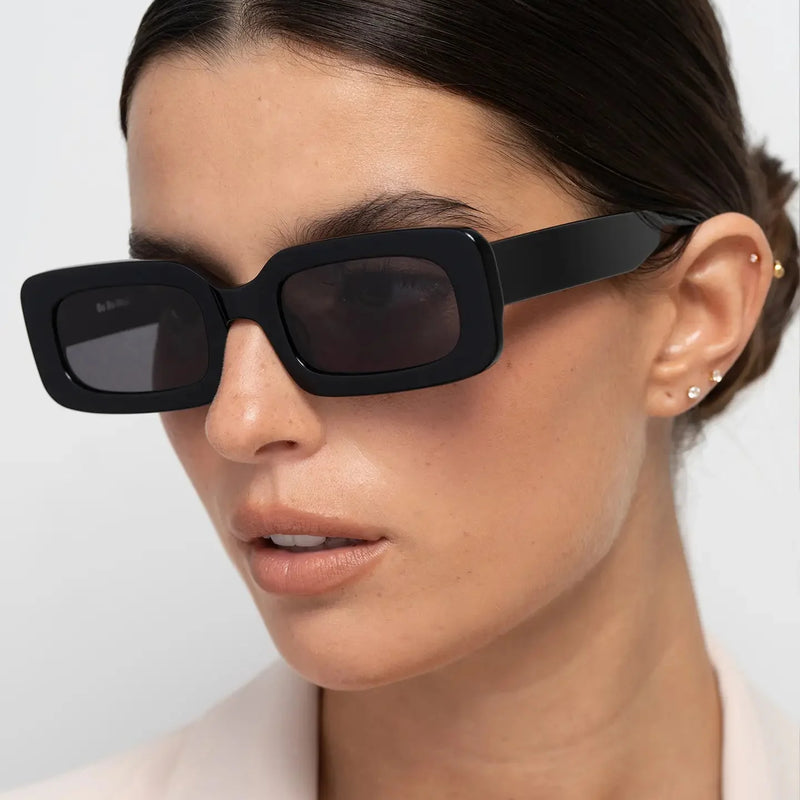
If you like bold eyewear, you may have noticed that some thick acetate frames look refined and carefully shaped, while others feel heavy, flat or unfinished.
The difference is not simply the amount of material used.
Thick acetate frames often look more expensive because they make material depth, surface finishing, edge definition and frame geometry easier to see.
There is more visible material around the lenses, more depth along the outer edges and more surface area for light to reveal curves, bevels and colour variation.
However, thickness also makes poor design easier to notice.
If the bridge feels disproportionately heavy, the lens openings appear compressed or the temples remain bulky from hinge to ear, the frame may look less considered rather than more refined.
This guide explains why substantial acetate creates a stronger perception of value, how colour and geometry change the effect, and how to recognise when thickness has been used with purpose.
For a broader comparison of frame profiles, read our guide to Thin vs Thick Frame Sunglasses.

QUICK ANSWER
Thick acetate frames often look more expensive because their greater visual weight makes the silhouette feel deliberate, while their deeper edges reveal colour, polishing and frame construction more clearly.
This effect works best when the upper rim, bridge, lens openings and temples feel proportionally connected. Avoid assuming that the thickest frame is automatically the most refined: uncontrolled width, excessive darkness or uneven finishing can make substantial acetate feel bulky rather than considered.
Thickness does not create perceived quality by itself.
It acts as a visual amplifier.
When the geometry and finishing are controlled, thickness makes those qualities more visible. When they are not, it makes the weaknesses more visible too.
WHY DOES THICK ACETATE CREATE A STRONGER FIRST IMPRESSION?
People usually judge eyewear as a complete silhouette before noticing individual details.
The eye first reads the broad relationship between the frame front, bridge, lenses, temples and face.
Thicker rims create clearer boundaries around the eyes. They make the brow line more visible, give the outer corners greater direction and establish a stronger shape at conversational distance.
A clearly defined silhouette is easier to recognise and easier to remember.
This recognisability can contribute to perceived value because the frame appears intentionally designed rather than visually generic.
A substantial rectangular frame, for example, may create a strong horizontal line across the upper face. A round frame made from similarly thick acetate distributes its visual weight around the entire lens opening. A panto frame may combine a structured upper rim with softer lower curves.
The amount of material may be similar, but the impression is different because the geometry organises the visual weight differently.
This is the first important distinction:
Thickness gives a frame presence. Geometry determines what that presence communicates.
WHAT ACTUALLY MAKES EYEWEAR LOOK MORE EXPENSIVE?
No single detail determines whether eyewear appears refined.
The impression usually comes from several signals working together:
Silhouette clarity
The frame has a recognisable shape that remains coherent from the front and side.
Material depth
The acetate reveals tonal variation, transparency or controlled reflections rather than appearing visually flat.
Edge control
The transitions around the lenses, bridge and outer corners feel deliberate.
Proportional consistency
The frame front, bridge and temples appear to belong to the same design system.
Fit and stability
The frame sits naturally rather than appearing tilted, compressed or excessively wide.
Thick acetate makes each of these signals easier to observe.
There is more surface area for polishing, more visible depth at the edges and more material through which colour can be perceived.
At the same time, there is also more opportunity for imbalance.
A thick upper rim may create useful facial definition. A bridge of equal visual density may concentrate too much attention at the centre of the face.
A substantial outer corner may give a rectangular frame direction. A temple that remains equally thick behind the ear may make the side profile feel unresolved.
The strongest frames use material selectively rather than uniformly.
WHY VISUAL WEIGHT INFLUENCES PERCEIVED VALUE

Visual weight describes how noticeable or substantial an object appears.
It is not the same as physical weight.
A frame may look bold while remaining comfortable, just as a visually delicate frame may feel uncomfortable when its pressure is poorly distributed.
Thick acetate increases visual weight because it occupies more space around the lenses and creates a stronger contrast between the eyewear and the face.
This can communicate structure, confidence and stability.
Similar associations appear in architecture, furniture and packaging. Substantial forms are often perceived as more permanent because their boundaries feel clear and their construction appears visible.
In eyewear, this effect becomes strongest around three areas:
- The upper rim, which creates definition around the eyebrows.
- The outer corners, which determine horizontal direction.
- The temples, which connect the front silhouette to the side profile.
Visual weight becomes convincing when these areas feel balanced.
It becomes excessive when every section competes for attention.
Low visual weight
Feels discreet and allows more attention to remain on the face.
Medium visual weight
Creates definition without making the eyewear the dominant feature.
High visual weight
Makes the frame an intentional part of the wearer's visual identity.
WHY DOES THICK ACETATE REVEAL MORE MATERIAL DEPTH?
Acetate colour is not always perceived as one flat surface.
In tortoise, crystal, amber, olive and other translucent variations, colour can appear at different depths within the material.
Thicker sections give light more material to travel through and reflect from.
This makes tonal variation easier to see, particularly along the rims and outer edges.
The pattern appears embedded in the frame rather than simply placed on top of it.
Tortoise acetate demonstrates this effect clearly.
Darker areas create definition, while amber or honey-coloured sections allow more light to pass through. As the viewing angle changes, the balance between those tones also changes.
Solid black acetate creates depth differently.
Because it has little visible tonal variation, its shape is revealed through reflections. A clean line of light along a bevel or rounded edge helps the eye understand the geometry of the frame.
Crystal acetate uses transparency to create another type of depth. The face remains partially visible through the material, allowing the silhouette to feel substantial without becoming visually dense.
No acetate colour is automatically more refined than another.
Each creates a different visual consequence:
- Black: maximum structure and edge definition.
- Tortoise: visible tonal depth and softer contrast.
- Crystal: material volume with reduced visual density.
- Cream: opaque structure without the darkness of black.
- Olive: visible colour with a softer transition into the face.

Material depth gives the eye more visual information.
Instead of seeing one uniform colour, the viewer sees changes in transparency, pattern and reflection.
This complexity makes the frame feel richer without relying on logos or decorative hardware.
HOW DOES POLISHING CHANGE THE APPEARANCE OF THICK FRAMES?
Thickness gives a frame more visible surface area.
Polishing determines how that surface interacts with light.
A carefully finished frame does not simply appear shiny. Its reflections describe its geometry.
A broad front surface may create a wider reflection. A bevel may produce a narrow line. A rounded temple may reveal a gradual highlight as it turns towards the ear.
These controlled changes help the eye understand the shape.
An inconsistent surface behaves differently.
Cloudy areas, irregular transitions or uneven edges interrupt the reflections and can make the material appear flatter.
This is why gloss should not be treated as proof of quality.
A highly reflective frame may still feel synthetic if every surface catches light in the same way.
What matters is whether the finishing supports the intended silhouette.
The most revealing areas are often:
- The inner edges around the lenses.
- The transition between the bridge and rims.
- The outer corners near the hinges.
- The side profile of the temples.
- The tapered area behind the ears.
Turn the frame slowly under natural light.
If the reflections move smoothly and the edges remain visually clear, the polishing is supporting the design rather than distracting from it.
WHY DO CLEAN EDGES MAKE ACETATE LOOK MORE REFINED?

An acetate frame contains several visible planes.
These include the main front surface, the outer edge, the inner lens edge, the bridge, the end pieces and the transition into the temples.
Thick acetate makes the relationship between these planes easier to see.
When their transitions are controlled, the frame appears sculpted.
When they merge without definition, it may feel like one heavy block of material.
A refined frame creates definition without unnecessary harshness.
A bevel can soften a rectangular silhouette while preserving its horizontal structure.
A rounded lower rim can balance a strong brow line.
A tapered temple can reduce physical and visual weight behind the ear.
These details matter at different distances.
From close range, the viewer notices the individual edge and polish.
From conversational distance, those details merge into one clear silhouette.
A resolved frame should work at both scales.
HOW DOES FRAME GEOMETRY CHANGE THE EFFECT OF THICKNESS?
Thickness is a material characteristic.
Geometry determines how that material is perceived.
Rectangular frames
Concentrate visual weight along the upper rim and outer corners. This creates stronger horizontal definition and a more architectural relationship with the brow line.
Round frames
Distribute visual weight around the entire lens opening. Substantial acetate gives the curved shape more presence, although excessive rim depth can make the lenses feel compressed.
Panto frames
Combine a structured upper section with softer lower curves. Thickness can emphasise this contrast, creating definition above and visual openness below.
The bridge changes the result again.
A keyhole-style bridge introduces negative space between the lenses and can reduce central density.
A wider saddle-style bridge creates a more continuous visual connection across the frame front.
The outer corners determine direction.
Horizontal corners make the frame appear wider. Rounded corners return attention towards the lens centres. Slightly lifted corners create upward movement.
The same amount of acetate can therefore communicate strength, softness or graphic clarity depending on where the material is placed.
This is why thickness measurements alone reveal very little about how a frame will look when worn.
WHEN DOES THICKNESS STOP LOOKING REFINED?
Thick acetate usually becomes visually heavy when several high-impact characteristics appear together.
A dark frame may feel balanced.
A dark frame combined with excessive width, shallow lenses, a dense bridge and very dark lenses may create one continuous block across the eye area.
Visual heaviness is cumulative.
Common causes include:
- Rims that occupy too much space relative to the lens openings.
- A bridge that feels heavier than the outer parts of the frame.
- Outer corners that extend far beyond the temples.
- Temples that remain uniformly thick from hinge to ear.
- Very dark lenses that remove all visible openness from the eye area.
- Strong black acetate combined with an already angular, high-contrast silhouette.
When a frame feels overwhelming, changing to thin acetate is not the only solution.
You can preserve the substantial silhouette while adjusting one variable:
- Choose tortoise, olive, cream or crystal instead of black.
- Select gradient lenses instead of uniformly dark lenses.
- Reduce the overall frame width.
- Choose greater lens height to create more openness.
- Look for a narrower bridge or softer lower rim.
- Select temples that taper more clearly.
Changing one variable at a time makes it easier to identify what is causing the imbalance.
THICK ACETATE VS THIN ACETATE: WHICH LOOKS MORE REFINED?
Both profiles can appear refined.
They communicate different visual intentions.
Thick acetate
Creates stronger presence, clearer geometry and more visible material depth.
Advantages
Recognisable silhouette, stronger facial definition and greater opportunity for sculpted edges.
Trade-offs
Can create excessive contrast or physical weight when poorly balanced.
Best suited to
Wearers who want the eyewear to become an intentional part of their appearance.
Thin acetate
Creates a quieter outline and allows more attention to remain on the face.
Advantages
Lower visual density, understated styling and easier integration with delicate features.
Trade-offs
Less visible colour depth and less definition around the eyes.
Best suited to
Wearers who want the frame to support rather than dominate their facial structure.
Medium-thickness acetate
Balances visible structure with everyday adaptability.
Advantages
Enough material to define the silhouette without creating the density of an extremely bold frame.
Trade-offs
May feel less distinctive for someone seeking maximum visual presence.
Best suited to
Wearers who want one versatile frame for different settings.
The more refined choice is not automatically the thicker or thinner option.
It is the profile whose visual weight supports the frame geometry and the wearer’s proportions.
DO THICK ACETATE FRAMES COST MORE?
They can, but thickness is only one part of eyewear cost.
A substantial frame may require more material and offer more surface area for shaping and polishing.
The final price can also reflect design development, lenses, hinges, quality control, production volume, distribution and brand positioning.
More material is not a reliable measure of value.
A relatively accessible frame can look considered when its proportions and finishing are controlled.
A more expensive frame can still feel visually unresolved or fit poorly.
Price explains what is being charged.
It does not explain whether the frame will suit your facial proportions, remain comfortable or create the visual effect you want.
Visible and practical evidence is more useful:
- Does the frame sit evenly?
- Do the temples open and close consistently?
- Are the lens openings clean?
- Does the polish remain clear around the bridge and hinges?
- Does the material distribution support the shape?
- Does the frame remain comfortable after several minutes?
ARE THICK ACETATE FRAMES MORE DURABLE?
Greater material volume can create more substance around the lenses, but durability depends on the complete construction.
The bridge, hinges and temple connections remain important stress points regardless of rim thickness.
Material behaviour, lens installation, hardware and everyday handling also affect how a frame performs over time.
A substantial appearance should not be treated as proof of durability.
Thicker sections may provide useful structural volume and more space for integrating hardware.
However, unnecessary physical weight can create other concerns. A heavy frame may slide when the bridge fit is incorrect or create concentrated pressure on the nose.
Assess the frame as one connected system rather than judging its strength from the thickest visible section.
ARE THICK FRAMES LESS COMFORTABLE?

Visual weight and physical comfort are separate questions.
A substantial-looking frame can feel balanced when its weight is distributed effectively between the bridge and ears.
A lighter frame may feel uncomfortable when pressure is concentrated in one area.
Weight distribution matters more than appearance alone.
Signs of poor balance include:
- Pressure concentrated on one part of the nose.
- Repeated sliding when the head moves.
- Excessive pressure behind the ears.
- One outer edge sitting higher than the other.
- Stability that depends on overly tight temples.
Do not judge comfort during the first few seconds.
Wear the frame for several minutes and notice where pressure develops.
Look down, turn your head and observe whether the frame remains stable.
Evaluate the frame twice.
First, assess the silhouette in the mirror.
Then stop looking at it and concentrate only on pressure, stability and movement.
A frame can look balanced but feel uncomfortable, or feel light while appearing visually overwhelming.
HOW DO THICK FRAMES CHANGE FACIAL PROPORTIONS?
Eyewear introduces new lines around the eyes, eyebrows and nose.
Thick acetate makes those lines more visible.
A strong upper rim can add definition around the eyebrows. Wider outer corners can create horizontal balance. Greater lens depth can occupy more vertical space and reduce the visual length of a longer face.
The effect depends on the relationship between:
- Frame width and temple width.
- Lens height and available cheek space.
- Bridge placement and brow position.
- Acetate colour and facial contrast.
- Frame geometry and existing facial angles.
The same thick frame can feel balanced on one face and overwhelming on another.
People with smaller or more delicate features do not necessarily need to avoid substantial acetate.
They may need a controlled overall width, moderate lens height or softer acetate colour.
A thick crystal, olive or tortoise frame may preserve the silhouette while reducing the contrast created by black.
For a complete explanation of sizing, read What Size Sunglasses Should I Choose?
WHICH FRAME GEOMETRY WORKS WITH DIFFERENT FACIAL PROPORTIONS?
Face-shape categories can be useful starting points, but they should not become fixed rules.
Frame width, feature scale, brow position and visual intention are often more useful than a single face-shape label.
Rounder facial proportions
Rectangular frames can introduce clearer corners and stronger horizontal definition. Avoid excessive width that disconnects the frame from the temples.
Longer facial proportions
Deeper lenses and substantial rims can occupy more of the middle face and reduce excessive vertical emphasis.
Square facial proportions
Round or panto frames can preserve visual weight while introducing softer curves.
Oval facial proportions
Can generally explore several geometries. Visual weight and personal style become the main decisions.
Heart-shaped facial proportions
Often benefit from controlled upper-frame weight and lower edges that do not add unnecessary width around the cheeks.
Rather than asking whether your face shape is “allowed” to wear thick frames, examine three relationships:
- Does the outer width relate naturally to the temples?
- Does the upper rim complement rather than obscure the eyebrows?
- Does the lens depth leave enough space above the cheeks?
These observations are more reliable than applying a category mechanically.
WHY DO THICK BLACK FRAMES FEEL MORE ARCHITECTURAL?

Black acetate creates one of the clearest boundaries between the frame and the face.
When the rims are thick, that boundary becomes more pronounced.
Rectangular corners appear sharper. Round lenses become more graphic. Panto silhouettes show a clearer contrast between their structured upper rim and curved lower section.
Black is not automatically the most refined colour. It is usually the most defined.
Polishing is particularly important because black acetate reveals shape through highlights rather than through internal colour variation.
A controlled reflection can make the frame appear deep and sculpted.
An uneven reflection may make the same silhouette feel visually flat.
Black also creates the greatest risk of excessive visual density.
When thick black acetate is combined with shallow lens openings, a heavy bridge and very dark lenses, the eye area may become one continuous block of contrast.
This effect can suit someone seeking maximum presence.
It may feel too severe for someone seeking a softer everyday frame.
WHY DO THICK TORTOISE FRAMES FEEL SOFTER?

Tortoise acetate combines dark definition with warmer, lighter areas.
This variation interrupts the continuous boundary created by a solid dark frame.
The silhouette remains substantial, but the material creates a softer transition into the face.
Tortoise preserves visual presence while reducing uniform density.
Its pattern also makes material depth easier to see.
Different areas interact with light differently, particularly along thick edges where amber and darker tones become more visible.
The scale of the pattern matters.
Large tonal areas create clearer variation on substantial rims. Smaller markings can produce a busier effect.
Tortoise is especially useful when black feels too severe but transparent acetate feels too quiet.
For a complete colour comparison, read Black vs Tortoise Sunglasses.
HOW DO CRYSTAL, CREAM AND OLIVE FRAMES REDUCE VISUAL HEAVINESS?
Thickness and darkness are separate characteristics.
A frame can be physically substantial but visually soft when its colour creates less contrast against the face.
Crystal acetate allows facial detail to remain partially visible through the material.
Cream acetate remains opaque but creates less darkness around the eyes than black.
Olive acetate provides visible colour and structure while producing a gentler transition into many facial colour palettes.
These options allow the wearer to preserve frame presence without choosing maximum visual weight.
Lens colour contributes to the result.
Gradient lenses allow more expression to remain visible through the lower lens area. Medium-density lenses may feel more open than uniformly dark alternatives.
The complete effect comes from acetate colour, lens density, frame thickness and geometry working together.

HOW CAN YOU RECOGNISE A WELL-DESIGNED THICK ACETATE FRAME?
Evaluate the frame from the front, side and three-quarter view.
A convincing silhouette should remain coherent from every angle.
1. Examine the front silhouette
The upper rim, bridge, lower edge and outer corners should feel connected rather than independently heavy.
2. Check the lens openings
They should look clean and proportionate to the amount of acetate around them.
3. Turn the frame towards natural light
Reflections should move smoothly and reveal the shape of the surfaces.
4. Inspect the bridge
It should connect the lens areas without creating an excessively dense centre.
5. Look at the side profile
The temples should continue the visual language of the front and taper where appropriate.
6. Assess physical stability
The frame should remain secure without relying on excessive temple pressure.
7. Step away from the mirror
The complete silhouette should remain balanced at conversational distance.
This process helps separate genuine design coherence from the immediate impression created by thickness or surface shine.
DECISION GUIDE: WHICH TYPE OF THICK ACETATE FRAME SHOULD YOU CHOOSE?
If you want maximum facial definition…
Choose black acetate with rectangular or structured panto geometry.
If you want substance without severe contrast…
Choose tortoise, olive, cream or crystal acetate.
If you want warmer visual balance…
Choose tortoise acetate with brown or gradient lenses.
If you have a narrow face…
Preserve acetate thickness but prioritise controlled total width.
If your features are delicate…
Choose a softer colour and avoid combining excessive width with very dark lenses.
If you want stronger horizontal definition…
Choose a rectangular frame with visible outer corners.
If your face already has strong angles…
Choose a round or panto silhouette to introduce softer curves.
If you want visible material depth…
Choose tortoise or translucent acetate with polished, clearly defined edges.
If comfort is your priority…
Evaluate bridge fit, temple pressure and stability rather than judging from thickness alone.
If you want one adaptable everyday frame…
Choose medium-to-thick acetate with moderate lens height and a lower-contrast colour.
There is no universal ideal thickness.
The correct choice creates the intended visual effect without compromising facial proportion or physical comfort.
WHICH BO BO NOIR FRAMES SHOW DIFFERENT TYPES OF VISUAL WEIGHT?
Each silhouette below uses substantial acetate differently.
The purpose of the comparison is not to identify one universally superior frame, but to show how geometry and colour change the visual result.
Jane Shiny Black
The rectangular silhouette, dark acetate and defined outer corners create strong horizontal structure. It is suited to wearers who want the frame to become a clear part of their appearance.
Explore Jane Shiny Black →
Jane Tortoise
Maintains the substantial rectangular geometry while tonal variation softens the boundary between the frame and face.
Explore Jane Tortoise →
Jane Cream White
Demonstrates how a thick opaque frame can remain visually lighter when the acetate colour reduces darkness around the eyes.
Explore Jane Cream White →
Narr Tortoise
Combines a structured upper rim with softer panto curves, preserving material presence without the severity of a rectangular black frame.
Explore Narr Tortoise →
Narr Olive Yellow
Uses translucent colour to reduce visual density while maintaining the character of a substantial panto silhouette.
Explore Narr Olive Yellow →
William Shiny Black
Shows how thick acetate can give a round silhouette stronger definition without relying on rectangular corners.
Explore William Shiny Black →
William Crystal Peach
Uses transparency and warm colour to preserve the round frame's substance while creating a softer relationship with the face.
Explore William Crystal Peach →
Triboulet Tortoise Gradient Brown
Combines warm acetate with gradient lenses, reducing the impression of one continuous dark block across the eyes.
Explore Triboulet Tortoise Gradient Brown →
These examples reinforce the central principle of the article:
Substantial acetate can create definition, softness, warmth or transparency depending on how colour, geometry and lenses are combined.

COMMON MISTAKES WHEN CHOOSING THICK ACETATE FRAMES
- Assuming the thickest frame will automatically look the most refined.
- Judging quality from surface shine without inspecting the edges.
- Ignoring the relationship between total frame width and temple width.
- Combining thick black acetate with very dark lenses when a softer result is preferred.
- Choosing lens openings that appear compressed by the surrounding rims.
- Evaluating the frame only from the front.
- Ignoring bridge placement and central visual density.
- Confusing visual weight with physical comfort.
- Choosing a bold frame only because the silhouette is currently familiar.
- Assuming every acetate colour creates the same depth and contrast.
- Reducing thickness when the real problem is excessive width.
- Accepting uncomfortable temple pressure because the front silhouette looks balanced.
The strongest thick acetate frames feel intentional rather than exaggerated.
They create presence while maintaining a clear relationship with the eyes, eyebrows, nose and total facial width.
Compare a frame from three distances.
Examine its edges closely, assess facial balance at arm’s length and then step farther away to judge the complete silhouette.
A resolved frame should remain coherent at every distance.
FREQUENTLY ASKED QUESTIONS
Why do thick acetate frames look more expensive?
They make visual weight, material depth, polishing and edge definition easier to see. These characteristics can make the silhouette appear more deliberate when the proportions are controlled.
Are thick acetate frames better quality?
Not automatically. Quality also depends on material behaviour, finishing, hinges, lens installation, fit and the relationship between the frame front and temples.
Why do some thick frames look cheap?
They may use uniform bulk without controlled shaping, have visually flat colour, show inconsistent polishing or create poor proportions around the bridge and lenses.
Do thick black frames look more expensive?
Black acetate creates strong contrast and clear edge definition, which can make the frame feel architectural. The effect still depends on polishing, geometry and fit.
Does tortoise acetate look more refined than black?
Tortoise creates visible tonal depth and softer contrast, while black creates stronger structure. Neither is universally more refined; they produce different visual effects.
Why does polished acetate look more considered?
Controlled polishing allows light to reveal the curves, bevels and planes of the frame. Smooth reflections help the eye understand the geometry.
Is shiny acetate better than matte acetate?
No. Gloss reveals colour depth and reflections more clearly, while matte acetate creates a quieter surface. The better option depends on the intended appearance.
Are thick frames heavier?
They may contain more material, but comfort depends on physical weight, bridge fit, temple pressure and weight distribution.
Are thick acetate frames more durable?
Greater material volume may add substance around the lenses, but durability also depends on hinges, bridge construction, lens installation and everyday care.
Do thick frames suit small faces?
Yes. Total width, lens height and bridge placement matter more than thickness alone. Softer acetate colours can also reduce visual density.
Can thick frames overwhelm delicate features?
They can when thickness is combined with excessive width, strong contrast and very dark lenses. Changing one of those variables may restore balance.
Do transparent thick frames look less heavy?
Yes. Transparent acetate allows more facial detail to remain visible, reducing visual density while preserving a substantial silhouette.
Do gradient lenses soften thick frames?
Gradient lenses reduce the impression of one continuous dark block across the eye area and preserve more visible expression through the lower lens area.
Which face shapes suit thick rectangular frames?
They are especially useful when stronger horizontal definition is desired. Total width and lens height remain more important than the face-shape label alone.
Which face shapes suit thick round frames?
Round frames can introduce softer curves to angular facial proportions while substantial acetate prevents the silhouette from feeling visually delicate.
Should thick frames cover the eyebrows?
The upper rim should relate naturally to the brow line. Some overlap may be appropriate, but the frame should not make the eyebrows appear awkwardly disconnected.
Can thick frames make the eyes look smaller?
Yes, particularly when the rims are dominant, the lenses are shallow or the lens colour is very dark. Balanced lens openings help preserve visual openness.
What matters more: frame thickness or frame width?
Both matter, but excessive width often creates more obvious proportional imbalance. A thick frame can work on a smaller face when its total width remains controlled.
How can I make thick frames feel less severe?
Choose tortoise, olive, cream or crystal acetate, consider gradient lenses and avoid combining extreme width with excessive darkness.
Should I choose thick or thin acetate frames?
Choose thick acetate when you want stronger presence and definition. Choose thinner acetate when you want the frame to maintain a quieter relationship with the face.
FINAL THOUGHTS
Thick acetate frames often look more expensive because they make design decisions more visible.
They create stronger visual weight, reveal greater material depth and provide wider surfaces for shaping, polishing and edge definition.
However, thickness is not a substitute for coherent design.
The refined appearance comes from how intelligently the material is distributed.
The upper rim should support the brow line.
The bridge should connect the lenses without creating excessive central density.
The outer corners should establish direction without extending unnecessarily beyond the face.
The temples should continue the visual language of the front while remaining physically comfortable.
Colour should create the intended level of contrast, whether that means the definition of black, the tonal depth of tortoise or the visual openness of crystal acetate.
The right thick acetate frame should feel substantial but controlled.
It should create presence without appearing separate from the person wearing it.
👁 YOU MAY ALSO LIKE
Thin vs Thick Frame Sunglasses
Compare visual weight, comfort and the trade-offs between different acetate profiles.
Read the article →
Black vs Tortoise Sunglasses
Understand how two essential acetate colours change contrast, warmth and facial definition.
Read the article →
What Size Sunglasses Should I Choose?
Learn how frame width, lens height and bridge fit influence comfort and facial proportions.
Read the article →
How Sunglasses Change Facial Balance
Explore how eyewear introduces new lines, proportions and visual weight around the eyes.
Read the article →
Explore Bo Bo Noir Sunglasses
Compare rectangular, round and panto acetate silhouettes through geometry, colour and visual weight.
Explore the collection →