Envío mundial gratuito • Devoluciones en 14 días • Diseñado en PortugalEnvío mundial gratuito • Devoluciones en 14 días • Diseñado en PortugalEnvío mundial gratuito • Devoluciones en 14 días • Diseñado en PortugalEnvío mundial gratuito • Devoluciones en 14 días • Diseñado en PortugalEnvío mundial gratuito • Devoluciones en 14 días • Diseñado en PortugalEnvío mundial gratuito • Devoluciones en 14 días • Diseñado en PortugalEnvío mundial gratuito • Devoluciones en 14 días • Diseñado en PortugalEnvío mundial gratuito • Devoluciones en 14 días • Diseñado en PortugalEnvío mundial gratuito • Devoluciones en 14 días • Diseñado en PortugalEnvío mundial gratuito • Devoluciones en 14 días • Diseñado en PortugalEnvío mundial gratuito • Devoluciones en 14 días • Diseñado en PortugalEnvío mundial gratuito • Devoluciones en 14 días • Diseñado en PortugalEnvío mundial gratuito • Devoluciones en 14 días • Diseñado en PortugalEnvío mundial gratuito • Devoluciones en 14 días • Diseñado en PortugalEnvío mundial gratuito • Devoluciones en 14 días • Diseñado en Portugal
Searching for independent eyewear brands from Europe can quickly become confusing. “Independent”, “European”, “design-led” and “made in Europe” are often used as though they mean the same thing. They do not.
A brand can be European without manufacturing every frame in Europe. It can be independent without being small. And independence does not automatically make its glasses or sunglasses better than those produced by a larger company.
What independence can create is greater freedom to develop and protect a specific design point of view. That freedom may appear as contemporary experimentation with shape, continuity with an eyewear archive or a disciplined design philosophy built around proportion and identity. If you want to understand the principle first, read our guide to why independent eyewear is different.
Rather than giving you a long list of names, this guide uses KALEOS, Lesca Lunetier and Bo Bo Noir as three contrasting European case studies. The objective is to show what independence can actually change at frame level — and how to decide whether any of those differences matter to you.
Independent eyewear becomes meaningful when a point of view survives at frame level. Shape, proportion, material and colour should communicate identity before a logo needs to.
Quick Answer
Independent eyewear brands from Europe can offer distinctive approaches to design, but independent describes control, not a particular aesthetic or level of quality. KALEOS demonstrates how autonomy can support contemporary experimentation with shape; Lesca Lunetier shows how it can protect heritage, material character and continuity; Bo Bo Noir uses it to develop strong silhouettes and a design philosophy beyond short-lived trends. Compare the resulting frames through identity, design, production, fit and repeat wear, not independence alone.
BBN Insight
Independent ≠ small ≠ made in Europe ≠ automatically better. Independence becomes useful to a wearer when creative autonomy produces an identifiable consequence: a recognisable silhouette, coherent proportions, meaningful material choices, continuity of design or a point of view that would be difficult to confuse with another brand.
1. What does an independent eyewear brand actually mean?
At its most useful, independent describes control rather than aesthetics. It tells you something about who can make decisions around the brand, not what the finished glasses must look like.
That distinction matters because independent eyewear does not have one visual language. One brand may use its autonomy to experiment with contemporary proportions. Another may preserve historic shapes and manufacturing relationships. Another may build its identity around a controlled set of silhouettes, materials and design principles.
The potential advantage is creative authorship. When design direction remains close to the people shaping the company, there can be more freedom to protect a specific point of view instead of making every decision around maximum market coverage.
But that freedom is an opportunity, not proof of quality. The frame still has to earn the argument.
A better way to evaluate independent eyewear
Who controls the creative and commercial decisions?
Can you identify a coherent design point of view?
Does that identity appear consistently in actual frames?
Are production claims specific enough to understand?
Would the design remain convincing without the brand story or logo?
2. Independent, European and made in Europe: what is the difference?
These terms answer different questions and should not be used interchangeably.
Term
What it tells you
What it does not prove
Independent
Something about ownership, control or decision-making autonomy.
Quality, manufacturing location or a particular aesthetic.
European brand
A company or creative identity meaningfully connected to Europe.
That every frame is manufactured in Europe.
European design direction
Creative development is connected to a European design context.
That production happens in the same country.
Made in Europe
A manufacturing-origin statement about the relevant product.
Independent ownership or automatically superior execution.
This distinction protects you from a common shortcut in eyewear marketing: using geography as a substitute for explaining the product.
European identity, manufacturing provenance and independence can all provide useful context. None should replace an examination of design, construction, fit and execution.
“Independent”, “European” and “made in” describe aspects of the system around an object. They become useful to a buyer when that system produces something identifiable: a recognisable silhouette, convincing construction, material depth, thoughtful proportion or coherent design language.
3. Why can independence matter to eyewear design?
Eyewear has an unusually direct relationship with identity because it sits on the face. Small changes in width, lens geometry, brow position, bridge shape, colour and material can alter how strongly a frame defines the wearer.
That gives a focused eyewear brand considerable room to develop a recognisable design language. Independence can matter when it gives the people responsible for that language enough control to develop it consistently.
But autonomy can produce very different outcomes. It may protect experimentation, continuity or discipline.
That distinction gives us a more useful way to compare independent brands than simply asking which one is “best”. Ask instead: what does this brand's independence allow it to do with greater conviction?
4. Three independent European eyewear brands with distinct design philosophies
KALEOS, Lesca Lunetier and Bo Bo Noir are useful together because they do not demonstrate the same thing. They show three different ways creative autonomy can become visible in eyewear.
This is not a ranking and it is not intended as an exhaustive list of European independent eyewear brands. The three brands are being used as comparative case studies.
Brand
European perspective
What independence helps demonstrate
Design emphasis
KALEOS
Barcelona
Freedom to explore contemporary shape
Proportion, silhouette and visual culture
Lesca Lunetier
French family heritage
Continuity between archive and contemporary eyewear
Generous proportions and sculpted acetate
Bo Bo Noir
Portuguese creative direction
A controlled design philosophy beyond short-lived trends
Strong silhouettes, proportion and identity
The important difference is not nationality. It is what each brand chooses to do with creative control.
5. KALEOS: independence as freedom to explore shape
KALEOS offers a useful example of independence expressed through contemporary experimentation. The company is based in Barcelona and describes itself as a contemporary eyewear brand with a particular focus on shape and visual culture.
Its development process also shows why that matters. Creative ideas and sketches are developed alongside the technical requirements needed to turn those ideas into functional eyewear. The result is a useful reminder that expressive eyewear still depends on the relationship between concept and engineering.
KALEOS demonstrates how shape itself can carry identity. Changes in lens geometry, outer width and overall proportion can make a familiar eyewear category feel distinctly contemporary.
The broader design lesson is important: proportion can become brand language. Eyewear does not need decoration or conspicuous branding to look specific. Altering lens depth, outer width, brow architecture or the relationship between different frame elements can change the entire visual character.
Explore this direction if: you enjoy contemporary silhouettes and want eyewear to interact visibly with current visual culture.
Consider another direction if: you want your frame identity to depend more heavily on heritage continuity or a deliberately beyond-trends philosophy.
6. Lesca Lunetier: independence as continuity and material heritage
Lesca represents a very different model. The French family eyewear house traces its work with European artisans to 1964 and describes long-standing relationships particularly in France and Germany.
Its design identity is closely connected to the eyewear culture of the 1950s and 1960s. Rather than treating heritage as decoration, Lesca uses generous proportions and sculpted acetate as recurring parts of its visual language.
Frame example: Lesca Lunetier Corbs
The Corbs is a useful example of the Lesca approach because substantial acetate and generous geometry make material presence part of the frame's identity rather than a background detail.
The Corbs is particularly useful because its story connects design archive and contemporary availability. The model is described as a frame associated with architect Le Corbusier and reissued in acetate by Joël Lesca in 1979.
That makes Lesca's independence interesting for a different reason from KALEOS. Here, autonomy can help a company maintain a conversation between archive, material and contemporary wear rather than continually replacing one visual identity with another.
Heritage still needs to be evaluated through the frame. Substantial acetate increases the visible boundary around the face, while generous proportions need to work with facial width, brow position and the amount of presence the wearer actually wants.
Explore this direction if: historical frame culture, substantial acetate and visible material character appeal to you.
Consider another direction if: you prefer very low visual weight or want a distinctly contemporary rather than heritage-informed silhouette.
BBN Insight: independence can protect change or continuity
KALEOS and Lesca expose an important distinction. Creative freedom does not have to produce the same outcome. One brand can use autonomy to explore new proportions while another uses it to protect continuity with an archive. Independence matters through the choices it enables, not through a single independent-eyewear aesthetic.
7. Bo Bo Noir: independence as a controlled design philosophy
Bo Bo Noir offers a third interpretation. Co-founded by Portuguese designer João Bessa, the brand's creative direction, brand development and design vision are based in Portugal.
Its design philosophy uses classic forms, strong silhouettes, proportion, structure and mid-century references, reinterpreted through a contemporary and restrained visual language.
The objective is not to freeze eyewear in the past or reject change. It is to distinguish between temporary novelty and design decisions capable of remaining convincing through repeated wear.
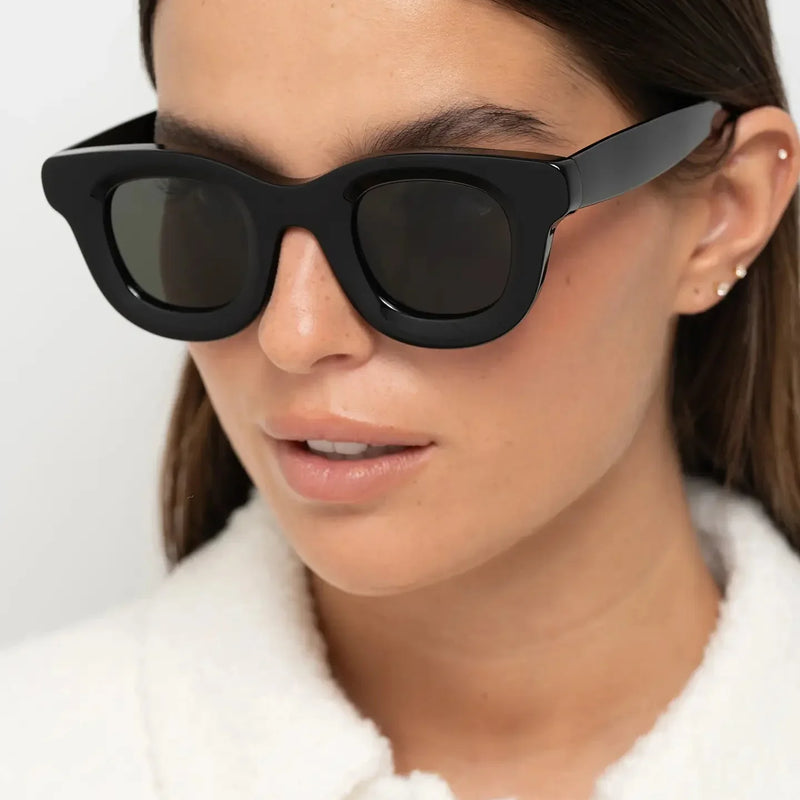
Narr Burgundy uses recognisable panto geometry rather than novelty for its own sake. Identity comes from the relationship between silhouette, acetate colour, material presence and proportion.
Bo Bo Noir uses high-quality acetate and works with specialised eyewear production facilities with extensive industry experience. This distinction matters: Portuguese creative direction is not the same claim as Portuguese manufacture. Design origin and production context should remain separate when evaluating any European eyewear brand.
Explore Bo Bo Noir if: you want strong silhouettes, expressive acetate and enough visual presence for eyewear to shape your look without depending on short-lived trends.
Consider another direction if: you specifically require manufacturing in a particular European country, prefer nearly invisible frames or want deliberately extreme conceptual eyewear.
8. How do KALEOS, Lesca and Bo Bo Noir differ?
Looking at the brands together reveals more than evaluating them separately. The important difference is where each brand places its design emphasis.
Design question
KALEOS
Lesca Lunetier
Bo Bo Noir
Core lens
Contemporary shape
Heritage continuity
Enduring identity
Visual emphasis
Changing proportion and silhouette
Material volume and generous geometry
Silhouette, proportion and controlled presence
Relationship with time
Contemporary visual culture
Archive reinterpreted for the present
Beyond short-lived trend cycles
Useful if you value...
Experimentation with shape
Material heritage and continuity
Presence with repeat-wear relevance
None of these approaches is universally superior. The comparison becomes useful when you identify which design variable matters most to you.
9. What does independence not guarantee?
Independent eyewear should not be treated as a quality certificate. Ownership structure cannot tell you whether a frame fits well, whether its proportions are resolved, whether its materials are appropriate or whether you will still want to wear it after the initial novelty disappears.
It also does not automatically mean local manufacture, handmade production, limited quantities or higher-quality materials. Those are separate claims and should be verified separately.
Claim
Ask instead
“Independent”
What does its autonomy allow the brand to do differently?
“European”
Is this describing the company, design direction, manufacture or material origin?
“Craftsmanship”
Which processes, materials or construction decisions does the word actually describe?
“Design-led”
Can you identify a coherent design language without relying on the brand name?
Price also needs separate evaluation. Production scale, materials, components, manufacturing, design development, finishing and distribution can all influence what eyewear costs, but a higher price remains different from proof of better suitability.
10. How should you choose an independent eyewear brand?
Start with the frame rather than the reputation. A useful decision sequence is:
Independence → Identity → Design → Production → Fit → Repetition
Independence: understand what the claim actually means for the company.
Identity: identify the brand's recurring point of view.
Design: examine silhouette, proportion, material, colour and visual weight.
Production: separate design origin from manufacturing origin and look for specific information.
Fit: make sure the frame works with your facial proportions and physical requirements.
Repetition: ask whether the identity you like today is something you will want to wear repeatedly.
The last step is easy to underestimate. Independent eyewear can be visually distinctive, but distinctiveness has little practical value if the frame spends most of its life in a case.
A frame you wear three times a week may deliver more value than a more dramatic design you admire but rarely choose. Repeat wear is where design identity meets everyday usefulness.
BBN Insight: ask whether the frame still works without the story
Independent brands often have compelling founders, histories and creative narratives. Those can deepen your connection to an object, but remove the biography for a moment. If the silhouette, proportion, material and fit remain convincing, the design is carrying value of its own.
11. How does design philosophy translate into actual frames?
Once you understand the principle, individual frames become easier to evaluate. Within Bo Bo Noir, different combinations of geometry, opacity and material presence demonstrate how design variables change the wearing experience without requiring a different brand philosophy.
William Crystal Peach: physical volume with softer visual weight
Translucency can soften the perceived boundary of a substantial acetate frame without removing its physical volume.
Design variable: translucent acetate combined with bold round geometry.
Visual effect: physical material remains visible, but lower opacity softens the perimeter contrast between frame and face.
Consider it if: you like bold round geometry but want less visual density than an opaque dark frame.
Consider another direction if: you want the glasses to create stronger facial definition through contrast.
Triboulet Olive: panto geometry with visible material presence
Panto geometry and visible acetate volume create a different relationship between curved lens shape, structure and material presence.
Design variable: panto geometry combined with visible acetate volume.
Visual effect: the frame becomes a more explicit part of the facial composition, while the curved lower geometry distributes that presence differently from a rectangular silhouette.
Consider it if: you want substantial acetate and a visible relationship between frame architecture and identity.
Consider another direction if: your priority is low visual weight or a quieter everyday frame.
Narr, William and Triboulet are not a hierarchy. They demonstrate the principle that should guide your comparison of independent eyewear: identify the design variable, understand its visual effect, decide whether that effect suits you and then ask whether you want to repeat it in everyday wear.
12. Frequently asked questions about independent European eyewear
What is an independent eyewear brand?
An independent eyewear brand is generally understood as a brand whose ownership or decision-making remains outside the control of a larger fashion or eyewear group. Structures vary, so independence should be verified rather than inferred from a brand's size or aesthetic.
Are independent eyewear brands better?
Not automatically. Independence can support creative autonomy and a focused identity, but quality still depends on design, materials, construction, fit, finishing and execution.
Are independent European glasses made in Europe?
Not necessarily. A brand can have its company or creative base in Europe while manufacturing elsewhere. Manufacturing origin should be checked separately from brand origin or design direction.
Why choose an independent eyewear brand?
A useful reason is a design point of view that genuinely matches what you want to wear. Independence can give a brand room to develop a coherent approach to silhouette, material, colour or construction, but the physical frame should remain the reason for the purchase.
Does independent mean handmade?
No. Independence describes company structure or control, while handmade describes aspects of production. The two claims should be evaluated separately.
Is a small eyewear brand always independent?
No. Company size and ownership are different questions. A small-looking label may have outside ownership, while an independent company can grow without necessarily losing independent control.
How can I tell whether an eyewear brand is genuinely design-led?
Look for consistency across several frames rather than one unusual product. Recurring relationships in proportion, geometry, material, colour and construction are stronger evidence of design authorship than slogans alone.
Which independent European eyewear brand should I choose?
Start with the design outcome you want rather than nationality alone. Contemporary experimentation with shape, heritage-informed material presence and controlled timelessness produce different visual effects. Compare those effects with your proportions, wardrobe and expected frequency of wear.
Is European eyewear automatically higher quality?
No. Europe has important eyewear design and manufacturing traditions, but geographic origin alone does not determine quality. Evaluate the actual frame and the specific claims made about its production.
Final thoughts
Independent European eyewear becomes interesting when independence produces a visible consequence rather than functioning as a marketing label.
KALEOS shows how autonomy can support contemporary exploration of shape. Lesca demonstrates how independence can preserve a dialogue between archive, material and modern wear. Bo Bo Noir shows another possibility: using creative control to develop strong silhouettes and a consistent design philosophy beyond short-lived trends.
The useful buying framework is therefore Independence → Identity → Design → Production → Fit → Repetition. Understand the company, identify its point of view, inspect the frame, verify the production claims that matter to you, check the fit and finally ask whether you will genuinely want to keep wearing it.
Independence gives a brand room to make clearer choices. The important question is whether those choices produce eyewear that makes sense for you.
Sources and methodology
This guide treats independence, design origin and manufacturing origin as separate claims. External brand information was checked against brand-published material where available, while the Lesca Corbs example was additionally checked against a specialist eyewear retailer listing for the model.
Discover sunglasses shaped through strong silhouettes, expressive acetate, considered proportions and a design philosophy built beyond short-lived trends.
¡Disfruta de un 10% de descuento en tu compra! Suscríbete a nuestro boletín informativo.¡Disfruta de un 10% de descuento en tu compra! Suscríbete a nuestro boletín informativo.¡Disfruta de un 10% de descuento en tu compra! Suscríbete a nuestro boletín informativo.¡Disfruta de un 10% de descuento en tu compra! Suscríbete a nuestro boletín informativo.¡Disfruta de un 10% de descuento en tu compra! Suscríbete a nuestro boletín informativo.¡Disfruta de un 10% de descuento en tu compra! Suscríbete a nuestro boletín informativo.¡Disfruta de un 10% de descuento en tu compra! Suscríbete a nuestro boletín informativo.¡Disfruta de un 10% de descuento en tu compra! Suscríbete a nuestro boletín informativo.¡Disfruta de un 10% de descuento en tu compra! Suscríbete a nuestro boletín informativo.¡Disfruta de un 10% de descuento en tu compra! Suscríbete a nuestro boletín informativo.¡Disfruta de un 10% de descuento en tu compra! Suscríbete a nuestro boletín informativo.¡Disfruta de un 10% de descuento en tu compra! Suscríbete a nuestro boletín informativo.¡Disfruta de un 10% de descuento en tu compra! Suscríbete a nuestro boletín informativo.¡Disfruta de un 10% de descuento en tu compra! Suscríbete a nuestro boletín informativo.¡Disfruta de un 10% de descuento en tu compra! Suscríbete a nuestro boletín informativo.