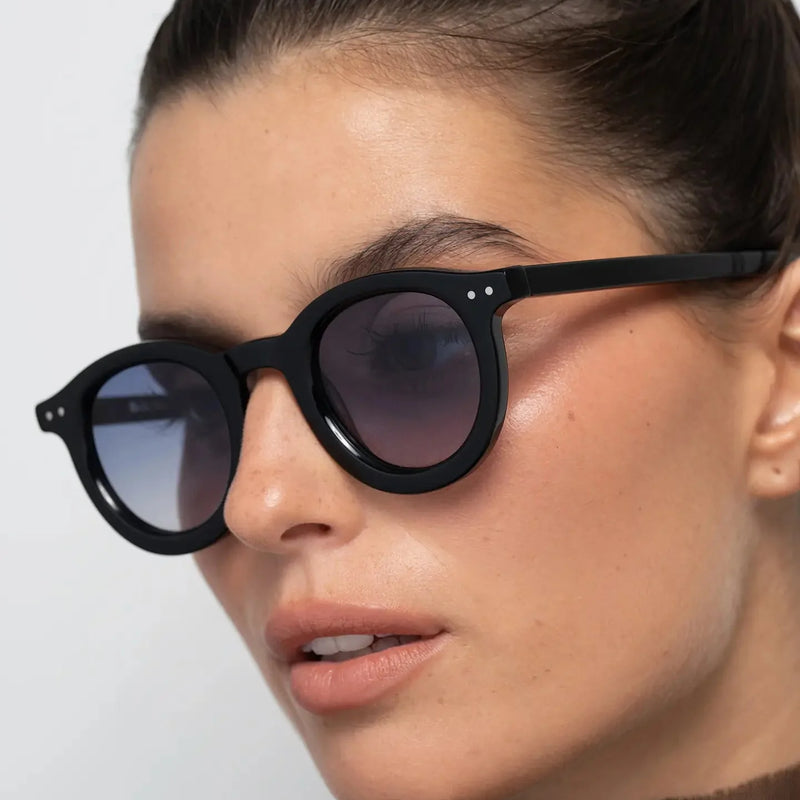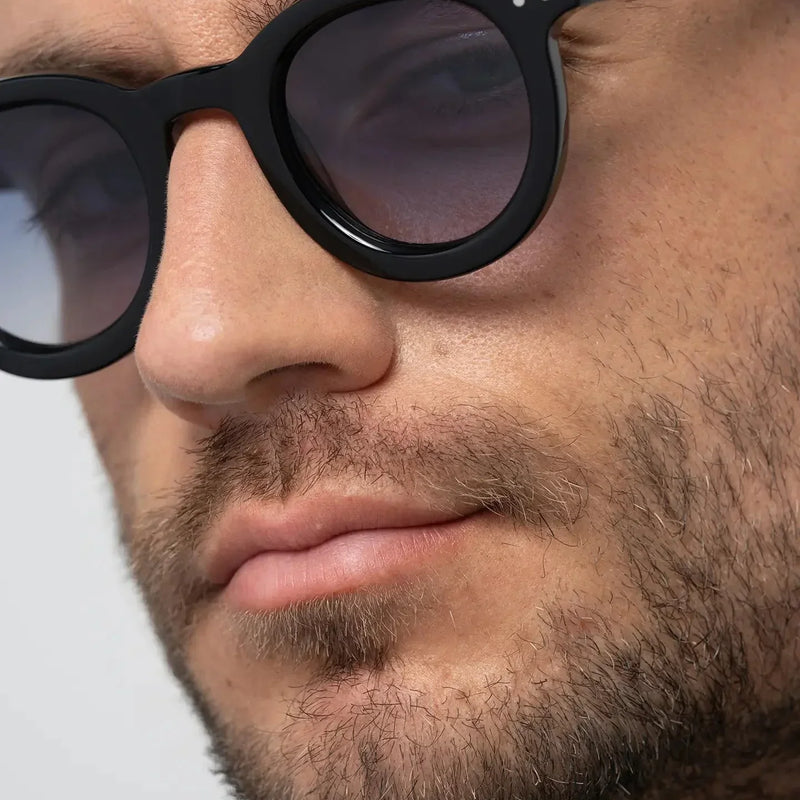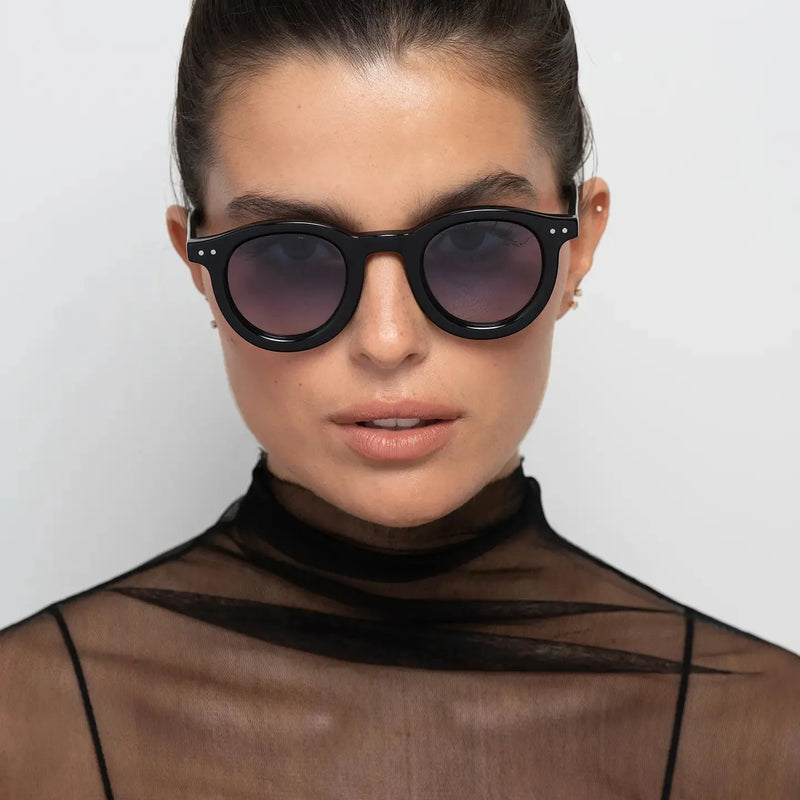
Choosing between gradient and solid lenses is not only about how sunglasses look. It affects how much brightness reaches your eyes, how easily you move between different light conditions and how comfortable the sunglasses feel during real daily use.
Gradient lenses are darker at the top and lighter at the bottom, while solid lenses keep the same tint across the full lens.
That small difference changes the way sunglasses perform. A gradient lens can feel easier when driving, walking through the city or checking your phone outdoors because the lower part of the lens lets in slightly more light. A solid lens feels more consistent in strong sunlight because the whole lens reduces brightness in the same way.
Many people choose between gradient and solid lenses based only on appearance. Gradient lenses often look softer and lighter on the face. Solid lenses usually look cleaner, stronger and more uniform. Both can be right, but they solve different visual needs.
This guide explains how each lens type works, when each one makes more sense and which Bo Bo Noir frames illustrate the difference clearly.
Quick Answer: Gradient vs Solid Lenses

Gradient lenses are usually better if you want sunglasses for driving, city use, travelling and everyday wear because they reduce overhead brightness while keeping the lower part of your vision slightly lighter. Solid lenses are usually better if you spend more time in strong sunlight and want consistent brightness reduction across the entire lens.
Choose gradient lenses if you want versatility and a lighter visual feel. Choose solid lenses if you want stronger, more uniform sun protection in bright environments.
The best lens type depends less on fashion and more on where your eyes spend the day. Gradient lenses are useful when your vision constantly moves between distance and detail. Solid lenses are useful when the light around you is consistently strong.
What Are Gradient Lenses?

Gradient lenses have a tint that changes from darker at the top to lighter at the bottom. The upper part of the lens helps reduce sunlight from above, while the lower part allows more light through when looking down.
This makes gradient lenses especially practical when you need both sun protection and visibility for closer tasks.
For example, when driving, the darker upper area helps manage bright sky and sunlight, while the lighter lower area can make it easier to see the dashboard, centre console or phone navigation. When sitting outdoors, the same effect can make reading a menu, checking a screen or looking down at a bag feel less visually heavy.
Gradient lenses are not always the strongest option for intense sunlight, but they are often one of the most comfortable choices for everyday life because daily light is rarely consistent. You move between shade, buildings, cars, streets, cafés and open spaces. A gradient lens adapts visually to that rhythm.
The Triboulet Tortoise Gradient Brown is a clear example of how gradient lenses support everyday use. The brown gradient lens softens overhead brightness while keeping the lower visual field lighter and easier to navigate.
What Are Solid Lenses?

Solid lenses have one consistent tint across the full lens. The top, middle and bottom areas all reduce brightness in the same way.
This creates a more uniform visual experience, which can be especially useful in strong sunlight or open environments.
Solid lenses are often preferred when the main goal is consistent sun protection rather than visual flexibility. If you are walking on a bright beach, spending time outdoors in strong sun or driving in very open light, a solid lens can feel steadier because there is no lighter lower section.
The trade-off is that solid lenses can feel darker when looking down at close objects. Reading a screen, checking a phone or looking at a dashboard may feel less easy depending on the lens darkness and lighting conditions.
For many people, that consistency is exactly the point. Solid lenses create a simple, reliable experience: the same tint, the same brightness reduction and the same visual character across the whole lens.
If you prefer consistent brightness reduction, the William Tortoise offers solid green lenses that create a balanced and steady visual experience for daily wear.
Gradient vs Solid Lenses for Driving

Driving is one of the situations where the difference between gradient and solid lenses becomes most noticeable. While both provide excellent UV protection when manufactured to the appropriate standard, they create different viewing experiences inside and outside the vehicle.
Gradient lenses are often preferred for everyday driving because they reduce glare from the road ahead while allowing slightly more light through the lower part of the lens.
When driving, your eyes constantly move between long-distance vision and nearby information. You look at the road, mirrors, dashboard, navigation system and instruments dozens of times every minute. A gradient lens can make these transitions feel more comfortable because the lower portion of the lens is not as dark as the upper section.
Solid lenses create a more uniform experience. The dashboard, steering wheel and centre console receive the same tint as the horizon, creating consistent brightness across your entire field of vision. Many people enjoy this because nothing changes as their eyes move.
Neither option is objectively better. If your daily routine involves commuting, city driving and frequent stops, gradient lenses often feel more practical. If you spend long periods driving in intense sunlight or open landscapes, solid lenses can provide a more uniform visual experience.
If driving represents a large part of your day, think about how often you look down at your dashboard. That simple habit can help determine whether gradient or solid lenses will feel more comfortable over time.
Which Lens Type Performs Better in Bright Sunlight?
Bright sunlight places different demands on sunglasses than everyday city use. Beaches, mountain walks, coastal roads and open countryside expose your eyes to continuous high levels of light, often with reflections from sand, water or stone.
In these situations, solid lenses usually provide a more consistent feeling because every part of the lens reduces brightness equally.
Gradient lenses still perform well in strong sunlight, especially when they are Category 3 lenses, but the lighter lower section naturally allows slightly more light through. For many people this difference is barely noticeable, while others prefer the completely even appearance of a solid lens.
The decision often depends less on protection and more on visual preference. Both lens types can offer the same UV protection. What changes is how the light feels across your field of vision.
If your sunglasses are primarily used in bright outdoor environments, the William Tortoise illustrates the advantages of a solid lens by delivering consistent brightness reduction from top to bottom.
Why Gradient Lenses Feel More Comfortable in Everyday Life
Most people do not spend their day in one lighting condition. They leave the house, walk through shaded streets, enter cafés, drive, work near windows and spend time outdoors. Everyday life is a constant mix of changing brightness.
This is exactly where gradient lenses perform particularly well.
Because the lower part of the lens is lighter, activities such as checking a phone, reading a receipt, looking inside a bag or speaking with someone seated opposite often feel more natural than they do with a uniformly dark lens.
Many wearers also appreciate the softer visual transition created by gradient lenses. Instead of creating one continuous level of darkness, they adapt more naturally to the way people actually use their eyes throughout the day.
This versatility explains why gradient lenses are especially popular among people looking for one pair of sunglasses that can comfortably move between different environments without feeling too dark.
The Jane Olive Green combines gradient brown lenses with a structured rectangular frame, creating a versatile everyday option that feels equally at home in the city, while travelling or during casual weekends.
Appearance Matters Too: The Visual Difference Between Gradient and Solid Lenses

Performance is only one part of the decision. Sunglasses are also one of the most visible accessories you wear, and the lens style changes the personality of the frame almost as much as the acetate colour.
Gradient lenses usually create a lighter, softer and more relaxed appearance, while solid lenses create a cleaner and more defined aesthetic.
A gradient lens allows more of the eyes to remain visible, making the sunglasses feel slightly less imposing. This subtle transparency often creates a more approachable look and can soften bold frame shapes.
Solid lenses create stronger visual contrast. Because the tint remains consistent across the entire lens, the sunglasses often feel more graphic and more architectural. Many classic eyewear designs rely on this clean, uninterrupted appearance.
Neither style is more fashionable than the other. The right choice depends on whether you want your sunglasses to appear lighter and more expressive or cleaner and more structured.
Many people choose gradient lenses for comfort but continue wearing them because they like how they soften the appearance of the frame. Others choose solid lenses because they appreciate the stronger visual definition they create.
The Most Common Buying Mistakes
Choosing sunglasses should never come down to appearance alone. Some of the most common disappointments happen because buyers select a lens style without considering how they actually use their sunglasses.
- Choosing gradient lenses when most use happens in extremely bright environments.
- Choosing solid lenses for frequent driving without considering dashboard visibility.
- Assuming gradient lenses provide less UV protection than solid lenses.
- Confusing frame colour with lens colour.
- Choosing based only on product photographs instead of lifestyle.
The best sunglasses are rarely the pair that looks most impressive on a product page. They are the pair that feels effortless every time you put them on.
Gradient vs Solid Lenses: A Side-by-Side Comparison

If you're still undecided, comparing both lens types side by side often makes the decision much easier. While both offer excellent protection against harmful UV rays, they create noticeably different experiences once you begin wearing them every day.
| Feature | Gradient Lenses | Solid Lenses |
|---|---|---|
| Brightness Reduction | Darker at the top, lighter below | Uniform across the lens |
| Driving | Excellent | Very Good |
| Reading Outdoors | Excellent | Good |
| Strong Sunlight | Very Good | Excellent |
| Visual Consistency | Moderate | Excellent |
| Versatility | Excellent | Very Good |
| Style | Softer appearance | Cleaner appearance |
| Best For | Driving, travel and daily wear | Bright sunlight and outdoor activities |
Rather than asking which lens is objectively better, ask which one better reflects how you spend your day. Your lifestyle is usually a far more reliable guide than trends or personal recommendations.
How to Choose the Right Lens for Your Lifestyle

Most people don't need several pairs of sunglasses for different situations. They need one pair that performs well most of the time. That's why understanding your own routine is far more valuable than following general advice.
If your day includes commuting, driving, walking through the city, travelling or frequently moving between indoors and outdoors, gradient lenses are often the more versatile option.
If your sunglasses are mainly used during holidays, beach days, countryside walks, mountain trips or prolonged exposure to strong sunlight, solid lenses usually provide the more consistent experience.
Your visual habits matter just as much as your environment.
- Do you often check your phone outdoors?
- Do you drive every day?
- Do you spend more time in cities than in nature?
- Do you normally wear your sunglasses for several hours continuously?
- Do you prefer maximum brightness reduction or visual flexibility?
The answers to these questions often make the decision much easier than comparing technical specifications.
Buy sunglasses for the life you actually live, not for the situations you imagine. The pair you enjoy wearing every day will always provide more value than the pair that only feels perfect in one specific environment.
Our Recommendations
Understanding the theory is useful, but seeing how these lens types are applied to real frames makes the choice much easier.
We recommend the Triboulet Tortoise Gradient Brown. Its Category 3 gradient brown lenses combine everyday comfort with a timeless panto silhouette, making it particularly well suited to driving, travelling and urban lifestyles.
If you prefer a bolder rectangular aesthetic, the Jane Olive Green offers the same everyday versatility through gradient brown lenses paired with a modern acetate frame.
The William Tortoise demonstrates why solid lenses remain one of the most versatile choices for everyday wear. Its solid green lenses deliver consistent brightness reduction while maintaining a calm, balanced visual experience.
Final Verdict: Gradient or Solid?
Neither gradient lenses nor solid lenses are universally better. Both can provide excellent UV protection, high visual comfort and long-term wearability when chosen for the right environment.
Gradient lenses are generally the better choice for everyday versatility. Solid lenses are generally the better choice for visual consistency in bright sunlight.
If you spend most of your day moving between different lighting conditions, driving, travelling or walking around town, gradient lenses will probably feel more natural.
If your sunglasses spend most of their time outdoors under strong sunlight, solid lenses will usually provide the more consistent visual experience.
Ultimately, the best sunglasses are the ones that disappear once you put them on. When your eyes feel comfortable and you stop thinking about the lenses altogether, you've probably made the right choice.
Key Takeaways

- Gradient lenses are darker at the top and lighter at the bottom.
- Solid lenses maintain the same tint across the entire lens.
- Both lens types can provide the same level of UV protection.
- Gradient lenses are especially useful for driving because they make dashboards and navigation screens easier to view.
- Solid lenses provide more consistent brightness reduction in strong sunlight.
- Gradient lenses are ideal for everyday wear, commuting and travelling.
- Solid lenses are well suited to beaches, mountains and prolonged outdoor exposure.
- Lens performance depends on tint category and UV protection, not whether the lens is gradient or solid.
- The best choice depends on your daily routine rather than fashion trends.
- Choose sunglasses that match how you actually use them, not just how they look.
Frequently Asked Questions
Are gradient lenses better than solid lenses?
Neither is objectively better. Gradient lenses are generally better for everyday versatility, driving and changing light conditions, while solid lenses are usually better for consistent brightness reduction in strong sunlight.
Do gradient lenses provide the same UV protection as solid lenses?
Yes. UV protection depends on how the lenses are manufactured, not on whether they are gradient or solid. A quality gradient lens can provide the same UV400 protection as a solid lens.
Are gradient lenses good for driving?
Yes. Gradient lenses are often considered one of the most comfortable options for driving because the darker upper section reduces glare while the lighter lower section makes dashboards and navigation displays easier to read.
Are solid lenses better for bright sunlight?
In very bright environments, many people prefer solid lenses because they reduce brightness evenly across the entire field of vision, creating a more consistent viewing experience.
Can I wear gradient lenses every day?
Absolutely. Gradient lenses are designed for everyday use and are particularly suitable for commuting, city life, travelling and situations where lighting conditions change throughout the day.
Do gradient lenses look lighter than solid lenses?
Yes. Because the lower part of the lens is lighter, gradient lenses usually create a softer appearance and allow slightly more of the eyes to remain visible.
Do solid lenses look darker?
Generally yes. Since the tint remains uniform across the lens, solid lenses often create a cleaner and more defined appearance.
Can gradient lenses be worn at the beach?
Yes. High-quality Category 3 gradient lenses perform well at the beach. However, some people prefer solid lenses if they spend long periods in intense sunlight because the tint remains equally dark across the whole lens.
Which lens type is more versatile?
Gradient lenses are generally considered the more versatile option because they adapt well to a wider variety of everyday situations, from driving to walking through the city.
Which lens type is more comfortable?
Comfort depends on your lifestyle. People who regularly drive or move between different lighting conditions often prefer gradient lenses, while people who spend long periods outdoors frequently prefer solid lenses.
Do gradient lenses make it easier to use a phone?
They can. The lighter lower section often makes it more comfortable to check a phone, read a menu or look at close objects without feeling that everything is too dark.
Do solid lenses reduce glare better?
Not necessarily. Glare reduction depends on the lens quality, tint category and, where applicable, polarisation—not simply on whether the lens is gradient or solid.
Should I choose based on style or performance?
Both matter. The best sunglasses combine the visual appearance you enjoy with the performance your daily routine requires.
Which Bo Bo Noir sunglasses feature gradient lenses?
The Triboulet Tortoise Gradient Brown and the Jane Olive Green both use gradient brown Category 3 lenses designed for comfortable everyday wear.
Which Bo Bo Noir sunglasses feature solid lenses?
The William Tortoise features solid green Category 3 lenses that provide balanced brightness reduction across the entire lens.
Explore More Sunglasses Guides
If you're comparing different lens technologies, colours and frame styles, these guides will help you make a more confident decision before choosing your next pair of sunglasses.
Green vs Brown Sunglasses
Discover how green and brown lenses influence colour perception, contrast, driving and outdoor visibility.
Read the guide →
Brown vs Grey Sunglasses
Learn how warm and neutral lenses perform in different lighting conditions and everyday situations.
Read the guide →
Black vs Tortoise Sunglasses
Compare two of the world's most versatile frame colours and discover which works best for your wardrobe and face shape.
Read the guide →
Warm vs Cool Tone Sunglasses
Understand how frame colours interact with skin tone and how to choose sunglasses that naturally complement your complexion.
Read the guide →
What Makes Sunglasses Look Flattering?
Learn how frame shape, proportions and facial balance influence the way sunglasses look when you wear them.
Read the guide →
The Bo Bo Noir Perspective
Sunglasses should do more than protect your eyes. They should make everyday life more comfortable, feel natural to wear and complement your personal style without demanding attention.
At Bo Bo Noir, lens selection is considered alongside frame shape, acetate colour and overall balance. Whether you prefer the versatility of gradient lenses or the consistency of solid lenses, the best choice is always the one that fits the way you live.
If your days involve commuting, travelling and moving between different environments, a gradient lens such as the Triboulet Tortoise Gradient Brown or the Jane Olive Green offers versatility without compromising protection.
If you prefer a more uniform visual experience, the William Tortoise demonstrates how solid lenses deliver balanced brightness reduction with a timeless round silhouette.
Rather than following trends, choose the sunglasses that match your daily routine. The pair you enjoy wearing every day is always the right investment.