Free Worldwide Shipping • 14-Day Returns • Designed in PortugalFree Worldwide Shipping • 14-Day Returns • Designed in PortugalFree Worldwide Shipping • 14-Day Returns • Designed in PortugalFree Worldwide Shipping • 14-Day Returns • Designed in PortugalFree Worldwide Shipping • 14-Day Returns • Designed in PortugalFree Worldwide Shipping • 14-Day Returns • Designed in PortugalFree Worldwide Shipping • 14-Day Returns • Designed in PortugalFree Worldwide Shipping • 14-Day Returns • Designed in PortugalFree Worldwide Shipping • 14-Day Returns • Designed in PortugalFree Worldwide Shipping • 14-Day Returns • Designed in PortugalFree Worldwide Shipping • 14-Day Returns • Designed in PortugalFree Worldwide Shipping • 14-Day Returns • Designed in PortugalFree Worldwide Shipping • 14-Day Returns • Designed in PortugalFree Worldwide Shipping • 14-Day Returns • Designed in PortugalFree Worldwide Shipping • 14-Day Returns • Designed in Portugal
The strongest emerging Spring/Summer 2027 sunglasses trends are not pointing toward one dominant shape. Instead, eyewear is moving across a wider visual spectrum: some frames are becoming more curved, substantial and enclosing, while others are becoming thinner, lighter, more transparent and deliberately less dominant on the face.
That makes SS27 more useful to understand through visual effect than through trend labels alone. Shield sunglasses, chunky and narrow ovals, softened aviators, gentler cat-eyes, thin round metal frames and translucent materials can all feel current, yet they create very different relationships with facial width, brow position, contrast, lens depth and visual weight.
The wider Eyewear Trends 2027 picture already includes renewed interest in material, transparency, colour and familiar silhouettes. This guide has a narrower purpose: which directions are emerging specifically for Spring/Summer 2027, what do they actually do to the face, and which are most useful to wear?
The international SS27 fashion season is still developing, so these are not presented as a final verdict on every runway collection. They are the strongest directions currently supported by professional eyewear forecasting, early SS27 fashion reporting and observed seasonal street style. That distinction matters: a useful trend guide should separate evidence from prediction.
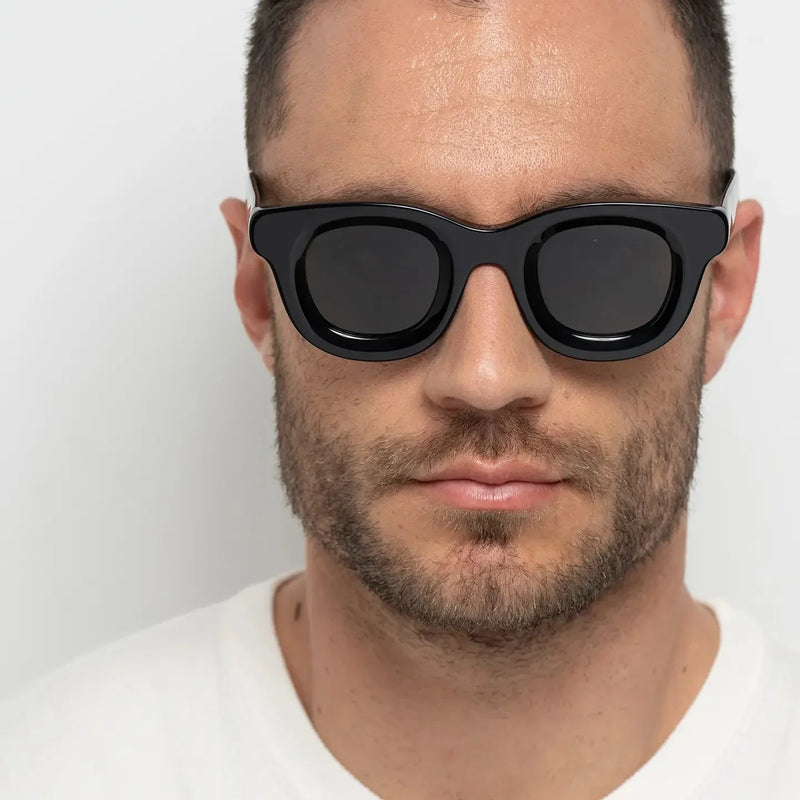
One side of the SS27 spectrum is about stronger facial presence. Substantial acetate demonstrates how scale and contrast can make sunglasses a defining part of the upper face without requiring a shield or wrap construction.
Quick Answer
The strongest emerging Spring/Summer 2027 sunglasses directions include shield and wraparound frames, chunky and narrow ovals, softened aviators and D-shapes, gentler cat-eyes, thin round metal frames, translucent materials and more expressive colour. There is no single dominant silhouette. The larger shift is toward more intentional differences in scale, curve and visual weight. Some frames enclose more of the face; others reveal more of it. The most useful way to choose is through Shape → Scale → Curve → Contrast → Context, not by following a trend name alone.
BBN Insight
SS27 is not choosing between bold and minimal. It is making the distance between them more visible. Shields, wraps and substantial frames increase facial enclosure. Thin metal, compact geometry and transparency create more openness. The real seasonal shift is the growing range of visual presence available to the wearer.
1. What are the biggest sunglasses trends for Spring/Summer 2027?
The clearest emerging SS27 directions are shields and sport-influenced wraps, oval frames at both substantial and narrow scales, softened aviators and D-shapes, less severe cat-eyes, lightweight round metal frames, translucent materials and a wider use of expressive colour.
These directions are supported by current eyewear forecasting and early Spring/Summer 2027 fashion reporting, but they should not be understood as equally dominant or universally wearable. Some are strong directional signals; others are broader evolutions of shapes that never truly disappeared.
The useful question is therefore not simply what is trending? It is what variable is changing? In some cases it is curvature. In others it is lens depth, material thickness, opacity, colour or the relationship between the brow and the frame.
A seasonal trend becomes useful when you can explain the visual change behind the name.
2. What is really changing in SS27 sunglasses?
The strongest macro shift is not one silhouette replacing another. It is a widening distance between facial enclosure and facial openness.
Shields and wraps extend around the face and create more continuous coverage. Chunky acetate adds material volume. At the opposite end, thin metal reduces the frame almost to an outline, while transparency allows substantial material to remain physically present without creating the same continuous visual boundary as opaque acetate.
More openness: thin metal → compact structure → transparency → lower contrast.
Neither direction is automatically better. The relevant question is how much of the face you want the sunglasses to visually control.
This distinction is more informative than declaring that sunglasses are simply getting bigger, smaller or bolder. SS27 is supporting several opposing answers at once.
3. Why are shield and wrap sunglasses becoming more important?
Shield and wraparound sunglasses are among the clearest directional signals currently visible for SS27. Copenhagen Spring 2027 street-style coverage has already highlighted shields prominently, while broader eyewear reporting continues to track sport-influenced masks and curved frames.
Their importance is not simply that they look sporty or futuristic. Curvature changes the architecture of the sunglasses. A conventional frame is read mainly as a front plane. A wrap continues around the side of the head, creating a more continuous relationship between lens, temple and face.
This produces greater facial enclosure. The sunglasses occupy more of the upper face, peripheral structure becomes visually important and a single large lens can create a stronger uninterrupted colour field than two conventional lenses.
That can be powerful when the wearer deliberately wants sport-tech identity, stronger coverage or an unmistakable seasonal statement. The trade-off is a narrower styling range: the more technical the curvature and lens treatment, the more the sunglasses may influence the rest of the outfit.
BBN Insight: curve changes perceived width
A shield is not simply a wider pair of sunglasses. A relatively flat wide frame concentrates width in the front view. A wrap distributes that line around the head. Similar nominal dimensions can therefore create very different levels of enclosure.
Bo Bo Noir does not currently offer a true shield or sport wrap, so there is no product image inserted here simply to imitate the trend. If you prefer strong facial presence without full wrap curvature, bold sunglasses without looking overpowering explains how acetate scale and contrast create a different route to presence.
4. Why do both chunky and narrow oval sunglasses matter?
Oval sunglasses are one of the more revealing SS27 directions because the same shape family is appearing at opposite scales. One version becomes thick, broad and materially present. Another becomes compact, shallow and noticeably more directional.
A chunky oval combines curvature with visible frame mass. It can soften angular facial relationships while still making eyewear an important part of the face. A narrow oval reduces lens height and compresses the silhouette vertically, increasing horizontal emphasis even when the overall frame is smaller.
That is why “oval sunglasses are trending” is incomplete advice. Scale can change the visual meaning of the geometry more than the category itself.
Oval direction
Visual effect
Useful when
Trade-off
Chunky oval
Curvature with material presence
You want rounded geometry that remains visible
Can dominate when scale exceeds the face
Narrow oval
Compact horizontal direction
You want a clearer seasonal fashion signal
Lower lens depth can be more trend-specific
Shape describes the family. Scale determines much of the effect.
5. Why are aviator sunglasses looking softer?
The emerging SS27 aviator story is better understood as recalibration rather than revival. Pilot-inspired sunglasses never disappeared completely. What is changing is how their familiar geometry is being softened through colour, lens treatment, material and modified D-shaped or navigator-like proportions.
Traditional aviators often communicate their identity through thin metal, a pronounced bridge and recognisable teardrop lens depth. Warmer transparent materials, amber or gradient lenses and flatter lower lines can reduce that severity without removing the underlying reference.
This gives the direction a relatively broad wearability range. The cultural familiarity of the shape creates stability while smaller changes in material and colour make the frame feel current.
The important SS27 change is not that aviators are suddenly fashionable again. It is that the aviator vocabulary is becoming less rigid.
6. How is the cat-eye changing for SS27?
Cat-eye sunglasses remain relevant, but current SS27 reporting points toward a softer interpretation. The outer corners still lift, yet the silhouette is less dependent on a severe point or exaggerated retro gesture.
That changes the facial effect. A sharp cat-eye concentrates attention at the outer brow and creates obvious directional tension. A softer version distributes the lift through a rounder line, preserving definition while reducing the feeling that the entire frame is built around one dramatic corner.
This is a good example of how SS27 can update an established shape without replacing it. The trend sits in the degree of execution, not merely in the category.
Controlled lift may prove more useful than exaggerated sharpness for wearers who want a cat-eye beyond occasional styling.
7. Are thin round and metal sunglasses returning?
Thin round sunglasses and lightweight metal are emerging alongside shields and substantial acetate, making them an important counterpoint to the high-presence side of SS27.
Thin metal reduces the visible boundary of the frame. More skin remains visible around the eyes, lens colour becomes proportionally more important and the brow can remain visually separate from the eyewear rather than being absorbed into a substantial rim.
Round geometry can soften the result, but scale still matters. A compact metal round can look precise and deliberate; a larger round can create more openness. Coloured lenses can then transform an otherwise minimal structure into a stronger visual statement.
For the material decision itself, Acetate vs Metal Glasses explains how the two constructions differ in presence, structure and everyday character.
BBN Insight: material presence and visual presence are not the same thing
A frame can contain substantial material and still appear visually lighter if transparency lowers its contrast with the face. Conversely, an extremely thin metal frame can become highly visible through a dark or strongly coloured lens. SS27 repeatedly separates physical scale from perceived intensity.
8. Why does transparency matter for summer sunglasses?
Transparency remains relevant because it allows eyewear to retain physical volume without producing the same visual density as opaque material. This makes it particularly useful when the wearer likes substantial geometry but wants the frame to feel more open.
In stronger spring and summer light, translucent acetate also reveals more depth, edge reflection and internal colour variation. A crystal frame can therefore remain visibly designed while creating a softer continuous boundary around the eyes.
This is different from saying that transparent sunglasses are automatically easier to wear. Saturation still matters. Crystal peach, crystal yellow and clear acetate can all transmit light while creating very different colour relationships with the face.
Transparency demonstrates the distinction between physical and visual weight. The acetate remains substantial, but transmitted light prevents the rim from reading as one uninterrupted dark boundary.
Transparency works best when it performs a visual function, not merely when it signals summer.
9. Which sunglasses colours are emerging for SS27?
Current SS27 forecasting points toward several colour families rather than one definitive shade: nature-based greens, blues, fresher pinks and warm earth tones including orange, terracotta and brown. Wider SS27 fashion reporting is also showing a stronger appetite for expressive colour.
For sunglasses, however, the useful variable is not only hue. Opacity, placement and surface area change how colour behaves. A translucent orange acetate frame creates a different effect from solid orange. Blue lenses inside tortoise do not behave like blue acetate. A deep burgundy frame carries colour while retaining considerably more visual density than crystal peach.
That distinction matters because frame colour, lens colour and material transparency can either reinforce one another or create deliberate contrast.
Muted green demonstrates why colour trend analysis should happen on the face. The hue adds identity, while its lower severity compared with solid black changes how strongly the rectangular geometry registers.
The useful SS27 colour question is not only “which shade?” but “how much visual territory does that shade occupy?”
10. Why does proportion matter more than the trend name?
A trend label identifies what to notice. It does not tell you whether the actual frame will work. “Oval”, “aviator”, “shield” and “cat-eye” say nothing precise about width, lens height, bridge relationship, brow position, rim thickness or wrap curvature.
Those variables determine the effect. A narrow oval can increase horizontal emphasis while reducing vertical coverage. A chunky oval can soften angularity but add considerable material mass. A wide shield may feel even more enclosing because its curve continues beyond the visible front.
The same principle applies to acetate. Two frames can have similar external dimensions and feel completely different because one has thick dark rims while another uses translucent material.
A trend label tells you what is current. Proportion tells you what it will do. Two people can both like the oval trend and need completely different versions because one wants softer curvature while the other wants compact horizontal direction.
11. Which SS27 sunglasses trends are easiest to wear every day?
The emerging directions with the broadest everyday adaptability are generally those that modify familiar geometry without demanding a highly specific styling context. Softer aviators, gentler cat-eyes, balanced round forms and translucent acetate can all look current while remaining compatible with work, travel, weekends and normal city wear.
That does not make them superior to shields or narrow ovals. It simply means their wearability range tends to be broader. Trend strength and practical versatility are different variables.
Colour can also remain highly wearable when its contrast is controlled. Tortoise, olive, burgundy and warm transparent tones can introduce identity without requiring the frame to dominate every outfit.
If frequency matters more than seasonal impact, Best Everyday Sunglasses is the more useful next guide.
Everyday adaptability is not the absence of fashion. It is the ability of a fashion direction to survive ordinary use.
12. Which SS27 trends are more directional?
Shields, aggressive sport wraps and very narrow ovals currently carry some of the clearest seasonal signals. They alter familiar eyewear proportions more visibly than a softened aviator or a change in acetate transparency.
That higher trend visibility can be useful. A strongly directional frame can transform simple clothing, create identity quickly and make eyewear the focal point of the upper face.
The trade-off is contextual. Mirrored shields and highly technical wraps may make sense in a sport-influenced or minimal wardrobe and feel considerably more demanding in conservative environments. A very narrow oval can feel precise and current while providing less coverage and a more recognisable period signal.
SS27 direction
Trend visibility
Everyday adaptability
Main effect
Shield / wrap
High
Lower
Curved facial enclosure
Chunky oval
Medium-high
Medium
Rounded material presence
Narrow oval
High
Medium-low
Compact horizontal direction
Soft aviator / D-shape
Medium
High
Familiar depth with softer severity
Soft cat-eye
Medium
High
Controlled outer lift
Thin round metal
Medium
Medium-high
Reduced material presence
Translucent acetate
Medium
High
Volume with reduced contrast
Trend visibility is not wearability. Treating them as separate variables makes seasonal buying decisions much clearer.
13. How should you choose an SS27 trend for your face?
Do not begin with the question “which trend suits my face shape?” Begin with what do I want the sunglasses to change? Face-shape categories describe broad geometry, but they do not tell you whether you want more width, more definition, greater softness, lower contrast or stronger upper-face presence.
If you want horizontal impact, a wider frame or lower lens depth may help. If you want to soften angular relationships, oval or rounded geometry may be useful. If substantial material feels too heavy visually, transparency can reduce frame-to-face contrast without requiring a smaller silhouette.
Brow position also changes the result. A deep shield that obscures the brow creates greater enclosure than a thin round frame that allows the brow to remain clearly visible. The same person could wear both successfully while producing completely different facial effects.
The BBN SS27 framework separates a fashionable label into five variables that are much more useful for an actual purchase decision.
Shape
Identify the basic geometry: oval, panto, round, cat-eye, pilot, rectangle or shield. Shape establishes the starting visual direction, but it does not determine the final result.
Scale
Look at width and lens depth. Scale determines how much territory the sunglasses occupy and whether the geometry feels compact, balanced or intentionally oversized.
Curve
Determine whether the frame behaves mainly as a front plane or wraps visibly around the side of the head. Curvature is especially important when evaluating shields and sport-inspired eyewear.
Contrast
Read frame colour, opacity and lens colour together. Opaque dark acetate creates a stronger boundary; transparency softens it; coloured or mirrored lenses can become major visual fields of their own.
Context
Decide where the frame needs to work. Everyday, holiday, sport-influenced and deliberately directional sunglasses do not need the same degree of versatility.
Shape → Scale → Curve → Contrast → Context
If you only know that a frame is “an SS27 oval” or “a trending shield”, you still do not know enough to predict how it will work. The five variables turn fashion information into a practical eyewear decision.
15. Which Bo Bo Noir frames connect naturally with SS27?
Not every Spring/Summer 2027 direction has a Bo Bo Noir equivalent, and it should not. The current collection is built around round, panto and rectangular sunglasses rather than shields, technical wraps or metal aviators. Product examples are useful only where the underlying visual principle genuinely overlaps.
Triboulet Shiny Black demonstrates stronger facial presence through substantial panto geometry and opaque black acetate. It does not imitate a shield. Instead, it shows how material scale and contrast can produce a strong upper-face effect through conventional acetate construction.
Consider it if: you are interested in the more substantial side of SS27 but do not want sport-wrap curvature.
Consider another direction if: lower contrast, thin metal or compact scale is what attracted you to the season.
William Crystal Peach sits closer to the transparent side of SS27. Its rounded geometry remains substantial, but translucent acetate reduces the continuity of the frame boundary and demonstrates how material volume can be separated from visual heaviness.
Consider it if: you want visible geometry without the intensity of opaque black acetate.
Consider another direction if: your preferred SS27 effect is sharp horizontal compression or technical wrap styling.
Jane Olive Green illustrates how one of the season's nature-based colour families can work through a strong rectangular silhouette. The olive tone keeps the frame visibly coloured while creating a different level of contrast from solid black.
Consider it if: you want colour to be noticeable but still integrated into everyday clothing.
Consider another direction if: rounded geometry or a lower-presence transparent frame is more consistent with your style.
The objective is not to make the Bo Bo Noir collection fit every trend. It is to identify where an SS27 idea already aligns with a genuine design variable in the collection.
16. Common mistakes when buying trend-led sunglasses
Choosing the trend name instead of the frame
Two oval sunglasses can produce very different effects. Evaluate width, lens depth, bridge, material and brow position rather than buying the category.
Assuming the strongest trend is the easiest to wear
A shield may currently be a clearer directional signal than a softened aviator, but that does not make it more adaptable to every wardrobe.
Ignoring curvature
Wraps interact with the head differently from flat-front sunglasses. Width measurements alone cannot tell you how enclosing they will feel.
Treating colour as hue alone
Solid green acetate, translucent green acetate and green lenses can belong to the same colour family while creating completely different facial contrast.
Using face shape as a rigid rule
The same face shape can support different sunglasses depending on whether the wearer wants structure, softness, width, openness or stronger contrast.
Buying the campaign instead of the sunglasses
Strong styling can make a highly directional frame look inevitable. Imagine the sunglasses with your normal clothing before deciding that the visual language belongs to you.
Ignoring fit because the trend looks right
Trend relevance cannot compensate for poor bridge contact, excessive width, temple pressure or cheek interference.
17. Frequently asked questions about 2027 sunglasses trends
What sunglasses are trending for Spring/Summer 2027?
The strongest emerging directions include shields and wraps, chunky and narrow ovals, softened aviators, gentler cat-eyes, thin round metal frames, translucent materials and expressive colour. Because the full international SS27 season is still developing, these are best understood as current directional signals rather than a final ranking of the season.
Are shield sunglasses in style for 2027?
Shield sunglasses are one of the clearest directional signals currently visible for SS27. Copenhagen Spring 2027 street style has already highlighted the silhouette, while sport-inspired masks and wraps continue to appear in eyewear reporting.
Are oval sunglasses in style in 2027?
Yes, with both chunky and narrow versions emerging. The chunky oval combines curvature with frame presence; the narrow oval compresses lens depth and creates a more directional horizontal effect.
Are aviator sunglasses coming back in 2027?
Aviators never fully disappeared. The more relevant SS27 shift is toward softer interpretations through transparent material, warmer lens colours and D-shaped or navigator-like adjustments.
Are cat-eye sunglasses still fashionable in 2027?
Yes. Current SS27 direction suggests a softer cat-eye with controlled outer lift rather than relying only on an exaggerated sharp point.
Are small sunglasses returning in 2027?
Narrow compact ovals are one visible direction, but they coexist with large shields and substantial frames. SS27 is therefore expanding the difference between compact and high-coverage eyewear rather than moving uniformly toward smaller sunglasses.
Are oversized sunglasses still in style in 2027?
Oversized scale remains relevant through shields, wraps and substantial rounded forms. Curvature, lens depth and material thickness determine whether that scale feels technical, sculptural or more traditionally glamorous.
What sunglasses colours are trending for 2027?
Current SS27 forecasting includes greens, blues, pinks and warm earth tones such as orange, terracotta and brown. The effect depends strongly on whether the colour appears in the frame, lens or translucent material.
Are transparent sunglasses still in style?
Transparency remains relevant because it allows substantial geometry to appear visually lighter. It is especially useful when the wearer wants material presence without a continuous opaque boundary around the eyes.
Which 2027 sunglasses trends are easiest to wear every day?
Softer aviators, controlled cat-eyes, balanced round forms and translucent acetate generally offer broader everyday adaptability than technical shields or extremely narrow proportions.
Should I buy sunglasses just because they are trending?
No. Use trends to discover possibilities, then evaluate shape, scale, curve, contrast and context. A current frame becomes a useful purchase only when its visual effect also makes sense for you.
18. Final thoughts: SS27 is widening the possibilities of sunglasses
Spring/Summer 2027 is not currently pointing toward one universal replacement for last season's sunglasses. The stronger story is the growing distance between different kinds of visual presence.
Shields and wraps increase curvature and facial enclosure. Chunky frames create presence through material. At the opposite end, thin metal and compact structures expose more of the face, while transparency preserves physical scale with lower visual density.
Between those extremes sit softer aviators, controlled cat-eyes and familiar geometries adjusted through proportion, lens colour and material. Their seasonal relevance comes from reinterpretation rather than complete replacement.
Colour adds another layer but cannot be separated from opacity and surface area. A hue in a translucent rim, opaque frame or large shield lens will produce three different visual effects.
That gives us the practical SS27 model: Shape → Scale → Curve → Contrast → Context. It turns trend information into a decision about how sunglasses actually interact with the face.
The most useful Spring/Summer 2027 sunglasses trend is not necessarily the one that looks most current. It is the one whose visual effect makes the most sense when the trend label is removed.
Sources and methodology
This article distinguishes between established annual eyewear directions and emerging Spring/Summer 2027 signals. At the time of writing, the full international SS27 womenswear cycle has not yet concluded, so directional claims are based on current professional forecasting and early seasonal evidence rather than presented as a completed runway consensus.
The Bo Bo Noir analysis adds a separate decision layer: how each direction changes scale, facial enclosure, contrast, visual weight and real-world wearability.
Choose the effect, not just the trend.
Explore Bo Bo Noir sunglasses through round, panto and rectangular silhouettes designed around proportion, material and individual presence.
Enjoy a 10% discount on your purchase! Sign up for our newsletter now.Enjoy a 10% discount on your purchase! Sign up for our newsletter now.Enjoy a 10% discount on your purchase! Sign up for our newsletter now.Enjoy a 10% discount on your purchase! Sign up for our newsletter now.Enjoy a 10% discount on your purchase! Sign up for our newsletter now.Enjoy a 10% discount on your purchase! Sign up for our newsletter now.Enjoy a 10% discount on your purchase! Sign up for our newsletter now.Enjoy a 10% discount on your purchase! Sign up for our newsletter now.Enjoy a 10% discount on your purchase! Sign up for our newsletter now.Enjoy a 10% discount on your purchase! Sign up for our newsletter now.Enjoy a 10% discount on your purchase! Sign up for our newsletter now.Enjoy a 10% discount on your purchase! Sign up for our newsletter now.Enjoy a 10% discount on your purchase! Sign up for our newsletter now.Enjoy a 10% discount on your purchase! Sign up for our newsletter now.Enjoy a 10% discount on your purchase! Sign up for our newsletter now.