Free Worldwide Shipping • 14-Day Returns • Designed in PortugalFree Worldwide Shipping • 14-Day Returns • Designed in PortugalFree Worldwide Shipping • 14-Day Returns • Designed in PortugalFree Worldwide Shipping • 14-Day Returns • Designed in PortugalFree Worldwide Shipping • 14-Day Returns • Designed in PortugalFree Worldwide Shipping • 14-Day Returns • Designed in PortugalFree Worldwide Shipping • 14-Day Returns • Designed in PortugalFree Worldwide Shipping • 14-Day Returns • Designed in PortugalFree Worldwide Shipping • 14-Day Returns • Designed in PortugalFree Worldwide Shipping • 14-Day Returns • Designed in PortugalFree Worldwide Shipping • 14-Day Returns • Designed in PortugalFree Worldwide Shipping • 14-Day Returns • Designed in PortugalFree Worldwide Shipping • 14-Day Returns • Designed in PortugalFree Worldwide Shipping • 14-Day Returns • Designed in PortugalFree Worldwide Shipping • 14-Day Returns • Designed in Portugal
Choosing optical frames is different from choosing eyewear for occasional use. Prescription glasses may stay on your face through work, travel, conversation, screens, changing clothes and different social settings. A frame that feels exciting for thirty seconds in front of a mirror still has to make sense after eight hours of wear.
That changes the decision. Shape and colour matter, but so do facial proportions, visual weight, physical fit, prescription requirements and how naturally the frame fits into your everyday identity. While Eyewear Trends 2027 explores the broader design directions shaping contemporary frames, choosing glasses for everyday wear requires a different filter: how well those ideas survive prescription needs and repetition.
The most useful question is therefore not simply “Do I like these glasses?” It is “Will I still want to wear them when the novelty has disappeared?”
Everyday optical frames have to work through repetition, not only at first impression.
Quick answer: Choose everyday optical frames by evaluating five things together: fit, facial proportion, visual weight, prescription compatibility and repetition. The right frame should sit securely, create the facial effect you want, work with your lenses and remain visually convincing across the situations in which you actually wear glasses.
BBN Insight: A frame can have high first-impression appeal and low repetition value. Everyday eyewear needs both. The strongest choice is not necessarily the frame that creates the biggest reaction when you first put it on, but the one whose character still feels intentional after hundreds of wears.
What makes an optical frame good for everyday wear?
A good everyday optical frame combines physical compatibility and visual compatibility. Physical compatibility means the frame fits securely, works with the intended prescription and remains comfortable during extended wear. Visual compatibility means its geometry, scale, material and colour create an effect you continue to like on your face.
These two forms of compatibility cannot be separated completely. A beautiful frame that constantly slides down the nose will become irritating. A technically comfortable frame whose proportions never feel right may remain in its case.
Everyday eyewear succeeds when neither function nor identity has to compensate for the other.
A useful test: imagine the frame with your most ordinary clothes, on a long working day and in a photograph you did not prepare for. If it only feels convincing in the ideal mirror moment, it may not yet be an everyday frame.
First-impression appeal vs repetition value
Trying on glasses naturally rewards novelty. A different colour, stronger silhouette or unfamiliar proportion can attract attention precisely because it changes how you normally see yourself.
That reaction is useful, but it should not be confused with long-term compatibility.
First-impression appeal describes how strongly a frame interests you when you first see yourself wearing it. Repetition value describes whether the same visual effect remains useful after the novelty has faded.
This distinction matters more with prescription glasses because they are often worn repeatedly and for long periods. The visual decision is not experienced once. It becomes part of your face.
Question
First-impression appeal
Repetition value
What does it measure?
Immediate attraction
Long-term usefulness
What drives it?
Novelty, contrast, change
Fit, proportion, identity, versatility
Main risk
Buying for the mirror moment
Choosing something so cautious that it lacks identity
The goal is not to eliminate excitement. It is to find a frame whose character survives familiarity.
Start with fit before thinking about style
Before deciding whether a frame is flattering, bold or versatile, check whether it has a credible physical relationship with your face.
The bridge should sit securely without creating excessive pressure. The frame should not repeatedly slide when you move your head. The temples should feel stable rather than relying on excessive pressure to keep the glasses in position, and your eyes should sit in a sensible relationship to the lenses.
Some aspects of fit can be adjusted by an optician, but adjustment should refine a suitable frame rather than rescue a fundamentally unsuitable one.
Fit also affects appearance. When a frame sits too low, too high or too far forward, the intended geometry changes. What looks like a shape problem may actually be a fit problem.
Choose the facial effect, not only the face shape
Traditional eyewear advice often begins by assigning a face shape and prescribing its supposed opposite. That can be a useful starting vocabulary, but it is too limited for a real buying decision.
Two people with broadly similar face shapes may want completely different visual effects. One may want more definition around the eyes. Another may want softness. One may want to make the upper face feel broader; another may prefer less visual width.
A better question is: what do you want the frame to do to your facial proportions?
Rounder geometry can soften a face dominated by straight lines, but it can also intentionally echo existing curves. More angular geometry can introduce definition, but that does not mean angular faces must avoid it. Contrast and repetition are both legitimate design strategies.
Scale determines how much territory the frame occupies on the face. It influences whether the eyewear feels integrated, delicate, assertive or oversized.
A wider-looking frame can increase horizontal emphasis through the upper face. A smaller frame can concentrate attention around the eyes. Lens depth, bridge design and the thickness of the rim can change perceived scale even when two frames have similar overall measurements.
This makes physical size and perceived size different things. A translucent acetate frame can have substantial material thickness while appearing visually lighter. A black frame with similar dimensions can feel more dominant because its outline creates stronger contrast.
Dark acetate increases the visibility of the frame outline, making scale feel more pronounced.
When evaluating everyday glasses, look at the whole face rather than only the frame. Ask where the outer edges sit, how much vertical space the lenses occupy and whether the frame supports or overwhelms the features around it.
How much visual weight should everyday glasses have?
Visual weight describes how strongly a frame registers on the face. It is influenced by rim thickness, colour contrast, transparency, lens depth and overall geometry.
It should not be confused with physical weight. A substantial acetate frame can appear lighter when the material is transparent or close in contrast to the wearer. Conversely, a relatively restrained black frame may appear visually stronger because its outline is immediately legible.
The right amount depends on the role you want glasses to play. If eyewear is central to your visual identity, stronger definition may have high repetition value. If you want the frame to interact more quietly with changing clothes and contexts, lower visual contrast may be easier to repeat.
The aim is not automatically to choose less. It is to choose the amount of presence you are comfortable repeating.
Which frame colours are easiest to wear repeatedly?
Black is often treated as the automatic everyday choice, but colour versatility depends on more than neutrality.
Black creates clear definition and a strong boundary around the eyes. Tortoise introduces variation and material depth, which can soften the outline without making the frame disappear. Transparent and translucent tones allow more skin to remain visible through the material, reducing perceived visual weight even when the frame itself is substantial.
For some people, a crystal tone will therefore be easier to repeat than black. For others, the clarity of a dark frame will feel more consistent with their wardrobe and identity.
The comparison between clear and black frames is ultimately a decision about visual contrast, not simply which colour is more versatile.
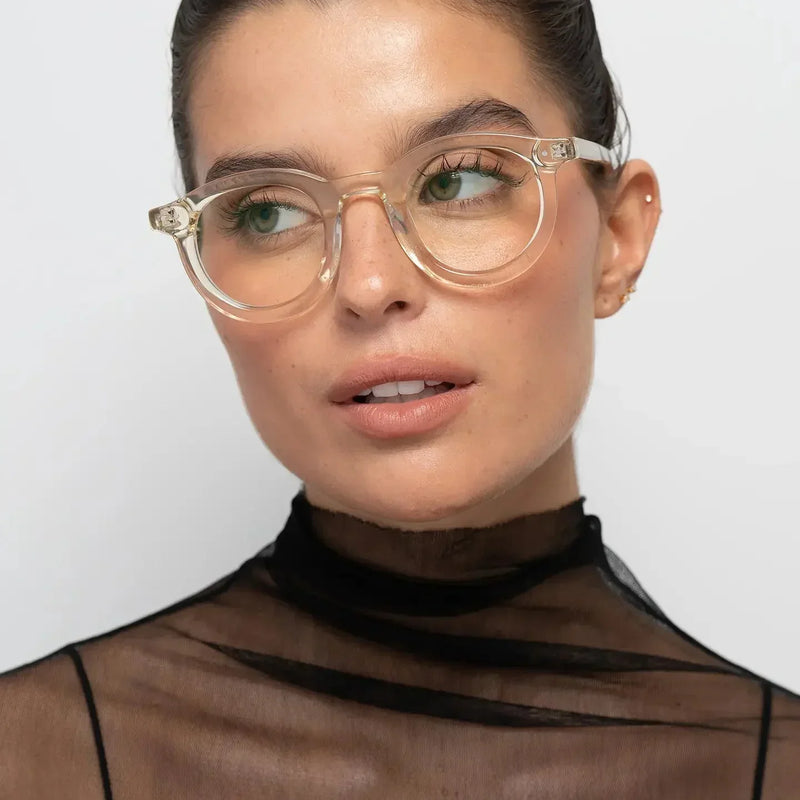
Transparency can reduce perceived visual weight while preserving the structure of an acetate frame.
How should your prescription influence the frame?
A frame is not an isolated fashion object once prescription lenses are added. Lens requirements can affect which dimensions, shapes and constructions are practical.
Depending on the prescription and lens design, lens thickness, weight and optical positioning may become more important. A very wide or deep lens shape may not be equally suitable for every prescription, while frame construction can influence how lens edges are contained or perceived.
This is one reason an optical frame should be evaluated with the intended lenses in mind rather than chosen purely from its appearance with demonstration lenses.
Practical rule: if you have a stronger or more complex prescription, confirm the frame and lens combination with a qualified optician before ordering lenses. Frame style matters, but optical suitability comes first.
The strongest everyday choice is the point where the desired visual effect and the practical requirements of the prescription agree.
What should comfortable optical frames feel like?
Comfort is not simply the absence of pain during a short try-on. Everyday comfort is stability without persistent pressure.
Pay attention to the bridge, temples and the way the frame remains positioned when you look down, speak or move normally. Pressure that seems insignificant after two minutes can become distracting after several hours.
Material thickness alone does not determine comfort. Distribution, frame dimensions, bridge compatibility and adjustment all matter. This is also why comparing acetate vs metal glasses should involve more than an assumption that one material is automatically lighter or more comfortable.
A good everyday frame should gradually become less noticeable physically even if it remains visually distinctive.
Should everyday glasses match everything you wear?
No. Requiring glasses to disappear into every possible outfit often leads to a frame chosen through fear rather than preference.
Everyday versatility does not mean visual neutrality. It means the frame can participate convincingly in enough of your real life to justify its frequency of use.
If most of your wardrobe is restrained, a distinctive optical frame may become the consistent element that gives different outfits identity. If your clothes already contain strong colour and pattern, you may prefer eyewear that creates a clearer visual anchor.
Versatility should be measured against your actual repetition, not an imaginary wardrobe containing everything.
The BBN everyday optical frame framework: Fit → Proportion → Visual Weight → Prescription → Repetition
Instead of asking whether a frame is simply flattering, use five consecutive filters.
Filter
Ask
Why it matters
Fit
Does it sit securely and naturally?
Poor fit undermines both comfort and appearance.
Proportion
What does its scale do to my face?
Width, depth and geometry change facial balance.
Visual Weight
How strongly do I want the frame to register?
Material, colour and thickness determine presence.
Prescription
Does the frame work with my intended lenses?
Optical requirements can change the practical choice.
Repetition
Will I want this visual effect repeatedly?
Everyday glasses become part of personal identity.
The order matters. A frame should not earn its place through repetition if it fails at fit or prescription compatibility. Equally, technical suitability alone does not make it the right frame if you do not want to see yourself wearing it.
Choosing between Bo Bo Noir optical frames
The Bo Bo Noir optical collection currently interprets the William round silhouette through different acetate colours. Because the underlying geometry remains consistent, the clearest decision is how each material treatment changes visual weight, contrast and identity.
William Shiny Black
William Shiny Black Optical creates the strongest graphic definition of the four directions. The dark acetate makes the outline highly legible, so the round geometry becomes a clear part of the face.
Consider it if: you want everyday glasses to provide structure and become a recognisable part of your visual identity.
Consider another direction if: you prefer lower contrast or want more of your skin tone to remain visible through the frame.
William Tortoise
William Tortoise Optical keeps substantial acetate presence while breaking up the outline through tonal variation. The pattern introduces depth and can make the visual boundary feel less absolute than solid black.
Tortoise adds material variation while preserving the structure of the William silhouette.
Consider it if: you want visible acetate character with more tonal variation than a solid dark frame.
Consider another direction if: you want either maximum graphic clarity or a distinctly translucent effect.
William Crystal Peach
William Crystal Peach Optical uses transparency and a softer colour direction to reduce the perceived weight of the acetate while retaining the same round structure.
Consider it if: you like substantial acetate but want the frame to interact more softly with the face.
Consider another direction if: you want stronger dark contrast or a more immediately graphic outline.
William Crystal Yellow
William Crystal Yellow Optical combines transparency with a more noticeable colour signal. The frame remains visually lighter than opaque black while allowing colour itself to become part of its identity.
Consider it if: you want transparency without making the frame visually anonymous.
Consider another direction if: your everyday preference is for quieter colour or stronger neutral definition.
The useful comparison: these four frames do not represent four different answers to face shape. They demonstrate how the same geometry can create different levels of contrast, transparency and visual presence. That is often a more useful everyday decision than searching for a supposedly perfect shape.
Common mistakes when choosing everyday glasses
Choosing only for the first reaction. Novelty can reveal a new preference, but excitement alone does not predict repetition value.
Using face shape as a rule instead of a starting point. Facial effect and proportion usually provide more useful information than a category label.
Assuming neutral means versatile. A frame can be distinctive and still work every day if its character is consistent with how you dress and see yourself.
Ignoring the prescription until after choosing the frame. The lenses and frame become one optical object. They should be considered together.
Confusing physical thickness with visual heaviness. Transparency, colour and contrast can make a substantial frame appear lighter.
Buying the frame you think you should wear. Repeated eyewear becomes personal. Preference is not noise in the decision; it is evidence.
FAQ about choosing everyday optical frames
What type of glasses are best for everyday wear?
The best everyday glasses combine secure fit, suitable proportions, prescription compatibility and a visual effect you genuinely want to repeat. There is no universal shape or colour that works best for everyone.
Should everyday glasses be neutral?
No. A distinctive frame can be highly versatile when its character fits your personal style and normal routine. Everyday versatility is better measured through frequency of use than through neutrality.
How do I know if glasses fit my face correctly?
The frame should feel stable without excessive pressure, sit securely at the bridge and remain sensibly positioned during normal movement. An optician can assess and adjust fit more precisely.
Should glasses be wider than my face?
Not as a universal rule. Frame width changes facial proportions, but the appropriate width depends on physical fit, the intended visual effect and the frame's geometry. Extremely poor alignment or unstable fit should not be justified purely as a style choice.
Are clear frames easier to wear every day than black frames?
Clear and translucent frames usually create less visual contrast, while black frames create stronger definition. Which is easier to repeat depends on your colouring, wardrobe and desired visual presence.
Does my prescription affect which frames I should choose?
Yes. Prescription strength, lens design and other optical requirements can affect suitable frame dimensions and lens compatibility. Discuss stronger or more complex prescriptions with a qualified optician before finalising the frame and lenses.
How many pairs of prescription glasses do I need?
There is no fixed number. One well-chosen everyday pair may cover most situations, while some people benefit from additional pairs for different prescriptions, activities or visual roles. Start by solving the role you use most frequently.
Final thoughts
Choosing optical frames for everyday wear is ultimately a decision about repetition. The frame has to fit your face physically, but it also has to fit the way you want to see yourself repeatedly.
Start with fit. Look at proportion rather than relying only on face-shape rules. Decide how much visual weight you want around the eyes. Make sure the frame works with your prescription. Then ask the question that a mirror cannot answer immediately: will I still want this effect when it no longer feels new?
The best everyday optical frame is not necessarily the quietest, safest or most fashionable. It is the one whose character remains useful after familiarity replaces novelty.
Explore optical frames designed with presence, proportion and everyday identity in mind.
Enjoy a 10% discount on your purchase! Sign up for our newsletter now.Enjoy a 10% discount on your purchase! Sign up for our newsletter now.Enjoy a 10% discount on your purchase! Sign up for our newsletter now.Enjoy a 10% discount on your purchase! Sign up for our newsletter now.Enjoy a 10% discount on your purchase! Sign up for our newsletter now.Enjoy a 10% discount on your purchase! Sign up for our newsletter now.Enjoy a 10% discount on your purchase! Sign up for our newsletter now.Enjoy a 10% discount on your purchase! Sign up for our newsletter now.Enjoy a 10% discount on your purchase! Sign up for our newsletter now.Enjoy a 10% discount on your purchase! Sign up for our newsletter now.Enjoy a 10% discount on your purchase! Sign up for our newsletter now.Enjoy a 10% discount on your purchase! Sign up for our newsletter now.Enjoy a 10% discount on your purchase! Sign up for our newsletter now.Enjoy a 10% discount on your purchase! Sign up for our newsletter now.Enjoy a 10% discount on your purchase! Sign up for our newsletter now.