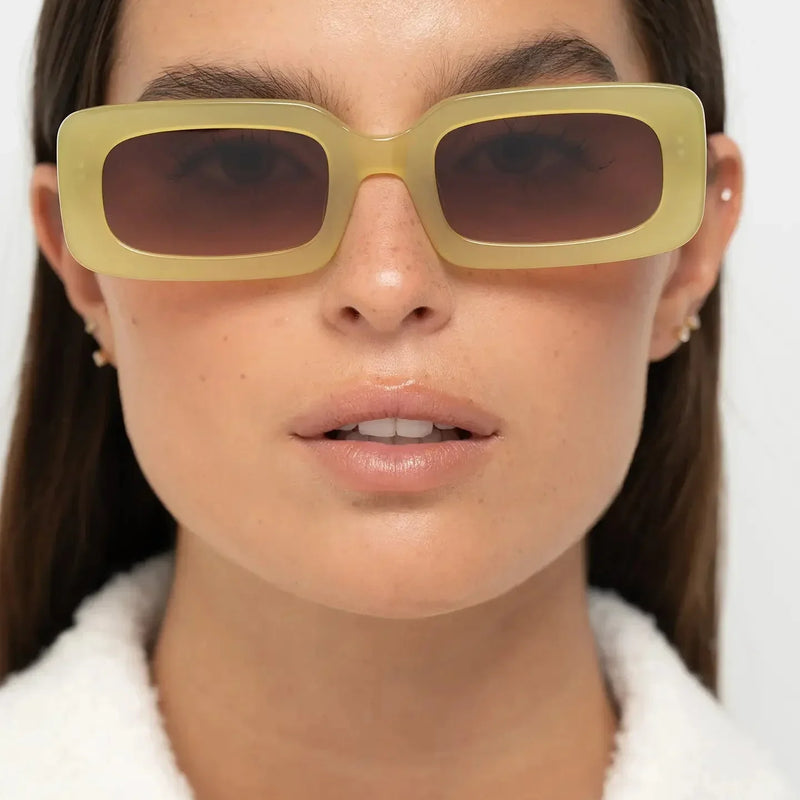
Buying sunglasses is easy when the question is simply, “Do I like these?” The harder question is whether you will still like them once they are on your face, part of your wardrobe and something you actually reach for week after week. Before buying sunglasses, it helps to separate the initial attraction of a frame from the reasons it will genuinely work for you. That means looking beyond generic face-shape rules. Frame width, lens depth, brow relationship, visual weight, colour, comfort, lens performance and wardrobe compatibility all influence whether sunglasses become a successful purchase. If you are still establishing the fundamentals, our guide to how to choose sunglasses that fit your face and style explains how those variables work together. The 10 questions below turn those variables into a practical decision framework. You do not need a perfect answer to every question. You need enough answers pointing in the same direction to know that you are choosing sunglasses for your face, your style and your actual life rather than for the product image alone. Before buying sunglasses, ask whether they feel like you, create the facial proportions you want, fit at the correct scale, work with your colouring and real wardrobe, remain comfortable, provide the lens performance you need, justify what you are paying and are likely to stay relevant to your style after the current trend changes. The final test is simple: if you could keep only one pair, would these still earn their place? A strong purchase does not need to be perfect in every category, but the important variables should reinforce one another rather than asking one attractive feature to compensate for several weaknesses. BBN insight Most sunglasses buying mistakes are not caused by choosing the “wrong face shape”. They happen because one attractive quality is allowed to overpower the complete decision: the colour is exciting, the silhouette is fashionable or the campaign image looks exceptional, so width, comfort, wardrobe compatibility or repeat wear receive less attention. The question is not whether one feature works. It is whether the frame works as a system. These questions work best as a sequence. They move from identity and facial proportion to fit, colour, real-world use, comfort, lens performance, value and longevity. By the time you reach the final question, you should be able to explain not simply why you like the sunglasses, but why they deserve a place in your wardrobe. A pair of sunglasses can look excellent on another person and still be the wrong purchase for you. The first question is therefore not whether the frame is attractive. It is whether you are responding to the frame itself or to the person, photograph and styling that introduced it to you. This distinction becomes particularly important online. Campaign photography combines eyewear with facial features, hair, clothing, lighting, pose and a particular aesthetic direction. The complete image can be desirable even when the sunglasses are only one part of what is creating that reaction. Mentally remove that context. Imagine the same frame with clothes you already own, on an ordinary day, without the campaign styling. If the appeal remains, the attraction is becoming personal. If it weakens dramatically, you may be attracted to the image of wearing the sunglasses rather than the sunglasses themselves. This does not mean you should choose the safest or least noticeable frame. Bold eyewear can feel deeply personal. The useful test is whether its visual presence feels like an extension of how you want to present yourself rather than a character you would have to perform every time you put it on. Try the three-outfit test Identify three real outfits you already wear: one simple everyday combination, one more considered look and one representing another regular part of your life. Imagine the sunglasses with each. If you need to mentally buy new clothes before the frame begins to make sense, it may be solving an imagined wardrobe rather than your existing one. Choose sunglasses by the visual effect you want, not by a rigid face-shape formula. Frame geometry changes the lines, width, contrast and visual weight around the face. Understanding that effect is more useful than being told that one face shape must always wear one type of frame. Rectangular geometry tends to introduce stronger horizontal and angular definition. Round geometry makes curvature more visible and creates a different relationship with straighter facial lines. Panto sits between those directions, combining a curved lower lens area with greater definition through the upper frame. None is universally better; they solve different visual objectives. Then look beyond the shape name. A fine black rectangle and a substantial tortoise rectangle belong to the same broad geometric family, but they can create very different amounts of visual weight. Likewise, a small round frame and a wider, thicker round frame will not affect facial proportions in the same way. This is why face shape should be treated as a starting observation rather than an instruction. Our guide to choosing sunglasses for your face shape explores how geometry can create balance without reducing the decision to fixed rules. Before choosing a frame, complete this sentence: “I want my sunglasses to create more...” Your answer might be horizontal definition, softness, width, structure, contrast, colour or visual presence. That gives you a design objective before any particular product enters the decision. BBN insight Shape names describe geometry; they do not describe the complete visual effect. Width, lens height, acetate thickness, brow relationship and colour can make two frames from the same shape family behave very differently on the face. Ask what the frame does before asking what the frame is called. The right sunglasses size is a relationship between the frame and your face, not a universal number. Overall width matters, but it should be considered alongside lens width, lens height, bridge fit and the way the temples leave the front of the frame. Start with horizontal scale. A frame that is too narrow can look compressed and may create unwanted pressure around the temples. A frame that extends further beyond the face creates a different visual effect and may be entirely intentional. The objective is not to force every frame to align perfectly with the widest point of the face, but to understand whether the additional or reduced width belongs to the design. Next, consider vertical scale. Lens height determines how much of the face the sunglasses occupy, so two frames with similar overall widths can feel dramatically different if one has deeper lenses. This is why “oversized” is not precise enough to determine whether sunglasses fit: a frame can gain scale horizontally, vertically or in both directions. The bridge changes the relationship again. It influences where the frame sits, how stable it feels and where the upper edge falls relative to the brow. Temple length and the way the temples travel around the head affect comfort and stability as well. Measurements are therefore most useful when interpreted together rather than treated as isolated pass-or-fail numbers. If size is your main hesitation, compare the measurements and proportions with sunglasses you already know fit well. Our guides to the best sunglasses for a small face and sunglasses for a wide face and balanced proportions explain how scale changes the decision at either end of the spectrum. Do not ask only, “Are these too big?” Ask which dimension is creating the sense of size. Width, lens depth and material thickness create different visual effects, and identifying the variable is the first step towards deciding whether that effect is intentional or simply the wrong fit. Size check before you buy Compare overall width, lens width, lens height, bridge and temple length with a pair you already wear comfortably. Then interpret the differences rather than automatically rejecting them. A measurement can be different because the design is trying to create a different proportion; the question is whether you want that effect. The best sunglasses colour is not simply the one that “matches” your skin tone. It is the colour that creates the level of contrast you want around your face and still makes sense with what you actually wear. Change the acetate colour and the same frame geometry can appear sharper, softer, heavier, warmer or more expressive. Black acetate tends to create a clearer boundary between the frame and face, particularly when the silhouette is substantial. Tortoise introduces tonal variation that can break up some of that visual weight. Transparent or crystal acetate allows more facial colour and light to remain visible through the frame, while burgundy, olive and other coloured acetates can make colour itself part of the frame's identity. This is why rules such as “warm skin should wear warm colours” are too restrictive to make the decision for you. Undertone can influence how a colour appears, but contrast is a styling choice, not a problem that always needs to be corrected. You may deliberately want black to create definition or a coloured acetate to become a focal point. Hair changes the relationship too. A dark frame against dark hair can create greater continuity, while the same frame against lighter hair may appear more graphic. A translucent or patterned acetate can produce another effect again. Rather than searching for a universally flattering combination, decide how much separation you want between the frame and the features surrounding it. Then bring your wardrobe into the decision. Your clothes do not need to literally match the sunglasses, but the frame should have a believable relationship with colours you already repeat. A distinctive acetate becomes easier to wear when it connects naturally with your existing palette rather than requiring a new wardrobe to justify it.
What should you ask yourself before buying sunglasses?
In this guide
The 10 questions to ask before buying sunglasses
Question
What you are really testing
Warning sign
1. Does this look like me?
Personal identity rather than borrowed styling.
You love the model or campaign context more than the frame on yourself.
2. What does it change?
The effect of geometry, proportion and visual weight.
You know the shape name but cannot explain what you want it to do.
3. Is the size right?
Width, lens depth, bridge relationship and overall scale.
You call the frame “too big” or “too small” without knowing which dimension causes it.
4. Does the colour work?
Facial contrast and wardrobe repeatability.
The colour looks exciting alone but disconnected from what you wear.
5. Will I actually wear it?
Real wardrobe compatibility.
The frame requires an imagined future wardrobe.
6. Is it comfortable?
Stability, pressure and prolonged wear.
You are already tolerating discomfort because you like the appearance.
7. Are the lenses right?
UV protection, tint, glare, coverage and intended use.
You are choosing the lenses primarily because of appearance.
8. What am I paying for?
Design, materials, construction, finishing and expected use.
Price itself is being used as proof of quality or suitability.
9. Will it outlast the trend?
Personal longevity rather than predicted timelessness.
Current popularity remains your strongest reason for wanting it.
10. Would I keep this pair?
The complete buying decision.
You like it, but another pair would still be your automatic choice.
1. Do these sunglasses look like me — or just look good on someone else?
2. What do I want the frame to change about my face?

3. Is the frame actually the right size for me?

4. Does this colour work with my skin, hair and wardrobe?

Try the wardrobe colour test
Think of the five colours you wear most often. Now ask whether the sunglasses should blend with them, complement them or deliberately contrast with them. There is no single correct relationship. The useful part is being able to explain why the frame colour belongs beside the colours already present in your wardrobe.
Should you choose black, tortoise, transparent or coloured sunglasses?
Choose according to the visual role you want the frame to play. Black is useful when you want definition; tortoise when you want tonal variation; transparent acetate when you want physical presence with less visual opacity; and colour when you want the frame itself to contribute more actively to personal style.
But colour should never be separated from geometry. A distinctive colour on a relatively restrained silhouette can be easier to integrate than the same colour on a very large, highly sculptural frame. Conversely, a strong silhouette in a quieter acetate can let shape provide most of the expression. You have several design variables available, so they do not all need to be turned up at once.
BBN insight
Colour and shape do not contribute independently. The more visual information one variable carries, the less another may need to do. A strong acetate colour can give a familiar silhouette greater identity, while a quieter colour can allow unusual geometry or substantial proportions to become the main source of presence.
5. Will I wear this shape with the clothes I actually own?
The real test of versatile sunglasses is not whether they work with everything. It is whether they work with enough of your actual wardrobe to justify how often you expect to wear them. A frame can be distinctive and versatile at the same time when its character has a believable relationship with your existing style.
This is where imagined styling can create expensive mistakes. You see sunglasses worn with a particular coat, shirt, jewellery, hairstyle or overall aesthetic and begin imagining an entire version of yourself around the frame. There is nothing wrong with using eyewear to evolve your style, but the purchase becomes less reliable when every successful outfit depends on things you do not yet own.
Instead, start with clothes already in regular rotation. Consider what you wear on an ordinary weekday, what you reach for at the weekend and what you choose when you want to look more considered. The sunglasses do not need to disappear into all three contexts, but you should understand the role they play in each one.
A strong rectangular frame can sharpen simple clothing by adding horizontal definition. A round or panto silhouette can introduce curves into a wardrobe dominated by straighter lines. Expressive acetate can function as a colour accent when the rest of an outfit is restrained. In each case, versatility comes from understanding what the frame contributes rather than asking it to contribute nothing.
Do not confuse versatility with invisibility. If you are attracted to independent eyewear because it has a stronger design identity, choosing the least noticeable option simply to maximise theoretical compatibility can defeat the purpose. A better objective is repeatable character: enough personality to change the look, enough compatibility to keep reaching for it.

BBN insight
Neutral and versatile are not synonyms. Neutral describes how little visual attention something demands; versatile describes how many useful relationships it can create. A burgundy, tortoise or olive frame can be more versatile for a particular wardrobe than black if those colours connect more naturally with what the wearer already owns.
How many outfits should work with a new pair of sunglasses?
There is no useful minimum number, but three genuinely different outfits provide a practical test before purchase. Ideally, they should represent different parts of your life rather than three variations of essentially the same look.
If the sunglasses make sense with a simple everyday outfit, something more considered and another combination you wear regularly, you already have evidence that the frame can move through your wardrobe. You are testing repeatability, not trying to prove that one pair of sunglasses can accompany everything you own.
6. Are these sunglasses comfortable enough for real wear?
Sunglasses are comfortable when they remain stable without creating distracting pressure at the bridge, temples, ears or other contact points during the amount of time you actually intend to wear them. A frame can look correctly proportioned from the front and still become frustrating after an hour.
Start with the bridge. The sunglasses should remain in a stable position rather than repeatedly sliding down the nose or creating concentrated pressure. Where the frame sits also affects its appearance: if it continually moves lower, the relationship between the brow, lenses and face changes with it.
Then consider the temples. They need enough security to keep the frame stable, but excessive pressure around the sides of the head can turn a visually successful frame into one you gradually stop wearing. The same applies behind the ears, where a small irritation during a quick try-on can become much more noticeable over several hours.
Weight matters, but it should not be judged in isolation. A substantial acetate frame will naturally feel different from a fine metal frame. What matters is how the weight is distributed and whether the complete wearing experience remains comfortable for you. Lightweight does not automatically mean comfortable, just as substantial does not automatically mean uncomfortable.
Your intended use changes the standard too. Sunglasses worn mainly for short city journeys do not face exactly the same comfort demands as a pair you expect to wear for hours while travelling, walking or spending a full day outdoors. The longer the expected wear, the less tolerance you should have for persistent pressure, slipping or repositioning.
Do not buy discomfort and call it a compromise. Some fit issues may be adjustable depending on the frame and construction, but the purchase should not begin with the assumption that you will simply learn to tolerate something that already feels wrong.
The 30-minute question
Ask yourself: “Would I still want these on my face after 30 minutes?” If you can try the sunglasses for longer than a quick mirror check, pay attention to sliding, pressure and the urge to keep repositioning them. Small irritations during a fitting can become the reason an otherwise attractive pair stays at home.
Can a beautiful frame still be the wrong purchase?
Absolutely. Design quality and personal suitability are different questions. A frame can have compelling geometry, expressive acetate and convincing construction while still being the wrong width, colour, comfort level or stylistic direction for you.
Recognising that distinction removes the need to declare a frame “bad” simply because you should not buy it. Good design can still be the wrong design for a particular person, wardrobe or use case. The purpose of these questions is to identify that difference before ownership rather than after it.
7. Do the lenses provide the protection and visual experience I need?
The right sunglasses lenses should provide appropriate UV protection while also giving you the brightness, colour perception, glare control and coverage you want for the way you will actually use them. Lens appearance matters because it contributes to the design, but appearance should come after the functional requirements.
Start with UV protection. Look for the manufacturer's stated protection against UVA and UVB radiation, commonly expressed as UV400 or 100% UV protection. Do not assume that a darker lens automatically provides stronger UV protection. Visible darkness and ultraviolet filtering are different characteristics.
Then consider the tint itself. Lens colour and darkness influence how much visible light reaches your eyes and can change how colours and contrast appear while you are wearing the sunglasses. A lens that looks particularly attractive from the outside may therefore create a different visual experience from behind it, which matters if the sunglasses will be worn for long periods.
Coverage is another variable. Lens size, shape and how closely the frame sits to the face all affect how much of the eye area is physically covered. A larger lens may provide more coverage than a smaller one, but the complete result depends on the frame's position and geometry rather than lens dimensions alone.
Polarisation is useful when reflected glare is a significant concern, particularly around roads, water and other reflective surfaces. But polarisation and UV protection are not the same thing: polarisation is designed to reduce particular types of reflected glare, while UV protection concerns ultraviolet radiation. Whether you need both depends on how and where you expect to use the sunglasses.
Choose the lens for both sides of the sunglasses: how it contributes to the frame from the outside and how it changes your visual experience from behind it.
Lens check before buying
Confirm the stated UV protection first. Then consider tint, visible darkness, glare reduction and coverage according to your intended use. A lens should not earn your confidence simply because its colour looks good with the acetate.
Are darker sunglasses better for your eyes?
Not simply because they are darker. Lens darkness primarily changes the amount of visible light reaching the eyes, while UV protection depends on the lens's ultraviolet-filtering properties. A lighter-looking lens can still provide appropriate UV protection when that protection is properly specified.
This distinction is useful when comparing different lens colours. Judge protection from the stated lens specification, not from how dark the sunglasses appear. Then choose the visible tint according to brightness, comfort and the visual experience you prefer.
8. What am I actually paying for?
The price of sunglasses can reflect design development, materials, lenses, construction, finishing, production scale, distribution and brand positioning, but a higher price does not automatically make a frame a better purchase for you. The useful question is what qualities are present and whether you personally value them.
Begin with what you can evaluate. Look at the material, hinges, lens information, finishing and overall construction. Examine how consistently surfaces meet, how the temples relate to the front and whether the frame feels coherent as an object rather than impressive only from one angle.
Then consider the design itself. Proportion, geometry, acetate colour, lens colour and component relationships do not happen independently. A frame can use familiar ingredients and still feel distinctive because those ingredients have been resolved into a recognisable design language. Design value is not limited to visible decoration.
Some of what you are paying for may therefore be less immediately visible: design development, production decisions, smaller-scale collections or the consistency required to maintain a particular point of view across different frames. Those qualities do not automatically justify any price, but they belong in a more complete assessment of value.
This is particularly useful when comparing an independent eyewear brand with a larger fashion label. Avoid reducing the decision to “logo versus no logo” or “expensive versus affordable”. Instead, compare what the frame offers, what matters to you and how often you realistically expect to wear it.
Before buying, try to complete this sentence: “These sunglasses are worth this price to me because...” A specific answer is more useful than assuming price itself is evidence of quality.

BBN insight
Value and price are not the same measurement. Price tells you what the sunglasses cost; value describes what the qualities you receive are worth to you. The stronger buying decision is therefore not necessarily the cheapest or most expensive option, but the one whose design, material, construction and expected use justify its cost in your own decision.
Does acetate quality matter?
Yes, but “acetate” alone is not a complete quality statement. Acetate is valued in eyewear because it can support depth of colour, transparency, pattern, substantial proportions and polished surfaces, but the final result also depends on how the material is selected, shaped, finished and integrated into the design.
Different finishes also use the material differently. Tortoise can reveal tonal variation across the frame, translucent acetate interacts with light and facial colour, and opaque acetate can make geometry appear more graphic. Those effects are part of the design value of the material, not simply alternative colour options.
When comparing frames, avoid stopping at the material name. Ask what the material actually contributes to the frame you are considering. For a deeper assessment of construction and finishing, see How to Tell If Glasses Are High Quality and Why Premium Acetate Looks Different.
9. Will I still want to wear these when the trend changes?
You do not need sunglasses that exist outside fashion. You need reasons for choosing them that remain meaningful when their current popularity changes. A frame can be connected to a trend and still have strong personal longevity if its proportions, geometry, colour and visual presence continue to work for you.
Try mentally removing the trend label. If nobody described the frame as current, would you still like what its width does to your face? Would you still choose the acetate colour with your wardrobe? Would the geometry still create the balance you want? Those answers reveal whether fashion introduced you to the frame or is doing most of the work required to justify it.
Trend-specific features are not automatically a problem. A very wide silhouette, unusual colour or substantial acetate can become part of your long-term style when you have independent reasons for enjoying those qualities. The risk appears when current popularity is the only reason the feature feels desirable.
This is also why “timeless” should not mean visually anonymous. A bold frame can remain relevant to one wearer for years because its presence feels connected to that person's identity. A supposedly classic frame can have poor longevity for someone else if it never feels convincing enough to wear regularly.
Ask yourself: “If fewer people were wearing this shape next year, would I still like what it does for me?” If the answer is yes and you can explain why, the trend has become secondary to the personal reason for choosing it.
The trend-removal test
Imagine the sunglasses disappear from social media, magazines and current style references tomorrow. Would you still want the proportions, colour and visual effect? If the appeal survives without external confirmation, you have a stronger reason to expect the frame to remain useful after the trend moves on.
Should you avoid trendy sunglasses?
No. Trends can introduce you to a shape, colour or proportion you might not otherwise have considered, and that discovery can become a lasting part of your personal style. The problem is not that a frame is fashionable; it is when fashion remains the only convincing reason to buy it.
There is an important difference between “I want these because they are fashionable” and “fashion made me notice these, but I know why they work for me.” The second answer is much more likely to survive a changing trend cycle.
A better definition of timeless sunglasses
Instead of trying to predict whether a frame will remain universally fashionable, think in terms of personal durability: will its proportions, colour, material and visual presence continue to solve something you consistently want from eyewear? That is a more useful standard than asking whether the design can avoid every future trend cycle.
10. If I could only keep one pair, would I choose these?
This final question forces the previous nine decisions to compete with one another. It asks whether the frame is simply attractive enough to own or strong enough to become one of the sunglasses you genuinely depend on.
You do not literally need to own only one pair. The purpose is to remove the easy justification that every new frame can occupy some hypothetical future role. Compare the sunglasses with a pair you already trust. Which would you choose for an ordinary day? Which works with more of the clothes you actually wear? Which feels more natural on your face after the initial novelty disappears?
If the existing pair still wins, that does not automatically make the new sunglasses a bad purchase. They may serve a genuinely different purpose: stronger colour, a more expressive silhouette, lower visual density or another styling direction you deliberately want to add. But you should be able to explain that role clearly.
“I like them” is attraction. “I know when and why I will choose them” is a buying decision. That distinction becomes particularly valuable when you already own several sunglasses and novelty can make every new frame appear to fill a gap.
If you do not have an existing reference pair, imagine these sunglasses becoming your automatic reach. Would you choose them for the ordinary parts of your life as confidently as for the outfit or occasion that first made them appealing?
By this point, the answer should no longer depend on a generic rule telling you the frame suits you. You have built a case for why it belongs to you.

BBN insight
The best purchase is not necessarily the safest frame or the one that makes the fewest visual demands. It is the frame for which the compromises are worth the qualities you receive in return. Distinctive silhouettes trade some neutrality for character; substantial acetate trades delicacy for presence; colour can require more styling intention while giving the frame a stronger identity.
How do you know when sunglasses are actually right for you?
Look for agreement between the variables that matter most rather than perfection in every category. Fit, comfort and appropriate lens protection are functional fundamentals. Beyond those, the strongest decision depends on what you personally prioritise in shape, colour, wardrobe compatibility, design and longevity.
A useful way to simplify the final comparison is to identify three non-negotiables. They might be comfortable all-day wear, a frame that adds visible structure and a colour that works naturally with your wardrobe. Another person might prioritise lower visual contrast, expressive acetate and a distinctive silhouette. The framework stays the same even when the priorities change.
| Decision area | A strong answer sounds like... | Reconsider if... |
|---|---|---|
| Identity | “The frame feels like a stronger version of how I already dress.” | You mainly want the complete campaign look surrounding it. |
| Proportion | “I know what the width and geometry are doing to my face.” | You are relying only on a face-shape rule. |
| Colour and wardrobe | “I can already picture these with clothes I regularly wear.” | The sunglasses require an imagined new wardrobe. |
| Comfort | “I can forget I am wearing them.” | You are already negotiating with pressure or slipping. |
| Lenses | “The protection and visual experience fit how I will use them.” | Lens appearance is doing all the decision-making. |
| Value | “I can explain what makes these worth the price to me.” | Price itself is your evidence of quality. |
| Longevity | “I would still like what these do even if the trend disappeared.” | Popularity remains the strongest argument. |
When those answers reinforce one another, you have something more useful than a rule saying the sunglasses suit you: you understand why they suit you.
How can you apply these 10 questions to an actual frame?
Once you have answered the 10 questions, the next step is not to search for a frame that scores perfectly in every category. Translate your answers into the visual effect you want, then compare frames according to how they create that effect. This keeps the decision focused on your priorities rather than on whichever product attracts your attention first.
If you want stronger horizontal definition, rectangular geometry may be a useful starting point. If you want curves without losing all structure around the upper frame, panto offers another direction. If you want curvature itself to become more prominent, a round silhouette can create that contrast. Colour, opacity and acetate presence then determine how strongly the chosen geometry registers.
This also makes trade-offs easier to understand. A substantial black frame may give you the definition and presence you want while demanding more visual attention from the rest of the outfit. Transparent acetate can preserve substantial proportions with softer contrast, but it will not create the same graphic boundary as opaque black. A distinctive colour may connect exceptionally well with your wardrobe while being less neutral in theory.
Start with the effect, not the product. Once you know what you want the sunglasses to do, individual frames become examples of different solutions rather than objects you need to justify after becoming attracted to them.
BBN insight
Do not begin with the product and search for reasons to justify it. Begin with the visual effect you want, then find the frame that creates it. This reverses one of the most common buying mistakes: deciding emotionally first and evaluating practically afterwards.
How do different Bo Bo Noir frames answer these questions?
Bo Bo Noir frames provide useful examples because different combinations of geometry, acetate and colour produce clearly different visual effects. These are not rankings or universal recommendations. The purpose is to connect the buying framework with visible design decisions.
William demonstrates how round geometry can create substantial curved definition, Triboulet shows the balance created by panto geometry, and Narr illustrates how colour can become a more active part of the frame's identity. The relevant question is not which frame is best, but which design variables correspond most closely to what you identified in the previous 10 questions.
William — when you want round geometry to have presence
William uses a substantial round silhouette, so curvature is not a minor detail: it becomes one of the defining features of the frame. That makes this direction useful when you want sunglasses to provide a clearly curved counterpoint rather than stronger horizontal or rectangular definition.
The trade-off is equally important. If the answer to question two was that you want sharper horizontal structure, a round silhouette may not be the most direct route to that effect. A strong design is only a strong recommendation when its visual effect matches the wearer's objective.
Triboulet — when you want curves with upper-frame structure
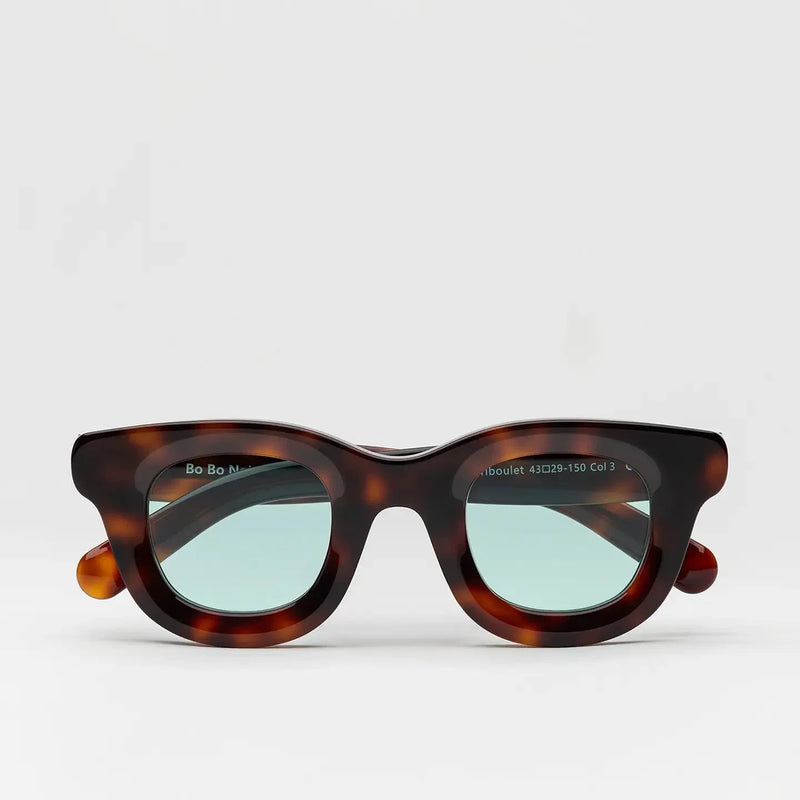
Triboulet's panto geometry creates a different balance. The curved lower lens area introduces softness, while the upper portion retains greater definition around the eye area. This can make panto useful when a rectangle feels more angular than you want but a clearly round silhouette takes curvature further than you prefer.
Colour then adjusts the result without changing the underlying geometry. A tortoise or olive treatment can alter warmth, contrast and visual continuity, which brings the decision back to question four: after choosing the shape effect, decide how strongly you want the acetate itself to register.
Narr — when colour should contribute more actively
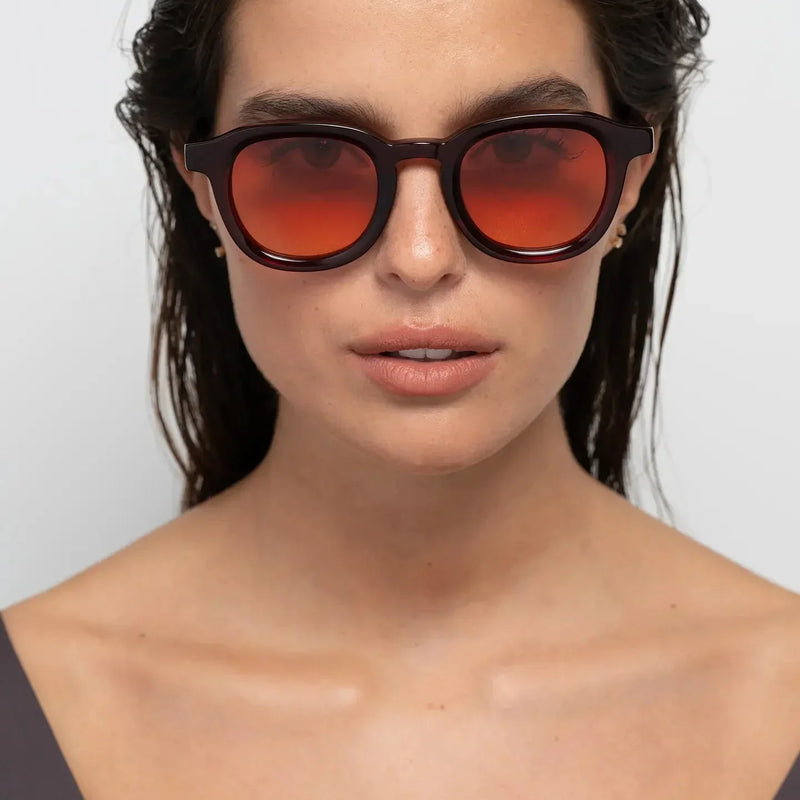
Narr demonstrates how a familiar geometric direction can become more distinctive when colour takes on a larger role. In burgundy, the acetate contributes a deeper colour identity without requiring the silhouette itself to become more extreme.
This is where the wardrobe questions become particularly useful. A coloured frame can be highly repeatable when its palette already belongs naturally beside the clothes and accessories you wear. Expressive does not automatically mean difficult to wear; the relevant question is whether the expression is connected to your existing style.

What should you check when buying sunglasses online?
When buying sunglasses online, replace the information you would normally gather during a physical try-on with deliberate comparisons of measurements, photography, colour, product information and frames you already know. The objective is to reduce uncertainty rather than pretend a screen can answer every fit question.
Start with measurements. If you own sunglasses that fit comfortably, use them as a reference for overall scale, lens width, lens height, bridge and temple length where those measurements are available. Differences are not automatically problems, but they tell you where the new frame may behave differently.
Use product photography for different jobs. A front view is useful for reading geometry and width; an angled view can reveal acetate depth and temple construction; worn photography helps you understand approximate scale and how the upper frame interacts with the face. No single image should be expected to answer every buying question.
Treat colour with some caution because lighting and screens can affect how acetate and lenses appear. Compare multiple photographs when available, especially with transparent, patterned or coloured materials where light can substantially change the visual impression.
Finally, read the available product information and any applicable store policies before purchasing. Lens specifications, materials, measurements and other product details can answer functional questions that photography cannot.
The objective is not to eliminate every uncertainty before ordering. It is to make sure the uncertainties that remain are smaller than the reasons you have for choosing the frame.
The 60-second sunglasses test
Before buying, ask: Does this feel like me? Do I like what the proportions do? Is the size intentional? Does the colour belong in my real wardrobe? Is it comfortable? Do the lenses suit my use? Do I understand what I am paying for? Would I still choose it without the trend? If several answers remain vague, keep evaluating. If they reinforce one another, the purchase has a much stronger foundation.
A different way to choose sunglasses: start with identity
Eyewear can do more than complete a look; it can shape it. That makes sunglasses unusual accessories because they sit directly on the face and can change perceived structure, contrast and character before almost any other styling detail is noticed.
Bo Bo Noir approaches eyewear through classic forms, strong silhouettes and references that often draw from mid-century design, reinterpreted through contemporary proportions and a more restrained visual language. High-quality acetate allows colour, depth and material presence to become part of that design vocabulary, while production in specialised eyewear facilities with extensive industry experience supports consistency and attention to detail. Creative direction, brand development and design vision are based in Portugal.
The objective is not to follow a trend simply because it is current. It is to choose with intention: to understand what a frame changes, why that change appeals to you and whether it remains connected to the way you want to present yourself.
That is why the 10 questions ultimately lead back to identity. The strongest frame is not necessarily the quietest, boldest or most universally flattering option. It is the one whose design decisions make sense for the person choosing it. You can compare the current Bo Bo Noir sunglasses collection using that principle rather than starting with a predetermined shape.
The Bo Bo Noir question
After the measurements, proportions, colour and practical checks, ask one final identity question: “Do I want to look like myself in these?” The purpose of expressive eyewear is not to turn you into someone else. It is to make the version of yourself you want to present more deliberate.
Frequently asked questions
What should I look for before buying sunglasses?
Check frame shape, width, lens height, bridge relationship, comfort, colour, wardrobe compatibility, lens protection and the quality information available for the frame. The best purchase is one in which those variables support the way you actually intend to wear the sunglasses.
How do I know if sunglasses really suit me?
Look at what the frame changes rather than relying on a single face-shape rule. Consider whether its geometry adds the structure or softness you want, whether its width feels intentional, how it relates to your brows and whether its visual weight matches your preferred level of contrast.
How do I know if sunglasses are the right size?
Evaluate overall width, lens width, lens height, bridge and temple length together. Compare them with a pair you already wear comfortably when possible. A different measurement is not automatically wrong; what matters is whether the resulting proportion and fit are intentional and comfortable.
Should sunglasses cover your eyebrows?
There is no universal rule requiring sunglasses to reveal or cover the eyebrows. The useful question is how the upper frame relates to the brow line. Frame height, bridge position, geometry and personal preference determine whether that relationship looks and feels intentional.
What colour sunglasses should I choose?
Choose according to the facial contrast and wardrobe relationship you want. Black creates stronger definition, tortoise adds tonal variation, transparent acetate reduces visual density, and colours such as olive or burgundy can give the frame a more distinctive identity when they connect naturally with your wardrobe.
How should sunglasses feel when they fit correctly?
They should remain stable without persistent slipping or distracting pressure at the bridge, temples or behind the ears. Comfort should be evaluated over realistic wear time rather than only during a brief mirror check.
Is UV400 important when buying sunglasses?
UV400 is a common specification indicating ultraviolet filtering up to 400 nanometres. When evaluating sunglasses, look for the manufacturer's stated UV protection rather than assuming that darker-looking lenses automatically provide stronger ultraviolet protection.
Are polarised sunglasses better?
Polarised lenses can be particularly useful when reflected glare is a concern, such as around roads or water. Polarisation is different from UV protection, however, so whether it is better for you depends on your intended use rather than being a universal requirement for every pair.
Are expensive sunglasses worth it?
They can be when the design, materials, lenses, construction, finishing and expected amount of wear justify the price to you. Price alone is not proof that sunglasses are higher quality or better suited to your face and wardrobe.
Should I avoid sunglasses that are trendy?
No. A trend can introduce you to a shape, colour or proportion that becomes part of your long-term style. The stronger test is whether you would still value what the sunglasses do for your face and wardrobe if their current popularity disappeared.
The best sunglasses are the ones you can explain
A good sunglasses decision becomes much easier when you can explain it in specific terms. You know what the geometry does to your face, why the width feels intentional, how the colour works with your wardrobe, whether the frame remains comfortable and what you expect from the lenses. You also understand what you are paying for and why the design has a realistic place in your life.
That does not remove emotion from buying eyewear. Attraction matters. A frame should create some desire before there is any reason to analyse it. The purpose of the 10 questions is to discover whether that first attraction survives contact with proportion, fit, use, value and personal style.
The result does not have to be the safest sunglasses in the room. It can be bold, colourful, substantial or unusual. What matters is that its character feels chosen rather than borrowed.
So before buying your next pair, ask the ten questions. Then choose the sunglasses you understand — not simply the ones you noticed first.

Find the frame that feels like yours
Compare different shapes, proportions and acetate colours, then use the 10 questions to narrow the sunglasses that make sense for your face, wardrobe and personal style.
Continue reading
- How to Choose Sunglasses That Fit Your Face and Style
- Best Sunglasses for Face Shape: How to Choose the Right Frame
- Best Sunglasses for a Small Face: How to Find the Right Fit
- Best Sunglasses for a Wide Face: How to Balance Proportions
- How to Tell If Glasses Are High Quality
- Why Premium Acetate Looks Different