
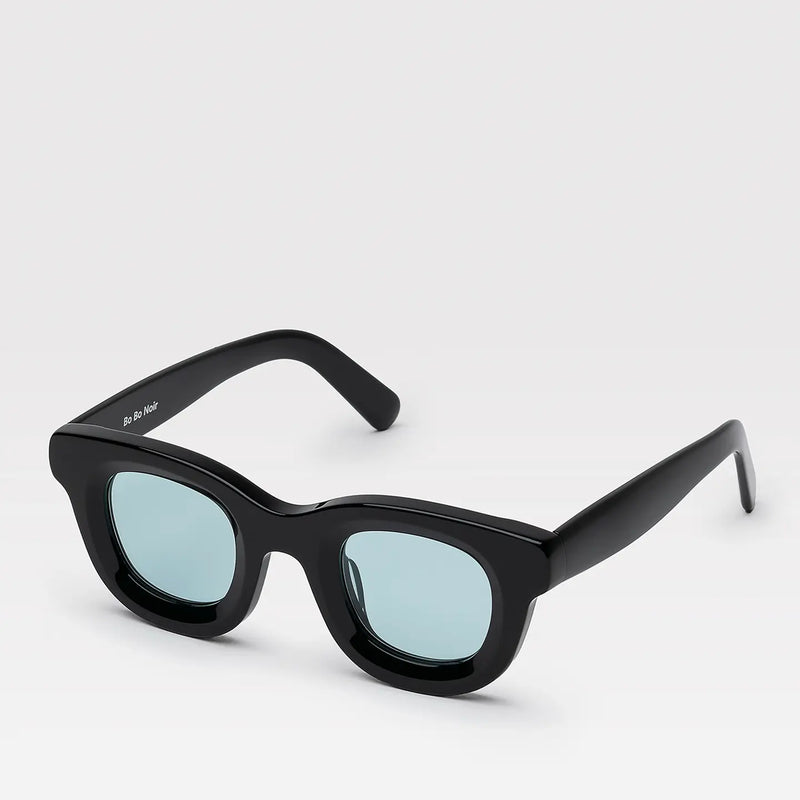
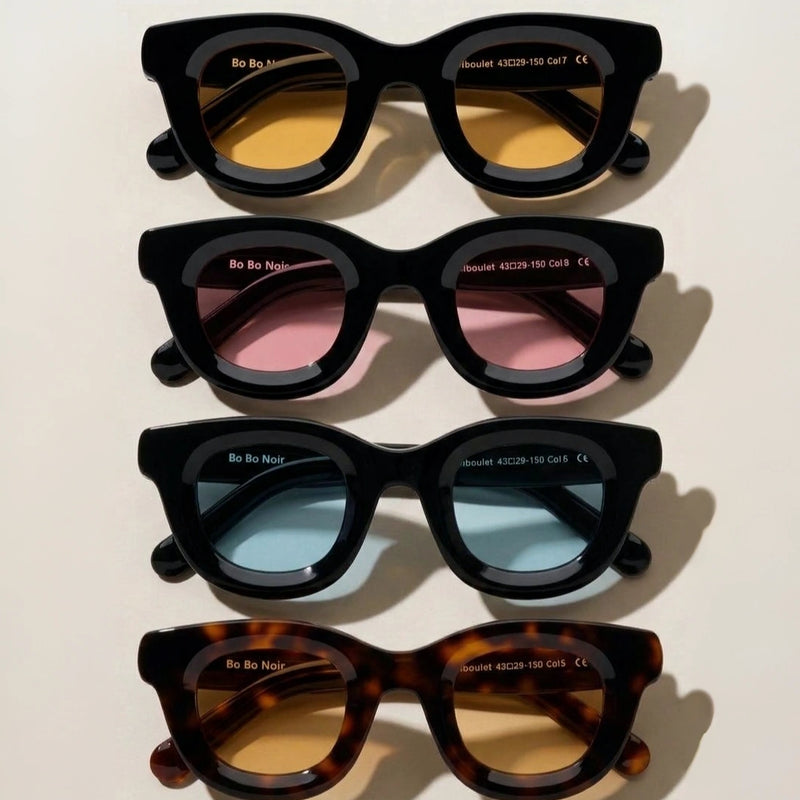
UV400 on sunglasses refers to ultraviolet protection up to a wavelength of 400 nanometres. It is a specification to look for when buying a pair, but it does not tell you how dark the lenses are, whether they are polarised or how the frame will fit. Understanding those differences helps you choose with a clear purpose. Start with UV protection, match the shading to your usual daylight, then compare the shape and dimensions. Below, three Bo Bo Noir examples show why pale and dark lenses can share a UV400 specification while offering different levels of shading. The “400” refers to a wavelength measured in nanometres, not a darkness score or a price tier. The FDA recommends sunglasses labelled UV400 or 100% UV protection. You may also see the more specific wording “100% UVA and UVB protection”. Use the specification rather than the appearance. A dark, mirrored or expensive lens does not establish its UV performance. Nor does a pale lens automatically mean less UV protection. Read the information for the exact version you are considering, especially when one frame family is sold with several lens colours. UV400 is also different from blue light filtering. Do not read the UV label as a promise about screen use, digital eye strain or every wavelength of visible blue light. UV400 concerns ultraviolet radiation; polarisation concerns reflected glare. A polarising filter can reduce glare from reflective surfaces such as water or roads. That feature does not, by itself, establish the UV specification. A pair can combine UV400 protection and polarisation, or have UV400 protection without being polarised. Check both properties separately. If reflected glare is central to the activity you are buying for, ask for an explicit polarisation specification rather than assuming that UV400 includes it. The Bo Bo Noir models below are presented using their stated UV protection and lens category. We do not describe them as polarised. For a more detailed comparison, read our guide to polarised sunglasses. Lens category tells you about visible light reduction. It answers a different question from UV400. In the examples below, Category 1 offers light shading for softer daylight, while Category 3 offers stronger shading for bright daylight. Both categories can be specified with UV400 protection. A lightly tinted pair may have the UV specification you want but still provide too little shading for strong sunshine. Conversely, a dark lens should not be chosen without checking its UV protection. Choose both properties for their own purpose. Colour and tint distribution add another decision. A solid lens has a uniform tint; a gradient lens changes from darker to lighter across its surface. A gradient appearance does not, by itself, establish weaker UV protection. Compare the actual category and specifications rather than judging by the lighter lower section. UV400 alone does not establish suitability for driving, specialist sports or direct solar viewing. Ordinary sunglasses must not be used to look directly at the sun. Use our lens category guide to understand the shading choices before comparing colours. Check the exact product information. Look for UV400 or explicit UVA and UVB protection, then identify the lens category and any stated polarisation. A frame name or photograph is not enough because lens versions can differ. Ask when a specification is missing. If you already own sunglasses and are unsure about their UV protection, an optician may be able to test them. Looking through the lenses, judging their darkness or checking how they interact with a phone screen does not establish UV400 protection. Compare fit and coverage. Front width, bridge contact and temple comfort help establish whether you can wear the pair securely. Lens coverage also matters because light can enter around the frame. Do not assume that thick acetate or a large product photograph guarantees a particular level of side coverage. For the Bo Bo Noir examples here, William measures approximately 139 mm across the front and Triboulet 148 mm. Compare a pair that already fits comfortably, then check the bridge and temple dimensions on the product page. Before ordering, review the returns and refunds conditions. These examples illustrate different shading and frame choices within the collection. All three are specified with UV400 protection. Choose by daylight and fit, rather than ranking them by lens darkness alone. Light shading and a defined black frame. Category 1 nylon lenses with a pale blue tint, UV400 protection and an approximately 148 mm front. Choose this version for softer daylight when light shading matches the conditions and you want glossy black acetate with visible lens colour. Its UV400 specification does not turn the light tint into a dark sun filter. Stronger shading in our narrower round frame. Category 3 CR 39 lenses with a solid green tint, UV400 protection and an approximately 139 mm front. Choose this version for bright daylight if William’s width and bridge suit you, and you prefer round geometry with patterned tortoise acetate. It is narrower than Triboulet, but not guaranteed to fit every small face. Stronger shading with a gradient finish. Category 3 nylon lenses with a brown gradient, UV400 protection and an approximately 148 mm front. Choose this version for a substantial panto silhouette and warm tortoise tones in bright daylight. Compare it with Light Blue when you like Triboulet but need a stronger filter rather than light shading. UV400 is a UV specification recommended by the FDA. It remains one part of choosing a pair: check shading, any required polarisation and fit separately. Both are label descriptions to look for when choosing UV protection. UV400 specifies protection up to 400 nm; wording such as 100% UVA and UVB protection explicitly names the UV types. Check the information for the exact lenses. No. UV protection and polarisation are separate properties. A pair can provide UV400 protection without a polarising filter. Yes. A pale lens can be specified with UV400 protection. Check its category separately because a light tint can offer less visible light reduction than a dark one. Category describes visible light reduction, not a UV400 ranking. In the Bo Bo Noir examples here, both the Category 1 and Category 3 versions are specified with UV400 protection. A gradient finish alone does not tell you that. Read the UV specification and lens category for each exact product rather than judging by the lighter part of a gradient. A phone screen is not a UV protection test. Ask an optician about checking the UV performance of a pair you are unsure about. No. UV400 does not establish suitability for driving or low light. A UV label is not permission to wear a sun tint in conditions where it reduces visibility. Start with Triboulet Shiny Black Light Blue for Category 1 light shading. For Category 3 shading in bright daylight, compare the 139 mm William Tortoise and the 148 mm Triboulet Tortoise Gradient Brown, then check the bridge and full dimensions. By Bo Bo Noir Journal. This buying guide distinguishes UV protection from shading and polarisation using the sources below. Product examples use Bo Bo Noir specifications; we have not conducted independent laboratory UV tests or comparative wearer testing. The source links explain the general principles and are not endorsements of the featured products.UV400 and 100% UV protection
UV400 vs polarised sunglasses
Why lens category and colour still matter
How to check UV protection before buying
Compare three Bo Bo Noir examples
Triboulet Shiny Black Light Blue

William Tortoise

Triboulet Tortoise Gradient Brown

Frequently asked questions
Is UV400 good for sunglasses?
Is UV400 the same as 100% UV protection?
Are UV400 sunglasses always polarised?
Can light blue or yellow lenses have UV400 protection?
Does Category 3 mean better UV protection than Category 1?
Are gradient lenses less UV protective than solid lenses?
Can I test UV400 protection with my phone?
Does UV400 make sunglasses suitable for night driving?
Which Bo Bo Noir pair should I compare first?
Sources and editorial approach
Continue choosing
Bo Bo Journal
Featured products


