Free Worldwide Shipping • 14-Day Returns • Designed in PortugalFree Worldwide Shipping • 14-Day Returns • Designed in PortugalFree Worldwide Shipping • 14-Day Returns • Designed in PortugalFree Worldwide Shipping • 14-Day Returns • Designed in PortugalFree Worldwide Shipping • 14-Day Returns • Designed in PortugalFree Worldwide Shipping • 14-Day Returns • Designed in PortugalFree Worldwide Shipping • 14-Day Returns • Designed in PortugalFree Worldwide Shipping • 14-Day Returns • Designed in PortugalFree Worldwide Shipping • 14-Day Returns • Designed in PortugalFree Worldwide Shipping • 14-Day Returns • Designed in PortugalFree Worldwide Shipping • 14-Day Returns • Designed in PortugalFree Worldwide Shipping • 14-Day Returns • Designed in PortugalFree Worldwide Shipping • 14-Day Returns • Designed in PortugalFree Worldwide Shipping • 14-Day Returns • Designed in PortugalFree Worldwide Shipping • 14-Day Returns • Designed in Portugal
Pick up a substantial French acetate frame and it can be tempting to attribute everything you notice — the depth of the colour, the polish, the solidity and the sculpted edges — to the acetate itself. But why French acetate feels different is a more interesting question than the label suggests.
“French acetate” is not one precise material category. A French eyewear brand does not automatically use acetate made in France, and a frame designed in Paris is not necessarily manufactured there. What creates the distinctive character associated with premium French acetate eyewear is usually a combination of material selection, frame architecture, machining, sculpting, polishing, colour and specialist production knowledge.
That distinction matters when comparing premium frames. Two sunglasses can both be described simply as acetate, yet one can appear dimensional and carefully resolved while another looks comparatively flat. Understanding why makes it easier to judge the object rather than the marketing language. For a broader explanation of the material itself, see our guide to why premium acetate looks different.
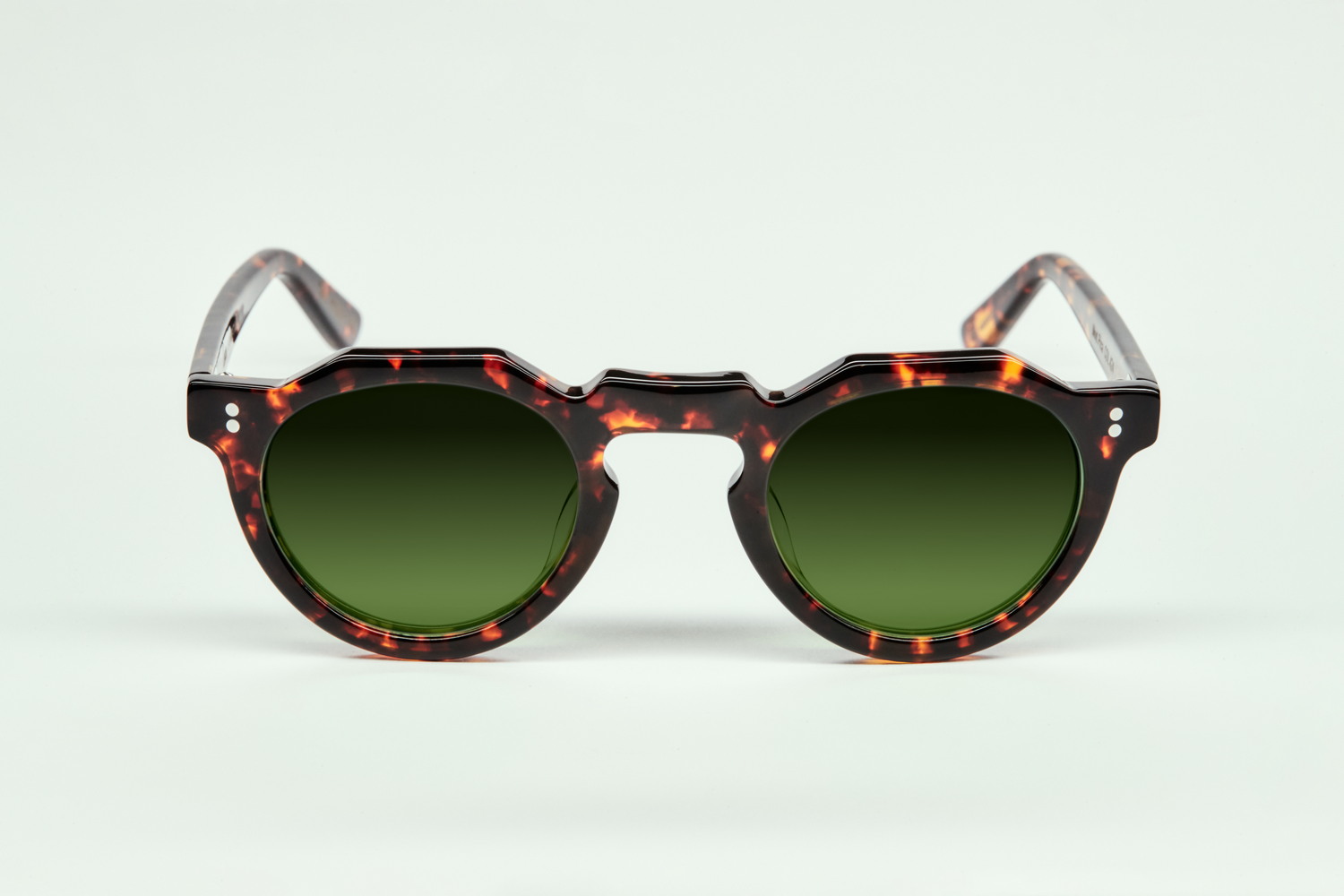
The Lesca Pica illustrates why the word acetate alone tells us relatively little. Material volume, lens geometry, sculpting and finishing determine how that acetate is ultimately perceived.
Quick Answer
French acetate eyewear can feel different because French frame-making traditions often combine substantial material with deliberate sculpting, precise geometry, careful polishing and specialist manufacturing knowledge. The effect does not come simply from an acetate sheet being “French.” Morez and the Jura have long-standing eyewear expertise, while Oyonnax developed an important industrial relationship with plastics and frame production. The useful distinction is therefore between a French brand, French design, French manufacture and the origin of the acetate itself. Premium character comes from how those elements work together.
BBN Insight
What people often interpret as “French acetate quality” is better understood as a system of small decisions rather than one luxury ingredient. Edge definition, polish, thickness distribution, lens geometry, bridge construction, colour and the transition from front to temple all influence whether a frame feels considered. Material matters, but material without resolution is only potential.
The first useful step is to separate four ideas that are often compressed into the same phrase: where the brand comes from, where the frame is designed, where it is manufactured and where its material comes from.
Those things can overlap, but they do not have to. This is why “French acetate sunglasses” can describe several different realities rather than one universal production method.
Description
What it tells you
What it does not automatically tell you
French brand
The company or brand identity is French.
Where every frame or component is manufactured.
Designed in France
The creative development takes place in France.
That production also takes place there.
Made in France
The frame meets the relevant requirements for French manufacturing origin.
That every raw material and component originated in France.
Acetate frame
The principal frame material is acetate.
Its quality, sheet origin, thickness, finishing or manufacturing standard.
Real French eyewear makes this distinction visible. Anne & Valentin combines its Toulouse design identity with long-standing production relationships in the French Jura for many of its frames. Lesca is a French family eyewear house whose production draws on specialist European workshops, including French manufacturing expertise. Other houses make French production itself a particularly explicit part of their identity.
The point is not to decide that one model is more authentic than another. It is to understand which part of the value chain is actually French. That makes provenance useful information instead of a vague proxy for quality.
This distinction also matters when comparing brands. Our updated guide to the best French eyewear brands for 2027 looks at French design identity more broadly; here, the narrower question is what makes acetate construction itself feel convincing.
Before paying more for “French acetate”
Ask four separate questions: Who designed the frame? Where was this particular model manufactured? What material is actually specified? And what has been done to that material through cutting, sculpting, polishing and assembly? Those answers are more informative than nationality used as a standalone adjective.
2. Why does France matter in acetate eyewear?
If acetate is not uniquely French, why does France continue to matter so much in discussions of premium eyewear? The answer is less about ownership of the material and more about concentrated manufacturing knowledge.
Morez and the surrounding Jura region have a long relationship with spectacle manufacturing. Specialist factories, technicians, component suppliers and finishing expertise developed around that industry over generations. Oyonnax, meanwhile, built a strong industrial history around plastics and later became important to French frame production.
That ecosystem still appears in contemporary eyewear. Lafont combines Paris-based design with production in the Jura and uses modern processes such as multi-axis acetate cutting alongside specialist finishing. Vuillet Vega traces six generations of eyewear activity in Morez and works with a regional network of specialist suppliers. Pantos Paris likewise makes French manufacture part of its approach to the panto silhouette.
This matters because specialist ecosystems accumulate knowledge that is difficult to reduce to a material specification. Knowing how much material can be removed from an edge, how a bevel changes reflected light or how a thick front should transition into a temple are manufacturing decisions learned through repeated frame making.
French eyewear expertise is not visible as a country label alone. It becomes visible through proportion, material control, finishing and the relationship between a frame and the face.
BBN Insight
Craftsmanship and technology are not opposites. In well-resolved acetate eyewear, precision machinery can establish repeatable geometry while skilled finishing determines how surfaces, transitions and edges finally read. The more useful question is not “machine or hand?” but whether every stage supports the same design intention.
3. What actually makes acetate frames feel different?
Acetate is a medium. It is not a finished design language. The same broad material category can produce a restrained transparent optical frame, a dense black rectangle, a patterned tortoise panto or a highly sculpted statement frame.
When one acetate frame looks noticeably better resolved than another, inspect the interaction between silhouette, material distribution, bridge geometry, corners, temple transitions, edges, surface finish and colour depth. These variables determine whether the material appears intentional.
A substantial frame, for example, does not have to feel visually heavy. Material can be concentrated around the brow and outer corners while carefully shaped lower rims keep the silhouette open. Equally, a thinner frame does not automatically look refined if its edges, proportions or transitions appear unresolved.
The same applies to surface finish. Gloss can reveal depth, pattern and sculpting, but shine by itself is not evidence of quality. A polished surface is most convincing when it allows the underlying geometry to become clearer.
The side view of Anne & Valentin STILLPOP shows why colour and acetate quality cannot be judged independently from geometry. Profile, thickness and material distribution change how colour is perceived.
What to inspect on an acetate frame
Geometry: Does the silhouette look deliberate from front, side and three-quarter view?
Material distribution: Is thickness used to create structure rather than simply bulk?
Edges and sculpting: Are transitions controlled and visually coherent?
Surface: Does the finish reveal the form rather than merely reflect light?
Colour: Does transparency, tortoise pattern or opacity have depth?
Construction: Do the front, bridge, hinges and temples feel like parts of one object?
These are also useful cues when asking what makes some sunglasses feel premium. Premium perception is rarely produced by one conspicuous detail; it is usually the result of several decisions agreeing with one another.
4. How thickness and sculpting change an acetate frame
Thickness is one of the easiest qualities to notice in acetate eyewear and one of the easiest to misunderstand. More material can create presence, but thickness alone does not create sophistication.
What matters is where the material is placed and how it is shaped. Extra volume around the brow can strengthen the upper architecture of a frame. More material at the outer corners can increase horizontal definition. A carefully resolved bridge can prevent a substantial front from appearing like one uninterrupted block.
Bevels and changes in surface angle add another layer. They alter the way light travels across an acetate front, making a frame appear more dimensional even when its overall outline remains simple. This helps explain why thick acetate frames can look more expensive when the additional material is actually used as part of the design.
A frame such as the Lesca Pica demonstrates this principle through a panto-derived lens shape combined with substantial material presence. The softness of the rounded geometry prevents the thickness from becoming purely aggressive; shape and volume moderate one another.
The same principle applies beyond French eyewear. A substantial frame can remain comfortable visually when width, bridge position, lens opening and colour are calibrated together. This is also why a frame should be judged as a complete composition rather than by thickness in isolation.
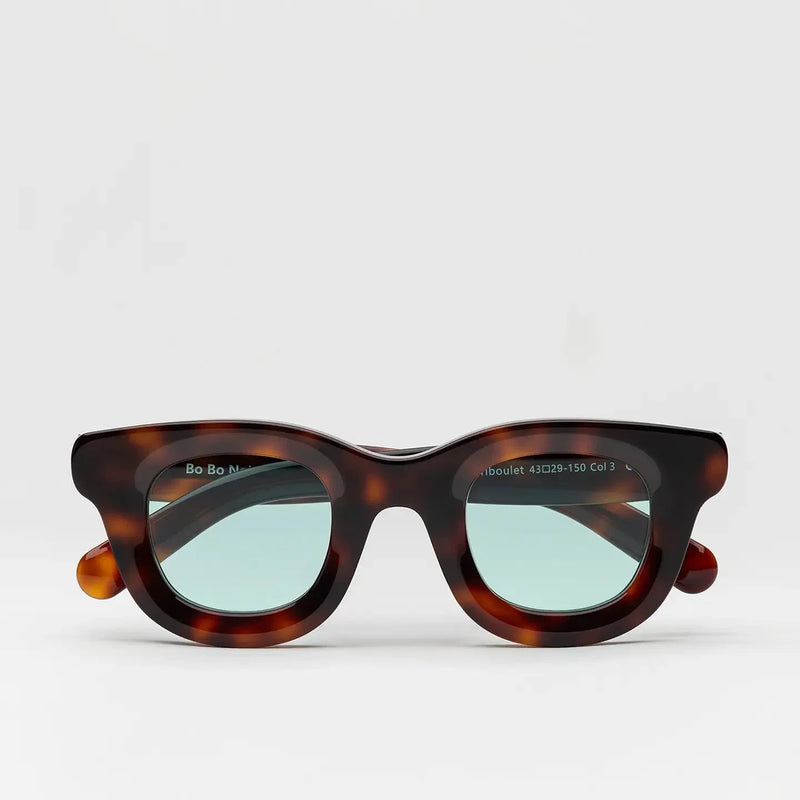
Bo Bo Noir Triboulet uses substantial acetate around a panto-derived silhouette, while lighter blue lenses reduce the perceived intensity of the frame.
Another European perspective
If what attracts you to substantial French acetate is material presence rather than nationality itself, compare the same variables across independent European eyewear: silhouette, proportion, sculpting, colour and visual weight. Bo Bo Noir approaches acetate through strong silhouettes, considered proportions and expressive colour rather than reproducing a specifically French design language. The meaningful comparison is how effectively each frame controls its material.
5. Why polishing matters in premium acetate eyewear
Polishing is one of the reasons two acetate frames made from visually similar material can look dramatically different once finished. After acetate has been cut and shaped, its surfaces and edges still need to be resolved. The quality of that finishing influences how clearly colour, transparency, pattern and sculpted contours are perceived.
A well-polished surface can reveal depth inside tortoiseshell, make translucent acetate appear more dimensional and allow light to move cleanly across a sculpted edge. Less carefully resolved finishing can do the opposite: the material may still look glossy, yet edges can appear less defined, transitions less precise and patterns visually flatter.
This is why shine and polish are not the same thing. Shine is a surface effect. Good polishing should help reveal the geometry underneath it. On a bevel, for example, changes in reflected light make the sculpting easier to read. On transparent or patterned acetate, finishing can expose more of the material's visual depth.
Nor should premium acetate be reduced to a simplistic “handmade versus machine-made” argument. Modern eyewear production can combine precision cutting and machining with multiple stages of finishing. What matters to the buyer is whether those processes produce clean surfaces, coherent edges and a frame whose finishing supports the original design.
Pantos Paris 3656A shows how surface finish and material volume work together. On a substantial panto frame, polish helps make contours and changes in surface direction easier to read.
BBN Insight: light reveals the quality of sculpting
One of the simplest ways to examine an acetate frame is to move it slowly under natural light. Do not look only for shine. Watch how reflections travel across the brow, bridge, outer corners and temples. Controlled changes in reflection make bevels and contours visible, while transparent and patterned areas reveal how much visual depth the material carries.
6. Why colour, transparency and material depth change how acetate feels
Acetate gives eyewear designers considerable control over colour because the material can appear opaque, translucent, transparent, patterned or layered. As a result, colour is not merely decoration applied after the shape has been decided. It changes how strongly the geometry itself is perceived.
Dark opaque acetate tends to create a clear perimeter around the lenses, making the outline of a frame immediately visible. Tortoiseshell interrupts that solid perimeter with tonal variation. Transparent and translucent acetates allow more skin tone and light to remain visible around or through the frame, which can reduce perceived visual weight even when the physical dimensions remain substantial.
This explains why two frames with nearly identical geometry can create very different impressions. A thick black panto can feel graphic and highly defined; the same broad silhouette in a translucent warm tone can appear softer because the boundary between face and frame is less absolute. Patterned tortoiseshell can sit between those extremes, maintaining material presence while introducing variation.
Thickness also affects colour perception. A transparent or translucent acetate can appear more saturated where material becomes deeper, while polished edges can interact differently with light from broad flat surfaces. This is one reason colour should be assessed on the finished three-dimensional frame rather than from a small material swatch alone.
Black: creates a strong perimeter and usually makes frame geometry more immediately visible.
Dark tortoiseshell: maintains substantial definition while breaking solid contrast into warmer tonal variation.
Light tortoiseshell: preserves pattern and material character with less visual density.
Transparent acetate: allows more of the face to remain visible and can make substantial geometry feel visually lighter.
Expressive colours: can make a frame distinctive without necessarily making it more visually dominant, especially when saturation and transparency are controlled.
BBN Insight: colour can compensate for volume
A common mistake is to assume that anyone who finds a thick acetate frame overpowering needs a thinner frame. Sometimes the more effective adjustment is colour. Keeping substantial geometry while reducing contrast or increasing transparency can preserve character without producing the same visual intensity. Thickness and colour should therefore be considered together rather than as separate buying decisions.
7. Does Made in France mean better eyewear?
No — not automatically. Made in France can provide meaningful information about manufacturing provenance, but nationality alone cannot tell you whether a particular frame has good proportions, suitable fit, careful finishing or a design that works for you.
What French manufacture can offer is access to an established specialist eyewear ecosystem. Lafont connects Paris-based design with manufacturing expertise in the Jura. Vuillet Vega has deep roots in Morez and describes a production network involving specialist suppliers and manufacturing stages in the Jura. Pantos Paris also makes French manufacture part of its approach to eyewear.
These examples make provenance meaningful because the location is connected to identifiable production knowledge. But that should not be converted into the claim that every French-made frame is inherently superior to every frame manufactured elsewhere.
It is also important to distinguish a French design identity from exclusively French production. Anne & Valentin, for example, has maintained long-term relationships with factories in the French Jura while also using specialist Japanese production for some titanium eyewear. The example demonstrates why brand nationality, design location, material origin and manufacturing location should be treated as separate pieces of information.
The reverse is equally important. A non-French brand can work with high-quality acetate, specialist eyewear facilities and rigorous design standards. If your objective is to buy a better frame rather than simply a particular provenance, country of manufacture should become one part of a wider assessment rather than the conclusion.
A useful buying sequence is therefore: first judge design, proportions and fit; then inspect material and finishing; finally consider manufacturing provenance as additional evidence. Our guide to How to Tell If Glasses Are High Quality provides a broader checklist that applies regardless of country.
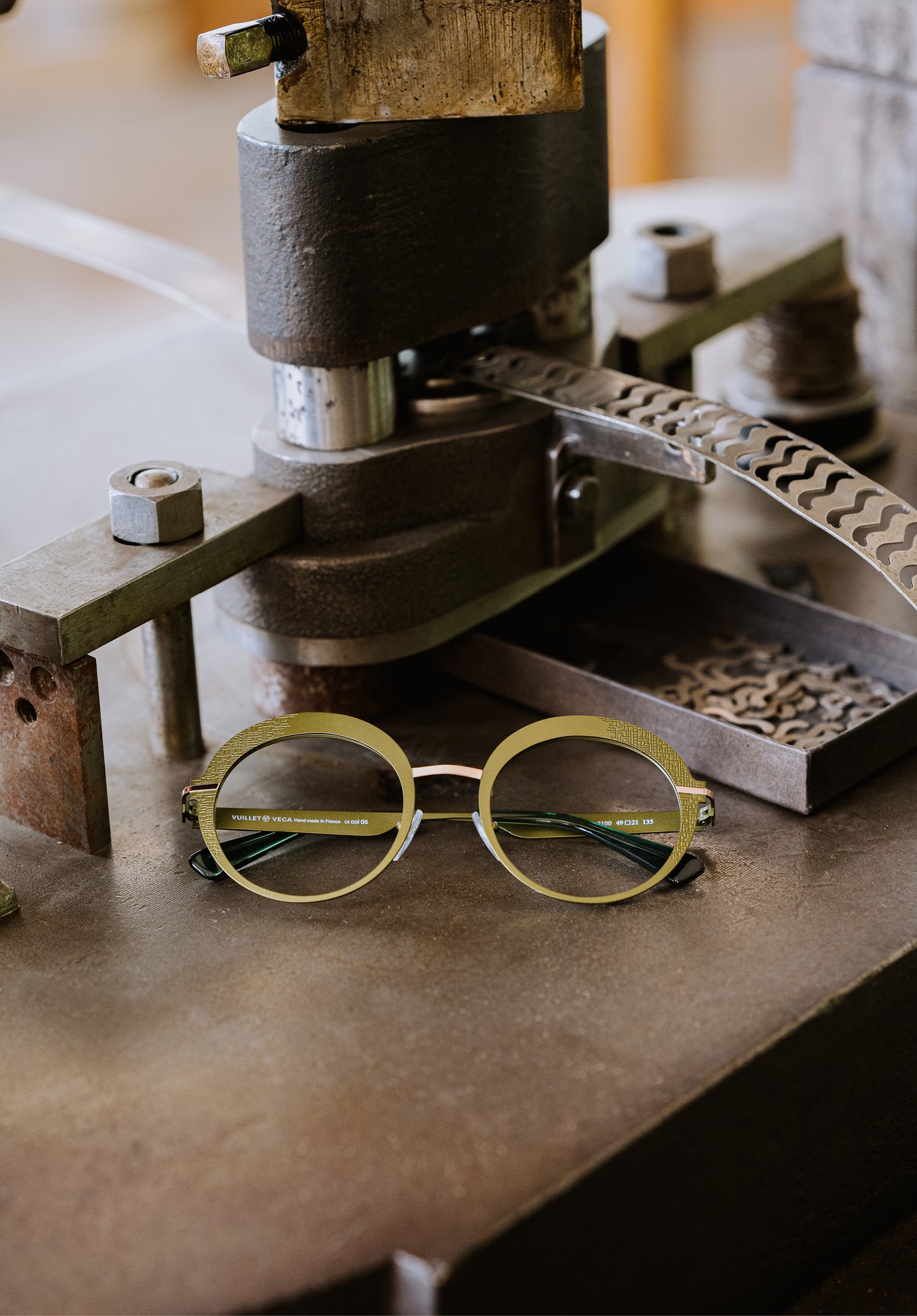
Vuillet Vega connects contemporary eyewear with a frame-making history in Morez extending across six generations. Here, provenance has meaning because it is connected to an identifiable manufacturing tradition.
BBN Insight: provenance is evidence, not a verdict
Manufacturing origin can tell you something useful about the context in which a frame was produced, particularly when a brand provides clear model-level information. But provenance should support what you can already observe in the object. A country label becomes most valuable when design, construction and finishing give you reasons to care about where the frame was made.
8. How to recognise a well-resolved acetate frame
You do not need to know the name of every manufacturing process to make a more informed comparison. A good acetate frame should make sense as a complete object. Material, silhouette, finishing, construction and fit should support one another rather than asking one conspicuous feature — usually thickness or shine — to communicate all of the perceived quality.
Start with the silhouette. From a short distance, ask whether the shape appears balanced and deliberate. Look at the relationship between lens depth, bridge width, brow line and outer corners. A frame that only becomes impressive when examined centimetres away may have excellent surface finishing but weak overall proportions.
Next, examine symmetry and alignment. Look at the frame from the front and from above. Observe how the temples meet the front, whether the lenses sit consistently within the rims and whether the overall geometry appears controlled. Then move closer to the surfaces and edges.
On patterned acetate, look for visual depth rather than expecting every section to appear identical. On transparent acetate, inspect how clearly the construction and material can be read. Around sculpted areas, watch how the surface moves between planes. At the hinges, consider whether the hardware and surrounding acetate feel proportionate to the rest of the design.
Finally, put the frame on. A beautifully finished object can still be the wrong frame for your face. Width, bridge behaviour, temple position and the relationship between the upper rim and eyebrows all influence whether a substantial acetate design feels balanced or intrusive.
This is where material quality and fit finally meet. The most useful inspection therefore happens at several distances rather than through close-up detail alone.
A practical acetate quality check
From a distance: does the silhouette look balanced and intentional?
At arm's length: do colour, thickness and lens geometry work together?
Up close: inspect edges, polish, sculpted transitions, hinges and alignment.
On the face: check width, bridge position, eyebrows, temples and whether the visual weight feels appropriate.
BBN Insight: premium is easier to recognise at three distances
A frame has to succeed at more than close-up inspection. From across a room, you perceive silhouette and contrast. At conversational distance, proportion, colour and facial balance become clearer. Only close up do polish, bevels and construction dominate. The most convincing acetate eyewear remains coherent at all three distances. Beautiful finishing cannot rescue weak proportions, just as strong proportions do not excuse careless finishing.
9. Can non-French eyewear have the same qualities?
Yes. The qualities that make a well-resolved French acetate frame compelling are not exclusive to France. Material depth, controlled thickness, precise geometry, considered colour, clean finishing and specialist production can all be achieved elsewhere. What changes is the design culture, manufacturing network and way each brand combines those variables.
This distinction matters because “French” should not become a quality ranking. France has an important eyewear tradition, but other specialist production cultures have developed their own approaches to acetate and frame making. The useful comparison is therefore not which country is universally “best”, but which frame translates its material and design intention most convincingly into the finished object.
A buyer attracted to French eyewear should first identify what exactly is creating that attraction. Is it substantial acetate? Restrained architecture? Expressive colour? Panto geometry? Heritage references? Sculpted surfaces? A lack of conspicuous logos? Those characteristics are more transferable than nationality.
For example, someone drawn to a substantial French panto frame may not actually be searching for France alone. They may be responding to the combination of rounded lens geometry, visible acetate volume, a strong brow and carefully controlled proportions. Once that preference is understood, relevant alternatives become much easier to recognise.
This is also why independent eyewear is useful for comparison. Different brands can approach the same design variables from different cultural perspectives. Our guide to Independent Eyewear Brands From Europe to Know explores that wider European landscape.
If you like French acetate eyewear, identify what you actually like
Substantial acetate: compare material distribution, thickness and sculpting rather than searching only by nationality.
Architectural refinement: examine proportion, bridge design, edge treatment and how the frame relates to the brow.
Expressive colour: compare saturation, transparency and the relationship between colour and visual weight.
Quiet luxury: look for material, proportion and finishing doing the work instead of conspicuous branding.
Strong personal identity: ask whether the silhouette would remain distinctive if you removed the logo from the equation.
BBN Insight: translate taste into variables
“I like French eyewear” is useful for discovery, but it is still too broad for a buying decision. “I like substantial panto frames with warm acetate, controlled brow weight and minimal branding” is actionable. The more precisely you can describe what attracts you to a frame, the easier it becomes to recognise the same qualities across different independent brands and design traditions.
10. A different European approach to acetate: Bo Bo Noir
If what attracts you to French acetate eyewear is design conviction, substantial material and frames with a recognisable identity, France is not the only perspective worth considering. Bo Bo Noir approaches acetate from a different European design context, built around strong silhouettes, considered proportions and eyewear intended to shape a look rather than merely complete it.
The brand's creative direction, brand development and design vision are based in Portugal and led by co-founder and Portuguese designer João Bessa. He founded Bessa Design in 2013, and his wider work explores the relationship between design history and contemporary form. In eyewear, that perspective appears through classic forms, strong silhouettes and frequent mid-century references interpreted through a contemporary, restrained design language.
Bo Bo Noir uses high-quality acetate and works with specialised eyewear production facilities with extensive industry experience, with an emphasis on consistency and attention to detail. The relevant comparison with French acetate eyewear is therefore not a claim of shared provenance. It is a design comparison: how effectively does each frame control material, proportion, geometry, colour and visual weight?
That distinction prevents the comparison from becoming imitation. Frames emerging from different eyewear cultures can all be evaluated through similar visual principles while still expressing distinct identities. The objective is not to find a substitute for a French label, but to recognise which design qualities matter to you.
For Bo Bo Noir, that approach connects to a broader belief that eyewear should remain relevant beyond short-lived trends. The frame carries identity through form and proportion rather than depending on conspicuous branding.
William Tortoise demonstrates how patterned acetate can soften the visual density of a substantial round silhouette. The frame retains material presence while tonal variation prevents the perimeter from reading as one continuous dark block.
If substantial, heritage-informed acetate is what attracts you
Some of the appeal associated with French acetate eyewear comes from frames that allow the material to remain visibly present rather than trying to disappear on the face. If that is the characteristic you respond to, compare how the frame distributes volume rather than simply searching for another thick acetate silhouette.
William Tortoise uses substantial round geometry with patterned acetate that interrupts the visual density of the front. The tortoise pattern introduces warmer tonal variation while the silhouette retains clear definition.
Consider it if: you want visible acetate, rounded geometry and warm pattern with a strong but controlled presence.
Consider another direction if: you want a thinner, quieter frame or if French manufacturing provenance itself is an important part of your purchase.
BBN perspective: bold does not have to mean maximum contrast
A frame can have a strong silhouette without every other variable being equally intense. Geometry can provide presence while colour moderates contrast; substantial acetate can provide identity while lens colour creates more openness. Controlling those variables independently is often what makes bold eyewear easier to integrate into everyday style.
11. What should you actually pay for in premium French acetate eyewear?
Once provenance, material and manufacturing have been separated, the buying decision becomes clearer. There is no single price at which acetate becomes premium, and a higher price does not prove that the material or finished frame is better.
Eyewear pricing can reflect design development, manufacturing location, specialist finishing, production scale, distribution, retail structure and brand positioning as well as the physical frame. The useful question is therefore not simply whether French acetate is expensive, but what identifiable qualities justify the price of the particular frame you are considering.
If a brand places significant value on French manufacture, look for clear information about where the frame is produced. If the emphasis is on acetate quality, inspect how that material has actually been used: thickness distribution, sculpting, surface finishing, colour depth and construction should support the claim.
Design also deserves part of the value equation. Developing a recognisable silhouette, resolving the relationship between bridge, lenses and outer corners, controlling visual weight and creating a frame that remains distinctive without relying on a large logo are meaningful design decisions even when they are harder to quantify than a material specification.
The strongest value is usually found where design, material, execution, fit and repeat wear intersect. A frame you continue to choose because its proportions and identity work for you can provide more meaningful value than a more expensive frame purchased mainly for a country label or prestige association.
BBN Insight: pay for visible decisions, not adjectives
“Premium”, “heritage”, “luxury” and “French” can all provide useful context, but none tells you whether a particular frame is right for you. The strongest reasons to pay more are usually visible or verifiable: distinctive design, considered proportions, convincing material expression, careful finishing, specialist construction, credible provenance and a frame you expect to wear repeatedly.
12. French acetate vs premium acetate: what is the difference?
The distinction becomes simpler once the terminology is separated. “French” describes a relationship with place; “premium” describes a judgement about material and execution. They can overlap, but neither automatically proves the other.
Question
French acetate eyewear
Premium acetate eyewear
Is it a precise material category?
Not necessarily. The phrase may refer to brand identity, design or manufacturing context.
Not by itself. “Premium” still needs evidence in the material and finished frame.
Does it guarantee quality?
No. French origin is not an automatic quality guarantee.
No. The quality claim still has to be supported by design, material, construction and finishing.
What should you inspect?
Manufacturing provenance, material, geometry, finishing, construction and fit.
Material depth, sculpting, polish, alignment, construction, geometry and fit.
Where can it be made?
Check the specific frame. French brands do not all use identical production models.
High-quality acetate eyewear can come from different specialist manufacturing traditions.
What matters most?
Whether French provenance is meaningful to you and supported by the specific product.
Whether material and execution create a convincing frame at the price being asked.
Material quality also becomes more meaningful over time rather than only at the moment of purchase. Our guide to Why High-Quality Acetate Ages Better Than Ordinary Plastic explains why the distinction between materials can matter beyond their initial appearance.
13. A final decision guide before buying an acetate frame
If you are comparing a French frame with another premium acetate option, reduce the decision to the variables that will still matter after the brand story has faded into the background.
1. Start with the silhouette. Would you still want the frame if you could not see the brand name?
2. Check the proportions. Look at total width, lens depth, bridge position and how the upper rim relates to your eyebrows.
3. Examine the acetate. Look for convincing colour, transparency or pattern and consider how material thickness is distributed.
4. Inspect the finishing. Look at surfaces, edges, sculpted transitions, hinges and front-to-temple alignment.
5. Judge visual weight on your face. A substantial frame should create the amount of presence you actually want.
6. Verify provenance if it matters to you. Check the specific model rather than assuming the nationality of the brand tells the whole production story.
7. Consider repeat wear. The strongest value usually comes from a frame whose design remains useful beyond a short-lived trend.
The final point is particularly important with statement acetate. Boldness does not have to mean novelty. A distinctive frame can remain relevant when its character comes from proportion, geometry and material rather than from a detail that depends entirely on a momentary trend.
When buying online, combine this framework with What to Check Before Buying Sunglasses Online. Product dimensions, front and side views, worn photography and clear material information help turn a general impression of quality into a more informed decision.
BBN Insight: provenance should strengthen the object, not replace it
The most persuasive provenance story is one you can connect back to the frame itself. If a manufacturing tradition supports better control of proportion, finishing, colour or construction, the story and object reinforce each other. When provenance is the only interesting thing about a frame, the design itself may not be doing enough.
14. Frequently asked questions about French acetate eyewear
What is French acetate?
“French acetate” is not always a precise technical description. It may be used informally for acetate eyewear from a French brand, frames designed in France or frames manufactured there. The acetate material itself can have a separate origin, so it is better to check the specific material and manufacturing information for the frame rather than assuming that “French” describes every stage of production.
Why do French acetate glasses feel different?
Well-resolved French acetate frames can feel distinctive because of the interaction between material selection, thickness distribution, cutting, sculpting, polishing, colour, construction and proportion. France also has specialist eyewear manufacturing knowledge concentrated in historic production regions such as Morez and the Jura. The difference is therefore better attributed to the complete frame and the expertise behind it than to nationality or acetate alone.
Is French acetate better than Italian acetate?
Not as a general rule. Comparing “French acetate” with “Italian acetate” can confuse material origin, brand nationality and manufacturing location. A more useful comparison examines the specific acetate, how the frame has been designed and finished, where that particular model was produced and whether its proportions and fit work for the wearer.
Are all French eyewear brands made in France?
No. French brand identity and French manufacturing are different things. Some French eyewear companies emphasise domestic production, while others work with specialist production facilities in more than one country. Check provenance at model level whenever manufacturing origin is important to your decision.
Does Made in France guarantee better glasses?
No. French manufacturing can be meaningful because France has established specialist eyewear expertise, but origin alone does not guarantee good design, finishing, comfort or fit. A convincing frame still needs coherent geometry, appropriate materials, careful execution and suitable proportions.
Why do thick acetate frames often look more expensive?
Greater material volume can make a silhouette more visible and give designers more opportunity to create bevels, contours and dimensional surfaces. But thickness only looks refined when it is controlled. Poorly distributed volume can make a frame feel bulky rather than premium, while well-placed thickness can strengthen the brow, corners or overall architecture without overwhelming the face.
How can I tell whether acetate is high quality?
Do not judge acetate from gloss alone. Examine colour and pattern depth, surface consistency, edge treatment, sculpting, alignment, hinges and the transitions between the frame front and temples. Then assess the complete object on the face. Material quality matters, but how effectively that material has been designed, finished and assembled matters just as much.
Are French acetate frames worth the price?
They can be when the price reflects design you value, specialist manufacturing, convincing material treatment, careful finishing, appropriate fit and provenance that matters to you. A French label alone is not sufficient reason to pay more. The strongest value usually comes from a frame whose design, construction and proportions make you want to wear it repeatedly.
Can non-French brands make equally premium acetate eyewear?
Yes. France represents an important eyewear tradition, not the only route to high-quality acetate frames. Strong design and specialist production exist in other eyewear cultures as well. Compare material, geometry, finishing, construction, fit and design identity rather than treating nationality as a universal quality ranking.
What should I look for when buying premium acetate sunglasses online?
Look for clear product photography from multiple angles, useful dimensions, material information and model-specific manufacturing details where provenance is important. Pay particular attention to total frame width, lens depth, bridge shape, acetate thickness, colour and worn photography. These give you more useful evidence than an isolated product image or broad description such as “premium acetate.”
Final thoughts: what really makes French acetate feel different?
The most useful answer is also the least romantic one: there is no single ingredient that makes French acetate eyewear feel different. The effect comes from a chain of decisions.
Material matters. So do thickness, sculpting, polishing, colour and construction. France matters because its eyewear history has created specialist manufacturing knowledge and brands with distinctive approaches to frame design. But none of those facts should be turned into a rule that French automatically means better.
The stronger buying skill is learning to recognise what a good frame is doing. Look at where it carries visual weight. Watch how light reveals its surfaces. Examine how colour changes its presence. Consider the bridge, brow line and outer width. Ask where the particular model was made if provenance matters to you.
Once you can identify those variables, French eyewear becomes more interesting rather than less. You can appreciate the tradition without depending on the label, understand why certain frames command attention and recognise similar levels of design conviction in other independent eyewear cultures.
That is ultimately what premium acetate should offer: not simply more material, more shine or a more prestigious origin, but a more considered relationship between material, geometry, colour, finishing and the person wearing it.
Explore acetate through design, not labels
Discover Bo Bo Noir sunglasses built around strong silhouettes, expressive acetate and considered proportions.
Best French Eyewear Brands 2027 — compare French eyewear houses through design identity, manufacturing approach and the qualities that distinguish them.
Enjoy a 10% discount on your purchase! Sign up for our newsletter now.Enjoy a 10% discount on your purchase! Sign up for our newsletter now.Enjoy a 10% discount on your purchase! Sign up for our newsletter now.Enjoy a 10% discount on your purchase! Sign up for our newsletter now.Enjoy a 10% discount on your purchase! Sign up for our newsletter now.Enjoy a 10% discount on your purchase! Sign up for our newsletter now.Enjoy a 10% discount on your purchase! Sign up for our newsletter now.Enjoy a 10% discount on your purchase! Sign up for our newsletter now.Enjoy a 10% discount on your purchase! Sign up for our newsletter now.Enjoy a 10% discount on your purchase! Sign up for our newsletter now.Enjoy a 10% discount on your purchase! Sign up for our newsletter now.Enjoy a 10% discount on your purchase! Sign up for our newsletter now.Enjoy a 10% discount on your purchase! Sign up for our newsletter now.Enjoy a 10% discount on your purchase! Sign up for our newsletter now.Enjoy a 10% discount on your purchase! Sign up for our newsletter now.