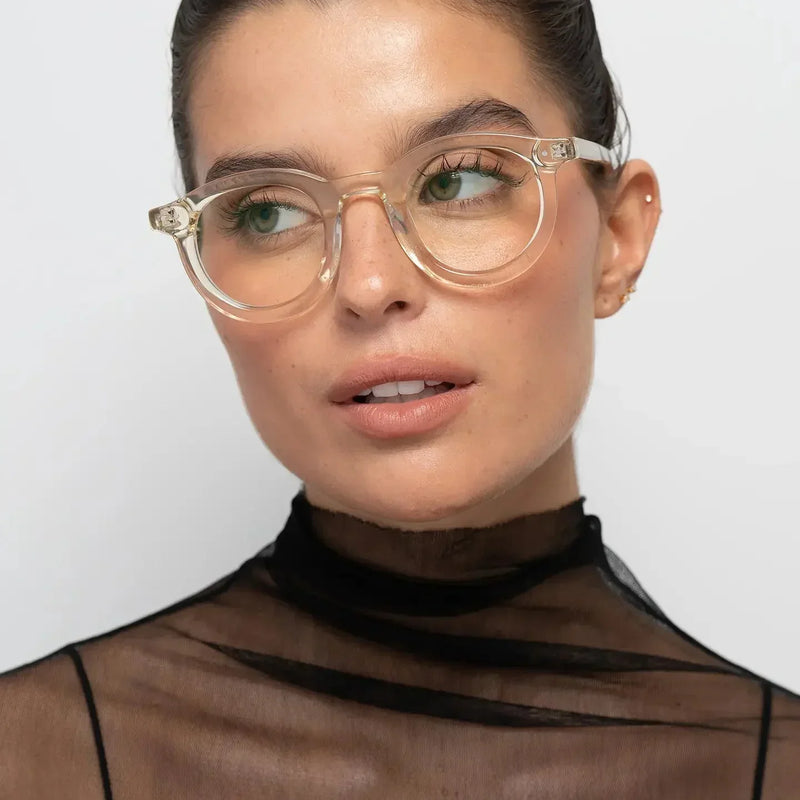
Some sunglasses create an immediate and highly visible outline around the eyes.
Others introduce structure without separating themselves so strongly from the face.
Transparent frames belong to the second category.
Their rims remain physically present, but light can travel through the acetate, allowing parts of the complexion and surrounding facial features to remain visible within the material.
Transparent frames create softer facial balance because they reduce the visual contrast between the eyewear and the skin.
The eye still recognises the bridge, upper rim, outer corners and lens openings.
However, these elements do not create the same continuous, opaque boundary produced by black, dark brown or solid tortoise acetate.
This changes the relationship between the sunglasses and the face.
Instead of becoming the strongest visual feature, the frame allows the eyebrows, eyes, cheekbones, hair and natural complexion to remain more visually dominant.
Transparency does not make a frame physically smaller.
A substantial crystal acetate design can have the same width, thickness and geometry as a black version.
Yet it will often feel considerably lighter because opacity and colour density influence how much visual space the frame appears to occupy.
This distinction is particularly important when choosing bold eyewear.
Some people appreciate thick acetate and expressive silhouettes but find that solid black creates more contrast than they want for everyday wear.
Transparent acetate preserves the craftsmanship and physical presence of the design while reducing the severity of its outline.
The final effect depends on more than transparency alone.
Colourless crystal, peach, yellow, smoke and translucent olive all interact differently with skin tone, hair colour, eyebrows and lenses.
Frame geometry also remains essential.
A transparent rectangular frame still creates stronger horizontal structure than a transparent round frame.
A thick crystal frame still has more presence than a thin one.
Dark lenses can also restore considerable visual density, even when the surrounding acetate remains light.
The most flattering result therefore comes from balancing transparency with colour, shape, thickness and lens tint.
This guide explains why transparent frames create softer facial balance, how different crystal tones interact with the complexion and when a darker frame may create better definition.
Because transparent and dark acetate create opposite contrast effects, it may also help to read Why Dark Frames Create Stronger Facial Definition.

QUICK ANSWER: WHY DO TRANSPARENT FRAMES CREATE SOFTER FACIAL BALANCE?
Transparent frames create softer facial balance because translucent acetate reduces the contrast between the sunglasses and the skin.
Light passes through the rims, making the bridge, upper edge and outer corners appear less visually dense than the same geometry in solid black or dark acetate.
The frame still provides structure, but the natural features of the face remain more visible and visually dominant.
Crystal peach and crystal yellow introduce warmth while preserving translucency. Colourless crystal creates an even lighter transition, while smoke or darker transparent acetate adds more definition.
The final effect becomes stronger when transparent acetate is combined with thick rims, angular geometry or dark lenses.
Transparent frames do not remove facial structure.
They make that structure less visually absolute.
The softness comes from reduced edge contrast and lower colour density, not from the frame becoming physically smaller.
WHAT DOES SOFTER FACIAL BALANCE MEAN IN EYEWEAR?
Softer facial balance describes a visual relationship in which the sunglasses support the face without becoming its strongest boundary.
The frame remains visible, but it does not divide the eye area from the surrounding skin as sharply as opaque acetate.
This allows the face to appear more continuous.
The eyebrows remain visually connected to the forehead.
The eyes remain connected to the cheeks.
The bridge introduces structure without creating one dense horizontal band across the centre of the face.
Softness does not mean a lack of definition.
It means that definition is introduced gradually rather than through a highly contrasted outline.
Every frame organises the face in some way.
The upper rim interacts with the eyebrows.
The bridge clarifies the space between the eyes.
The outer corners direct attention towards the temples.
The lower rims influence the relationship between the lenses and the upper cheeks.
With dark acetate, these boundaries are immediately visible.
With transparent acetate, the same boundaries are perceived through reflections, edge thickness, lens shape and subtle colour rather than through one continuous opaque silhouette.
This creates a quieter form of structure.
The sunglasses can still feel deliberate and substantial, but the viewer notices more of the wearer before noticing the frame as an isolated object.
Softer balance can be especially useful when the wearer wants bold acetate without maximum contrast.
It can also help a large frame feel less visually heavy, create a more open appearance around the eyes and allow lighter facial colouring to remain visible.
However, softness is not automatically more flattering.
Some faces benefit from stronger boundaries, particularly when the eyebrows, hair and complexion already create high natural contrast.
Other faces feel more harmonious when the eyewear introduces less visual interruption.
The objective is not to make the frame disappear.
It is to choose a level of contrast that supports the wearer’s facial proportions and intended appearance.
WHY DOES TRANSPARENCY REDUCE VISUAL WEIGHT?
Visual weight describes how strongly an object attracts attention within a composition.
In eyewear, it is influenced by colour, opacity, thickness, scale, geometry, reflections and lens density.
A solid black frame has high visual weight because its complete shape remains continuously visible.
The eye recognises one uninterrupted dark object placed across the upper face.
Transparent acetate behaves differently.
Light passes into and through the material.
The complexion remains partially visible behind the rims.
Reflections appear along the polished edges rather than across one completely solid surface.
This reduces the apparent density of the frame even when its physical measurements remain unchanged.
The distinction can be understood by comparing two identical silhouettes.
A thick black round frame creates a strong dark ring around each lens.
A thick crystal peach version still creates a ring, but its appearance changes as the frame crosses different areas of the face.
It may appear warmer over the cheeks, lighter near the temples and brighter where direct light reaches the polished acetate.
The frame therefore feels less like one continuous graphic object.
Its visual weight becomes distributed through transparency, colour and reflected light.
Opaque dark acetate
Creates one stable and highly visible silhouette across the face.
Transparent acetate
Allows skin tone, light and surrounding colours to influence the appearance of the frame.
Translucent coloured acetate
Preserves visible colour identity while reducing the density of the outer boundary.
This is why transparency can make substantial frames feel easier to wear.
The physical design remains bold.
The material simply prevents that boldness from becoming one uninterrupted block of colour.
Lens tint must still be considered.
A transparent frame with very dark lenses can retain considerable visual weight because the lenses occupy most of the visible area around the eyes.
A lighter or gradient lens creates a softer transition by allowing more of the lower eye area and cheeks to remain perceptible.
The final impression is always produced by the complete pair of sunglasses, not by the acetate alone.

WHY CAN THICK TRANSPARENT FRAMES STILL LOOK SOFT?
Thickness and visual heaviness are related, but they are not identical.
A thicker rim occupies more physical space around the lenses.
It creates stronger edges, deeper side profiles and more visible acetate.
However, the colour and opacity of that acetate determine how strongly the material separates itself from the face.
A thick transparent frame can therefore appear substantial without appearing severe.
The silhouette remains expressive.
The bridge remains visible.
The outer corners still influence facial width.
The lens shape continues to organise the eye area.
But the frame does not create the same dense outline as an opaque version with identical dimensions.
This makes crystal acetate especially useful for people who appreciate sculptural eyewear.
They can wear generous rims, pronounced bridges and bold lens shapes while preserving a lighter relationship with the complexion.
The softness becomes particularly noticeable in warm, lower-contrast tones such as crystal peach.
Crystal yellow creates more colour identity while remaining less visually dense than opaque yellow, tortoise or black acetate.
Geometry continues to influence the final effect.
A thick transparent rectangular frame may still appear architectural because straight lines and pronounced corners create directional structure.
A thick transparent round frame produces softer movement because the eye follows continuous curves around the lenses.
A transparent panto frame combines a stronger upper rim with a rounded lower section, creating a balanced middle position.
Thickness determines how much frame is present.
Transparency determines how strongly that material separates itself from the face.
This is why substantial crystal acetate can feel bold in design but soft in facial contrast.
HOW DO WARM CRYSTAL TONES CHANGE THE FACE?
Transparent acetate is rarely completely neutral.
Even clear crystal reflects the complexion, lenses, hair and surrounding light.
Warm crystal tones create an even more visible interaction because peach, yellow, honey and champagne pigments become part of the facial colour palette.
Crystal peach introduces warmth without creating a solid coloured boundary.
It can connect naturally with warm skin undertones, freckles, brown eyes, auburn hair and golden highlights.
On cooler complexions, the same peach tone may create a gentle contrast that adds warmth to the centre of the face.
Crystal yellow creates stronger colour identity.
It remains transparent, but its brighter pigment makes the frame more visible from conversational distance.
Warm transparent frames soften through translucency while defining the face through colour.
This creates an important middle position.
The sunglasses remain easier to recognise than perfectly clear crystal, but they avoid the density of opaque brown, tortoise or black acetate.
Warm crystal tones can also influence the perceived temperature of the lenses.
Brown or amber lenses reinforce tonal harmony.
Grey lenses create a more noticeable contrast between the warm frame and the cooler lens surface.
The most flattering warm crystal tone should not be chosen through undertone rules alone.
Personal preference, wardrobe colours, lens tint and desired visibility remain equally important.
Some wearers want the frame to blend closely with their complexion.
Others prefer a warm crystal colour that remains clearly visible while still feeling softer than solid acetate.

DO TRANSPARENT FRAMES SUIT EVERY SKIN TONE?
Transparent frames can suit virtually every complexion, but the most flattering result depends on choosing a crystal tone that complements rather than competes with the natural colouring of the face.
Unlike opaque acetate, transparent materials allow light to pass through the frame.
This means the surrounding skin influences the apparent colour of the sunglasses.
The same crystal frame may therefore appear warmer, cooler or more neutral depending on who is wearing it.
This interaction is one of the defining characteristics of transparent acetate.
Crystal peach introduces warmth and often works beautifully with golden, olive and neutral complexions because it echoes the natural warmth already present in the skin.
Crystal yellow creates a brighter appearance that feels slightly more expressive while remaining considerably softer than opaque coloured acetate.
Very fair complexions sometimes benefit from crystal tones with a little warmth rather than completely colourless acetate, which can occasionally appear visually disconnected under flat indoor lighting.
Darker skin tones often create exceptional contrast with transparent acetate because the complexion itself becomes part of the visual composition of the frame.
The material appears richer, deeper and more dimensional without creating the hard outline associated with black acetate.
Hair colour also influences the final balance.
Dark hair naturally introduces stronger facial contrast, allowing completely transparent frames to remain visible without feeling overwhelming.
Lighter hair often benefits from warmer crystal colours that preserve definition while maintaining softness.
Eyebrows should not be ignored either.
Prominent eyebrows naturally define the upper face.
When this definition already exists, transparent acetate allows the eyebrows to remain one of the strongest facial features instead of competing with them.
Transparent frames do not have a fixed colour.
They constantly borrow colour from the wearer, surrounding light and even the lenses themselves.
This changing relationship is what gives crystal acetate its uniquely natural appearance.

HOW DO LENS COLOURS CHANGE THE LOOK OF TRANSPARENT FRAMES?
Transparent acetate never works in isolation.
The lenses occupy most of the visible surface area of the sunglasses and contribute significantly to perceived contrast.
A crystal frame fitted with dark grey lenses creates a noticeably stronger appearance than the same frame paired with lighter gradient lenses.
The eye naturally reads both components together.
The frame softens the outline while the lenses determine much of the visual density inside that outline.
Grey lenses create the cleanest contemporary appearance.
Brown lenses reinforce warmth and produce a more harmonious transition with crystal peach, honey and yellow acetate.
Green lenses often create a vintage-inspired aesthetic that pairs particularly well with olive crystal tones.
Gradient lenses soften the lower half of the face because more light reaches the cheeks and lower eye area.
This makes the transition between sunglasses and skin appear even more gradual.
Solid dark lenses create greater emphasis around the eyes.
They can therefore restore some of the visual strength reduced by transparent acetate.
This balance explains why many luxury eyewear collections combine crystal acetate with darker lenses.
The result preserves softness around the frame while maintaining enough definition for the sunglasses to feel intentional and architecturally complete.
Light lenses
Create the softest overall appearance and reveal more facial detail.
Gradient lenses
Balance sun protection with a lighter visual transition around the lower face.
Dark lenses
Increase visual definition while allowing transparent acetate to prevent the frame from feeling excessively heavy.
TRANSPARENT VS BLACK FRAMES: WHICH CREATES THE BETTER BALANCE?
Neither option is objectively better.
They simply solve different styling objectives.
Black acetate creates stronger facial definition.
The frame immediately establishes itself as a deliberate design element and produces one of the highest levels of contrast available in eyewear.
Transparent acetate produces the opposite effect.
Instead of drawing attention towards the frame itself, it allows the wearer to remain the primary visual focus.
This distinction becomes especially noticeable with thicker acetate constructions.
A bold black frame feels sculptural because both thickness and colour contribute to visual weight.
A bold crystal frame preserves the sculptural silhouette while reducing the density of its outline.
| Transparent Frames | Black Frames |
|---|---|
| Lower visual contrast | High facial contrast |
| Softer transition with skin | Clear facial definition |
| Allows complexion to remain visible | Frame becomes a dominant design feature |
| Excellent for bold acetate with softer appearance | Excellent for maximum structure and contrast |
For many people, neither becomes the permanent choice.
Transparent and dark acetate often complement different wardrobes, seasons and styling intentions.
Owning both provides considerably more versatility than relying on only one level of contrast.

HOW DOES FRAME SHAPE AFFECT THE SOFTNESS OF TRANSPARENT EYEWEAR?
Transparency reduces visual density, but frame geometry still determines how the sunglasses organise the face.
A transparent frame does not become visually neutral simply because light passes through the acetate.
The eye continues to recognise whether the design is round, rectangular, panto-shaped, oversized or sharply angular.
Transparency softens the material boundary, while geometry controls the direction of the structure.
Round transparent frames create the most continuous visual movement.
The absence of hard corners allows the eye to travel smoothly around the lenses, which can make the upper face feel more open and less divided.
This effect becomes especially noticeable in warm crystal colours such as peach and yellow.
The curved silhouette introduces personality, while the translucent acetate prevents the design from becoming too visually forceful.
Rectangular transparent frames create more directional structure.
Their horizontal lines can make the face appear wider, sharper or more architecturally defined.
Even in clear or pale acetate, pronounced corners remain visually active.
The result is softer than an opaque black rectangle, but it still feels more graphic than a round crystal frame.
Panto frames sit between these two effects.
The upper rim usually creates a straighter and more structured relationship with the eyebrows, while the rounded lower section introduces softness around the cheeks.
This makes transparent panto shapes particularly versatile.
They offer more definition than a completely round frame without creating the rigidity of a narrow rectangle.
Oversized transparent frames can also appear softer than expected.
The large lens area remains visually prominent, but the translucent rim prevents the silhouette from becoming one dense block across the face.
However, oversizing should still be controlled.
A frame that extends too far beyond the temples can alter facial proportions regardless of its opacity.
Similarly, a lens depth that reaches too close to the cheeks may make the frame feel large even when its colour remains subtle.
| Transparent Frame Shape | Visual Effect | Best Styling Objective |
|---|---|---|
| Round | Soft, continuous and expressive | Reducing angularity and creating openness |
| Panto | Balanced upper structure with rounded softness | Combining definition with versatility |
| Rectangular | More directional and architectural | Adding horizontal definition without dark opacity |
| Oversized | High physical presence with softened colour density | Creating a statement while preserving facial visibility |
Transparency cannot erase geometry.
A crystal rectangle remains rectangular, and a crystal round frame remains curved.
The material changes how strongly the shape is perceived, not the directional effect of the shape itself.

WHICH FACE SHAPES BENEFIT MOST FROM TRANSPARENT FRAMES?
Transparent frames can work across all face shapes because opacity and geometry can be adjusted independently.
The more useful question is not whether a face shape can wear transparency.
It is which transparent silhouette creates the intended balance.
Round faces often benefit from crystal frames with clearer corners or a slightly straighter upper rim.
The transparency prevents the frame from feeling severe, while the geometry introduces enough direction to define the upper face.
A transparent rectangular or structured panto shape can therefore create balance without producing the strong contrast of black acetate.
Square faces may benefit from round or panto crystal frames.
Curved lens openings can soften a pronounced jawline and create visual movement around the eyes.
Because the acetate is translucent, the frame can introduce curvature without appearing overly decorative or heavy.
Oval faces generally accommodate a wide range of transparent silhouettes.
The primary consideration becomes scale.
A frame that is too narrow can visually compress the face, while one that is excessively wide may weaken the natural symmetry.
Crystal acetate can make larger designs easier to wear, but correct temple alignment remains essential.
Heart-shaped faces often respond well to frames that do not concentrate too much visual weight across the forehead.
Transparent round and panto shapes can introduce width around the eyes while maintaining a lighter relationship with the upper face.
Frames with very heavy outer corners may still exaggerate forehead width, even when the material is translucent.
Long or oblong faces may benefit from deeper lenses.
Greater lens height can visually interrupt facial length and create stronger balance between the forehead, eyes and lower face.
Transparent acetate makes this additional depth feel less imposing than a dark oversized frame.
Face shape should guide geometry, while natural facial contrast should guide opacity and colour.
This distinction prevents overly simple recommendations.
Two people with similarly shaped faces may need completely different frames because their hair colour, eyebrow strength, skin tone and preferred level of visibility are different.
For softer curvature
Choose round or panto crystal frames.
For clearer horizontal structure
Choose transparent rectangular frames or panto frames with a straighter upper rim.
For greater facial balance on longer faces
Choose deeper lenses rather than relying only on wider frames.
For small faces
Prioritise correct width and bridge fit before using transparency to reduce visual scale.
HOW DOES NATURAL FACIAL CONTRAST AFFECT TRANSPARENT FRAMES?
Natural facial contrast describes the visual difference between the skin, hair, eyebrows and eyes.
Some people have strong contrast.
Dark hair, defined eyebrows and light skin can create clear visual separation between facial features.
Other people have lower contrast, with hair, eyebrows and complexion sitting within a closer tonal range.
This natural contrast influences how visible transparent frames appear.
On a high-contrast face, crystal acetate can provide structure without adding another dominant dark element.
The eyebrows and hair already define the upper face, so the frame does not need to perform all of the visual work.
This can create a sophisticated balance in which the sunglasses remain substantial but do not compete with the wearer’s natural features.
On a low-contrast face, completely colourless acetate may become extremely subtle.
This can be desirable when the objective is minimal interruption.
However, some wearers may feel that the frame lacks definition or appears visually unfinished.
In this situation, a tinted crystal colour can be more effective.
Peach, yellow, smoke, olive or champagne acetate preserves transparency while adding enough pigment to clarify the silhouette.
The best transparent frame often matches the wearer’s preferred contrast level rather than simply matching the skin tone.
A person with soft colouring may still prefer a brighter crystal yellow frame.
A person with strong natural contrast may prefer almost colourless acetate.
The decision depends on whether the sunglasses should blend, support or deliberately interrupt the existing facial palette.
Lenses again influence the outcome.
Dark lenses create a strong central area even when the acetate remains pale.
Lighter lenses allow more of the eyes and surrounding features to remain visible, reducing contrast further.
The interaction between frame colour and lens density should therefore be assessed together.
| Natural Facial Contrast | Transparent Frame Effect | Useful Direction |
|---|---|---|
| High contrast | The face remains defined even with very pale acetate | Clear, peach or lightly tinted crystal |
| Medium contrast | Transparency creates balance without disappearing | Peach, yellow, champagne or smoke crystal |
| Low contrast | Colourless acetate may appear extremely subtle | Choose visible tint, stronger geometry or darker lenses |
Skin tone alone does not determine whether a transparent frame will work.
Hair, eyebrows, eyes and lens darkness all influence the final contrast.
Transparent eyewear should be chosen as part of the complete facial composition, not as an isolated colour sample.

CAN TRANSPARENT FRAMES MAKE LARGE SUNGLASSES LOOK SMALLER?
Transparent frames can make large sunglasses appear less visually dominant, but they do not make the physical dimensions smaller.
This distinction matters when assessing both style and fit.
A wide crystal frame may look lighter than a narrower black frame because the rim creates less contrast with the face.
However, the temples still need to align correctly.
The bridge must still remain stable.
The lower rims must still clear the cheeks, and the overall width must still correspond to the wearer’s head and facial proportions.
Transparency changes perceived scale more effectively than actual scale.
This can be especially helpful with thick acetate.
The wearer can retain the expressive depth and craftsmanship of a substantial frame while reducing the impression that the sunglasses dominate the entire face.
Large crystal frames also reveal more light through the rims.
This interrupts the silhouette and prevents the acetate from reading as one continuous mass.
Nevertheless, several design features can restore visual size.
Deep lenses create a larger central area.
Wide temples add visible material at the sides of the face.
Strong keyhole bridges attract attention towards the centre.
Dark lenses create a dense surface that may make the sunglasses feel larger, even when the frame itself remains transparent.
The most balanced large transparent frame usually combines adequate width with controlled lens depth and a bridge that sits close enough to the face to prevent instability.
It should feel intentionally oversized rather than simply too large.
Photographs can make this distinction difficult to assess.
Close-up product images emphasise frame thickness, while wider worn images reveal how the sunglasses relate to the whole head and body.
Both views are necessary when evaluating visual scale.
Transparency can reduce:
The apparent heaviness of thick rims, wide bridges and pronounced outer corners.
Transparency cannot correct:
Temples that are too wide, a bridge that slips, lenses that touch the cheeks or a frame that extends excessively beyond the face.
WHY DO TRANSPARENT FRAMES OFTEN FEEL MORE APPROACHABLE?
Eyewear influences expression because it changes how visible and accessible the eye area appears.
Dark, opaque frames create a stronger border around the eyes.
This can produce authority, intensity and visual certainty.
Transparent frames create a more gradual boundary.
The eyebrows, temples and surrounding skin remain easier to perceive, which can make the expression feel more open.
This does not mean transparent eyewear always appears casual.
Thick crystal acetate can still feel luxurious, artistic and highly intentional.
The approachability comes from the reduced separation between the eyewear and the face, not from a lack of design.
The viewer sees the person and the frame simultaneously rather than reading the frame first.
This quality can make transparent sunglasses particularly effective for everyday use.
They can support expressive personal style without introducing the maximum contrast associated with black acetate.
Warm crystal colours can enhance this effect because their tones often connect with natural colours already present in the skin and hair.
Round geometry adds further softness.
Rectangular geometry introduces more confidence and direction, while transparency prevents the effect from becoming too severe.
The result can therefore be adjusted precisely.
A crystal peach round frame creates one of the softest combinations.
A crystal yellow round frame introduces more energy and colour.
A transparent rectangular frame creates stronger structure while maintaining a lighter facial boundary than black.
Approachability should not be confused with passivity.
A well-designed crystal frame can remain bold, memorable and visually distinctive.
Its impact simply comes from material depth, silhouette and colour interaction rather than from opaque contrast alone.
Dark frames often communicate through contrast.
Transparent frames communicate through light, depth and interaction with the wearer.
Both can be expressive, but they create expression through different visual mechanisms.

WHEN CAN TRANSPARENT FRAMES LOOK TOO SUBTLE?
Transparent frames create softness by reducing the boundary between the eyewear and the face.
However, there is a point at which reduced contrast can become insufficient definition.
This usually happens when the frame, complexion, hair and lenses all sit within a very narrow tonal range.
A nearly colourless frame on a low-contrast face may become difficult to recognise from conversational distance.
The sunglasses still occupy physical space, but their design details can lose clarity.
The result may feel less like deliberate softness and more like visual absence.
This is not necessarily a problem.
Some wearers actively want eyewear that creates minimal interruption.
Others prefer the frame to remain clearly visible as part of their personal style.
The distinction depends on intention.
A transparent frame may feel too subtle when:
- The acetate is almost colourless and the lenses are very pale.
- The wearer has low natural contrast between skin, hair and eyebrows.
- The frame geometry is thin and understated.
- Flat indoor lighting removes reflections from the acetate.
- The frame colour closely matches the surrounding complexion without adding enough tonal variation.
Several adjustments can restore definition without abandoning transparency.
A tinted crystal colour is often the simplest solution.
Crystal peach adds warmth.
Crystal yellow introduces brightness and stronger identity.
Smoke crystal creates a cooler and more visible outline.
Translucent olive introduces earthy depth while preserving the interaction between acetate and skin.
Lens density can also increase structure.
Darker lenses create a more noticeable central shape, allowing the frame itself to remain light.
A thicker rim provides another solution.
More acetate becomes visible around the lenses, but translucency prevents that additional material from becoming excessively heavy.
Geometry can contribute as well.
A clearer brow line, stronger outer corner or more distinctive bridge can make the frame easier to recognise even when the material remains pale.
When transparent frames feel too invisible
Add pigment before moving immediately to black.
When the lenses feel too pale
Choose a darker or gradient tint to restore central definition.
When the silhouette lacks presence
Choose greater rim thickness or clearer geometry rather than excessive width.
WHEN DO DARKER FRAMES CREATE BETTER FACIAL DEFINITION?
Transparent frames are not always the strongest choice.
There are situations in which darker acetate creates better balance because the face benefits from a clearer visual boundary.
This may happen when the natural features are very soft, when the eyebrows are light or when the wearer wants the sunglasses to function as a dominant styling element.
Dark frames immediately define the upper face.
They establish the bridge, lens shape and outer corners with greater clarity.
This can make the eyes appear more framed and the overall expression more intentional.
Dark acetate is particularly effective when the objective is definition rather than integration.
A strong black frame can also create useful contrast against pale clothing, light hair or minimal styling.
It becomes an anchor within the complete appearance.
Tortoise offers a slightly softer alternative.
Its variation prevents the frame from reading as one uninterrupted block, while the darker pattern still creates substantially more structure than crystal acetate.
The choice between transparent and dark frames should therefore be based on the role the eyewear needs to perform.
Transparent frames support the facial composition.
Dark frames can actively reshape it.
| Choose Transparent Frames When | Choose Darker Frames When |
|---|---|
| You want bold acetate with lower contrast | You want the frame to become a dominant feature |
| You want the eyebrows and complexion to remain visible | You want stronger definition around the eyes |
| You prefer visual integration | You prefer a clear graphic boundary |
| You want large frames to feel visually lighter | You want the frame to add authority and structure |
Some wearers move between both effects depending on the situation.
Transparent acetate may work better for daytime, softer colours and relaxed styling.
Black or tortoise may work better when stronger tailoring, evening clothing or a more graphic visual identity is required.
Neither option needs to replace the other.
They create different expressions from the same face.

HOW DOES TRANSPARENT ACETATE BEHAVE IN DIFFERENT LIGHTING?
Transparent acetate changes more noticeably with lighting than opaque acetate.
This is because light does not simply reflect from the surface.
It enters the material, travels through its depth and creates highlights along the polished edges.
The same frame can therefore look different indoors, outdoors, in direct sunlight and under warm artificial lighting.
In bright daylight, crystal acetate often appears clearer and more dimensional.
The edges become easier to recognise, and the internal colour of the material becomes more visible.
Crystal peach may appear fresher and more luminous.
Crystal yellow may become brighter and more saturated.
Under overcast light, reflections become softer.
The frame may blend more closely with the face because fewer sharp highlights define the acetate.
Warm indoor lighting can intensify yellow, honey and peach tones.
Cool artificial light may make the same frames appear paler or more neutral.
This variability is part of the appeal of transparent eyewear.
The frame does not remain visually fixed.
It reacts to the wearer’s environment and becomes part of the surrounding colour composition.
However, this also means product photography should be interpreted carefully.
A frame photographed against a white studio background may look paler than it appears against skin.
A close-up image may emphasise reflections and thickness.
A worn photograph reveals how the material behaves across the bridge, cheeks and temples.
For the most accurate assessment, review several image types:
- A clean front product image to understand colour and geometry.
- An angled image to evaluate acetate depth.
- A worn front view to assess facial balance.
- A close-up worn image to see how the frame interacts with skin tone.
Transparent acetate is not a static colour surface.
Its appearance is created by material colour, skin tone, lens tint, reflected light and background conditions.
This is why crystal frames often feel more personal when worn than they appear in isolated product photography.
HOW SHOULD TRANSPARENT FRAMES BE STYLED WITH CLOTHING?
Transparent frames are highly adaptable because they do not introduce the same fixed visual boundary as opaque acetate.
They can blend with neutral clothing, echo warm colours or create subtle contrast against darker garments.
The most successful styling usually begins with the frame’s undertone.
Crystal peach works naturally with cream, camel, tan, rust, soft pink, brown and warm white.
It can also create a gentle counterpoint to navy, charcoal and black.
Crystal yellow works well with olive, denim, chocolate brown, burgundy and natural fabrics.
Its brighter pigment gives it more visual identity, making it suitable when the eyewear should contribute colour without becoming opaque.
Completely clear acetate often works best with minimal palettes.
White, grey, black, beige and cool blue allow the construction of the frame to remain visible without introducing competing colour.
Smoke crystal pairs easily with monochrome clothing and cooler tones.
Translucent olive can connect with earth colours, military-inspired greens, stone, brown and muted orange.
Transparent frames can either repeat colours already present in an outfit or act as a softer alternative to strong colour blocking.
The level of contrast should also be considered.
A pale crystal frame with pale clothing creates a low-contrast, continuous appearance.
The same frame against black clothing becomes more noticeable because the surrounding outfit provides the contrast that the acetate itself lacks.
Metal jewellery can affect the overall temperature.
Gold often reinforces peach, yellow and honey crystal tones.
Silver can make colourless or smoke acetate feel cleaner and more contemporary.
These are not strict rules.
They simply explain why the same sunglasses may feel different when styled with different materials and colour palettes.
For tonal softness
Pair warm crystal frames with cream, camel, brown and muted natural colours.
For controlled contrast
Wear pale transparent frames with navy, charcoal or black.
For stronger colour identity
Choose crystal yellow or translucent olive and repeat one related colour elsewhere in the outfit.
ARE TRANSPARENT FRAMES MORE VERSATILE THAN DARK FRAMES?
Transparent frames are often easier to integrate across different wardrobes because their colour shifts according to the wearer and the surrounding environment.
They do not impose one fixed dark outline on every outfit.
This can make them especially useful as an everyday frame.
However, versatility depends on how the wearer defines it.
If versatility means blending with many colours and allowing clothing to remain dominant, transparent acetate has a clear advantage.
If versatility means creating reliable definition regardless of lighting or outfit, black and dark tortoise may perform more consistently.
Transparent frames are adaptable; dark frames are dependable.
Crystal acetate can feel soft with pale clothing, more defined with dark clothing and warmer under golden light.
Black acetate remains visually strong in almost every context.
This makes the two materials versatile in different ways.
A transparent frame can also move easily between casual and refined styling.
The softness of the material works with relaxed clothing, while thick acetate construction and polished surfaces preserve a sense of intention.
Dark frames can appear more formal or graphic, particularly when paired with tailoring and monochrome outfits.
For many wardrobes, the most useful combination is one transparent frame and one darker frame in a similar shape.
This creates two distinct contrast levels without requiring a completely different silhouette.
A crystal William and a shiny black William, for example, preserve the same bold round geometry while producing very different facial effects.
The transparent version feels lighter and more integrated.
The black version feels more graphic and defined.

WHAT SHOULD YOU CHECK BEFORE BUYING TRANSPARENT FRAMES ONLINE?
Transparent frames require careful online evaluation because colour and opacity can change significantly between product photography and real wear.
The first step is to review more than one image.
A front product photograph shows the overall silhouette.
An angled image reveals acetate thickness and internal colour.
A worn close-up shows how the frame interacts with the complexion.
A wider worn image reveals scale.
No single photograph provides enough information to judge transparent eyewear accurately.
Next, check whether the colour description indicates clear, crystal, translucent or opaque acetate.
These terms are sometimes used loosely.
The images should confirm how much light actually passes through the material.
Frame dimensions remain essential.
Transparency can reduce perceived size, which may cause a buyer to underestimate how broad or deep the frame really is.
Review the total width, lens width, bridge width and temple length whenever those measurements are available.
The lens colour should also be assessed separately from the frame.
Dark lenses can make a pale frame feel significantly stronger.
Gradient or lighter lenses preserve more of the soft effect.
Consider the likely lighting conditions in which the sunglasses will be worn.
A pale crystal frame may look highly reflective in bright sunlight but considerably quieter indoors.
Finally, compare the transparent colour with the darker version of the same design when available.
This is one of the clearest ways to understand how opacity changes the frame’s visual weight without changing its geometry.
| Check | Why It Matters |
|---|---|
| Front product image | Shows shape, lens proportions and overall colour distribution |
| Angled image | Shows acetate depth, reflections and transparency |
| Worn close-up | Shows interaction with skin tone and facial contrast |
| Worn front view | Shows scale, width and facial balance |
| Dimensions and lens tint | Confirm physical fit and total visual density |
Do not judge transparent acetate only against a white product background.
Always prioritise worn photography.
The frame’s real colour emerges from its interaction with skin, light and lenses.
PRODUCT GUIDE: TRANSPARENT FRAMES FOR SOFTER FACIAL BALANCE
The most useful transparent frame is not necessarily the palest one.
The correct choice depends on how much structure, warmth and colour visibility you want the sunglasses to introduce.
The William silhouette demonstrates how the same bold round construction can create different levels of facial contrast through acetate colour alone.
William Crystal Peach Bold Round Sunglasses
The crystal peach version creates the softest and warmest balance within the William sunglasses collection.
Its translucent acetate allows the complexion to remain visible through the rims, while the peach tint adds enough warmth to keep the substantial silhouette clearly defined.
The rounded lens openings reinforce the soft visual movement of the material.
This combination works particularly well for someone who wants thick acetate, expressive proportions and visible craftsmanship without the stronger boundary of black or tortoise.
Explore William Crystal Peach Bold Round Sunglasses
William Crystal Yellow Bold Round Sunglasses
Crystal yellow creates more colour presence than crystal peach.
The frame remains translucent, but the brighter pigment makes the rims easier to recognise from conversational distance.
This makes it a strong option for lower-contrast complexions or for wearers who want transparent acetate to remain an intentional colour statement.
The result is visually lighter than opaque yellow, tortoise or black, but more expressive than completely colourless crystal.
Explore William Crystal Yellow Bold Round Sunglasses
William Tortoise Bold Round Sunglasses
The tortoise version provides a useful middle point between transparent and black acetate.
Its pattern introduces tonal variation, preventing the rims from reading as one uninterrupted dark outline.
However, it creates considerably more facial definition than either crystal colour.
Choose tortoise when transparent acetate feels too subtle but shiny black feels too severe.
Explore William Tortoise Bold Round Sunglasses
William Shiny Black Bold Round Sunglasses
The shiny black version produces the strongest visual boundary.
Its bold round geometry remains the same, but opaque acetate makes the bridge, rims and outer edges immediately visible.
This is the best choice when the objective is stronger facial definition, maximum contrast and a more graphic eyewear statement.

DECISION GUIDE: WHICH FRAME COLOUR SHOULD YOU CHOOSE?
The easiest way to choose between crystal peach, crystal yellow, tortoise and black is to decide how visible you want the frame to become.
Choose Crystal Peach if you want:
A warm, low-contrast frame that blends gently with the complexion.
Substantial acetate without a severe outline.
Round geometry that feels expressive but approachable.
Choose Crystal Yellow if you want:
Transparent acetate with stronger colour identity.
A brighter frame that remains softer than opaque acetate.
More definition on a low-contrast face without moving directly to dark brown or black.
Choose Tortoise if you want:
More facial definition than transparent acetate provides.
A patterned alternative to solid black.
Warmth, depth and visible contrast in one frame.
Choose Shiny Black if you want:
The strongest possible outline around the eyes.
Maximum contrast and clear graphic structure.
A bold frame that becomes one of the dominant features of the face.
When two versions of the same silhouette fit equally well, choose according to contrast rather than size.
Crystal acetate reduces visual density without sacrificing the proportions, thickness or construction of the frame.
FREQUENTLY ASKED QUESTIONS
Why do transparent frames look softer than black frames?
Transparent acetate allows light and parts of the complexion to remain visible through the rims. This reduces the strength of the boundary between the frame and the face. Black acetate blocks the skin behind it and creates a more continuous, high-contrast outline.
Do transparent frames make the face look wider?
Transparency alone does not make the face look wider. Perceived width is influenced mainly by the total frame width, outer corners and horizontal geometry. A transparent rectangular frame can still add width, while a transparent round frame usually creates softer and more continuous movement.
Are clear frames suitable for pale skin?
Yes. However, completely colourless acetate may appear extremely subtle on pale, low-contrast complexions. Crystal peach, champagne, yellow or smoke can add enough pigment to define the frame while preserving transparency.
Do transparent frames suit dark skin tones?
Yes. Transparent acetate can create striking dimensional contrast on darker complexions because the skin becomes visible through the material. Warm crystal colours may appear richer, while colourless acetate can create a clean and luminous effect.
Can thick transparent frames still look heavy?
They can still look substantial because the physical thickness remains visible. However, they usually appear less dense than an identical frame in black or dark tortoise. Lens darkness, bridge size and outer-corner geometry can increase their visual weight.
Which is softer: crystal peach or crystal yellow?
Crystal peach usually creates the softer and warmer transition. Crystal yellow remains transparent but has a brighter pigment, making the frame more visible and expressive.
Do dark lenses make transparent frames look stronger?
Yes. Dark lenses increase the visual density inside the frame. They can restore definition around the eyes while the transparent acetate keeps the outer boundary softer than opaque black or tortoise.
Are transparent frames good for small faces?
They can make substantial frames feel visually lighter, but physical dimensions still matter. The total width, bridge fit, lens depth and temple alignment must remain suitable for the face.
Can transparent frames look professional?
Yes. Thick, well-proportioned crystal acetate can look polished, architectural and refined. Transparent does not mean casual. The final impression depends on geometry, construction, lens colour and styling.
Are transparent sunglasses more versatile than black sunglasses?
Transparent sunglasses often integrate more easily with different colour palettes because they do not impose one fixed dark boundary. Black sunglasses offer more consistent definition and stronger contrast. Each is versatile in a different way.
Should transparent frames match the skin undertone?
They do not need to match it exactly. A related undertone can create harmony, while a contrasting crystal colour can add brightness or deliberate colour interest. The preferred level of visibility is just as important as undertone.
Why do transparent frames look different indoors and outdoors?
Light travels through the acetate and changes the visibility of its colour, depth and polished edges. Bright daylight often makes crystal frames appear clearer and more dimensional, while flat indoor light can make them blend more closely with the face.
Do transparent frames make the eyes more visible?
The acetate allows more of the surrounding eye area to remain visually connected to the face. Actual eye visibility depends mainly on lens tint. Gradient and lighter lenses reveal more of the eyes than solid dark lenses.
Are transparent frames a trend?
Transparent acetate moves in and out of stronger fashion visibility, but its practical effect is not trend-dependent. It remains a useful material choice for reducing visual contrast while preserving frame structure.
How do I know whether transparent frames are too subtle?
They may be too subtle when the frame, lenses, skin, hair and eyebrows all sit within a narrow tonal range and the silhouette becomes difficult to recognise. A brighter crystal tint, thicker rim or darker lens can restore definition.
FINAL THOUGHTS
Transparent frames create softer facial balance because they change the relationship between structure and contrast.
The bridge, rims and outer corners remain physically present.
The silhouette still influences facial width, eye placement and perceived proportions.
What changes is the strength of the boundary.
Light passes through the acetate.
Skin tone and surrounding colours remain part of the frame’s appearance.
The eyewear becomes integrated with the face rather than sitting across it as one uninterrupted opaque object.
This is why transparent acetate can make bold frames feel more approachable.
A thick crystal frame can preserve sculptural construction, generous proportions and expressive geometry while reducing the severity associated with solid black.
Warm tones such as crystal peach create the most gradual transition.
Crystal yellow introduces stronger colour identity.
Tortoise restores greater definition, while black produces the clearest and most graphic outline.
The most flattering option depends on the result you want.
Choose transparency when the frame should support the face.
Choose darker acetate when the frame should actively define it.
The essential decision is not whether the sunglasses are bold.
It is whether that boldness should come from shape, colour, contrast or a combination of all three.
YOU MAY ALSO LIKE
Why Dark Frames Create Stronger Facial Definition
Learn how black, tortoise and other dark acetate colours create stronger boundaries around the eyes and increase perceived facial structure.
Why Do Thick Acetate Frames Look More Expensive?
Explore how acetate depth, polishing, edge construction and material volume influence the perceived quality of a frame.
William Crystal Peach Bold Round Sunglasses
Discover a warm transparent frame that combines substantial round acetate with softer facial contrast.