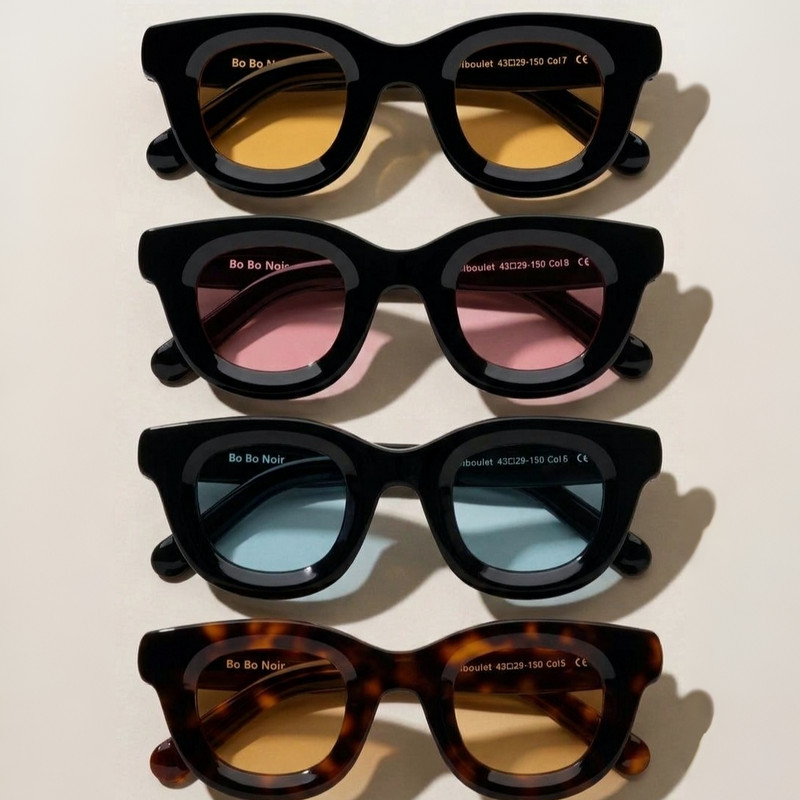
Buying five pairs of cheap sunglasses can feel like better value than spending more on one pair. You get more colours, more shapes and more choice for the same budget. But the calculation changes when one pair fits better, works with more of your wardrobe and becomes the frame you actually reach for several times each week. That is the real argument for one good pair of sunglasses instead of several cheap ones. It is not that a higher price automatically means higher quality, or that inexpensive sunglasses cannot be useful. Value depends on fit, comfort, construction, material, versatility and repeat wear as much as it depends on the price at checkout. A €50 pair worn five times and forgotten can ultimately provide less practical value than a €200 pair worn 100 times; equally, an expensive pair that fits badly or never leaves its case is not a good investment simply because it cost more. The useful comparison is therefore not expensive versus cheap. It is frequent, satisfying use versus unused quantity. This guide explains how to compare those two approaches, where cost per wear becomes useful, what quality can change during everyday use and when owning several less expensive pairs can still make sense. If you first want to understand what separates a convincing frame from marketing language, read how to tell if glasses are high quality. It can be, particularly when the better pair fits comfortably, works across several outfits and situations, is constructed for repeated use and becomes the pair you choose most often. In that situation, the higher initial price is distributed across many more wears. But price alone does not decide the answer. Five inexpensive pairs can be more useful if you genuinely wear all five, while one costly pair is poor value if it is uncomfortable or rarely used. The better purchase is the one that delivers more useful wear, not simply the one with the higher or lower price. Price tells you what a pair of sunglasses costs to acquire. Value asks what you receive from that purchase over time. The distinction matters because neither a low nor a high price tells you how often the sunglasses will be worn, whether they fit comfortably or whether they solve a useful role in your wardrobe. Imagine two purchases. The first gives you several inexpensive frames in different colours, but only one sits comfortably and works with most of your clothes. The second gives you one more considered frame whose width, bridge relationship, colour and geometry make it easy to wear repeatedly. The first purchase creates more objects; the second may create more actual use. The opposite can also be true: a higher-priced frame with the wrong proportions is not transformed into good value by its price tag. If it slides, creates pressure or feels difficult to style, the reasons you paid more may never become relevant in daily life. That is why quality should start with observable qualities rather than status. Material, construction, finishing and design can all matter, but the final buying question is more practical: will those qualities make you wear the frame enough to matter? BBN insight Owning more sunglasses increases choice. It does not automatically increase value. Value appears when a frame repeatedly solves the practical and visual reason you bought it. Cost per wear is the purchase price divided by the number of times you wear the item. It is a simple calculation, but it changes the way two apparently different purchases can be compared. Suppose one pair costs €200 and is worn 100 times: its cost per wear is €2. Now suppose five €40 pairs cost the same €200 in total, but across the five frames you accumulate only 50 wears. Their combined cost per wear is €4. The initial spend was identical, yet the purchase that looked more expensive per pair produced twice as much use for the money. The calculation also works in the other direction. If those five €40 pairs collectively receive 200 wears, their cost per wear falls to €1. Cost per wear therefore does not prove that expensive sunglasses are better. It reveals something more useful: frequency of use can matter as much as purchase price. Cost per wear cannot measure everything that matters. It does not tell you whether the frame remains comfortable after several hours, whether you enjoy how it looks, whether the construction behaves predictably through regular use or whether the material and finishing meet your expectations. What it does well is expose unused quantity. If one frame becomes your default while four alternatives stay in a drawer, the number of sunglasses you own is a poor description of the value you received. The main risk is not simply that inexpensive sunglasses cost less to produce. It is that buying several pairs can spread the decision across quantity rather than concentrate it on the qualities that determine repeated use. A slightly uncomfortable bridge may seem acceptable when the frame is inexpensive; a colour that works with only one outfit may feel harmless when there are four alternatives waiting beside it. Those compromises can accumulate until you technically own five choices but still rely on the one pair that creates the least friction. A more considered purchase reverses the process. Instead of asking how many frames a budget can buy, you ask which combination of fit, shape, colour, material and everyday versatility is most likely to earn repeated wear. The number of pairs becomes secondary. This is also why a smaller collection can sometimes be more effective than a large one. How many pairs of sunglasses should you own? explores when additional frames add a genuinely different role and when they simply duplicate what is already there. One pair becomes more valuable when it gets five things right at the same time Small fit problems become larger through repetition. A frame that feels slightly wide during a short try-on may become frustrating if it slides whenever you move; mild temple pressure can become distracting after several hours, while poor bridge contact can make you continually reposition the sunglasses throughout the day. This is why a frequently worn pair deserves more attention at the selection stage: appropriate frame width, stable bridge contact and balanced temple pressure reduce physical friction and make it easier for the sunglasses to become part of everyday life. Weight should also be judged through distribution rather than by assuming lighter is always more comfortable. A substantial acetate frame can remain comfortable when its weight is supported appropriately, while a lighter frame can still feel unpleasant if pressure is concentrated in the wrong place. When buying online, dimensions and worn photography become particularly important. Compare the measurements with a pair you already know fits well, then use front and side images to understand scale rather than relying on the model name or shape category alone. BBN perspective A frame intended for frequent wear should become less noticeable physically as the day continues, not more. Visual presence can be deliberate; physical distraction rarely is.
Is one good pair of sunglasses really better than five cheap ones?
In this guide
Why is price different from value when buying sunglasses?
What does cost per wear tell you about sunglasses?
Purchase
Total spend
Total wears
Cost per wear
What it shows
1 pair at €200
€200
100
€2
A higher initial price can become reasonable through frequent wear.
5 pairs at €40 each
€200
50 combined
€4
More pairs do not create better value if most receive little use.
5 pairs at €40 each
€200
200 combined
€1
Several inexpensive pairs can be good value when they are genuinely worn.
Why cost per wear is useful — but not enough

Why can five cheap pairs offer less value than one good pair?
Why do fit and comfort matter more with sunglasses you wear frequently?
What can better materials and construction change?
Once fit is right, material and construction begin to matter because they influence how the frame feels, holds its shape and responds to repeated handling. This does not mean that one material name automatically proves quality. Two acetate frames, for example, can differ considerably in thickness, finishing, hinge integration and overall execution, so the useful question is not simply what the frame is made from but what the material and construction actually contribute to the experience of wearing it.
Acetate is particularly useful in substantial eyewear because colour and structure exist through the material rather than simply on its surface. Depending on the frame, this can create visible depth in tortoise patterns, transparency in crystal finishes and a more dimensional appearance in solid colours. Construction matters alongside that material: the relationship between the front, temples and hinges influences how coherent the frame feels, while the proportions of the acetate affect both visual presence and physical balance.
A good material cannot compensate for poor fit or careless execution, just as a well-proportioned design still needs appropriate construction to perform consistently. Material should therefore be evaluated as part of a system rather than treated as a luxury keyword. Why premium acetate looks different explores the visual side of that distinction, while what makes a frame feel substantial without being heavy looks more closely at the relationship between material presence, proportions and wear.

Does acetate automatically mean better sunglasses?
No. The word acetate describes a material category; it does not by itself tell you how well a frame has been designed, produced or finished. Material claims become useful only when they correspond to qualities you can actually observe or experience.
The same principle applies to price. Paying more can give a manufacturer more room for material choice, construction, finishing and design, but the final frame still needs to justify that difference through the product itself. A useful buying decision therefore asks what is better, why does it matter and where can I see or feel the difference? rather than assuming that either an acetate label or a premium price settles the question.
BBN insight
Material is evidence only when it changes something meaningful: structure, visual depth, fit, finishing or the experience of repeated wear. A material name on its own is not a quality verdict.
Why does finishing matter during repeated wear?
Finishing is easy to underestimate because many of its effects are subtle in a product photograph. Edges, contours, transitions and surface consistency contribute to how resolved the sunglasses feel when handled and worn repeatedly. This becomes particularly noticeable in substantial acetate because a thicker frame exposes more material, making the treatment of that volume part of the design rather than something that disappears into a thin silhouette.
Some stages of eyewear production can involve human handling, inspection or finishing, while other stages rely on machinery and repeatable manufacturing processes. The useful quality question is therefore not whether a frame can be broadly described as “handmade”, but how carefully the relevant production and finishing stages have been executed. Craftsmanship is most useful as a description of observable care rather than as a vague synonym for expensive.
When comparing frames, look at how surfaces meet, whether edges and transitions appear deliberate, whether the shape remains coherent from different angles and whether the frame feels resolved as a complete object. These details may be less immediately dramatic than colour or shape, but they become more relevant when the same pair is handled day after day.
What to inspect beyond the material name
- Edges and contours: do transitions look deliberate rather than abrupt?
- Surface finish: does the acetate appear consistent across the frame?
- Hinge area: does the connection between front and temple look coherent and properly integrated?
- Symmetry: does the frame appear balanced when viewed from the front?
- Temple relationship: do the temples align naturally with the frame front?
- Material depth: do transparent, patterned or coloured acetates reveal the character expected from the material?
Does better finishing make sunglasses indestructible?
No. Sunglasses remain objects that can be scratched, dropped, sat on or damaged through poor storage and handling. Better material, construction or finishing should never be interpreted as a promise that a frame cannot wear or fail.
The more reasonable expectation is that a well-executed frame should feel considered in normal use and that its material, construction and finishing should support the role for which it was designed. Longevity still depends partly on how the sunglasses are handled, stored and cared for over time.
Why is wardrobe versatility part of sunglasses value?
A pair of sunglasses can be beautifully made and still offer poor personal value if it works with almost nothing you wear. This is why wardrobe compatibility belongs in the same conversation as material and construction: it directly affects how often the frame leaves its case. Versatility, however, does not require buying the safest or least distinctive design. A bold round, panto or rectangular frame can become an everyday pair when its colour, scale and visual character make sense with the wearer's existing style.
One useful test is to ignore the product photograph for a moment and picture the sunglasses with five outfits you already wear regularly. Consider work, weekends, travel and the clothes you reach for without thinking. If the same pair feels convincing across several of those situations, it has a much stronger chance of generating repeat wear.
Colour can make a major difference here. Black and tortoise generally cover a wide range of wardrobes, while crystal, olive, burgundy and cream can remain highly repeatable when their visual effect corresponds to the colours and contrast you already prefer. The objective is not universal versatility; it is versatility within your real wardrobe.

Versatility is personal rather than universal. A muted olive frame can function almost like a neutral when its colour and geometry already make sense with the wearer's wardrobe.
Does an everyday pair have to be black?
No. Black is exceptionally versatile because it creates a neutral colour anchor, but everyday wear depends on the person rather than a universal colour hierarchy. Someone who wears cream, denim, khaki and brown may find olive or tortoise just as easy to repeat, while crystal can work naturally in a lighter or more minimalist wardrobe.
The strongest everyday colour is therefore the one that requires the least negotiation with your existing clothes while still creating the level of facial contrast and personality you want. Choosing for your actual wardrobe is more useful than choosing a colour simply because it is conventionally described as versatile.
Why do we keep reaching for the same pair of sunglasses?
Frequently worn accessories tend to reduce decision friction. They fit predictably, feel familiar, work with many outfits and create an appearance the wearer recognises as their own. Instead of asking whether the sunglasses work each morning, the decision becomes almost automatic. This helps explain why a collection of five frames can gradually become a collection of one favourite and four occasional alternatives.
The favourite is not necessarily the most neutral or the most expensive. It is often simply the pair in which physical comfort, facial proportions, colour and personal style align most consistently. There can also be a visual familiarity effect: a frame that initially feels distinctive can become part of the way you recognise yourself once you wear it frequently.
This is one reason bold eyewear does not have to be reserved for occasional use. When the proportions and colour feel right, a strong frame can become more natural through repetition rather than less interesting. That relationship between frame and identity is explored further in how sunglasses become part of your personal style.
The repeat-wear test
Before buying, ask yourself four practical questions:
1. Would I wear this with at least five outfits I already own?
2. Does the frame feel comfortable enough for several hours rather than several minutes?
3. Do I like the way its shape and colour change my face enough to repeat that effect often?
4. If I could only take one pair on a week-long trip, would this be a serious candidate?
What makes sunglasses last beyond physical durability?
Physical durability is only one form of longevity. A frame can remain structurally intact and still stop being useful because the wearer no longer likes its proportions, colour or relationship with their wardrobe. For a pair of sunglasses to remain valuable, physical, visual and personal durability need to overlap.
Physical durability concerns how the frame responds to normal wear and care. Visual durability asks whether the design can remain convincing after a particular trend cycle has passed. Personal durability asks whether the frame continues to fit the way you dress and the level of expression you enjoy. This broader view matters because physical survival alone does not create useful longevity if you no longer want to wear the object.
This is where one carefully chosen pair can outperform several impulse purchases. A frame based entirely on a short-lived styling idea may receive intense use for a few months and then disappear from rotation, while a frame whose geometry, colour and presence already make sense with the wearer has a stronger reason to remain useful as trends change. Timelessness should not be confused with invisibility: distinctive frames can have strong visual durability when their proportions are coherent and the wearer genuinely identifies with them. What makes sunglasses timeless explores that distinction in more detail.
| Type of longevity | What it means | Useful question before buying |
|---|---|---|
| Physical | The frame remains suitable for normal repeated use when appropriately handled and cared for. | Do the material, construction and finishing feel appropriate for how often I expect to wear it? |
| Visual | The design remains convincing beyond one short trend cycle. | Would I still like this shape and colour if nobody described them as fashionable? |
| Personal | The frame continues to make sense with your wardrobe and preferred level of expression. | Does this feel like something I will actually want to be seen wearing repeatedly? |
Why buying fewer sunglasses does not mean buying boring sunglasses
A smaller collection only works when the frames inside it feel worth wearing. Choosing fewer pairs therefore does not mean reducing everything to conservative black rectangles; it means being more selective about which shapes, colours and proportions deserve repeated space in your wardrobe.
For one person that may be a glossy black round frame; for another it may be tortoise panto, olive rectangular or translucent crystal acetate. The common factor is not visual restraint. It is that the frame has a clear purpose and enough personal relevance to survive repeated wear.

When can cheaper sunglasses still make sense?
The case for buying one better pair should not become a rule that every inexpensive pair is a bad purchase. Price and usefulness are different things, and there are situations where spending less is entirely rational. A cheaper pair can make sense when you want to experiment with an unfamiliar shape or colour before committing more money, when you need a secondary frame for an occasional styling role, or when you know the sunglasses will be used in circumstances where you would prefer not to carry your primary pair.
Several affordable frames can also represent good value when they genuinely receive enough wear to justify the combined spend. The problem begins when low price repeatedly makes compromise easier to accept: another pair is added because it is inexpensive rather than because it fits well, works with your wardrobe or performs a role that is currently missing.
The better question is therefore not “Should I ever buy cheap sunglasses?” but “What job will this pair do that my existing sunglasses do not already do?” If there is a clear answer and the frame meets the practical requirements you need from it, lower price alone is not a reason to reject it.
Cheaper sunglasses can be a rational choice when:
- you are testing an unfamiliar shape, colour or level of visual expression;
- the pair has a specific secondary role rather than duplicating sunglasses you already own;
- you genuinely expect to wear it often enough to justify the purchase;
- fit and comfort are appropriate for the way you intend to use it;
- the product information gives you enough confidence about the features that matter to you;
- you are choosing the frame because it solves a need, not simply because the price makes another purchase easy.
When does buying several pairs become inefficient?
Duplication is usually the clearest warning sign. If several pairs have almost the same colour, shape, level of contrast and wardrobe role, each additional purchase may add less useful choice than the previous one. A black everyday pair, a lighter crystal frame and a more expressive burgundy option can each solve a different visual problem; three near-identical black frames bought because each seemed inexpensive may not.
A useful collection is therefore measured less by its size than by the distance between the roles of the frames inside it. Quantity becomes valuable when it creates genuine range rather than multiple versions of essentially the same decision.
BBN insight
Quantity becomes useful when it creates range. If every additional pair gives you essentially the same visual effect and serves the same wardrobe role, you have added inventory rather than meaningful choice.
When is paying more for sunglasses worth it?
Paying more becomes easier to justify when the additional spend corresponds to qualities you value and expect to experience repeatedly. That can include material, construction, finishing, fit, distinctive design or simply finding a frame whose proportions and colour make it unusually easy for you to wear. Frequency matters because even relatively small improvements become more relevant when they are experienced several days each week.
Design can also justify part of the decision when it gives you something you genuinely value. A distinctive silhouette, unusual acetate colour or more substantial proportion may make one frame feel more personal than several generic alternatives. That value is subjective, but subjective does not mean irrelevant: eyewear sits directly on the face, so liking what you repeatedly see in the mirror is part of practical use.
What paying more should not do is remove the need to evaluate the product. A high price cannot correct poor fit, guarantee durability or prove that a frame will work with your wardrobe. The premium only becomes meaningful when you can identify what the additional spend gives you and those qualities matter to the way you expect to use the sunglasses.
What should you expect when you spend more?
You should expect a clearer reason for the difference. That reason may appear in the material, the way the frame is constructed and finished, the design, the information supplied about dimensions or the overall coherence of the product. It should be possible to identify what you are paying for rather than relying entirely on language such as “premium” or “luxury”.
Not every difference will be dramatic in a photograph, and not every buyer will value the same qualities equally. The objective is not to prove that the most expensive frame wins every comparison. It is to determine whether the additional value is visible or meaningful enough for your own use to justify the additional cost.

How can you separate real quality from marketing?
Start by translating every broad claim into something observable. If a frame is described as premium, ask what makes it premium. If craftsmanship is emphasised, look for information about the processes, construction or finishing that support the claim. If comfort is promised, examine the dimensions, proportions and available worn photography rather than assuming one frame can be universally comfortable.
The same discipline applies to materials. “Acetate” is useful information, but it is not a complete quality argument. Look at the depth and character of the material, the amount of structure in the frame and how the front, temples and hinges relate to one another. With transparent or patterned acetate, multiple angles can be particularly useful because they reveal qualities a flat front photograph cannot show.
Country of origin, heritage language, exclusivity and a high price can provide context, but none should replace evaluation of the frame itself. For a more detailed inspection framework, how to tell if glasses are high quality covers the physical signals to examine before allowing brand language or price to make the decision for you.
| Marketing claim | Better question to ask | What to examine |
|---|---|---|
| “Premium” | What specifically is different? | Material, construction, finishing, design and product information. |
| “Crafted” | Which production or finishing stages support that description? | Observable execution rather than assuming every process is performed by hand. |
| “Comfortable” | Comfortable for which proportions? | Frame width, bridge relationship, temples, balance and worn scale. |
| “Timeless” | Would I still choose this without the label? | Shape, colour, wardrobe role and personal relevance. |
| “Exclusive” | Does exclusivity improve anything I personally value? | The actual product rather than scarcity language alone. |
A useful rule
The stronger the marketing adjective, the more specific the evidence should become. “Premium”, “crafted”, “timeless” and “luxury” are conclusions; material, proportions, construction, finishing and repeat wear are the things that help you decide whether those conclusions are justified.
How should you compare one better pair with several cheaper pairs?
Instead of beginning with the number of sunglasses you can obtain for a fixed budget, compare the two strategies across the qualities that affect actual use. Start with fit and comfort because a frame that is physically frustrating will struggle to become a favourite regardless of material or price. Then consider wardrobe compatibility and visual effect: does the frame work with enough of your clothes, and do you like what its shape and colour do to your face?
Only after those questions should material, construction and finishing be used to distinguish between options that already make sense for you. Finally, estimate realistic wear. A frame that survives all of those questions has a much stronger chance of delivering value than one chosen primarily because it was inexpensive, fashionable or heavily promoted.
The framework is intentionally neutral. It can lead to one more expensive pair, two mid-priced pairs or several inexpensive ones. The point is to make usefulness the output of the decision rather than quantity or price.
| Question | One better pair is stronger when... | Several cheaper pairs are stronger when... |
|---|---|---|
| Fit | One frame fits noticeably better and is likely to remain comfortable through frequent wear. | Several options fit equally well and genuinely suit different situations. |
| Wardrobe | One pair works naturally across most of the clothes you already wear. | Different colours or shapes each solve a real wardrobe role. |
| Design | You have found a shape and level of expression you want to make part of your regular style. | You genuinely enjoy changing visual direction frequently. |
| Quality | The additional spend corresponds to material, construction, finishing or design you value. | The lower-priced frames still meet your practical requirements for their intended use. |
| Repeat wear | One pair is likely to become your default choice. | Wear will realistically be distributed across the collection. |
| Cost per wear | High frequency is likely to offset the larger initial spend. | The combined collection will receive enough use to justify the total spend. |
The 10-wear thought experiment
Before buying another pair, imagine the next ten occasions on which you are likely to wear sunglasses. Which frame would you realistically choose each time? If the new pair barely appears in that sequence, its low purchase price may not translate into useful value.
Now apply the same test to a more expensive pair. If you can immediately imagine choosing it on most of those occasions because the fit, colour and proportions work naturally, the higher initial spend becomes easier to understand. It still does not prove the purchase is right, but it gives you a realistic estimate of the behaviour that ultimately determines cost per wear and moves attention away from the excitement of the product page towards the life the sunglasses will actually enter.
Can one pair of sunglasses really be enough?
For some people, yes. If one pair covers everyday clothing, travel and the situations in which sunglasses are normally worn, there is no practical requirement to own several. A strong one-pair collection prioritises reliable fit, wardrobe versatility and a design the wearer is happy to repeat.
For other people, one pair will feel unnecessarily restrictive because different colours, shapes or levels of contrast genuinely perform different roles. In that case, a small collection may make more sense. The principle remains the same at either size: each pair should have a reason to exist.

What should your second pair add?
If your primary sunglasses already work well, the strongest second pair is usually not a near-copy. It should change something meaningful: frame shape, colour, transparency, facial contrast or the situations in which you wear it. Someone with black everyday sunglasses might add tortoise for warmth, crystal for a lighter visual boundary, olive for muted colour or burgundy for stronger personality; someone whose first pair is round might choose a rectangle rather than buying another round frame with only a minor detail changed.
This is the point at which a collection becomes more valuable rather than merely larger. How to build a timeless sunglasses collection develops that strategy by giving different frames distinct roles.
BBN perspective
The goal is not minimalism for its own sake. It is reducing weak purchases. One pair, three pairs or five pairs can all make sense when each frame earns enough wear and performs a sufficiently different role.
Which Bo Bo Noir frames illustrate the one-pair approach?
A strong primary pair does not need to look neutral or anonymous. What matters is whether the frame combines a shape you genuinely enjoy with enough wardrobe compatibility, comfort potential and visual longevity to earn frequent use. That can mean a structured tortoise rectangle, a muted olive panto, a translucent round frame or a deeper burgundy option; the right direction depends on which combination creates the least friction in your own wardrobe.
The following Bo Bo Noir frames illustrate four different approaches rather than a ranking from best to worst. Each solves a different visual problem, so the useful question is not which frame is universally “best”, but which one you are most likely to keep choosing after the novelty of buying it has disappeared.
Jane Tortoise — strong structure with everyday warmth
Jane Tortoise combines substantial rectangular geometry with patterned acetate. The shape creates clear horizontal structure, while tortoise breaks up the continuous dark boundary that the same type of frame would create in black. This makes it particularly relevant when you want a primary pair with visible presence but prefer warmth and variation within the material.
Why it can work as a primary pair: the geometry is distinctive, while tortoise remains easy to combine with denim, brown, cream, camel, navy and many neutral wardrobes. Main trade-off: if you prefer softer facial geometry or very low visual presence, a substantial rectangle may feel more directional than you want for everyday wear.

Triboulet Olive — familiar geometry with muted colour
Triboulet Olive uses panto geometry to balance curved lower lenses with a more structured upper frame. Olive gives the frame a distinct colour direction without moving as far from a neutral wardrobe as a brighter green would, making it useful for someone who wants colour to be noticeable without becoming the only thing the frame communicates.
Why it can work as a primary pair: muted colour adds personality while remaining relatively easy to repeat with beige, brown, denim, grey, cream and earth tones. Main trade-off: if most of your wardrobe depends on sharp black-and-white contrast, black may integrate more automatically.

William Crystal Yellow — expressive scale with softer contrast
William Crystal Yellow demonstrates why repeat wear does not require choosing a dark neutral. Substantial round geometry gives the frame presence, while translucent acetate reduces the visual density of the boundary around the face. The result is a useful alternative for someone who likes bold proportions but does not necessarily want the stronger contrast of opaque black.
Why it can work as a primary pair: the frame is distinctive without relying on maximum dark contrast, which can make substantial geometry easier to integrate into a lighter wardrobe. Main trade-off: crystal acetate will not create the same graphic facial definition as a similarly sized opaque dark frame.

Narr Burgundy — deeper colour with familiar panto structure
Narr Burgundy keeps a familiar panto direction while allowing colour to become the stronger expressive element. Burgundy remains deep enough to provide definition, but it introduces more colour character than conventional black and can work particularly well when similar tones already appear naturally in the wardrobe.
Why it can work as a primary pair: if burgundy already fits naturally with your clothes and preferred contrast, the colour can become part of your recurring style rather than an occasional statement. Main trade-off: it is less universally neutral than black or tortoise, so wardrobe compatibility matters more.

How do these one-pair directions compare?
These four frames show why “versatile” does not have one visual definition. Jane prioritises structure and warmth, Triboulet introduces muted colour, William combines bold scale with transparency, and Narr uses deeper colour as part of the frame's identity. The comparison below is designed to help narrow the direction rather than declare one universal winner.
| Frame | Main strength | Best considered for | Main trade-off |
|---|---|---|---|
| Jane Tortoise | Strong rectangular definition with patterned warmth. | A structured primary pair with broad neutral-wardrobe compatibility. | More directional than softer panto or round geometry. |
| Triboulet Olive | Balanced panto geometry with muted colour. | Earth-toned wardrobes and quieter colour expression. | Less automatic with very high-contrast wardrobes. |
| William Crystal Yellow | Substantial geometry with lower visual density. | Someone who wants a distinctive primary pair without dark-frame severity. | Less graphic definition around the eyes. |
| Narr Burgundy | Familiar geometry with deeper colour expression. | A wearer whose wardrobe already supports burgundy and darker neutrals. | Less neutral than black, tortoise or olive. |
BBN insight
The best primary pair is not necessarily the frame with the widest theoretical appeal. It is the frame whose fit, colour and geometry create the least friction in your own life while still giving you a visual effect you want to repeat.
What should you check before choosing one better pair?
By this point, the decision can be reduced to a practical sequence. Start with the things that can prevent repeat wear — fit and comfort — then move through visual compatibility, construction and realistic use. A frame does not need to win every theoretical category; it needs to perform strongly in the categories that determine whether you will actually choose it.
- Fit: does the frame width work with your face rather than simply looking good in the product image?
- Bridge: does the frame sit at a useful height and feel stable?
- Comfort: can you realistically imagine wearing it for several hours?
- Shape: does the geometry create the visual effect you want to repeat frequently?
- Colour: does the frame work with several outfits you already own?
- Material: can you identify what the material contributes rather than relying on the material name alone?
- Construction: do the front, temples and hinge area appear coherent?
- Finishing: do surfaces, edges and transitions look resolved from several angles?
- Role: is this intended to be your primary pair, a second pair or a specific styling option?
- Repeat wear: can you imagine choosing it on most of your next ten sunglasses-wearing occasions?
- Cost per wear: does the expected frequency of use make the initial price reasonable for you?
- Longevity: would you still want the frame if nobody described it as fashionable or premium?
If you want one final check before committing, before buying sunglasses, ask yourself these 10 questions provides a broader purchase framework.
Frequently asked questions
Is it better to buy one expensive pair of sunglasses or several cheap pairs?
Neither strategy is automatically better. One higher-priced pair can provide stronger value when it fits well, works across your wardrobe and receives frequent wear, while several cheaper pairs can be good value when each serves a real purpose and is genuinely used.
Are expensive sunglasses always better quality?
No. Price can reflect materials, design, production, distribution, branding and other factors. Quality should be evaluated through observable details such as fit, construction, material and finishing rather than price alone.
Are cheap sunglasses always poor quality?
No. A lower price does not automatically make a frame unsuitable. The important question is whether the sunglasses meet the fit, construction and use requirements that matter for the role you expect them to perform.
What is cost per wear for sunglasses?
Cost per wear is the purchase price divided by the number of times the sunglasses are worn. A €200 pair worn 100 times has a cost per wear of €2.
Does lower cost per wear mean a pair is automatically better?
No. Cost per wear measures frequency relative to price, but it does not measure comfort, satisfaction, construction or whether the frame performs well. It is one decision tool rather than a complete quality score.
How many pairs of sunglasses do you really need?
There is no universal number. One pair can be enough when it covers your main needs, while a small collection can be more useful when different frames genuinely serve different styling or practical roles.
Why do I always wear the same sunglasses?
The favourite pair often creates the least friction: it fits predictably, works with many outfits and produces a visual effect that already feels natural to the wearer.
How can I tell whether paying more is worth it?
Identify what the additional spend gives you. Better fit for your proportions, material you value, more convincing finishing, distinctive design or higher expected repeat wear can all matter, but the difference should be meaningful to your own use rather than assumed from price.
Should my first good pair of sunglasses be black?
Not necessarily. Black is highly versatile, but tortoise, olive, crystal or other colours can also become strong primary choices when they fit your wardrobe and preferred level of facial contrast more naturally.
What should a second pair of sunglasses add?
Ideally, it should change something meaningful — shape, colour, transparency, facial contrast or use case — rather than duplicating the role already covered by your primary pair.
So, is one good pair of sunglasses better than five cheap ones?
It is better when that one pair gives you something the five alternatives do not: a more dependable fit, greater comfort, stronger wardrobe compatibility, a design you genuinely identify with and enough repeat wear to justify the initial spend. But quantity is not the enemy, and price is not proof of quality. Five inexpensive pairs can outperform one expensive pair when they fit well, serve different roles and are genuinely worn; likewise, one costly frame can be poor value if it spends most of its life in a case.
The real difference is between intentional ownership and accumulated choice. A smaller collection forces each pair to earn its role, while a larger collection only creates more value when the frames inside it are sufficiently different and sufficiently useful.
One good pair is better than five cheap ones when it becomes the pair you would have chosen from those five anyway — only with fewer compromises along the way.
Final BBN perspective
Buy for repeat wear rather than accumulation. The strongest sunglasses purchase is the frame whose fit, material, proportions and visual character give you enough reasons to keep choosing it after the novelty of buying it has disappeared.
Find a pair worth repeating
Explore Bo Bo Noir sunglasses by shape, acetate, colour and visual presence, then choose the frame that makes the most sense for the way you actually wear eyewear.