Envío mundial gratuito • Devoluciones en 14 días • Diseñado en PortugalEnvío mundial gratuito • Devoluciones en 14 días • Diseñado en PortugalEnvío mundial gratuito • Devoluciones en 14 días • Diseñado en PortugalEnvío mundial gratuito • Devoluciones en 14 días • Diseñado en PortugalEnvío mundial gratuito • Devoluciones en 14 días • Diseñado en PortugalEnvío mundial gratuito • Devoluciones en 14 días • Diseñado en PortugalEnvío mundial gratuito • Devoluciones en 14 días • Diseñado en PortugalEnvío mundial gratuito • Devoluciones en 14 días • Diseñado en PortugalEnvío mundial gratuito • Devoluciones en 14 días • Diseñado en PortugalEnvío mundial gratuito • Devoluciones en 14 días • Diseñado en PortugalEnvío mundial gratuito • Devoluciones en 14 días • Diseñado en PortugalEnvío mundial gratuito • Devoluciones en 14 días • Diseñado en PortugalEnvío mundial gratuito • Devoluciones en 14 días • Diseñado en PortugalEnvío mundial gratuito • Devoluciones en 14 días • Diseñado en PortugalEnvío mundial gratuito • Devoluciones en 14 días • Diseñado en Portugal
Independent eyewear has become one of the most interesting parts of the optical market, but the category is increasingly difficult to navigate. Some brands are built around engineering. Others around colour, heritage, sculptural acetate, optical expertise or a highly specific design language. The word independent tells you something about the company, but relatively little about which frame you should actually buy.
That distinction becomes especially important when searching for the best independent eyewear brands in 2027. Independence is not a quality certificate. It does not automatically mean handmade, European-made, more durable, more original or better designed. What it can provide is the freedom to build a more specific relationship between product, design philosophy and wearer.
This guide therefore looks at independent eyewear as a complete category — optical frames and sunglasses — rather than repeating our separate analysis of the best independent sunglasses brands for 2027. We compare seven eyewear brands through design identity, optical credibility, materials, production approach, collection coherence and buyer fit. The objective is not to declare one universal winner, but to understand what each brand does differently — and whether that difference matters to the way you actually wear glasses.
Independent eyewear is not one aesthetic. The useful distinction is how clearly a brand turns proportion, material, colour and construction into a recognisable point of view.
Quick Answer
The best independent eyewear brands for 2027 include MYKITA for engineering-led eyewear, Anne & Valentin for expressive optical design, Cutler and Gross for British optical heritage, AHLEM for refined French eyewear craft, Cubitts for modern spectacle-making, KALEOS for contemporary shape and colour, and Bo Bo Noir for bold, refined eyewear designed beyond trends. The right choice depends less on which brand is universally “best” and more on whether you value technical innovation, colour, heritage, understated refinement, optical functionality or expressive acetate.
BBN Insight
Independent is a business condition; design identity is a product achievement. A brand becomes interesting not simply because it operates independently, but because that independence produces something meaningful in the eyewear: a particular approach to proportion, construction, colour, fit, material, creative direction or the relationship between optical frames and sunglasses.
1. How did we choose the best independent eyewear brands?
A useful independent eyewear ranking needs a different methodology from a list of fashionable sunglasses. Sunglasses can be evaluated heavily through styling, sun protection and visual impact. An eyewear brand has a broader relationship with the face because optical frames may carry prescription lenses, be fitted for prolonged wear and remain part of someone's appearance from morning until night.
For that reason, we looked for brands with a recognisable approach to eyewear as a complete product category. Sunglasses still matter, but so do optical frames, fit, proportion, material choices, construction and the ability to translate a design language across different wearing situations.
We also avoided treating prestige as a scoring system. A brand with a long history is not automatically more relevant than a younger studio. Higher prices do not automatically indicate better design. In-house production can be strategically important for one company, while another may work successfully with specialised external eyewear facilities.
Instead, the shortlist was built around six questions.
Design identity: Can you recognise a coherent point of view across different frames?
Optical credibility: Does the brand treat prescription eyewear as a core category rather than an afterthought?
Product resolution: Do proportion, material, colour and construction support the intended design?
Collection range: Can the brand create meaningful variety without losing its identity?
Production clarity: Can the production model be explained accurately rather than reduced to vague provenance language?
Buyer fit: Is there a clear reason why one wearer might choose this brand over another?
That final criterion is particularly important. A comparison becomes less useful when every company is described as beautifully crafted, timeless and unique. Independent eyewear contains genuinely different philosophies. The differences are what help you make a decision.
BBN Insight: ask what independence produces
Independence is most useful to the buyer when it creates a meaningful product consequence. That might be unusual engineering, control over manufacturing, a distinctive colour language, specialist optical knowledge or the freedom to maintain a design philosophy beyond short trend cycles. Do not buy the ownership structure; look for what the ownership structure allows the brand to do.
2. What does independent eyewear actually mean?
Independent eyewear is often presented as the opposite of mainstream designer eyewear, but that definition is too simple. At its most useful, the term describes eyewear companies whose identity and creative direction are centred on eyewear itself rather than primarily extending the visual codes of a fashion house into another accessory category.
That can create greater freedom to develop specialist products, unusual construction systems, distinctive proportions or collections that do not need to follow the rhythm of a larger fashion business. But independence should not be romanticised. It describes context, not an automatic standard of quality.
An independent brand is not necessarily handmade. It is not necessarily small. It does not necessarily manufacture in its country of origin, and it may work with one factory, several specialised facilities or its own production operation. Independence also tells you nothing definitive about price.
Independent eyewear can enable
It does not automatically mean
A specific creative direction centred on eyewear.
Better quality than every larger brand.
Greater freedom over product development.
Made in the brand's home country.
A recognisable design philosophy.
Handmade.
Specialist optical or manufacturing knowledge.
Expensive or luxury.
A closer relationship between company identity and frame design.
Automatically original or design-led.
The most useful approach is therefore to separate four questions that are often collapsed into one: Who controls the brand? Who develops the design? Who manufactures the frame? What qualities are visible in the finished product?
Those questions can lead to very different answers from one independent eyewear company to another. That diversity is not a problem. It is precisely why comparing independent brands through their actual design and production choices is more informative than treating independence itself as a quality label.
BBN Insight: provenance has more than one layer
Brand origin, design location and manufacturing location are separate pieces of information. A useful provenance story explains those layers rather than blending them into one geographic impression. The country attached to a brand name should never be used as a substitute for understanding how the frame is actually developed and produced.
3. Why is an eyewear brand different from a sunglasses brand?
The distinction may sound semantic, but it changes the buying question. Sunglasses are often chosen partly as expressive accessories. Optical frames can occupy the face for considerably longer periods and may need to accommodate prescription, fitting and everyday visual requirements.
This places greater emphasis on repeat wear. A dramatic frame that works brilliantly for an afternoon may not be the frame you want to see every morning. Conversely, optical eyewear does not have to disappear. For many people, glasses are one of the most consistent elements of personal appearance.
The strongest eyewear brands understand this tension between identity and continuity. They can create frames with enough character to matter while recognising the practical reality that spectacles sit around the eyes, interact with eyebrows and bridge, influence perceived facial proportions and remain visible throughout conversation.
Optical credibility also changes how we interpret a collection. Look for different frame widths, bridge approaches, lens depths, materials and visual weights. A mature eyewear collection should not simply offer the same fashionable silhouette in numerous colours. It should recognise that different faces, prescriptions and wearing preferences create different requirements.
This is why this guide is not simply an expanded version of our independent sunglasses ranking. The search intent is different: here we are evaluating brands that have something meaningful to say about eyewear itself.
BBN Insight: optical frames create the repeat-wear test
Sunglasses can tolerate a degree of theatricality because they are often worn selectively. Optical frames create a harder test: can the brand's design identity remain interesting after hundreds of hours of wear? That does not require conservative design. It requires enough resolution that character survives familiarity.
4. Which independent eyewear brands should be on your 2027 shortlist?
There is no useful way to reduce independent eyewear to one winner because these brands solve different problems. A buyer attracted to technical minimalism may have little interest in expressive colour. Someone who wants substantial acetate may not want an ultra-light metal frame. A wearer looking for quiet everyday opticals may evaluate boldness differently from someone who wants eyewear to transform the face.
The shortlist is therefore organised around distinctive reasons to consider each brand, not a fictional universal score.
Brand
Particularly relevant for
Design direction
MYKITA
Engineering-led eyewear
Technical, lightweight and construction-driven
Anne & Valentin
Expressive optical design
Graphic, colourful and personality-led
Cutler and Gross
British optical heritage
Characterful, substantial and historically informed
AHLEM
Refined French eyewear craft
Controlled, geometric and understated
Cubitts
Modern spectacle-making
Functional, considered and historically aware
KALEOS
Contemporary shape and colour
Modern, expressive and fashion-aware
Bo Bo Noir
Bold, refined eyewear designed beyond trends
Strong silhouettes, considered proportions and expressive acetate
Notice what the table deliberately does not include: a generic quality score. Such a number would create false precision across brands with different materials, manufacturing systems, price structures and design objectives.
Instead, the next sections examine what each brand is unusually good at expressing, who that approach is likely to suit and when another direction may make more sense.
5. MYKITA — best for engineering-led eyewear
Founded in Berlin in 2003, German independent eyewear brand MYKITA is one of the clearest examples of a company where design language and production system developed together. When the company could not find a manufacturer able to realise its original designs, it established its own production and developed tools and processes around those requirements.
That history is relevant because it remains visible in the product. MYKITA's identity has long been connected to functional construction, technical problem-solving and the idea that engineering can become part of the aesthetic rather than something hidden behind decoration.
MYKITA Kiene shows how the brand can apply its technical design philosophy to a more substantial acetate frame, combining material presence with a construction-led approach.
The Kiene image above is particularly useful because MYKITA is sometimes reduced visually to thin sheet-metal eyewear. Kiene demonstrates that the deeper principle is not one material or one silhouette. It is the relationship between construction, material integrity and a controlled product language.
For buyers, that creates a coherent proposition. If you are attracted to eyewear where technical development, adjustability, construction and visual clarity are closely connected, MYKITA deserves serious consideration. The brand's own manufacturing model also gives unusually direct evidence of how independence can influence the product itself.
Consider MYKITA if: you value technical construction, functional detail, material experimentation and a close relationship between engineering and aesthetics.
Consider another direction if: your ideal eyewear is driven primarily by traditional acetate craft, decorative colour or a deliberately heritage-heavy visual language.
6. Anne & Valentin — best for expressive optical design
French independent eyewear brand Anne & Valentin grew from a couple of opticians in Toulouse looking for distinctive frames for their customers. That origin remains unusually relevant because the brand's identity is built around the interaction between eyewear and personality rather than treating optical frames as secondary versions of sunglasses.
Line and colour sit at the centre of the company's design language. But the useful distinction is that expression is intended to work with the wearer. The objective is not simply to create an unusual object, but to make eyewear capable of contributing personality without disguising the person behind it.
Anne & Valentin demonstrates a different route to independent eyewear identity: colour and graphic line can create personality without requiring the frame to overwhelm the wearer.
This makes Anne & Valentin especially useful for buyers who find neutral optical eyewear too anonymous but do not necessarily want maximum acetate volume. Colour relationships, lens geometry and line can provide expression in a more graphic way.
Its production story is also more specific than a simple country label. The company has maintained long-standing production relationships in France's Jura region, while some titanium models are produced in Japan. This is a useful example of why provenance should explain material and production context rather than compress an entire brand into one geographic claim.
Consider Anne & Valentin if: you want optical frames where colour, line and personality are central to the design rather than secondary variations.
Consider another direction if: you prefer eyewear that deliberately reduces graphic expression in favour of technical minimalism or heavier monochromatic acetate.
7. Cutler and Gross — best for British optical heritage
British eyewear brand Cutler and Gross offers a different interpretation of independent eyewear: one built around the relationship between optical knowledge, strong frame character and a long design history. Founded in London in 1969 by opticians Graham Cutler and Tony Gross, the brand developed from an optical context rather than beginning as an extension of a wider fashion business.
That origin matters because Cutler and Gross has never needed to make eyewear visually neutral in order to make it credible. Substantial acetate, distinctive lens shapes and assertive proportions have long been part of its vocabulary. The frames can carry considerable presence, yet the strongest examples retain enough control that material volume contributes to character rather than becoming the entire design idea.
Cutler and Gross shows how substantial acetate can create identity through proportion and material presence rather than relying on a large external logo.
The brand's manufacturing story is distinct from its British identity. Its roots and design culture are closely associated with London, while production is connected to specialist eyewear manufacturing in Italy, with the brand's current positioning also encompassing Japanese manufacture. That distinction illustrates one of the recurring principles in this guide: brand origin, design identity and manufacturing geography should be understood separately rather than compressed into a single country label.
For the wearer, Cutler and Gross makes most sense when eyewear is expected to contribute visibly to personal style. The brand is less about making the frame disappear and more about allowing familiar optical forms to acquire character through thickness, lens geometry, colour and proportion.
There is also an important distinction between this approach and novelty. A substantial frame does not need an unprecedented silhouette to be distinctive. The design can work through how an established category is resolved — the relationship between brow and lens, the depth of the rim, the treatment of the corners and the way the acetate occupies the face.
Consider Cutler and Gross if: you want substantial eyewear with British optical heritage, strong acetate presence and frames intended to become a visible part of personal style.
Consider another direction if: your priority is ultra-light construction, technical minimalism or optical frames designed to recede as much as possible on the face.
BBN Insight: heritage matters when you can see what it taught the product
A founding date alone does not make contemporary eyewear better. Heritage becomes useful when accumulated experience remains visible in proportion, construction, material judgement or the way a brand reinterprets its own design vocabulary. The relevant question is not how old a brand is, but what its history helps it do.
8. AHLEM — best for refined French eyewear craft
Independent eyewear brand AHLEM, launched in 2014 by Ahlem Manai-Platt, represents a quieter form of design identity. The brand combines a Paris-informed sensibility with specialist production in France and has built a visual language around controlled geometry, material refinement and detail rather than obvious branding.
This restraint is useful to examine because independent eyewear is sometimes associated primarily with eccentricity. AHLEM demonstrates that a brand can have a strong point of view without making every frame visually loud. When decoration is reduced, proportion and line have to carry more of the identity.
AHLEM illustrates how an independent design identity can be quiet rather than theatrical. Geometry, line and proportion carry the frame when overt decoration is deliberately reduced.
That makes AHLEM particularly relevant for someone who wants eyewear to be noticed through resolution rather than volume. The visual effect often depends on small relationships: how the brow travels across the frame, where a corner changes direction, how the bridge relates to the lenses or how much material surrounds the eye.
The brand also provides a useful contrast with MYKITA. Both can produce visually controlled eyewear, but the source of that control is different. MYKITA frequently foregrounds engineering and construction logic. AHLEM's identity is more closely associated with proportion, line, material refinement and French eyewear craft.
This comparison matters because words such as minimal or refined are too broad to help someone choose. Two relatively restrained frames can produce different experiences: one may feel technical and industrial, another architectural and material-led.
Consider AHLEM if: you value controlled geometry, refined detail, specialist French production and a design identity that does not depend on maximum visual volume.
Consider another direction if: you want your eyewear to create stronger immediate contrast through heavier acetate, louder colour or more overtly expressive geometry.
9. Cubitts — best for modern spectacle-making
Founded in King's Cross, London, in 2013, British eyewear brand Cubitts approaches independence through the idea of the spectacle maker. Rather than positioning glasses only as fashion accessories, the brand places the object itself — its shape, fit, construction and relationship with optical history — at the centre of its identity.
The result is a useful bridge between traditional spectacle vocabulary and contemporary everyday eyewear. Many Cubitts frames begin with recognisable optical archetypes rather than deliberately unfamiliar shapes. The distinction comes from how those archetypes are proportioned, detailed and adapted for present-day wear.
The Cubitts Judd demonstrates why worn imagery matters when evaluating optical eyewear: the design has to work not only as an isolated object, but in relation to the eyes, brow, bridge and overall scale of the face.
Judd is especially useful in this article because it brings the discussion back to the face. Product photography can make almost any well-styled frame look convincing in isolation. Optical eyewear faces a harder test. Lens depth, bridge position, overall width and brow relationship become immediately more meaningful once the frame is worn.
Cubitts also illustrates why classic does not need to mean generic. Familiar spectacle shapes contain considerable room for interpretation. Adjusting width, lens depth, bridge, rim thickness or corner treatment can preserve recognisability while changing how intellectual, graphic, soft or assertive the frame feels.
The brand's production model is also instructive. Its approach spans different specialist contexts rather than depending on a single simplistic country-of-origin story, reinforcing the wider point that independence and manufacturing geography are separate questions.
For buyers who want independent eyewear but do not necessarily want the frame to announce its independence through extreme geometry, this can be an attractive proposition. The design interest sits in the resolution of the object rather than in the requirement to make it look unconventional.
Consider Cubitts if: you value optical-first thinking, recognisable spectacle forms, everyday wearability and contemporary reinterpretations of established frame categories.
Consider another direction if: you want eyewear whose primary role is to create a stronger fashion statement through unusual colour, exaggerated material volume or highly experimental construction.
BBN Insight: familiar geometry is not the same as generic design
Round, rectangular, panto and other established frame categories are design starting points, not finished answers. Independent eyewear can be original through proportion, editing and fit rather than through novelty alone. This is particularly important in optical frames, where the most wearable design may be the one that changes a familiar form intelligently rather than replacing it entirely.
10. KALEOS — best for contemporary shape and colour
Born in Barcelona in 2014, Barcelona eyewear brand KALEOS occupies a more fashion-aware position within independent eyewear. Its relevance comes from the way contemporary colour, proportion and shape are brought into optical and sun collections without reducing the brand to a single recurring silhouette.
This is an important category because fashion awareness and design credibility are sometimes presented as opposites. They do not need to be. A brand can respond to changing visual culture while still applying its own judgement to the result. The question is whether a contemporary idea has been interpreted or merely reproduced.
KALEOS shows how contemporary colour and geometry can become part of an optical design language. Fashion relevance is most useful when it changes the frame in a deliberate way rather than simply attaching a seasonal colour to a generic shape.
Colour is particularly important here because it changes more than styling. A transparent or lightly tinted frame can soften a substantial geometry by allowing more facial information to remain visible. Dark opaque acetate can make the same broad dimensions appear stronger. Contrasting components can draw attention towards particular parts of the frame.
KALEOS therefore makes sense for buyers who want their optical frames to participate more actively in contemporary style. That does not necessarily mean choosing the loudest model. It means accepting that eyewear can evolve with fashion while remaining a product that needs to work around the eyes and across repeated wear.
The distinction from Anne & Valentin is useful. Both brands can employ expressive colour, but they do not produce the same visual language. Anne & Valentin often uses colour as part of a highly graphic, personality-centred optical vocabulary. KALEOS tends to place it within a more contemporary fashion context where silhouette and styling references shift more visibly with the moment.
Consider KALEOS if: you want independent eyewear with contemporary proportions, noticeable colour and a closer conversation with current fashion.
Consider another direction if: your priority is a design philosophy deliberately distanced from seasonal fashion or a more engineering-led approach to eyewear.
BBN Insight: trend awareness and trend dependence are different
A contemporary eyewear brand does not become less design-led simply because it engages with fashion. The more useful test is whether the frame still contains convincing proportion, material logic and facial balance once the trend itself is removed. Design can participate in its moment without depending entirely on that moment for its value.
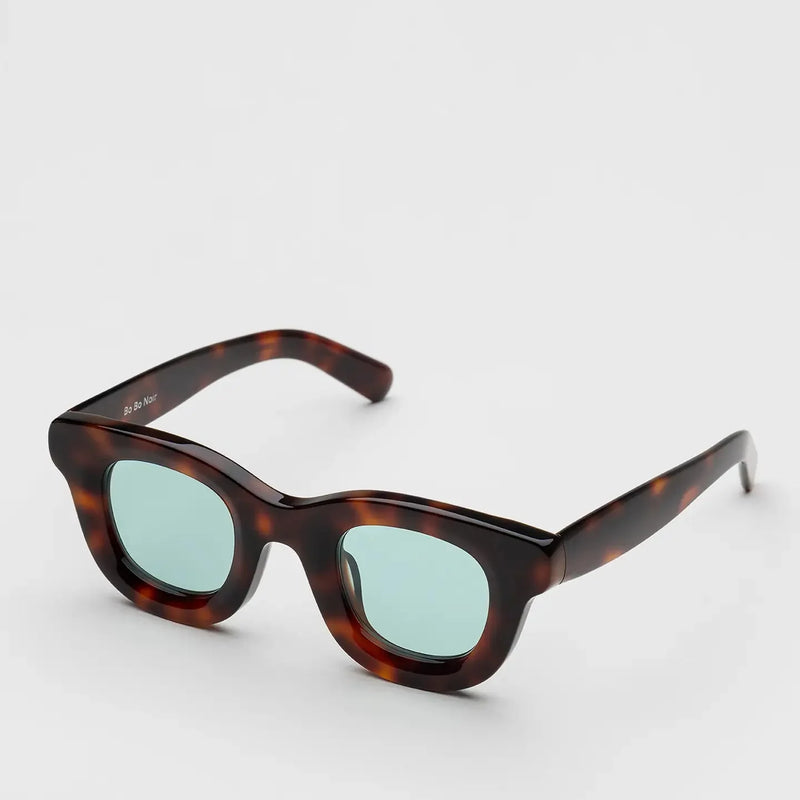
11. Bo Bo Noir — best for bold, refined eyewear designed beyond trends
Portuguese independent eyewear brand Bo Bo Noir approaches eyewear from the idea that a frame should shape a look rather than merely complete it. The result is eyewear with visible presence, but the objective is not maximum visual impact. The more important design problem is balancing strength with restraint so that a frame can establish identity without becoming dependent on novelty.
The brand was co-founded by Portuguese designer João Bessa, who founded Bessa Design in 2013. His wider design work explores relationships between past and present, drawing from design history and translating familiar references into contemporary forms. Within eyewear, that approach appears through classic categories such as round, panto and rectangular frames reconsidered through proportion, material volume, colour and structural clarity.
This is an important distinction because Bo Bo Noir does not depend on inventing unfamiliar frame categories. The design identity sits in how familiar shapes are resolved. A rectangle can become more architectural through brow weight and controlled lens depth. A round frame can gain more presence through substantial acetate. A panto can become more contemporary through colour, material and proportion without losing its historical foundation.
Narr Burgundy demonstrates Bo Bo Noir's approach on the face: recognisable panto geometry, substantial acetate, controlled proportions and colour strong enough to create identity without relying on oversized branding.
Material is part of that approach. Bo Bo Noir uses high-quality acetate for durability, comfort and depth of colour, but acetate is not presented as proof of design quality by itself. Its value depends on what the frame does with it: how much material surrounds the lens, how strongly the silhouette is perceived and whether colour increases or moderates the visual weight.
Production takes place in specialised eyewear facilities with extensive industry experience, with an emphasis on consistency and attention to detail. Creative direction, brand development and design vision are based in Portugal. Keeping those statements separate is deliberate: design origin and manufacturing location are related parts of a product story, but they are not interchangeable.
The phrase bold yet refined is therefore better understood as a balance than as a style category. Boldness can come from silhouette, colour or acetate volume. Refinement comes from controlling those variables so that the frame remains coherent. Increasing every dimension would create more impact, but not necessarily better design.
This also differentiates Bo Bo Noir from several brands earlier in the guide. MYKITA makes engineering particularly visible. Anne & Valentin uses colour and graphic expression in another way. Cutler and Gross brings a different relationship with British optical heritage. AHLEM works through quieter refinement. KALEOS has a closer conversation with contemporary fashion. Bo Bo Noir's strongest territory is design-led personal identity through strong, considered acetate frames intended to remain relevant beyond a short trend cycle.
Consider Bo Bo Noir if: you want eyewear with a strong silhouette, expressive acetate and enough visual presence to become part of your identity, while retaining controlled proportions and a design language intended to move beyond short-lived trends.
Consider another direction if: you want extremely lightweight technical construction, deliberately invisible optical frames or a design language built primarily around engineering rather than acetate and silhouette.
BBN Insight: boldness is a relationship, not a measurement
A frame does not become better simply because it is thicker, wider or darker. Bold eyewear works when material volume, facial scale, lens geometry, colour and proportion reinforce one another. The objective is not maximum presence. It is the right amount of presence for the design and the wearer.
12. How do the best independent eyewear brands compare?
Once the seven brands are viewed together, the most useful comparison is not which one has the strongest reputation. It is where each brand concentrates its design intelligence. The same buyer is unlikely to value engineering, colour, optical heritage, French refinement, contemporary fashion and substantial acetate equally.
This is why apparently similar independent eyewear can produce very different wearing experiences. Two brands may both offer round optical frames, but one may reduce visual weight through thin technical construction while another deliberately increases acetate presence. The category name remains the same; the relationship with the face changes.
Brand
Design identity
Especially relevant if you value
Potential trade-off
MYKITA
Engineering-led, technical, construction-aware
Technical innovation and product systems
May feel too technical if you want traditional acetate richness
Anne & Valentin
Graphic, colourful, personality-centred
Expressive optical frames and colour
May be more visually active than a restrained wardrobe requires
Cutler and Gross
Substantial, characterful, heritage-informed
Strong acetate presence and optical history
Less suitable if low visual weight is your priority
AHLEM
Refined, geometric, controlled
Quiet distinction and French eyewear craft
May feel too restrained if you want obvious visual impact
Cubitts
Spectacle-led, functional, historically aware
Everyday optical wear and familiar forms intelligently resolved
Less focused on extreme fashion expression
KALEOS
Contemporary, expressive, fashion-aware
Current shape, colour and styling relevance
May appeal less if you deliberately avoid fashion-led change
Bo Bo Noir
Bold, refined, acetate-led
Strong silhouettes, personal identity and design beyond trends
Less appropriate if you want eyewear to become almost visually invisible
The trade-off column is particularly important. Good independent eyewear does not remove trade-offs; it makes them more intentional. A frame that creates stronger facial definition will usually be more visible. A lightweight technical frame may sacrifice some of the visual depth of thick acetate. An expressive colour can provide personality while reducing neutrality.
This is why the concept of a universal winner is misleading. The frame that works best for someone seeking quiet everyday opticals could be precisely the wrong choice for a wearer who wants eyewear to become the strongest visual element around the face.
The better comparison is therefore between design intention and wearer intention. Once those align, brand reputation becomes secondary to the actual relationship between frame and person.
BBN Insight: compare trade-offs, not just strengths
Every meaningful design decision creates a consequence. More material can create stronger presence but greater visual weight. More colour can create identity but reduce neutrality. Technical lightness can increase physical discretion while changing the emotional character of the frame. A useful comparison explains what you gain and what you give up.
13. How should you choose an independent eyewear brand?
The easiest mistake is to begin with brand names. A more reliable process begins with the frame role you are trying to fill. Define the job before choosing the company.
For optical frames, start with frequency of wear. Will these be your primary everyday glasses, part of a rotation or a more expressive second pair? A frame worn every day has to survive familiarity. That does not mean it must be visually neutral, but you should be comfortable with the amount of contrast, colour and material presence it creates repeatedly.
Then consider facial effect. Do you want the frame to add definition around the eyes? Soften facial contrast? Create more structure through a strong brow? Introduce colour? Make the face appear visually wider or more compact? Thinking in these terms is more useful than beginning with a generic face-shape rule.
Next, decide how much visual weight you want. Dark opaque acetate generally creates stronger contrast. Transparent material can soften substantial geometry. Thin metal often reduces the apparent boundary around the eyes. Patterned acetate introduces variation that can break up a large solid surface.
Only after those decisions should the brand shortlist become narrower.
If you want technical construction and engineering to be visible: start with MYKITA.
If colour and graphic personality are central: look closely at Anne & Valentin.
If substantial acetate and optical heritage appeal to you: consider Cutler and Gross.
If you prefer quiet refinement and controlled geometry: AHLEM is particularly relevant.
If you want modern everyday spectacles built around established optical forms: explore Cubitts.
If contemporary fashion, colour and proportion matter strongly: consider KALEOS.
If you want bold acetate, strong silhouettes and a design identity intended to outlast short trend cycles: explore Bo Bo Noir.
After narrowing the design direction, move to practical information. Check frame width, lens dimensions, bridge, temple length and worn photography wherever available. Compare those measurements with a frame you already know fits well rather than assuming labels such as small, medium or oversized are consistent between brands.
For optical eyewear, prescription requirements matter too. Certain lens shapes, frame dimensions or constructions may be more appropriate for particular prescriptions than others. Your optician can advise on lens compatibility, thickness, fitting and adjustment, especially when the design you prefer has unusual dimensions or construction.
If you are buying sunglasses online, the same principle of comparison applies. Product dimensions, front and side imagery, bridge design and worn photography provide more useful information than relying on face-shape labels alone. Our guide to how to choose sunglasses online without trying them explains this process in more detail.
Finally, use the wider collection as a credibility check. A strong individual frame tells you that you like one product. Several different frames with coherent design logic tell you something more meaningful about the brand.
This gives us a practical sequence: wearing role → facial effect → visual weight → design philosophy → dimensions and fit → collection consistency. Brand discovery becomes much easier once those questions are answered in that order.
BBN Insight: build a frame brief before you build a brand shortlist
The strongest buying decisions often begin without a brand name. Decide whether you want more or less facial contrast, substantial or light visual weight, classic or more contemporary geometry, neutral or expressive colour, and everyday versatility or stronger identity. Once the frame brief is clear, the right independent brands become easier to identify — and the wrong ones become easier to ignore.
14. Is independent eyewear worth it?
Independent eyewear can be worth paying attention to when the brand gives you something you genuinely value: a particular design language, specialist optical knowledge, distinctive construction, stronger material expression or a frame that feels more specific to your identity. Independence itself, however, is not the reason to pay more.
This distinction matters because price is often used as a shortcut for quality. Eyewear pricing can reflect many things — materials, production complexity, manufacturing location, labour, distribution, retail structure, development costs and brand positioning. A higher price does not tell you, on its own, whether the proportions will suit you or whether you will enjoy wearing the frame for years.
The same applies to materials. Acetate, stainless steel and titanium can all be used intelligently or indifferently. Material names are useful information, but they become meaningful only when considered alongside construction, finishing, fit and the design problem the material is being asked to solve.
A better value question is therefore: what am I receiving that matters to me? For one buyer, the answer may be MYKITA's relationship between engineering and production. For another, it may be Anne & Valentin's expressive optical language, Cutler and Gross's substantial acetate character, AHLEM's controlled refinement, Cubitts' spectacle-making approach, KALEOS's contemporary expression or Bo Bo Noir's balance of strong silhouette and restraint.
Long-term value also depends on whether you continue to want the frame after its initial novelty has disappeared. This is especially important with prescription glasses because the product may be worn for hundreds or thousands of hours. A design that still feels coherent once it has become familiar can be more valuable than one whose appeal depended entirely on the excitement of first seeing it.
If you are evaluating construction and finish rather than brand positioning alone, our guide to what makes some sunglasses feel premium explains how material, finishing, hinges, lenses and overall product resolution affect the experience of a frame.
BBN Insight: value is accumulated through wear
The most expensive frame is not automatically the most valuable, and the cheapest is not automatically the most economical. For eyewear, value is partly accumulated through successful wear. A frame that fits your visual identity, works with your daily life and remains convincing over time can justify itself differently from one chosen mainly for novelty or recognition.
15. Frequently asked questions
What is an independent eyewear brand?
An independent eyewear brand is generally an eyewear-focused company operating with meaningful control over its own brand and creative direction rather than functioning primarily as a licensed eyewear extension of a larger fashion label. Independence does not automatically tell you where the frames are manufactured, whether they are handmade or how good they are. Those questions need to be evaluated separately.
What are the best independent eyewear brands in 2027?
Seven independent eyewear brands worth knowing in 2027 are MYKITA, Anne & Valentin, Cutler and Gross, AHLEM, Cubitts, KALEOS and Bo Bo Noir. They are useful to compare because they represent different approaches to engineering, colour, optical heritage, refinement, spectacle-making, contemporary fashion and bold acetate design rather than repeating one independent-eyewear aesthetic.
Are independent eyewear brands better than designer brands?
Not automatically. Independence describes the context in which a company operates, not a universal level of quality. An independent brand may offer a particularly coherent eyewear philosophy or specialist expertise, but the individual frame should still be judged through design, materials, construction, fit, lenses where relevant and suitability for the wearer.
Is independent eyewear always handmade?
No. Independent brands use different production models. Some operate their own manufacturing systems, some work with specialist external facilities and some combine different production approaches depending on material or collection. “Independent” and “handmade” describe different things and should not be treated as synonyms.
Is independent eyewear always made in Europe?
No. A brand can be independent regardless of where its frames are manufactured. Even among European independent eyewear companies, brand origin, design location and manufacturing location may be different. Some brands also use different specialist production locations for acetate, metal or titanium frames.
Why do independent eyewear brands often look different?
Some independent brands have greater freedom to concentrate on a specific design philosophy because eyewear is central to the business. That can lead to unusual construction, distinctive colour systems, stronger silhouettes or more specialised optical thinking. But independence does not guarantee originality; the finished collection still has to demonstrate a coherent point of view.
Are independent glasses worth the price?
They can be when the price corresponds to qualities you value, such as design specificity, materials, construction, specialist production, fit or long-term wearability. Price alone is not proof of quality. Compare what is actually different about the frame and whether those differences matter to you.
How can I tell if an eyewear brand is genuinely design-led?
Look beyond one striking frame. A design-led brand should show consistent thinking across different shapes, colours and materials without simply repeating the same product. Remove the logo mentally and ask whether proportion, construction, material and visual character still create a recognisable identity.
Should I choose an eyewear brand before choosing a frame?
Usually, no. Begin by deciding what you need the frame to do: how often you will wear it, how much visual weight you want, whether you prefer neutral or expressive colour, and what kind of facial definition you want. Then use those requirements to identify brands whose design philosophy is relevant to your brief.
What should I check before buying independent eyewear online?
Check the frame's measurements, bridge design, lens dimensions, temple length, front and side photography, worn images where available, material information and return conditions. Compare dimensions with a frame that already fits you well. For prescription eyewear, confirm lens suitability and fitting requirements with an optician when necessary.
16. Which independent eyewear brand is right for you?
The most useful answer depends on what you want the frame to contribute to your appearance. If your priority is engineering and technical construction, MYKITA provides one of the clearest propositions in this shortlist. If optical eyewear is a vehicle for colour and graphic personality, Anne & Valentin approaches the category from a very different direction.
Cutler and Gross becomes more relevant when you want substantial acetate and a strong relationship with optical heritage. AHLEM suits a preference for controlled geometry and quieter refinement. Cubitts makes sense when everyday spectacle-making and familiar forms intelligently reworked are central to the brief.
KALEOS is particularly relevant when you want eyewear to participate more actively in contemporary fashion through shape and colour. Bo Bo Noir becomes the stronger fit when you want bold, refined eyewear with strong silhouettes, considered proportions and expressive acetate, designed with an emphasis on identity beyond short trend cycles.
Choose for engineering: MYKITA
Choose for expressive optical colour: Anne & Valentin
Choose for British optical heritage: Cutler and Gross
Choose for quiet French refinement: AHLEM
Choose for modern spectacle-making: Cubitts
Choose for contemporary shape and colour: KALEOS
Choose for bold, refined design beyond trends: Bo Bo Noir
Do not treat those descriptions as rigid categories. The purpose is to establish a useful starting point. Each brand contains more variety than a single phrase can capture, and the individual frame still needs to work with your proportions, prescription where relevant, personal style and expectations for daily wear.
The final decision should therefore happen at frame level. A brand can bring you to the right design territory; the individual frame determines whether that territory works on you.
Final thoughts
The best independent eyewear brands in 2027 do not share one look. That is precisely what makes the category valuable. MYKITA can make engineering part of the aesthetic. Anne & Valentin can build optical identity through line and colour. Cutler and Gross can draw on decades of optical history without requiring the frame to become visually anonymous. AHLEM demonstrates the strength of controlled refinement. Cubitts approaches the object through modern spectacle-making, while KALEOS brings a more contemporary relationship with fashion and colour.
Bo Bo Noir occupies another position: bold, refined eyewear designed beyond trends, where classic forms, strong silhouettes, considered proportions and expressive acetate are used to give the frame identity without making novelty the objective.
What connects the strongest examples is not independence alone. It is the ability to turn creative control into a coherent product language. The brand knows what it wants the frame to do, and the wearer can understand why that approach may — or may not — be right for them.
That leads to the most useful question in independent eyewear: not “Which independent brand is best?” but “Which design philosophy produces the frame I actually want to live with?”
Discover the Bo Bo Noir perspective
Explore bold, refined eyewear built around strong silhouettes, considered proportions and expressive acetate — designed for people who choose rather than follow.
¡Disfruta de un 10% de descuento en tu compra! Suscríbete a nuestro boletín informativo.¡Disfruta de un 10% de descuento en tu compra! Suscríbete a nuestro boletín informativo.¡Disfruta de un 10% de descuento en tu compra! Suscríbete a nuestro boletín informativo.¡Disfruta de un 10% de descuento en tu compra! Suscríbete a nuestro boletín informativo.¡Disfruta de un 10% de descuento en tu compra! Suscríbete a nuestro boletín informativo.¡Disfruta de un 10% de descuento en tu compra! Suscríbete a nuestro boletín informativo.¡Disfruta de un 10% de descuento en tu compra! Suscríbete a nuestro boletín informativo.¡Disfruta de un 10% de descuento en tu compra! Suscríbete a nuestro boletín informativo.¡Disfruta de un 10% de descuento en tu compra! Suscríbete a nuestro boletín informativo.¡Disfruta de un 10% de descuento en tu compra! Suscríbete a nuestro boletín informativo.¡Disfruta de un 10% de descuento en tu compra! Suscríbete a nuestro boletín informativo.¡Disfruta de un 10% de descuento en tu compra! Suscríbete a nuestro boletín informativo.¡Disfruta de un 10% de descuento en tu compra! Suscríbete a nuestro boletín informativo.¡Disfruta de un 10% de descuento en tu compra! Suscríbete a nuestro boletín informativo.¡Disfruta de un 10% de descuento en tu compra! Suscríbete a nuestro boletín informativo.