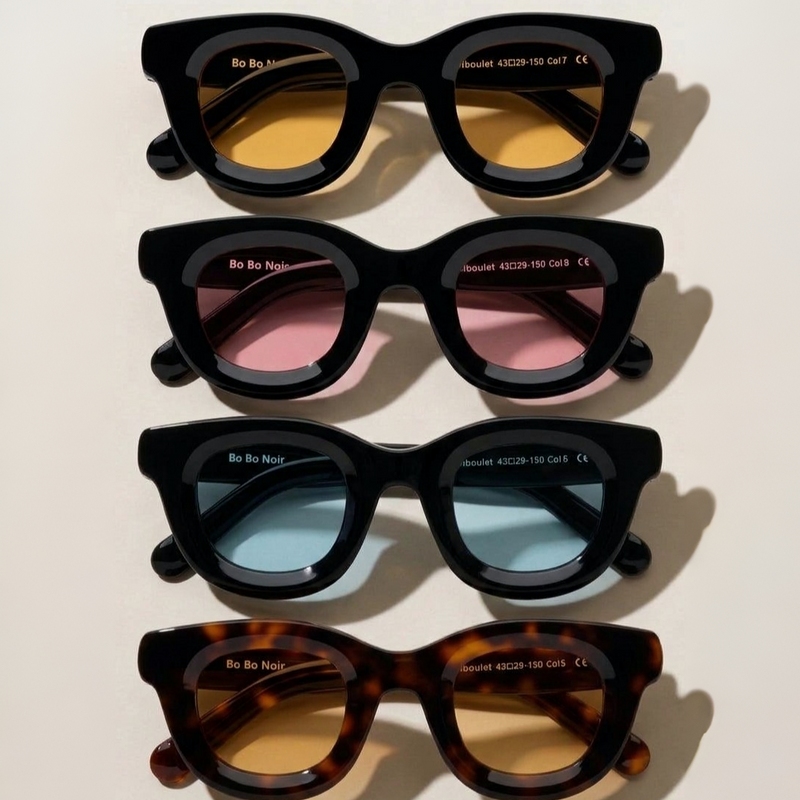
Why are sunglasses so expensive? It’s one of the most common questions when comparing two frames that seem similar but sit at completely different price points.
Expensive sunglasses cost more because of lens quality, acetate materials, design precision, comfort, durability, and how consistently the frame performs over time.
The answer isn’t visible at first glance. Quality eyewear lives in what you don’t immediately see: materials, optical precision, balance, and how a frame behaves over time. Sunglasses are not just an accessory. They are a product where design, engineering, and visual comfort intersect.
Understanding that difference is what separates price from value.
THE MYTH OF THE LOGO
Price is often associated with branding, but logos don’t define quality. Two frames can look alike and perform completely differently.
The real difference lives in the clarity of the lenses, the density of the material, and the geometry of fit. These are the elements that determine how a frame feels after hours of wear, not just how it looks in a mirror.
At Bo Bo Noir, the frame is not built to signal status. It is built around intention, proportion, light, and balance working together without excess.

1. MATERIALS DEFINE THE FOUNDATION
One of the biggest cost differences comes from materials.
Mass produced sunglasses typically use injection molded plastic. It is lightweight and inexpensive, but lacks depth, flexibility, and durability.
Higher quality frames use acetate, a plant based material cut from solid sheets and polished over multiple stages. This process allows for:
- greater color depth and transparency
- better structural memory and flexibility
- a more natural adaptation to the face over time
Instead of reflecting light superficially, acetate interacts with it. That subtle depth is one of the reasons premium frames feel visually richer without being louder.
2. LENSES ARE WHERE REAL VALUE LIVES
Lenses are not interchangeable, even if they look similar.
Low cost lenses are often simple tinted plastic with minimal protection. In contrast, higher quality sunglasses use materials such as CR 39 or nylon with full UV400 protection.
This means:
- 100 percent UVA and UVB protection
- more accurate color perception
- reduced eye strain over time
Coatings also play a critical role. Anti reflective, anti scratch, and gradient treatments are designed to control how light enters the eye. The result is not just darker vision, but more balanced vision.

3. DESIGN IS ENGINEERING, NOT STYLING
A well designed frame is built around anatomy.
Every angle matters, the curvature of the bridge, the length of the temples, the pressure distribution across the face. These are not aesthetic decisions alone. They define comfort.
Frames like the William or the Triboulet are designed to distribute weight evenly, reducing pressure points and allowing the frame to disappear during wear.
That invisibility is the result of precision.
4. FINISHING AND PRECISION DETAILS
What feels simple is often the result of multiple stages of refinement.
Premium eyewear goes through detailed finishing processes, including:
- multi stage polishing
- precise hinge alignment
- consistent structural calibration
These elements ensure that the frame opens smoothly, sits correctly, and maintains its structure over time.
You don’t notice them when they are done right. You only notice when they are missing.
5. CONSISTENCY IS EXPENSIVE
Producing one good frame is easier than producing thousands that behave the same way.
Consistency requires stricter quality control, slower processes, and tighter tolerances. This increases production cost but ensures that every pair delivers the same experience.
That is where price reflects discipline rather than volume.
6. DESIGN DIRECTION AND IDENTITY
Beyond function, price also reflects design thinking.
A frame is a physical expression of a point of view. Shape, proportion, and silhouette define how it interacts with the face and with light.
Bo Bo Noir frames are built around geometry rather than decoration. Each shape carries a distinct visual balance, whether round, rectangular, or panto.
This approach creates pieces that remain relevant beyond seasonal trends.
7. COMFORT AND LONG TERM USE
The real test of sunglasses is not how they look on day one, but how they feel after months of use.
Higher quality frames maintain:
- structural stability
- lens clarity
- consistent comfort
This reduces the need for replacement and improves overall cost per wear.
8. CHEAP VS EXPENSIVE: THE REAL COMPARISON
Lower priced sunglasses often need to be replaced more frequently due to:
- scratches
- loose hinges
- degraded UV protection
Over time, the total cost can surpass a single well made pair.
Expensive sunglasses are not about paying more upfront. They are about reducing compromise over time.
9. A DESIGN APPROACH ROOTED IN BALANCE
Bo Bo Noir is shaped by a Portuguese design mindset focused on proportion and restraint.
The goal is not to create excess, but to refine structure until it feels natural. Each frame is designed to balance clarity, comfort, and presence without distraction.

SO WHY ARE SUNGLASSES EXPENSIVE?
Because the cost is not in what you see first.
It is in how the frame performs, how long it lasts, and how it protects your vision. When those elements are engineered correctly, the experience becomes consistent and almost invisible.
That is where price becomes value.
FAQ: SUNGLASSES PRICING EXPLAINED
Why are some sunglasses much more expensive than others?
The difference comes from materials, lens quality, design precision, and production consistency. Higher priced sunglasses typically offer better durability, comfort, and visual protection.
Are expensive sunglasses really better for your eyes?
Yes, when they include proper UV400 protection and high quality lenses. They reduce eye strain and protect against long term UV damage.
What is the best material for sunglasses frames?
Acetate is considered one of the best materials due to its durability, flexibility, and ability to maintain shape and finish over time.
Do cheaper sunglasses protect from UV?
Some do, but many lower cost options have inconsistent or lower quality coatings. Protection may degrade faster compared to higher quality lenses.
How long should good sunglasses last?
With proper care, high quality sunglasses can last several years while maintaining structure, clarity, and comfort.
EXPLORE FRAMES DESIGNED WITH INTENTION
If you’re looking for sunglasses built around clarity, proportion, and long term comfort, explore the Bo Bo Noir sunglasses collection.
Each model is designed to feel natural, balanced, and consistent over time.
👁 YOU MAY ALSO LIKE:
The Power of Proportion: Why Round Frames Never Fade
Explore why round silhouettes continue to feel relevant through balance and proportion.
Read the article
Light, Structure and Confidence: The Essence of the William Frame
Discover the design logic behind a frame built around balance, comfort, and presence.
Read the article