Livraison gratuite dans le monde • Retours sous 14 jours • Conçu au PortugalLivraison gratuite dans le monde • Retours sous 14 jours • Conçu au PortugalLivraison gratuite dans le monde • Retours sous 14 jours • Conçu au PortugalLivraison gratuite dans le monde • Retours sous 14 jours • Conçu au PortugalLivraison gratuite dans le monde • Retours sous 14 jours • Conçu au PortugalLivraison gratuite dans le monde • Retours sous 14 jours • Conçu au PortugalLivraison gratuite dans le monde • Retours sous 14 jours • Conçu au PortugalLivraison gratuite dans le monde • Retours sous 14 jours • Conçu au PortugalLivraison gratuite dans le monde • Retours sous 14 jours • Conçu au PortugalLivraison gratuite dans le monde • Retours sous 14 jours • Conçu au PortugalLivraison gratuite dans le monde • Retours sous 14 jours • Conçu au PortugalLivraison gratuite dans le monde • Retours sous 14 jours • Conçu au PortugalLivraison gratuite dans le monde • Retours sous 14 jours • Conçu au PortugalLivraison gratuite dans le monde • Retours sous 14 jours • Conçu au PortugalLivraison gratuite dans le monde • Retours sous 14 jours • Conçu au Portugal
Choosing between oversized and standard sunglasses is not simply a question of following a trend. Frame size changes how the face appears, how much visual weight sits around the eyes and how naturally the eyewear aligns with the temples, cheekbones and brow line.
An oversized frame can introduce stronger structure, wider coverage and a more expressive silhouette. A standard-size frame can feel more balanced, easier to wear and more adaptable across different outfits and settings. Neither category is automatically better. The more useful question is whether the proportions of the frame work with the proportions of your face.
This guide explains the differences between oversized and standard sunglasses, how each size affects facial balance, what to check before choosing and which type of wearer is likely to benefit from each option.
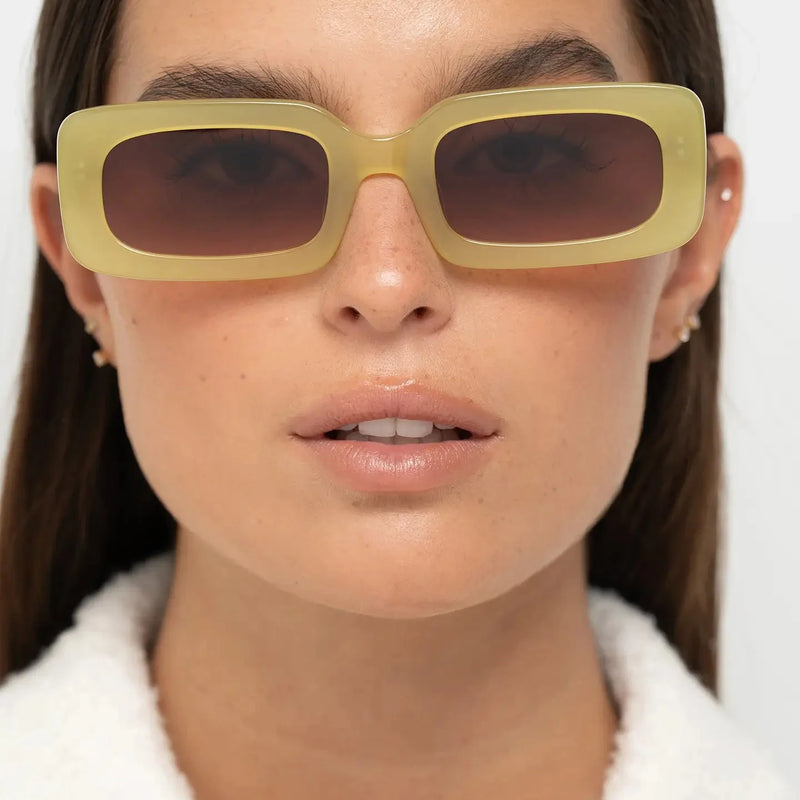
The Jane Olive Green frame uses a broad rectangular silhouette to create stronger facial definition and a more prominent eyewear profile.
Quick Answer
Oversized sunglasses work best when you want greater visual impact, wider lens coverage and a frame that becomes a defining part of the overall look. Standard sunglasses are often the better choice when you prefer lighter visual weight, easier everyday wear and proportions that sit closer to the natural width of the face.
Avoid choosing by the word “oversized” alone. Check whether the frame extends too far beyond the temples, rests on the cheeks, slips at the bridge or overwhelms the brow line. A frame can look bold without being too large, and a standard frame can still create strong definition through shape, colour and acetate thickness.
Oversized vs Standard Sunglasses at a Glance
The clearest difference between oversized and standard sunglasses is the amount of space the frame occupies across the face. Oversized designs usually feature greater overall width, taller lenses, thicker rims or a combination of all three. Standard designs tend to remain closer to the natural boundaries of the eye area and temples.
These differences influence appearance, but they also affect practical details such as cheek contact, bridge stability, peripheral coverage and how much of the eyebrow remains visible.
Feature
Oversized Sunglasses
Standard Sunglasses
Visual presence
Stronger and more dominant
More restrained and proportionate
Lens coverage
Usually wider and taller
Usually concentrated around the eye area
Facial effect
Can add structure and reduce the visible scale of facial features
Tends to preserve the face’s existing proportions
Comfort considerations
More likely to touch the cheeks or feel heavy if poorly fitted
Often easier to stabilise across the bridge and temples
Styling effect
Expressive, graphic and attention-directing
Adaptable, balanced and easier to integrate
Best suited to
Wearers seeking stronger frame geometry and broader coverage
Wearers seeking everyday versatility and moderate visual weight
The comparison is useful as a starting point, but the final result depends on more than total frame width. A thick standard-size frame may appear more prominent than a thin oversized frame. Similarly, a tall round lens can look visually larger than a wide but shallow rectangular lens.
Shape, colour, lens depth and acetate thickness all influence how large the sunglasses appear once they are worn.
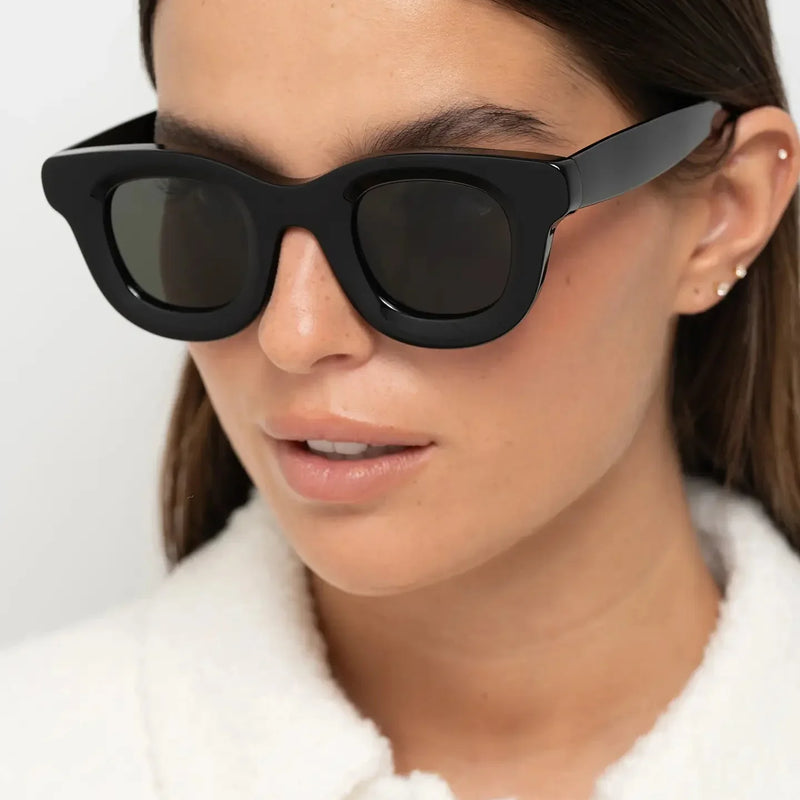
The Narr Shiny Black frame demonstrates how a standard panto silhouette can retain definition without occupying excessive space across the face.
Why Sunglass Size Changes the Appearance of the Face
Sunglasses create a new visual boundary around the eyes. That boundary can either follow the existing structure of the face or deliberately extend beyond it. The wider and taller the frame becomes, the more it changes the way facial proportions are perceived.
Oversized sunglasses often make the central facial features appear smaller because the frame occupies more space around them. A larger lens area can reduce the visible distance between the eyes, cheeks and outer edges of the frame. This can create a stronger sense of structure, particularly when the frame uses thick acetate or a sharply defined shape.
Standard-size sunglasses usually leave more of the face visible. The cheekbones, brow line and temples remain more exposed, which can make the eyewear feel integrated rather than dominant. This is one reason standard frames are frequently easier to combine with a wider range of clothing silhouettes, hairstyles and jewellery.
Frame width affects horizontal balance
The total width of the sunglasses determines how the frame aligns with the widest part of the face. A balanced fit usually sits close to the temple width without creating visible pressure or extending so far that the hinges appear disconnected from the sides of the head.
When an oversized frame extends moderately beyond the temples, it can create a deliberate horizontal emphasis. This may add definition to a longer or more angular face. When the extension becomes excessive, however, the frame may appear unstable or visually detached from the wearer.
Standard sunglasses tend to follow the facial width more closely. This can be useful for narrow faces, smaller features or anyone who prefers the sunglasses to support the face rather than redefine it.
Lens height affects vertical balance
Lens height changes how much space the sunglasses occupy between the eyebrows and cheekbones. Taller lenses usually produce a more oversized effect, even when the overall width is moderate. Shallower lenses create a more compact appearance and leave more of the upper cheek area visible.
A tall frame may work well when there is sufficient space between the brow and cheek. On a shorter mid-face, the same frame may rest on the cheeks, rise above the eyebrows or move when the wearer smiles. This is not only a visual issue. Repeated cheek contact can push the frame upward and affect stability.
Acetate thickness affects visual weight
Size and visual weight are related, but they are not identical. A frame can be standard in width and still appear bold because of thick rims, dark colour or strongly defined corners. In contrast, a wide frame with translucent acetate may appear lighter despite covering more of the face.
This distinction matters when comparing designs such as the Jane Olive Green and the Narr Shiny Black . Jane uses a broad rectangular geometry that creates stronger horizontal definition. Narr uses a more compact panto structure, but the shiny black acetate still gives the frame clear presence.
The decision is therefore not simply “large or small”. It is a balance between width, height, shape, colour and material density.
Larger round silhouettes can soften facial lines while creating a noticeable visual focal point.
Why Bigger Doesn't Always Mean Better
One of the biggest misconceptions surrounding sunglasses is that choosing the largest frame
automatically produces the best result. While oversized sunglasses remain a popular style,
increasing the size of a frame eventually reaches a point where it begins to work against the
natural proportions of the wearer.
Good eyewear creates balance. Oversized eyewear should feel intentional rather than accidental.
When a frame dominates the face so completely that it hides the eyebrows, extends far beyond the
temples or constantly rests against the cheeks, the overall appearance can feel visually heavy
instead of refined.
The objective is not to wear the biggest sunglasses available. The objective is to wear the
largest size that still respects the proportions of your own face.
Facial proportions matter more than measurements
Two people can wear exactly the same sunglasses and experience completely different results.
Someone with a broader face may find a frame looks perfectly balanced, while the identical frame
appears dramatically oversized on someone with narrower facial proportions.
This is why experienced eyewear designers rarely begin by asking whether someone wants oversized
or standard sunglasses. They first consider the relationship between facial width, temple
position, cheekbone height, bridge width and lens depth.
Once these proportions are understood, selecting the appropriate frame size becomes much easier.
Large frames should create balance, not distraction
Oversized sunglasses naturally attract attention because they increase the visual weight around
the eyes. When used well, this additional presence creates stronger facial definition and a more
confident silhouette.
Problems begin when the frame becomes the only thing people notice. Instead of complementing the
face, the sunglasses begin to compete with it.
A balanced oversized frame allows the face and eyewear to work together. An oversized frame that
is too large makes the face disappear behind the lenses.
BBN Insight
Many people assume oversized sunglasses should completely dominate the face. In reality,
the strongest styling often comes from frames that appear only slightly larger than expected.
That subtle increase in scale usually creates a more timeless result.
Signs Your Sunglasses Are Too Large
Oversized does not mean unlimited sizing. Several visual clues indicate that a frame has become
disproportionately large.
Sign
Why It Matters
Frame extends far beyond the temples
Creates an unbalanced horizontal silhouette.
Frame touches the cheeks while smiling
Movement affects comfort and stability.
Bridge slides constantly
The fit is no longer supported correctly.
Eyebrows disappear completely
The frame dominates facial expression.
Eyes appear unusually low inside the lenses
The optical centre may no longer align comfortably.
None of these automatically makes a frame unsuitable, but seeing several together is usually a
sign that trying a slightly smaller size will produce a more balanced appearance.
A standard-size panto frame like Triboulet demonstrates how balanced proportions can still
deliver a distinctive silhouette without relying on exaggerated dimensions.
Choosing Between Oversized and Standard Sunglasses
Frame size is only one part of the decision. Face shape, lens height, bridge fit, comfort,
everyday use and personal styling preferences all influence which category performs best.
In the next section, we'll compare oversized and standard sunglasses across face shapes,
coverage, comfort, versatility and styling scenarios to help identify which size works best
for different wearers.
Oversized Sunglasses Explained
Oversized sunglasses are defined less by an exact measurement and more by how much visual space
they occupy on the face. They typically feature wider frame fronts, taller lenses or thicker
acetate rims that extend beyond the proportions associated with traditional everyday eyewear.
Although oversized sunglasses are often linked with fashion, their appeal goes beyond style.
A larger frame can increase lens coverage, create stronger facial definition and introduce a
more distinctive silhouette. When correctly fitted, oversized sunglasses become an intentional
design feature rather than simply a larger version of a standard frame.
The most successful oversized designs never rely on size alone. They balance frame width, lens
depth, bridge fit and acetate thickness so that the sunglasses appear confident without looking
disproportionate.
The Jane Olive Green demonstrates how an oversized rectangular frame creates stronger horizontal
definition while maintaining clean proportions.
Advantages of Oversized Sunglasses
A well-proportioned oversized frame offers several practical and aesthetic advantages.
Greater lens coverage around the eyes.
More noticeable facial structure.
Strong visual presence.
Better integration with bold wardrobes.
Reduced visual emphasis on individual facial features.
Because more of the upper face is framed by the sunglasses, oversized designs often become the
dominant accessory within an outfit. This makes them particularly attractive for people who want
eyewear to become part of their personal identity rather than simply serving a functional role.
BBN Insight
Oversized sunglasses should attract attention because of their proportions—not because they
appear too large for the wearer. The strongest oversized styling still respects facial balance.
Standard Sunglasses Explained
Standard sunglasses generally follow the natural width of the face more closely. Rather than
extending significantly beyond the temples or using unusually tall lenses, they sit comfortably
within the existing facial proportions.
This creates a balanced appearance that works across professional settings, casual wear,
holidays and everyday use. Because standard frames draw less attention to themselves, they often
complement a wider variety of clothing styles without dominating the overall look.
Standard does not mean plain. Frame geometry, acetate colour, lens tint and construction quality
continue to influence how expressive the sunglasses appear.
The Narr Shiny Black illustrates how a standard-size panto frame maintains strong character
while preserving balanced facial proportions.
Advantages of Standard Sunglasses
Natural facial balance.
Easy everyday wear.
Versatile styling.
Comfort during extended use.
Suitable for a broad range of face widths.
Standard sunglasses are often recommended as a first pair because they adapt well to changing
wardrobes and different occasions. They also tend to feel visually timeless, making them a safe
long-term investment.
Coverage vs Comfort
One reason many people choose oversized sunglasses is the perception of greater protection.
Larger lenses generally cover a larger area around the eyes, helping reduce light entering from
above and the sides. This can improve visual comfort during bright conditions.
However, coverage should never be confused with UV protection.
A standard-sized pair fitted with certified UV400 lenses provides the same ultraviolet protection
as an oversized frame using the same lens technology. Frame size changes coverage—not the UV
filtering capability of the lenses themselves.
Factor
Oversized
Standard
Eye coverage
Higher
Moderate
Visual presence
Strong
Balanced
Long-term comfort
Depends heavily on fit
Usually easier
Styling flexibility
Statement piece
Highly versatile
Comfort ultimately depends on bridge fit, temple pressure and weight distribution rather than
frame size alone. A perfectly fitted oversized frame will almost always feel better than a poorly
fitted standard frame.
Rounded oversized silhouettes such as William Crystal Peach combine generous lens coverage with
soft facial geometry.
Do Oversized Sunglasses Offer Better UV Protection?
This is one of the most common misconceptions in eyewear.
Oversized sunglasses do not automatically provide better UV protection than
standard sunglasses. UV protection comes from the lens material and coating, not from the physical
size of the frame.
Where oversized sunglasses can provide an advantage is in reducing stray sunlight entering around
the edges of the lenses. This may improve visual comfort in bright environments, but it should not
be confused with additional ultraviolet filtering.
The most important specification to check is the UV rating of the lenses—not whether the sunglasses
are oversized or standard.
Best Sunglass Size by Face Shape
Face shape can help narrow the choice between oversized and standard sunglasses, but it should
never be treated as a rigid rule. The more useful approach is to study the relationship between
frame width, lens height, facial length, cheekbone position and jaw structure.
An oversized frame can add contrast, soften angular lines or create stronger horizontal balance.
A standard frame usually preserves more of the face and can feel easier to wear when the features
are smaller or the facial width is narrow.
The following recommendations are starting points rather than fixed prescriptions. A well-fitted
frame in the “wrong” category will usually look better than a poorly fitted frame chosen only
because it supposedly suits a particular face shape.
Face Shape
Often Works Well
What to Check
Round
Oversized rectangular or angular frames
Avoid excessive lens height if the frame rests on the cheeks
Oval
Oversized or standard proportions
Keep the frame width aligned with the temples
Square
Round or panto shapes in moderate to larger sizes
Choose enough width to avoid compressing the temples
Heart
Standard panto or softly rounded frames
Avoid adding too much visual weight above the cheekbones
Diamond
Panto, oval or softly rectangular frames
Check that the frame does not press against prominent cheekbones
Oblong
Taller lenses and slightly oversized proportions
Avoid frames that are too narrow or visually shallow
Round Faces: Oversized Rectangular Frames Can Add Definition
Round faces generally have softer contours, fuller cheeks and similar proportions across facial
width and length. Sunglasses with a clear horizontal line can introduce contrast and make the face
appear more structured.
Oversized rectangular sunglasses can work particularly well because the extended width draws the
eye outward. Defined corners also create visual separation from the natural curves of the face.
The
Jane Olive Green Sunglasses
are a useful example. Their broad rectangular silhouette creates horizontal definition, while
the olive acetate adds visual interest without relying only on dark colour.
For a stronger monochrome effect, the
Jane Shiny Black Sunglasses
use the same rectangular geometry with greater contrast around the eyes.
The main point to check is lens height. If a rectangular frame is both very wide and very tall,
it may sit too close to the cheeks. A slightly oversized width with controlled vertical depth
often creates the most balanced result.
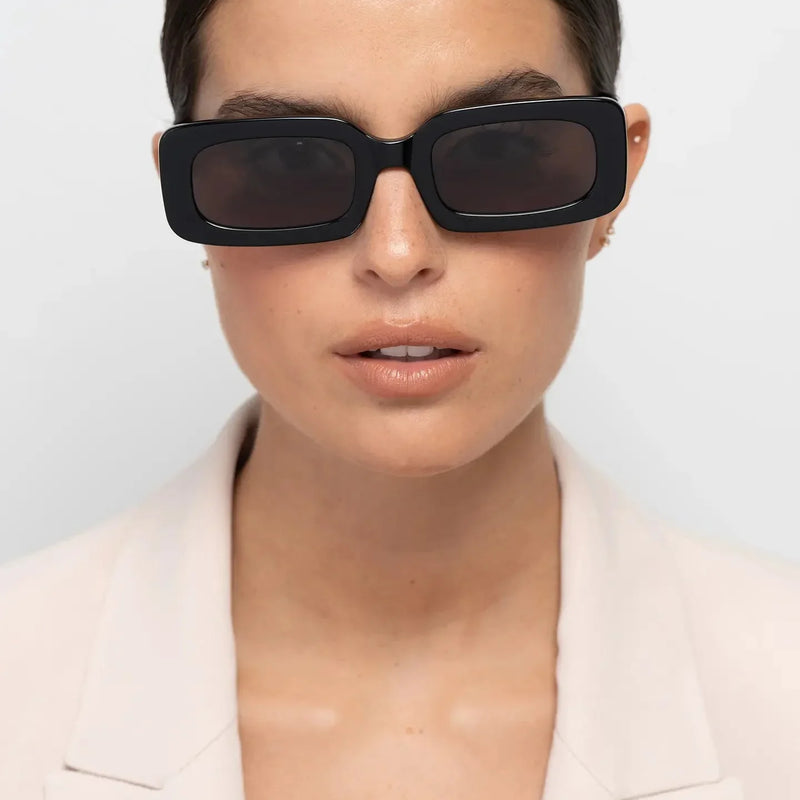
The Jane Shiny Black frame uses broad rectangular lines to add definition and visual structure
around softer facial contours.
Oval Faces: Both Oversized and Standard Sizes Can Work
Oval faces usually have balanced proportions, with a slightly longer facial length and gently
curved lines. Because the width and length are already visually harmonious, oval faces can often
wear both oversized and standard sunglasses successfully.
The choice depends more on the desired effect than on correction. Oversized frames create a
stronger focal point and can make the eyewear central to the outfit. Standard frames preserve the
face’s existing balance and are often easier to wear across different settings.
For a larger rounded silhouette, the
William Crystal Peach Sunglasses
combine generous lens depth with translucent acetate. The transparency reduces some of the visual
weight that would normally come from a larger frame.
For a more compact alternative, the
Narr Tortoise Sunglasses
use a standard panto silhouette that follows the eye area more closely.
Oval faces should still avoid frames that extend excessively beyond the temples. Facial balance
does not remove the need for correct width and bridge fit.
Square Faces: Rounded Frames Can Soften Strong Angles
Square faces are characterised by a broad forehead, a defined jaw and relatively straight side
lines. Round and panto frames create contrast with this geometry and can soften the visual effect
of the jaw.
A slightly oversized round frame can be especially effective because the curves occupy enough
space to balance a broader facial structure. However, the frame should still align comfortably
with the temples rather than squeezing the sides of the head.
The
William Shiny Black Sunglasses
offer a bold round silhouette with substantial visual weight. This makes them suitable for wearers
who want the sunglasses to provide clear contrast against a more angular face.
A more restrained option is the
Triboulet Tortoise Gradient Brown Sunglasses
.
The panto shape remains rounded, but its standard proportions create a softer and more integrated
result.
Heart-Shaped Faces: Standard Frames Often Preserve Better Balance
Heart-shaped faces are typically wider through the forehead and narrower toward the chin. Because
there is already more visual weight in the upper half of the face, very tall or heavily oversized
sunglasses can sometimes make the forehead appear broader.
Standard panto frames often work well because they sit closer to the eye area and avoid adding
unnecessary width at the temples. Softer lower curves can also complement the taper toward the chin.
The
Narr Burgundy Sunglasses
provide a balanced panto profile with colour that introduces definition without relying on an
exaggerated frame size.
The
Triboulet Olive Sunglasses
are another useful option for wearers who prefer a quieter relationship between the frame and the
upper face.
A heart-shaped face can still wear oversized sunglasses, but the design should avoid excessive
width across the brow. Translucent acetate, softer corners and moderate lens height can make a
larger frame feel more balanced.
Diamond Faces: Check the Relationship Between Frame Depth and Cheekbones
Diamond faces are often narrower at the forehead and jaw, with the cheekbones forming the widest
point. This makes cheek contact one of the most important fit considerations.
Frames with softly rounded or panto geometry can work well because they follow the central width
of the face without creating harsh horizontal expansion. Standard sizes are often easier to fit,
although a carefully proportioned oversized frame can also work.
Wearers with prominent cheekbones should pay close attention to what happens when they smile.
If the cheeks lift the sunglasses or move the bridge upward, the frame is likely too deep or
positioned too low.
Oblong Faces: Taller Lenses Can Improve Vertical Balance
Oblong faces are longer than they are wide. Very shallow sunglasses can reinforce that length by
leaving large areas of the face uncovered above and below the frame.
Taller lenses and slightly oversized proportions can create better vertical balance. The added
lens depth occupies more of the mid-face and can make the overall facial length appear less
pronounced.
The
William Tortoise Sunglasses
combine rounded geometry with generous lens height, making them a relevant option for wearers who
want a more substantial frame across a longer face.
The
Jane Cream White Sunglasses
provide a different effect. Their rectangular width creates stronger horizontal emphasis, while
the light acetate reduces the visual density of the larger silhouette.
The Jane Cream White frame demonstrates how a broad silhouette can add horizontal balance while
lighter acetate keeps the overall visual weight controlled.
Face Shape Is a Guide, Not a Final Decision
Face-shape recommendations are useful because they reveal where contrast or balance may be helpful.
They do not account for every feature that influences fit.
Two people with round faces may have different bridge widths, temple widths and cheekbone heights.
One may wear an oversized rectangular frame comfortably, while the other needs a shallower standard
frame to prevent cheek contact.
The final decision should combine four factors:
How the frame width aligns with the temples.
How the lens height relates to the cheeks and eyebrows.
Whether the bridge remains stable without sliding.
Whether the visual weight supports or overwhelms the face.
When these elements are balanced, both oversized and standard sunglasses can work across a wide
range of face shapes.
Oversized vs Standard Sunglasses for Men and Women
Sunglass size is not determined by gender. Facial width, bridge structure, temple position and
personal styling preferences are more useful than labels such as men’s or women’s eyewear.
A broader face may require a wider frame regardless of gender. A narrower face may need controlled
width even when the wearer prefers an oversized look. This is why the same frame can appear
restrained on one person and dramatically oversized on another.
The more useful question is not whether a frame is designed for men or women. It is whether the
geometry, width and visual weight create the effect the wearer wants.
The Bo Bo Noir Approach to Sunglass Sizing
Rather than separating sunglasses into "oversized" and "standard" collections, Bo Bo Noir approaches
frame design through proportion. Every silhouette is created to deliver a distinct visual character
while remaining comfortable for everyday wear.
This means that a frame such as the
Jane Olive Green Sunglasses
is intentionally bold because of its strong rectangular geometry and generous width, while the
Narr Shiny Black Sunglasses
achieve presence through balanced panto proportions instead of exaggerated dimensions.
Instead of asking whether a frame is oversized or standard, consider how its geometry interacts with
your facial proportions. Width, lens depth, bridge position and acetate thickness all contribute to
the final appearance.
How to Choose Between Oversized and Standard Sunglasses
If you're still undecided, asking a few practical questions can make the choice much easier.
Rather than focusing on trends, think about how you expect your sunglasses to function within your
everyday wardrobe.
Buying Guide
Choose oversized sunglasses if you enjoy statement eyewear, prefer greater lens
coverage and want your sunglasses to become a defining feature of your outfit.
Choose standard sunglasses if versatility, everyday comfort and timeless styling
are your priorities.
If you have never owned bold sunglasses before, begin with a slightly oversized frame rather than
the largest silhouette available.
Always prioritise bridge fit and temple width before considering fashion trends.
If two sizes both fit comfortably, choose the one that feels visually balanced rather than the one
that simply appears larger.
Choose Oversized Sunglasses If…
You enjoy bold accessories.
You want stronger facial definition.
You prefer generous lens coverage.
You wear minimalist clothing and want your eyewear to become the focal point.
You have medium or broad facial proportions that comfortably support larger frames.
Choose Standard Sunglasses If…
You wear sunglasses every day.
You prefer understated styling.
You frequently move between professional and casual environments.
You have narrower facial proportions.
You value versatility over visual impact.
The William Shiny Black combines generous round proportions with clean acetate lines, creating a
bold silhouette without overwhelming the face.
Key Takeaways
Oversized sunglasses create greater visual impact and broader facial coverage.
Standard sunglasses prioritise versatility and balanced proportions.
Face shape provides useful guidance, but bridge fit and overall proportions matter more.
Larger sunglasses do not automatically provide better UV protection.
Frame geometry, acetate thickness and lens height influence appearance just as much as width.
The best sunglasses are those that complement your facial proportions rather than simply following
current trends.
Whether you choose oversized or standard sunglasses, the most important factor is achieving harmony
between the frame and your own facial proportions. A well-balanced pair will always look more
natural, feel more comfortable and remain relevant long after seasonal trends have changed.
Frequently Asked Questions
Are oversized sunglasses still in style?
Yes. Oversized sunglasses remain a popular choice because they offer greater visual presence and
work across both contemporary and classic wardrobes. Rather than following short-lived trends,
choose a frame that complements your facial proportions. Models such as the
Jane Olive Green
or
William Crystal Peach
demonstrate how oversized silhouettes can remain timeless when the proportions are balanced.
Who should wear oversized sunglasses?
Oversized sunglasses are well suited to anyone looking for greater lens coverage, stronger facial
definition or a more expressive eyewear style. The deciding factor should always be fit rather than
face shape alone.
Do oversized sunglasses suit small faces?
They can. Choosing a slightly oversized frame rather than an extremely large design often produces a
more balanced result. Frame width, bridge fit and lens height remain more important than the size
label.
Are standard sunglasses better for everyday use?
Many people find standard sunglasses easier to wear daily because they integrate naturally with
different clothing styles and generally feel less visually dominant. Frames such as the
Narr Shiny Black
or
Triboulet Shiny Black
illustrate this versatility.
Do oversized sunglasses provide better UV protection?
No. UV protection depends on the lenses, not on the physical size of the frame. Larger sunglasses
may reduce light entering around the edges, but UV filtering comes from certified lens technology.
Should sunglasses cover my eyebrows?
There is no universal rule. Some oversized frames partially cover the eyebrows while many standard
frames leave them visible. The most important consideration is that the frame appears balanced and
does not dominate your facial expression.
How wide should sunglasses be?
Ideally, the frame should align closely with the widest part of your face without extending
significantly beyond the temples. Excessive width often makes sunglasses appear disconnected from
the face.
Why do sunglasses touch my cheeks?
This usually happens when the lenses are too tall, the bridge fit is unsuitable or the frame sits
too low on the nose. Trying a shallower lens or a slightly smaller frame often resolves the issue.
Are round oversized sunglasses easier to wear than rectangular ones?
Not necessarily. Round frames generally soften facial angles, while rectangular frames introduce
stronger definition. The better option depends on your facial proportions and the look you want to
achieve.
Can men wear oversized sunglasses?
Absolutely. Frame size should be selected according to facial proportions rather than gender.
Oversized styles can work equally well for men and women when the fit is correct.
Can women wear standard sunglasses?
Yes. Standard sunglasses remain one of the most versatile choices for everyday wear and pair easily
with both casual and tailored wardrobes.
How can I tell if my sunglasses are too large?
Common signs include excessive overhang beyond the temples, frequent contact with the cheeks, bridge
slippage and a frame that overwhelms the face rather than complementing it.
Which Bo Bo Noir sunglasses are best for a first purchase?
Oversized and standard sunglasses each offer distinct advantages. Oversized frames provide greater
visual impact, broader lens coverage and a stronger statement, while standard frames emphasise
balance, versatility and effortless everyday wear.
The best choice depends less on trends and more on proportion. Frame width, lens height, bridge fit
and overall visual weight should work together with your facial features rather than competing
against them.
Whether you prefer the bold rectangular lines of the
Jane Olive Green,
the soft oversized curves of the
William Crystal Peach,
the everyday versatility of the
Narr Shiny Black
or the timeless proportions of the
Triboulet Tortoise Gradient Brown,
the goal remains the same: choose sunglasses that feel comfortable, complement your features and
reflect your personal style.
Discover the Bo Bo Noir Sunglasses Collection
Explore handcrafted acetate sunglasses designed with balanced proportions, timeless silhouettes and
everyday comfort in mind.
Bénéficiez de 10 % de réduction sur votre achat ! Inscrivez-vous à notre newsletter.Bénéficiez de 10 % de réduction sur votre achat ! Inscrivez-vous à notre newsletter.Bénéficiez de 10 % de réduction sur votre achat ! Inscrivez-vous à notre newsletter.Bénéficiez de 10 % de réduction sur votre achat ! Inscrivez-vous à notre newsletter.Bénéficiez de 10 % de réduction sur votre achat ! Inscrivez-vous à notre newsletter.Bénéficiez de 10 % de réduction sur votre achat ! Inscrivez-vous à notre newsletter.Bénéficiez de 10 % de réduction sur votre achat ! Inscrivez-vous à notre newsletter.Bénéficiez de 10 % de réduction sur votre achat ! Inscrivez-vous à notre newsletter.Bénéficiez de 10 % de réduction sur votre achat ! Inscrivez-vous à notre newsletter.Bénéficiez de 10 % de réduction sur votre achat ! Inscrivez-vous à notre newsletter.Bénéficiez de 10 % de réduction sur votre achat ! Inscrivez-vous à notre newsletter.Bénéficiez de 10 % de réduction sur votre achat ! Inscrivez-vous à notre newsletter.Bénéficiez de 10 % de réduction sur votre achat ! Inscrivez-vous à notre newsletter.Bénéficiez de 10 % de réduction sur votre achat ! Inscrivez-vous à notre newsletter.Bénéficiez de 10 % de réduction sur votre achat ! Inscrivez-vous à notre newsletter.