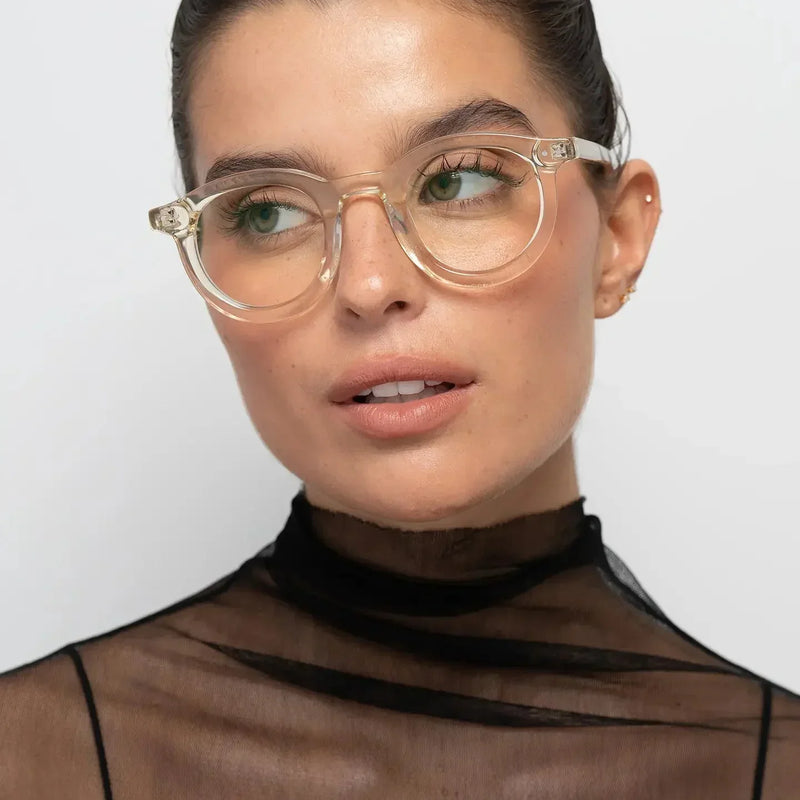
Blue light glasses are often worn for long periods throughout the day, so the way a frame looks and feels visually becomes especially important.
Balanced contrast matters because it creates enough definition to feel intentional without making the frame feel visually heavy or distracting.
This balance helps eyewear feel more natural across work, study, video calls and everyday screen-focused routines.
William Tortoise Blue Light Glasses were designed around this relationship between warm acetate, balanced contrast and everyday wearability.

WHY BALANCED CONTRAST MATTERS FOR DAILY WEAR
Frames with too much contrast can feel visually dominant, while frames with too little contrast may feel undefined.
Balanced contrast creates structure without overwhelming the face, making eyewear easier to wear repeatedly throughout the day.
This is especially valuable for blue light glasses, which often become part of a daily routine rather than an occasional accessory.
HOW TORTOISE ACETATE CREATES CONTROLLED CONTRAST
Tortoise acetate creates depth through warm tonal variation instead of one flat block of colour.
This allows the frame to define the face while keeping the overall effect softer and more natural than solid black acetate.
The result is eyewear that feels structured, but not visually severe.
WHY THIS WORKS FOR SCREEN-FOCUSED ROUTINES
Blue light glasses are often worn during work, reading, video calls, study and extended digital tasks.
In these settings, balanced contrast helps the frame feel present without becoming distracting or overly styled.
This makes the eyewear easier to integrate into daily screen use and professional environments.

BALANCED CONTRAST VS STRONG CONTRAST
Strong contrast creates sharper definition and a more graphic visual effect. Balanced contrast creates a softer and more wearable form of structure.
The difference is not about reducing presence, but about making that presence easier to live with every day.
This is why tortoise blue light glasses often feel more adaptable than darker, high-contrast frames.
WHO BALANCED-CONTRAST BLUE LIGHT GLASSES WORK BEST FOR
Balanced-contrast blue light glasses work especially well for people who want definition without visual heaviness.
They are particularly suited to professionals, creatives, remote workers and anyone looking for screen-focused eyewear that feels warm, versatile and easy to wear consistently.
William Tortoise Blue Light Glasses were designed for this balance between facial definition, warm acetate and everyday visual comfort.
RELATED READING
Explore how warmth and facial definition shape William Tortoise Blue Light Glasses.
Why Warm Tones Feel Better For All-Day Screen Use
How Warm Contrast Creates Softer Facial Definition
COMMON QUESTIONS
Why does balanced contrast matter for blue light glasses?
Because blue light glasses are often worn for long periods, balanced contrast helps the frame feel structured without becoming visually distracting.
Do tortoise frames create enough definition?
Yes. Tortoise acetate creates definition through tonal depth and balanced contrast rather than strong visual separation.
Are tortoise blue light glasses easier to wear than black frames?
For many people, yes. Tortoise acetate often feels softer and more adaptable than solid black acetate.
Who should choose balanced-contrast eyewear?
People who want everyday definition, warmth and versatility without the intensity of stronger high-contrast frames.
What makes William Tortoise Blue Light Glasses different?
William combines blue light filtering lenses with warm tortoise acetate and balanced round proportions for everyday screen-focused wearability.
Explore William Tortoise Blue Light Glasses for eyewear designed around balanced contrast, warm acetate and everyday visual comfort.